
Special Needs Trust Attorney West Palm Beach: Protecting Your Family’s Future in 2026
- Kelly Mata
- May 13
- 13 min read

What if the inheritance you leave behind becomes the very reason your child loses their healthcare? It's a terrifying thought that keeps many Florida parents awake at night. You've worked hard to build a legacy, yet the strict $2,000 asset limit for 2026 Medicaid and SSI eligibility means a simple gift can unintentionally "disinherit" your loved one from state support. Partnering with a special needs trust attorney West Palm Beach allows you to bypass these hurdles with a strategy that prioritizes both care and financial security.
We understand that you want a clear path forward that doesn't feel like a cold, rigid legal document. You'll discover how a customized third-party trust preserves your family's assets without risking essential government benefits. This article previews the latest 2026 shifts, including the expanded ABLE Age Adjustment Act and how to handle the new, stricter Medicaid audit landscape with confidence. We'll show you how to build a dynamic safety net that protects your loved one's future long after you're gone.
Key Takeaways
Understand why a Special Needs Trust is a vital supplemental tool that enhances quality of life without disqualifying your loved one from government aid.
Learn how a specialized special needs trust attorney West Palm Beach can help you choose between first-party and third-party trusts to find the best fit for your family's needs.
Discover the dangers of "informal trusts" and how proper planning prevents the common "spend-down" trap that wastes valuable family assets.
Get a clear, step-by-step roadmap for identifying your beneficiary's future goals and establishing a legal structure that adapts as laws change.
See how modern, flat-fee legal solutions provide the transparency and partnership you need to protect your legacy with confidence.
Table of Contents
What is a Special Needs Trust and Why Do West Palm Beach Families Need One?
Defining What is a Special Needs Trust starts with understanding its primary mission: protection. It isn't just about moving money around. It's a sophisticated legal structure designed to hold assets for a person with disabilities while keeping them eligible for essential government programs. For many families, this tool represents the difference between a life of basic survival and one filled with dignity and comfort. It's about providing for the "extras" that the state doesn't cover, such as specialized medical equipment, private education, or even simple recreational trips.
West Palm Beach families face unique challenges because Florida is an "income cap" state with very specific eligibility rules. If you leave a direct inheritance or a large gift to a loved one with special needs, you might accidentally disqualify them from the healthcare and housing they rely on. A special needs trust attorney West Palm Beach ensures your legacy provides for these "supplemental" needs without replacing the foundational support provided by the state. This proactive planning offers emotional peace of mind, knowing that your family member won't be left vulnerable to shifting state budgets or administrative hurdles.
The Role of Supplemental Security Income (SSI) and Medicaid
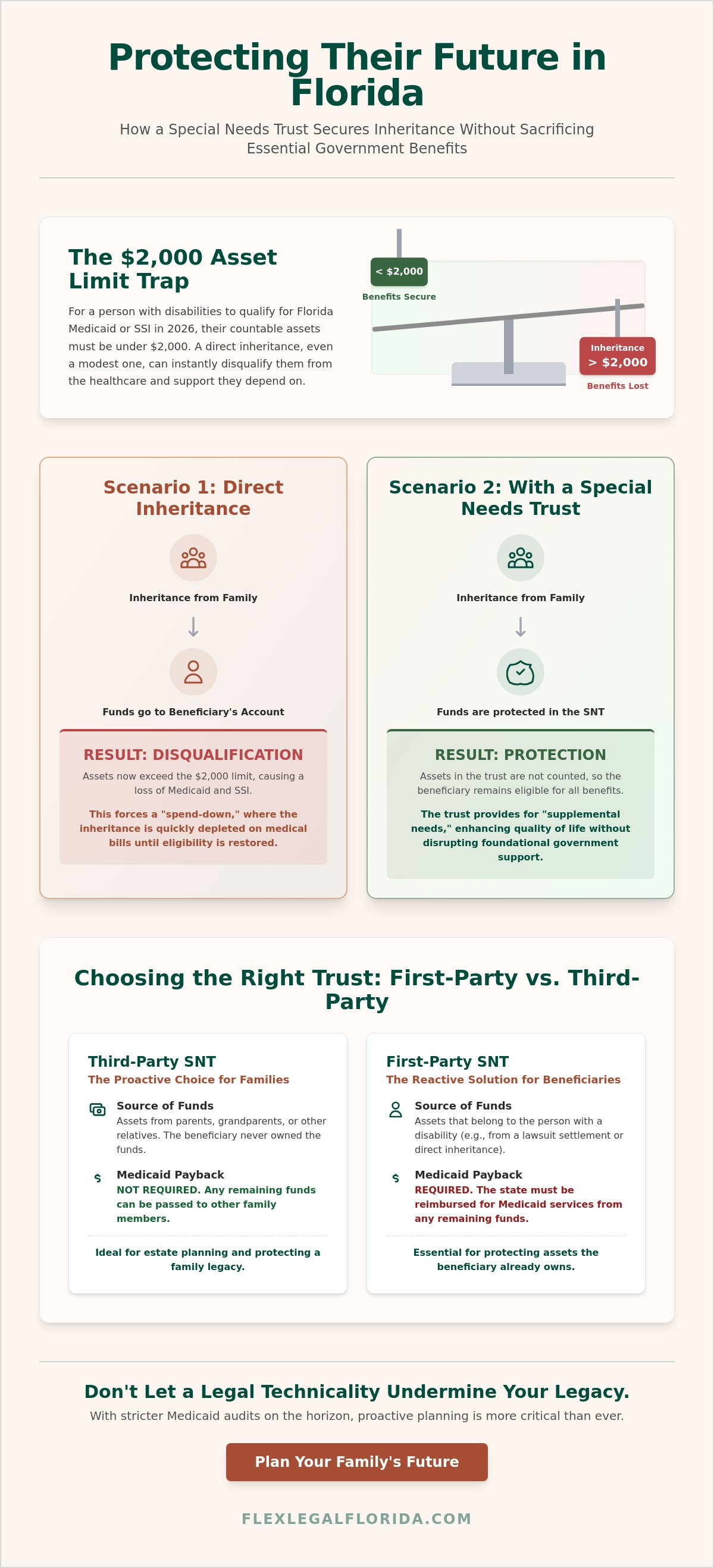
The math for government aid is unforgiving. In 2026, the asset limit for an individual to qualify for Florida Medicaid or SSI remains at just $2,000. It's a razor-thin margin. If a beneficiary receives even a modest life insurance payout or a gift from a grandparent, their benefits could stop immediately. The trust acts as a protective shield for these assets. Funds held within the trust don't count toward that $2,000 limit, allowing your loved one to maintain their health coverage while using trust funds for quality-of-life improvements. With federal funding for stricter Medicaid audits increasing this year, a professionally managed trust is essential to avoid red flags during asset verification.
Special Needs Planning as a Modern Family Strategy
Modern planning has evolved past the simple "Last Will and Testament." A will is often a static document that doesn't account for the complex, shifting landscape of disability laws. Integrating your trust into a broader strategy with an estate planning attorney west palm beach ensures all your legal tools work in harmony. We focus on adaptability as a core value. A well-crafted trust isn't a set of rigid rules; it's a dynamic support system. It can adjust to changes in the beneficiary's health, new government regulations, or shifts in family dynamics. This forward-thinking approach provides a clear path forward that feels both efficient and deeply personal.
First-Party vs. Third-Party Special Needs Trusts: Which is Right for You?
Choosing the right trust structure depends entirely on one question: Whose money is being used? While the legal definition of a special needs trust remains consistent, the source of funding changes the rules of the game. The distinction between first-party and third-party trusts determines your level of control, tax responsibilities, and where the remaining assets go in the future. A special needs trust attorney West Palm Beach can help you identify which path aligns with your family's specific financial landscape.
The source of funds changes everything. If the money comes from you, a grandparent, or another relative, it's a third-party trust. If the money already belongs to the beneficiary, perhaps through a lawsuit settlement or a direct inheritance, it's a first-party trust. Both options shield assets from being counted against the $2,000 Medicaid limit, but they operate under very different Florida regulations. Understanding these nuances is the key to building a plan that protects your loved one without leaving money on the table for the state.
Third-Party SNTs: The Tool for Parents and Grandparents
Third-party trusts are often called the "gold standard" for estate planning. You fund these using your own assets, such as life insurance policies, real estate, or investment accounts. Because the beneficiary never legally owned these funds, Florida law does not require a Medicaid payback. When the beneficiary passes away, any remaining assets stay in your family. You have the freedom to name successor beneficiaries, such as siblings or charities. This flexibility makes it a cornerstone of modern special needs planning strategies.
First-Party SNTs: Protecting Settlements and Personal Assets
A first-party trust is a reactive tool. It's designed for individuals who have already acquired assets that would otherwise disqualify them from benefits. This often happens after a personal injury settlement or an unexpected windfall. In 2026, Florida continues to enforce a strict "payback provision" for these trusts. This means upon the beneficiary’s death, the trust must reimburse the state for any Medicaid services provided. Additionally, the "sole benefit" rule is paramount here. Every expenditure must be for the direct, exclusive benefit of the person with the disability. This requires careful management to avoid triggering a Medicaid audit or penalty.
Deciding between these structures isn't always straightforward. Some families even use both. You might use a third-party trust for your inheritance and an ABLE account for the beneficiary's smaller personal savings. This hybrid approach offers the best of both worlds: long-term security and daily flexibility. Finding a partner who understands these dynamic options ensures your plan remains as agile as your family's needs.
The Risk of "Doing Nothing": Protecting Medicaid and SSI Eligibility
Choosing to wait isn't a neutral decision. It's a gamble with your loved one's health and housing. Many families fall into the "spend-down" trap, where they feel forced to waste a significant inheritance on rapid, often unnecessary purchases just to drop below the $2,000 asset limit. This approach effectively destroys the financial cushion you worked so hard to provide. By consulting a special needs trust attorney West Palm Beach, you avoid this cycle of waste and ensure every dollar serves its intended purpose.
Some parents believe they can simply let the Florida courts handle the situation later. This is a costly misconception. Without a clear plan, your family could face lengthy guardianship proceedings that are both expensive and emotionally draining. Proactive planning keeps you in the driver's seat, rather than leaving your child's future to the discretion of a judge who doesn't know your family dynamic. The 2026 legal landscape is more complex than ever, and "later" is often too late to protect essential benefits.
The Myth of the "Reliable Sibling"
It's a common strategy: leave everything to a "responsible" sibling with a handshake agreement to take care of their brother or sister. While the intention is noble, the legal reality is dangerous. If that sibling faces a divorce, a lawsuit, or a bankruptcy, the money meant for your child with special needs is legally considered the sibling's asset. Creditors and ex-spouses don't care about handshake deals. A formal revocable trust or a dedicated third-party SNT creates a legal barrier that keeps these funds safe. It ensures the money is legally earmarked for the person with special needs, protecting it from the sibling's personal financial risks.
Florida Medicaid Recovery and Asset Limits
The Florida Department of Children and Families (DCF) has become increasingly efficient at monitoring asset changes. In 2026, stricter federal funding for audits means that an unreported inheritance will likely be flagged quickly through enhanced verification systems. Once the asset is discovered, the timeline for losing benefits is swift. This often leaves families scrambling to find alternative care in the middle of a crisis. A special needs trust prevents immediate benefit termination by legally removing the inheritance from the individual's "countable" resource column, keeping them safely under the $2,000 limit.
Waiting to plan also exposes your estate to Medicaid recovery efforts. If assets aren't protected in a trust, the state may have a claim against them to reimburse the costs of care provided during the beneficiary's lifetime. Taking action now isn't just about qualifying for aid; it's about preserving the value of your hard work for the next generation.
Steps to Creating a Special Needs Trust in Florida
Setting up a legal safety net requires more than just filling out forms; it's a process that begins with a deep dive into your family’s specific goals. You must first identify what a "good life" looks like for your beneficiary. This includes considering future housing, specialized care, and even the social activities that bring them joy. Once you have a vision, the next step is to partner with a qualified special needs planning attorney. Working with a special needs trust attorney West Palm Beach ensures that the document reflects local Florida court preferences and the most recent 2026 administrative changes.
Drafting the document requires precise "supplemental" language. This phrasing is critical because it explicitly states that the trust funds are intended to augment, not replace, government aid. Without this exact wording, the Social Security Administration or Florida Medicaid could count the trust assets as available resources, potentially triggering a benefit termination. After the document is signed, the final hurdle is funding. A trust is like a vehicle; it doesn't go anywhere without fuel. You must formally transfer assets or update your beneficiary designations to name the trust as the recipient.
Choosing the Right Trustee
Selecting the person who will manage the money is often the hardest part. While many parents instinctively choose a sibling, this isn't always the best fit. A trustee needs financial literacy, empathy, and long-term availability. If a family member lacks the expertise to handle complex Medicaid reporting, a professional trustee might be better. Many modern plans now use a Trust Advisory Committee. This group includes a family member for personal insight and a professional for technical accounting, creating a balanced partnership that protects the beneficiary.
Funding the Trust: Beyond Just Cash
Funding your trust isn't limited to cash. Life insurance is one of the most efficient ways to provide a future windfall for a loved one. You can also transfer real estate or investment accounts into the trust. It's vital to review your "Transfer on Death" (TOD) designations on all financial accounts. If these name the individual instead of the trust, the assets will bypass your planning and likely cause a loss of benefits. Connect with us to streamline your asset transfers and secure your legacy.
Why Flex Legal is the Agile Ally for Your Family’s Future
West Palm Beach families deserve a legal partner that doesn't feel like a relic of the past. Many traditional firms rely on rigid structures and intimidating environments that make sensitive discussions feel cold. At Flex Legal, we’ve built our practice on a foundation of modern accessibility and deep empathy. As your special needs trust attorney West Palm Beach, we act as a dynamic ally. We ensure your plan stays as responsive as your family's evolving needs while providing the professional authority required to navigate complex Florida statutes. We prioritize clarity over complexity, making sure you feel empowered rather than overwhelmed throughout the process.
Our approach is built on the idea that legal support should be a partnership, not just a transaction. We understand the local procedural nuances of the Palm Beach County courts, and we use that expertise to streamline your experience. By choosing an agile firm, you're opting for a team that values speed, transparency, and modern communication. We don't hide behind dense jargon. Instead, we provide straightforward declarations of value that help you make informed decisions for your loved one’s future.
The Advantage of Flat-Fee Planning
Hourly billing often creates unnecessary friction. It makes parents hesitate to pick up the phone when they have a vital question about their child's care or a potential change in assets. We've eliminated that anxiety by adopting a transparent flat-fee model. This ensures price certainty from the very first meeting. Our comprehensive special needs package is thorough. It includes the trust document itself, but it also integrates essential tools like a Durable Power of Attorney and a Designation of Health Care Surrogate. This price certainty allows for better long-term financial planning, ensuring that more of your legacy goes toward your beneficiary’s quality of life.
A Partnership Built on Adaptability
Life doesn't stand still, and your legal strategy shouldn't either. Whether it’s a shift in 2026 Florida Medicaid regulations or a change in your beneficiary's personal health, we provide the ongoing support needed to stay compliant. We use a streamlined, tech-forward approach to document preparation. This means less friction for you and faster results for your family. This efficiency allows us to focus on the human side of your planning, acting as a reliable expert who is also a peer to our clients. We’re here to help you build a safety net that is as dynamic as the world around us.
Ready to secure your legacy with a plan that truly fits your life? Schedule a consultation today to start your family’s special needs planning.
Secure Your Legacy with a Modern Safety Net
Protecting your loved one’s future shouldn't feel like a burden. By now, you've seen how a properly structured trust serves as a vital shield against the strict $2,000 asset limits and enhanced 2026 Medicaid audits. Whether you choose a first-party or third-party trust, the goal remains the same: enhancing quality of life while maintaining essential state support. Moving away from risky handshake deals toward a formal, adaptable plan is the most compassionate choice you can make for your family.
Partnering with a dedicated special needs trust attorney West Palm Beach ensures your legal documents reflect the specific requirements of Palm Beach County courts. Founded by Jennifer L. Flexer, Esq., Flex Legal specializes in Palm Beach County probate and trusts. Our transparent flat-fee pricing models remove the stress of hourly billing, allowing us to focus entirely on your family’s dynamics. You don't have to navigate these complexities alone.
Schedule Your Free Special Needs Planning Consultation with Flex Legal today. Let’s work together to build a clear, reliable path forward that gives you the peace of mind you deserve.
Frequently Asked Questions
What is the main purpose of a Special Needs Trust?
The main purpose is to provide financial resources for a person with disabilities without disqualifying them from government benefits like SSI or Medicaid. It serves as a supplemental fund for expenses that the state doesn't cover. This includes things like private nursing, specialized electronics, or travel. A special needs trust attorney West Palm Beach helps you draft the document to ensure it meets strict "sole benefit" rules while protecting your family's legacy.
Can a Special Needs Trust pay for housing and food?
Yes, a trust can pay for these, though paying for housing may reduce SSI payments by a set amount. A significant change in late 2024 means the Social Security Administration no longer considers food purchases as in-kind support and maintenance (ISM). This allows the trust to pay for groceries and restaurant meals without any reduction in the beneficiary's monthly SSI check. This change provides much more flexibility for daily living expenses than in previous years.
Who can set up a Special Needs Trust in Florida?
In Florida, a third-party trust can be established by anyone other than the beneficiary, such as a parent, grandparent, or legal guardian. For first-party trusts, the individual with the disability can set it up themselves if they are mentally capable. Otherwise, a parent, grandparent, guardian, or a court can establish it. This flexibility ensures that assets from personal injury settlements or direct inheritances remain protected from being counted as personal resources.
What happens to the money in a Special Needs Trust when the beneficiary dies?
What happens depends on whether the trust is a first-party or third-party structure. A third-party trust allows the remaining assets to pass to other family members or charities without any state reimbursement. In contrast, a first-party trust requires a "payback" to Florida Medicaid for the cost of care provided during the beneficiary's life. Any funds left after the state is reimbursed can then go to the heirs you've named in the document.
Can the beneficiary of a Special Needs Trust also be the trustee?
No, the beneficiary cannot serve as their own trustee because they would have direct control over the assets. Having this level of control would cause the Social Security Administration to count the trust funds as a personal resource, leading to a loss of benefits. You must appoint a separate individual or a professional entity to manage the distributions. A special needs trust attorney West Palm Beach can help you evaluate whether a family member or a professional trustee is better for your situation.
How much does it cost to set up a Special Needs Trust in West Palm Beach?
The cost varies based on the complexity of your family's assets and the specific type of trust required. Flex Legal utilizes a transparent flat-fee model for special needs planning to provide predictability for West Palm Beach families. This approach eliminates the uncertainty of hourly billing and allows for more open communication. Contacting us for a consultation is the best way to get a quote tailored to your specific goals and family dynamic.
Is a Special Needs Trust the same as an ABLE account?
No, they are different tools that often work together to provide a comprehensive safety net. A Special Needs Trust can hold unlimited assets, whereas an ABLE account has a $20,000 annual contribution limit in 2026. ABLE accounts offer more flexibility for daily spending, while trusts are better for protecting large inheritances. Effective January 1, 2026, the ABLE Age Adjustment Act raised the age of disability onset to 46, expanding eligibility to more individuals.
How does a Special Needs Trust affect Medicaid eligibility in Florida?
A properly drafted trust protects Medicaid eligibility by keeping the beneficiary's countable assets below the $2,000 individual limit. Because the assets are owned by the trust and not the individual, they aren't factored into the state's financial requirements. This ensures the beneficiary continues to receive medical coverage and long-term care services while still having access to the trust's funds. It prevents the "spend-down" trap where families feel forced to waste assets to stay eligible for aid.


Comments