
Securing My Special Needs Child's Future in Florida: A Comprehensive 2026 Guide
- Kelly Mata
- May 26
- 13 min read

What if the inheritance you leave behind actually disqualifies your child from the essential medical care they depend on every day? It is a terrifying thought that keeps many parents awake at night. You likely already know that even a small financial mistake can jeopardize Supplemental Security Income or Medicaid eligibility. When you think about securing my special needs child's future in Florida, you aren't just looking for a document; you're looking for the certainty that your child will be cared for exactly as you care for them now.
We understand that navigating complex legal jargon feels like a barrier to that peace of mind. This article provides a clear roadmap to ensure your child's lifelong financial stability without risking their vital government benefits. You'll learn how to leverage the latest 2026 ABLE Act expansions, which now allow for disability onset up to age 46, and how Florida's updated trust laws offer more flexibility for successor caregivers. From Special Needs Trusts to guardianship options, we'll preview the essential steps to build a resilient support system that adapts as your family's needs evolve.
Key Takeaways
Identify the specific Florida statutes that prevent an inheritance from triggering a "benefit cliff" and disqualifying your child from Medicaid or SSI.
Distinguish between First-Party and Third-Party Special Needs Trusts to ensure your assets are protected and accessible for your child's unique lifestyle.
Prepare for the legal shift at age 18 by exploring guardianship proceedings and less restrictive alternatives that respect your child's autonomy.
Create a comprehensive Letter of Intent that bridges the gap between legal documents and the day-to-day reality of your child's care.
Establish a modern, flat-fee roadmap for securing my special needs child's future in Florida that adapts as laws and family circumstances change.
Table of Contents
The Landscape of Special Needs Planning in Florida
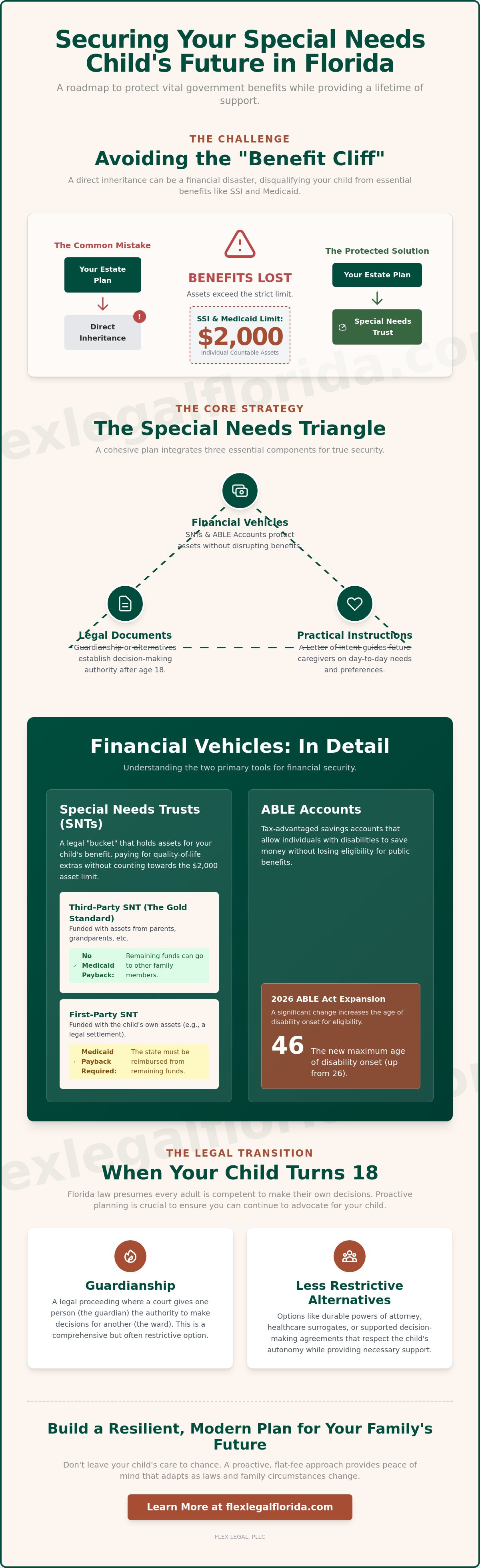
Florida law doesn't wait for you to be ready. For parents in Palm Beach County, the legal environment regarding disability benefits is rigid and unforgiving. Securing my special needs child's future in Florida requires more than a standard Will; it demands a proactive strategy that balances legal authority with financial preservation. Most families stumble into the "Benefit Cliff" because they rely on traditional estate planning that fails to account for the strict asset limits required for government assistance. True security relies on a "Special Needs Triangle" that integrates legal documents, financial vehicles, and practical care instructions into one cohesive plan.
Traditional estate plans often fall short because they treat every beneficiary the same. In a typical family, leaving an equal share of assets to each child is the goal. For a child with a disability, that same inheritance can be a disaster. It triggers an immediate loss of essential services, forcing the family into a reactive scramble to "spend down" assets just to regain basic healthcare coverage. We view planning not as a static set of rules, but as a dynamic support system that evolves with your family's needs.
Preserving Government Benefit Eligibility
In Florida, the math is simple but the stakes are high. As of 2026, the individual countable asset limit for Supplemental Security Income (SSI) and long-term care Medicaid remains at just $2,000. If a well-meaning relative leaves a direct inheritance of even $5,000 in a Last Will and Testament, that child could immediately lose their health coverage and monthly income. To avoid this, families often utilize a Special Needs Trust. This legal tool holds assets for the child's benefit without counting toward that restrictive $2,000 cap.
It's also vital to understand "deeming" rules. Before age 18, the Social Security Administration considers a portion of parental income and assets when determining a child's eligibility. Once your child turns 18, they are viewed as an individual household. This shift often makes them eligible for benefits they previously couldn't access, provided their own assets remain below the threshold. Naming a special needs child as a direct beneficiary on a life insurance policy or bank account is one of the most common, and avoidable, mistakes we see in West Palm Beach.
The Importance of Early Intervention
Effective planning shouldn't be a reaction to a crisis. It's a transition that begins long before your child reaches the age of majority. We often see families overlook the possibility of their own sudden incapacity. If you are the primary caregiver and suddenly become unable to manage your child's affairs, a gap in advocacy can lead to a breakdown in care. Modern Special Needs Planning addresses this by naming successor advocates who can step in immediately.
At age 18, Florida law assumes every person is competent to make their own legal, financial, and medical decisions. Without a clear roadmap involving Guardianship Proceedings or less restrictive alternatives, you could lose the legal right to advocate for your child overnight. Starting this process during the teenage years ensures a smooth transition from parental control to legal advocacy. This proactive approach provides the peace of mind that your child's care remains uninterrupted, regardless of what the future holds.
Financial Vehicles: Special Needs Trusts and ABLE Accounts
Think of a Special Needs Trust (SNT) as a legal "bucket" designed to hold and protect assets for your child's benefit. Because the trust owns the assets rather than the individual, these funds don't count toward the restrictive $2,000 government resource limit. This structure is a cornerstone of securing my special needs child's future in Florida. It allows you to fund their life's "extras"—from specialized therapy to recreational travel—without endangering their baseline healthcare. To be truly effective, you should coordinate these tools with revocable living trusts to ensure a seamless transition of your entire estate into the protective SNT structure.
A Third-Party SNT is the gold standard for parental planning because it allows you to provide for your child without the state claiming any remaining funds upon their death. This differs significantly from trusts funded with the child's own money, such as a personal injury settlement. By choosing the right vehicle now, you maintain control over how your legacy is spent while ensuring your child remains supported by every available public resource. If you're looking for a partner to help design this roadmap, exploring Special Needs Planning is an excellent starting point.
Third-Party vs. First-Party Trusts
The distinction between trust types determines what happens to the money once it's no longer needed. A Third-Party SNT is funded by anyone other than the beneficiary, typically parents or grandparents. It's often funded through life insurance proceeds or a Last Will and Testament. Crucially, these trusts don't require a Medicaid payback. In contrast, a First-Party SNT is funded with the child's own assets and must include a provision to reimburse the state for medical costs after the beneficiary passes away. Choosing a trustee is equally vital. While family members offer personal connection, many Florida families opt for professional fiduciaries to handle the complex accounting and reporting requirements these trusts demand.
Leveraging Florida ABLE Accounts
As of January 1, 2026, the ABLE Act expansion significantly changed the landscape by raising the age of disability onset from 26 to 46. This makes the ABLE United program accessible to a much wider population. For 2026, the annual contribution limit has increased to $20,000 from all sources. These accounts offer a unique advantage: the first $100,000 is completely ignored for SSI resource limits.
Unlike a trust, an ABLE account allows the individual to manage their own funds for "qualified disability expenses," which includes housing, transportation, and health prevention. In Florida, these accounts are especially powerful because they aren't subject to Medicaid payback provisions. Using a hybrid strategy that combines an SNT for large, long-term assets and an ABLE account for daily spending provides the ultimate balance of security and autonomy.
Legal Decision-Making: Guardianship vs. Alternatives
Turning 18 is a major milestone, but in the eyes of Florida law, it's a total shift in legal status. The moment your child reaches the age of majority, the state presumes they are fully competent to sign contracts, refuse medical treatment, or manage their own finances. This legal cliff makes decision-making planning a vital part of securing my special needs child's future in Florida. You aren't just protecting their money; you're protecting their right to safe, informed advocacy throughout their adult life.
While Plenary Guardianship removes all delegable rights, Florida courts strongly prefer the least restrictive option available. Limited Guardianship allows a person to retain specific rights while delegating others, such as the right to sue or manage high-value property. For deeper context on how the state regulates these roles, you can review official Florida Guardianship Information. We view these legal tools as a dynamic support system rather than a set of rigid constraints, ensuring the level of protection matches your child's specific abilities.
The Florida Guardian Advocacy Process
Florida Statute 393.12 offers a unique, streamlined path specifically for families of individuals with developmental disabilities. Guardian Advocacy allows parents to maintain legal authority without the court requiring a formal adjudication of incapacity. This distinction is important. It means your child isn't legally declared "incapacitated," which is often a more dignified and less adversarial approach for the family. Working with a special needs planning attorney ensures the court filings meet local probate requirements while minimizing the emotional stress on your child.
Less Restrictive Alternatives
Not every adult with a disability needs a court-appointed guardian. Supported Decision-Making (SDM) is a modern, non-court alternative where the individual makes their own choices with the guidance of a trusted support team. This preserves maximum autonomy while providing a safety net for complex decisions. For high-functioning adults, a Durable Power of Attorney or the Designation of a Health Care Surrogate can often provide enough legal authority to manage healthcare and financial matters. However, if a person is truly vulnerable to financial exploitation or cannot communicate their needs, formal guardianship proceedings serve as a robust legal shield. These tools ensure your child's voice is heard while their physical and financial well-being is aggressively defended.
The Letter of Intent: Your Child's Practical Care Manual
A Special Needs Trust manages the money, and a guardian manages the legal rights. However, neither of these documents explains that your child only eats a specific brand of yogurt or that loud sirens cause them physical distress. This is where the Letter of Intent becomes the most valuable tool in your arsenal. When you are securing my special needs child's future in Florida, you have to bridge the gap between high-level legal authority and the messy, beautiful reality of day-to-day care. The Letter of Intent provides the "soul" to the trust's "skeleton."
While this document isn't legally binding in a Florida probate court, it serves as the ultimate guide for whoever steps into your shoes. It transforms your successor from a mere legal representative into a true advocate who understands your child’s history and heart. Without this manual, a successor is left guessing, which can lead to unnecessary stress and a decline in your child’s quality of life. If you want to ensure every piece of your plan works together, starting with Special Needs Planning allows you to document these nuances effectively.
What to Include in Your Letter of Intent
Your letter should be as granular as possible. It starts with a clear medical snapshot: a full history, current medications, dosages, and the contact information for trusted healthcare providers who already know your child's needs. Beyond the clinical, you must document the daily rhythms that make your child feel safe. List their dietary preferences, specific sensory triggers to avoid, and the routines that provide them with a sense of stability.
Medical and Therapeutic: List all specialists, current therapy schedules, and insurance details.
Daily Living: Detail sleep schedules, hygiene routines, and food allergies or strong dislikes.
Social and Emotional: Describe their closest friends, favorite hobbies, and the long-term goals you have for their independence and happiness.
Updating and Sharing the Document
A Letter of Intent is not a "one and done" project. It must be a dynamic document that grows as your child matures. We recommend setting a recurring date, perhaps every January, to review and update these instructions. This ensures that a successor isn't relying on information that is five years out of date. Whenever possible, involve your child in this process. Respecting their autonomy by asking about their own goals and preferences ensures the document reflects their voice, not just your own.
Once finished, keep the letter in an accessible location. Your successor trustees and guardians must know exactly where to find it. Digital copies should be shared with your legal team and stored alongside your formal trust documents. This ensures that if an emergency happens tomorrow, the person stepping in has a clear, compassionate roadmap to follow immediately.
Securing the Future with Flex Legal, PLLC: A Modern Approach
At Flex Legal, PLLC, we believe that securing my special needs child's future in Florida shouldn't feel like a series of rigid, intimidating hurdles. We've replaced the traditional, slow models of law with a streamlined, flat-fee approach that provides families with total cost certainty from day one. Our "Agile Ally" philosophy means your plan isn't a static document gathering dust. It's a dynamic support system designed to adapt as Florida’s statutes evolve and your child’s needs change. Jennifer L. Flexer, Esq. leads our West Palm Beach practice with a focus on compassionate advocacy, ensuring every family feels heard and protected.
Planning for your child also means planning for yourself. If you suddenly become unable to manage your own affairs, your child's advocacy could stall immediately. We integrate comprehensive incapacity planning for parents, utilizing a durable power of attorney to ensure that a trusted successor can step in without a gap in care. This proactive step protects the entire family unit, ensuring that your child's daily routine remains uninterrupted even if you cannot be the one to manage it.
Our Specialized Planning Process
Our process begins with a focused initial consultation. We work to identify your child's specific sensory, medical, and financial needs while aligning them with your family's long-term goals. We then draft the "Special Needs Triangle," which includes a custom SNT, legal advocacy documents, and detailed guidance on your Letter of Intent. We don't work in a vacuum. Our team coordinates seamlessly with your existing financial advisors and care teams to ensure every part of your financial life supports the same goal of lifelong stability.
Next Steps for Your Family
The danger of "Do-It-Yourself" special needs forms in Florida cannot be overstated. A single misplaced clause or an improperly executed document can trigger the "benefit cliff" and lead to a loss of SSI or Medicaid. These generic forms often fail to account for the specific 2026 ABLE Act changes or Florida's unique trust statutes. Don't leave your child's stability to chance. Schedule a strategy session with our team to review your current estate plan and identify any gaps in your protection. Secure your child's future with a Florida Special Needs Plan today.
Taking the First Step Toward Lifelong Peace of Mind
Securing my special needs child's future in Florida is a journey that requires an agile, forward-thinking partner who understands the local legal landscape. Throughout this guide, we have explored the critical balance between financial vehicles like SNTs and the practical, day-to-day guidance provided by a Letter of Intent. By addressing both the legal "skeleton" and the care-focused "soul" of your plan, you ensure that your child is protected from the benefit cliff while maintaining the quality of life they deserve.
At Flex Legal, PLLC, we offer flat-fee pricing for total transparency and a specialized focus on Florida Special Needs Law. We've built our practice around a modern, empathetic approach that prioritizes the unique needs of West Palm Beach families. We act as your agile ally, ensuring your plan stays current as laws and family circumstances change. Don't wait for a crisis to decide what happens next. Schedule Your Special Needs Planning Strategy Session today. You've worked hard to provide for your child; let’s work together to make sure that care continues for a lifetime.
Frequently Asked Questions
What is the difference between a Special Needs Trust and an ABLE account?
Special Needs Trusts (SNTs) are legal structures designed to hold unlimited assets like real estate or large inheritances without a contribution cap. In contrast, ABLE accounts are tax-advantaged savings vehicles for daily expenses with an annual contribution limit of $20,000 for 2026. SNTs generally require a trustee to manage distributions, while ABLE accounts offer the individual more autonomy over their spending for qualified disability expenses.
Can my child have both an SNT and an ABLE account in Florida?
Yes, and using both tools together is often the most effective strategy for families. You can fund a Third-Party SNT with large assets like life insurance proceeds and then move smaller amounts into an ABLE account for your child's discretionary use. This hybrid approach provides the maximum level of financial flexibility while ensuring your child remains below the $2,000 individual resource limit for government benefits.
Will my child lose their SSI if I leave them money in my Will?
A direct inheritance will likely disqualify your child from Supplemental Security Income (SSI) if it pushes their countable assets above $2,000. To avoid this "benefit cliff," you shouldn't name your child as a direct beneficiary in your Last Will and Testament. Instead, you should direct those assets into a Third-Party Special Needs Trust, which protects their eligibility for monthly income and Medicaid health coverage.
What happens if I don't name a guardian for my special needs child in Florida?
If you don't establish a legal advocate, the court may eventually appoint a professional guardian who is unfamiliar with your child's personal history. Securing my special needs child's future in Florida involves using a Designation of Pre-need Guardian or initiating Guardianship Proceedings before the child turns 18. Taking these steps early ensures that a trusted family member or advocate maintains the legal authority to make critical medical and financial decisions.
How much money can I put into a Florida Special Needs Trust?
There is no legal limit to the total amount of money a Special Needs Trust can hold. Unlike ABLE United accounts, which have a lifetime contribution cap of $418,000 in Florida, an SNT can manage millions of dollars in assets. This makes the trust the primary vehicle for high-level planning, such as protecting a family home or a significant investment portfolio, while maintaining your child's access to public assistance.
Can a sibling be the trustee of a Special Needs Trust?
A sibling can certainly serve as a trustee, but they must be prepared to handle complex accounting and strict Social Security Administration reporting rules. Many families choose to name a sibling as a co-trustee alongside a professional fiduciary to balance personal care with professional compliance. This structure allows the sibling to focus on the child's well-being while the professional manages the intricate tax and legal requirements of Trust Administration.
Does a Special Needs Trust protect against Florida Medicaid estate recovery?
A Third-Party Special Needs Trust is not subject to Medicaid payback provisions because the assets never belonged to the beneficiary. However, a First-Party SNT funded with the child's own money must include a provision to reimburse the state for medical costs after they pass away. By using a Third-Party trust for your legacy, you ensure that any remaining funds can eventually pass to other family members rather than the state.
How often should I update my special needs estate plan?
You should review your estate plan at least every three to five years or whenever your child's health or financial needs change. Securing my special needs child's future in Florida requires staying adaptable to new regulations, such as the 2026 expansion that raised the ABLE disability onset age to 46. Regular updates ensure your Designation of Health Care Surrogate and successor trustee choices reflect your current family dynamics and goals.


Comments