
Revocable vs. Irrevocable Trust in West Palm Beach: The 2026 Comparison Guide

What if you could keep your family out of the 150,000 probate filings Florida courts handle each year while securing a $15 million estate tax exemption? For many West Palm Beach residents, the choice between a revocable vs irrevocable trust is the difference between a seamless transition and a 24 month legal freeze. You likely want to protect your Palm Beach County assets but worry that choosing the wrong structure might lock you out of your own wealth or leave your home vulnerable to Florida’s complex homestead restrictions.
It’s natural to feel anxious about losing control or overpaying for probate administration that can cost up to $6,000 in local fees. We believe estate planning should be a strategic advantage, not a source of stress. This guide will help you master the critical differences between these two tools so you can avoid the Palm Beach County probate process and shield your legacy from lawsuits or long-term care costs. We’ll compare current 2026 tax brackets, explain the new summary procedures under House Bill 895, and help you decide which path offers the flexibility your family deserves.
Key Takeaways
Discover how a revocable trust keeps you in full control of your assets while providing a seamless transition for your family that bypasses the public probate process.
Learn why an irrevocable trust is the strategic choice for those seeking to shield their wealth from creditors and minimize future estate tax liabilities.
Master the functional differences of a revocable vs irrevocable trust, from who holds the legal title to how the IRS identifies your assets.
Identify the specific steps needed to protect your Florida homestead and digital assets from the delays and costs associated with traditional estate administration.
Gain clarity on how a tailored, flat-fee legal plan replaces traditional legalese with an agile strategy designed for the modern Florida lifestyle.
Table of Contents Understanding Trust Fundamentals in West Palm Beach The Revocable Living Trust: Flexibility for Florida Families The Irrevocable Trust: The Fortress for Asset Protection Revocable vs. Irrevocable: A Comparison Framework Crafting Your Tailored Estate Plan with Flex Legal
Understanding Trust Fundamentals in West Palm Beach
Think of a trust as a private rulebook for your assets. At its core, it's a fiduciary relationship where you, the grantor, give a trustee the legal right to hold title to your property for the benefit of your chosen beneficiaries. While many people view estate planning as a series of complex forms, Understanding Trust Fundamentals reveals that a trust is actually a versatile tool designed to provide clarity and protection. A Florida trust is a private, contractual arrangement that empowers you to transfer wealth outside of the public court system, effectively shielding your family from the delays and costs of the 15th Judicial Circuit. The central choice between a revocable vs irrevocable trust hinges on whether you want the flexibility to change your mind or the permanence required for high-level asset protection.
The Three Pillars: Grantor, Trustee, and Beneficiary
Every trust in West Palm Beach relies on three distinct roles. First, the Grantor is the person who creates the trust and provides the assets, which is typically you. Second, the Trustee is the individual or institution responsible for managing those assets according to the specific instructions laid out in the document. In Florida, these duties are governed by Florida Statutes Chapter 736, which requires trustees to act with the highest level of loyalty and care. Finally, the Beneficiaries are the people or organizations who will eventually receive the trust's benefits. It's vital to remember that under Florida law, beneficiaries have specific rights to receive information and annual accountings, ensuring the trustee remains accountable to your original vision.
Why West Palm Beach Families Choose Trusts Over Wills
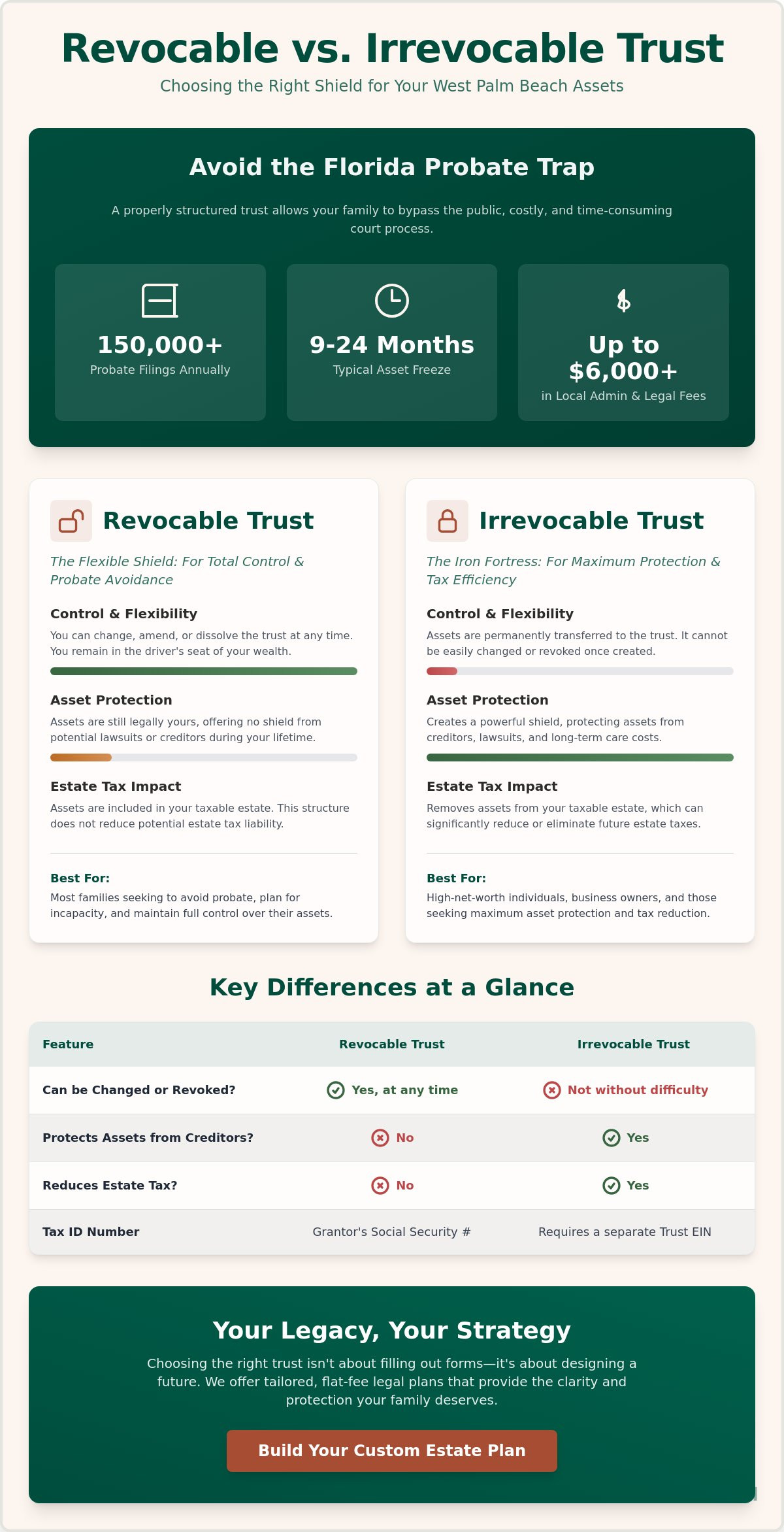
The "Probate Trap" is a real concern for local families. Florida courts handle almost 150,000 probate filings annually, and the process in Palm Beach County typically takes between 9 and 24 months to complete. During this time, your assets can be frozen, and your family's private financial details become part of the public record. Choosing a trust over a simple will offers several strategic advantages:
Privacy Protection: Unlike a will, a trust doesn't need to be filed with the court, keeping your asset list and distribution plan away from prying eyes.
Immediate Access: Your heirs can often access funds within weeks rather than waiting a year or more for a judge's approval.
Cost Efficiency: While probate can cost between $2,000 and $6,000 in administrative and legal fees, a properly funded trust eliminates these expenses entirely.
Deciding which structure fits your lifestyle is the first step toward true peace of mind. For a deeper look at how these tools compare to traditional planning, explore our guide on Will vs. Trust in West Palm Beach to see which estate plan protects you best in 2026.
The Revocable Living Trust: Flexibility for Florida Families
For many West Palm Beach families, the revocable living trust is the gold standard for daily wealth management. It allows you to retain 100% control over your assets. You act as your own trustee. You can move money, sell your home, or change beneficiaries whenever you like. This is the primary reason people weigh the revocable vs irrevocable trust; they value the ability to pivot as life changes. It's an agile tool that grows with you, whether you're acquiring new property in Jupiter or managing a portfolio of digital assets.
Assets in a revocable trust stay in your estate for tax purposes. Since the IRS views you and the trust as the same entity, you'll use your own Social Security number for tax filings. While this doesn't offer immediate tax savings on your 2026 returns, it ensures your estate avoids the 9 to 24 month probate delay that often plagues Florida families. To see how these structures stack up side by side, you can review this Revocable vs. Irrevocable: A Comparison Framework.
Key Benefits: Control and Incapacity Planning
The real power of this document is its role as a sophisticated backup plan. If you ever become unable to manage your West Palm Beach property due to illness or injury, your successor trustee steps in immediately. This transition happens without a court-supervised guardianship, which can be expensive and intrusive. It's a seamless way to protect your interests as your wealth in Florida grows. For a deeper dive into these mechanics, our Revocable Trust Guide offers a step by step look at the process.
The Trade-off: No Immediate Asset Protection
You should understand that flexibility has its limits. Under Florida law, assets in a revocable trust are still considered your personal property. If a creditor wins a judgment against you, these assets are not shielded. Similarly, this trust type won't help you qualify for Medicaid, as the state views the funds as fully accessible to you. When comparing a revocable vs irrevocable trust, remember that the former is about management, while the latter is about defense. In the world of Florida estate planning, total flexibility comes at the cost of total asset vulnerability. If you're looking for a more robust shield, our team can help you find agile legal support tailored to your specific risk profile.
The Irrevocable Trust: The Fortress for Asset Protection
If a revocable trust is a flexible tool for daily management, an irrevocable trust is a permanent fortress. Once you transfer assets into this structure, you generally relinquish legal ownership and the power to amend the document. This trade-off is strategic. By removing assets from your personal name, you effectively move them out of your taxable estate and beyond the reach of future creditors. When evaluating a revocable vs irrevocable trust, West Palm Beach residents often choose the latter when their goals shift from simple probate avoidance to high-level defense. In a legal landscape where Florida courts handle thousands of liability claims annually, this "firewall" provides a level of security that a living trust simply cannot match.
The permanence of these trusts has become even more relevant with the 2026 federal estate tax exemption set at $15 million per individual. For high-net-worth families in Palm Beach County, an irrevocable trust allows you to lock in this high exemption amount and protect future asset appreciation from the flat 40% federal tax rate. While the choice feels significant, modern wealth strategists often highlight The Revocable Living Trust: Flexibility for Florida Families as a starting point before graduating to these more robust irrevocable structures. Our role as your agile ally is to help you determine exactly when that transition makes sense for your specific portfolio.
Asset Protection and Creditor Shielding in Florida
Transferring title to an irrevocable trust creates a legal barrier that is difficult for creditors to pierce. In Florida, once assets are properly seasoned within the trust, they are generally shielded from personal lawsuits, business failures, or professional liability claims. This is particularly vital for West Palm Beach professionals in high-risk fields like medicine or real estate development. You must plan well before a crisis occurs, however. Florida maintains a strict "look-back" period for fraudulent transfers, meaning you can't move assets into a trust once a claim is already pending against you. Strategic planning ensures your wealth remains protected by Florida’s robust asset protection statutes before any storm clouds appear.
Medicaid Planning and Tax Mitigation
Irrevocable trusts are also essential for long-term care planning. A Medicaid Asset Protection Trust (MAPT) can help you qualify for benefits while preserving your legacy for your heirs. Because Florida enforces a five-year look-back rule for Medicaid eligibility, establishing this trust early is critical to avoid being forced to "spend down" your life savings on nursing home costs. These structures also provide a lifeline for families with unique needs. By working with a special needs planning attorney, you can create a third-party special needs trust. This ensures a child with disabilities remains eligible for government assistance while still enjoying the financial support of the trust. Under the new House Bill 895 signed in April 2026, trustees now have a streamlined summary procedure to discharge liability in these non-adversarial trusts, making the administration process more efficient than ever.
Revocable vs. Irrevocable: A Comparison Framework
Comparing a revocable vs irrevocable trust often comes down to one specific question: Do you value flexibility or fortress-level protection? In a revocable structure, you are the boss. You maintain total control as the trustee, and the IRS treats the assets as your personal property linked to your Social Security number. Conversely, an irrevocable trust requires an independent trustee to hold the keys. This separation creates a new legal entity with its own Tax ID (EIN). While both paths successfully bypass the 9 to 24 month Florida probate process, only the irrevocable option provides a shield against creditors. Your ultimate choice depends on whether you value the freedom to change your mind or the security of permanent asset protection.
Even though irrevocable trusts are generally permanent, Florida law offers modern solutions for changing circumstances. Under Florida Statute 736.04117, trustees may have the power to "decant" a trust, essentially pouring assets from an old, outdated trust into a new one with better terms. This is the kind of agile legal strategy that traditional firms often overlook. We prioritize these flexible solutions to ensure your estate plan doesn't become a static set of rules that no longer serves your family.
The Florida Homestead Factor
Your primary West Palm Beach residence requires special care. A revocable trust is an excellent tool for homestead property because it preserves your Florida Homestead tax exemption and the "Save Our Homes" 3% assessment cap. If you place your home in a standard irrevocable trust, you risk losing these significant tax benefits and the vital protection from forced sale. For many clients, a "Lady Bird Deed" serves as a strategic alternative. It allows you to keep your homestead rights and total control during your lifetime while automatically transferring the property to your heirs at death; this effectively avoids probate without the rigidity of an irrevocable trust.
When to Choose Which: A Decision Matrix
Choosing the right path doesn't have to be overwhelming. We look at your specific 2026 financial landscape to build a tailored plan that balances control with security. Consider these criteria:
Choose a Revocable Trust if: You want to avoid probate, manage assets during potential incapacity, and maintain the right to sell or move property at any time.
Choose an Irrevocable Trust if: You have a high-net-worth estate exceeding the $15 million federal exemption, you're planning for Medicaid eligibility, or you work in a high-liability profession.
The Hybrid Approach: Many families use a revocable trust for their home and daily accounts while using an irrevocable trust for life insurance or long-term investments.
Our team acts as your agile ally to ensure your plan reflects your current goals and local regulations. If you're ready to build a strategy that fits your life, schedule a consultation with Flex Legal today.
Crafting Your Tailored Estate Plan with Flex Legal
Deciding on a revocable vs irrevocable trust is a significant step, but it's only the beginning of your journey. At Flex Legal, we believe that high-quality estate planning should be transparent and accessible. We provide West Palm Beach residents with flat-fee certainty for both trust types, ensuring you never have to worry about an unpredictable bill. Our "agile ally" approach replaces traditional legalese with clear, actionable advice. We speak your language, not the dense jargon of the 15th Judicial Circuit. This clarity allows you to make informed decisions about your legacy with confidence.
Local expertise matters because trust administration doesn't happen in a vacuum. We understand the specific procedural nuances of the Palm Beach County court system, which is vital if your trust ever requires judicial oversight. Whether you are looking for Asset Protection Lawyers Near Me or simply need a streamlined way to avoid probate, our team is positioned to act quickly. We prioritize efficiency and results, moving your plan from concept to completion without the friction of a traditional law firm model.
The Flex Legal Process: From Consultation to Funding
A common mistake in Florida estate planning is failing to "fund" the trust. An empty trust is just an expensive stack of paper; it only works if you actually transfer the titles of your assets into the trust's name. We guide you through this critical stage, ensuring your West Palm Beach real estate, bank accounts, and investment portfolios are properly titled. Our process includes seamless coordination with your financial advisors and CPAs to ensure every piece of your financial life is aligned. For more details on how we integrate these tools, read our Trust and Will in West Palm Beach guide.
Secure Your Future Today
Taking the first step toward peace of mind is easier than you think. Jennifer L. Flexer provides personalized oversight on every estate plan we create, ensuring your strategy is both technically sound and tailored to your family's unique dynamics. We don't offer one-size-fits-all templates. Instead, we build dynamic support systems that adapt to your life. Your wealth represents a lifetime of hard work; don't leave it vulnerable to the delays of probate or the high costs of long-term care. Contact us today to schedule your strategy session and discover how a revocable vs irrevocable trust can serve as the foundation of your 2026 legacy.
Secure Your West Palm Beach Legacy with Confidence
You now have the framework to protect your family from the 9 to 24 month probate timeline and the complexities of Florida’s 2026 tax landscape. Whether you prioritize the absolute control of a living trust or the creditor firewall of an irrevocable structure, your decision shapes your financial security for decades. Choosing a revocable vs irrevocable trust doesn't have to be a source of anxiety when you have a strategic ally to translate complex statutes into a clear path forward. Our approach focuses on modern, agile solutions that adapt as your life in Palm Beach County evolves.
We pride ourselves on providing flat-fee pricing certainty and deep expertise in Florida Homestead law to keep your primary residence safe. Every plan receives the personalized oversight of founding attorney Jennifer L. Flexer, ensuring your documents reflect your specific goals rather than a rigid template. Your wealth represents a lifetime of hard work; let's make sure it's protected with the sophisticated care you deserve. Schedule your flat-fee trust strategy session with Flex Legal today to transition from uncertainty to a tailored estate plan. You've built a remarkable life in Florida, and we're here to help you secure it for the next generation.
Frequently Asked Questions
Can I change a revocable trust to an irrevocable trust later in Florida?
Yes, you can. Since a revocable trust is fully amendable, you have the legal authority to restate its terms or move assets into a new irrevocable structure as your goals shift toward asset protection. This transition is common when West Palm Beach residents move from simple probate avoidance to advanced tax or long-term care planning. Our team helps you evaluate when this pivot makes sense for your 2026 financial strategy.
Does a revocable trust protect my assets from a Florida nursing home?
No, it doesn't. Because you maintain 100% control and can withdraw funds at any time, Florida Medicaid views these assets as "countable" resources. When comparing a revocable vs irrevocable trust for nursing home costs, only the irrevocable version with a five year look-back period provides the necessary shield. You must establish these protections well before you need long-term care to satisfy Florida's strict eligibility rules.
What happens to my Florida Homestead exemption if I put my house in a trust?
You generally keep your exemption and the "Save Our Homes" 3% assessment cap if you use a revocable trust. However, transferring your primary West Palm Beach residence to an irrevocable trust can trigger a loss of these vital tax benefits. We always review the specific trust language to ensure your homestead rights remain intact and your property taxes don't skyrocket due to a technical error.
Do I need a separate tax ID number for a revocable trust in West Palm Beach?
No, you don't. While you're alive and competent, the IRS treats a revocable trust as a "grantor trust" for income tax purposes. You'll continue to use your Social Security number for all tax filings and 1099s. A separate Employer Identification Number (EIN) is typically only required for irrevocable trusts or after a grantor passes away and the trust becomes a separate legal entity.
How much does it cost to set up a trust with a West Palm Beach estate planning attorney?
Costs vary based on your specific needs. As of February 2026, a basic revocable trust package in Florida typically ranges from $1,500 to $2,000. More complex irrevocable or special needs trusts often range between $2,000 and $5,000 or more. These fees generally cover the trust document, a pour-over will, power of attorney, and healthcare directives to provide a complete protection system.
Can an irrevocable trust ever be changed or dissolved under Florida law?
Yes, it's possible through a modern process called decanting. Under Florida Statute 736.04117, a trustee can sometimes "pour" assets into a new trust with updated terms to reflect changing laws or family needs. You can also modify these trusts through judicial intervention or non-judicial settlement agreements if all beneficiaries and the trustee agree. This provides a level of flexibility that many traditional firms fail to mention.
Is a revocable trust public record in Palm Beach County?
No, your trust remains a private document. One of the primary reasons 150,000 probate cases are filed annually in Florida is that wills must be recorded with the court clerk, making your assets and beneficiaries public information. A trust stays off the public record, ensuring your family's financial details and your distribution plan remain confidential and away from prying eyes.
Do I still need a will if I have a revocable living trust in Florida?
Yes, you need a specific document called a "pour-over" will. This acts as a legal safety net for any assets you might forget to fund into your trust before you pass away. It ensures that those stray assets are "poured" into your revocable vs irrevocable trust during the probate process. While we aim to avoid probate entirely, this document ensures your final wishes are still followed for every piece of property you own.



Comments