
Probate Definition: A 2026 Guide for West Palm Beach Families
- Kelly Mata
- May 3
- 12 min read

What if the most stressful part of losing a loved one isn't the paperwork, but the fear that their legacy is stuck in a legal stalemate? For many families in West Palm Beach, the search for a clear probate definition starts with anxiety about court dates and rising costs. You aren't alone in feeling overwhelmed by the thought of a judge deciding how assets are distributed. It's a common concern, especially when the average Florida probate can last anywhere from six to twelve months depending on the complexity of the estate.
We believe that legal clarity shouldn't be a luxury reserved for the few. This 2026 guide explains exactly what probate means in Florida and how it impacts your inheritance right here in Palm Beach County. You'll learn the essential steps to move through the local court system with confidence and transparency. We also provide a roadmap of modern, strategic options that help you protect your family's time and potentially avoid the court process altogether.
Key Takeaways
Start with a clear probate definition to understand how the Florida court system supervises the transition of ownership and pays final creditors.
You'll learn how the Letters of Administration grant your Personal Representative the legal authority to manage and protect estate assets.
Distinguish between probate and non-probate assets. This ensures you don't waste time on items that pass directly to beneficiaries by contract.
Understand the common six to twelve month timeline for 2026. It's vital for planning your family's future in West Palm Beach.
Discover why an agile legal ally is the modern alternative to traditional, rigid firms.
Table of Contents Probate Definition: What It Means in Florida Law How the Florida Probate Process Works in 2026 Probate vs. Non-Probate Assets: What Stays Out of Court? Timeline and Costs: What to Expect in West Palm Beach Flex Legal: Your Agile Ally in Florida Probate
Probate Definition: What It Means in Florida Law
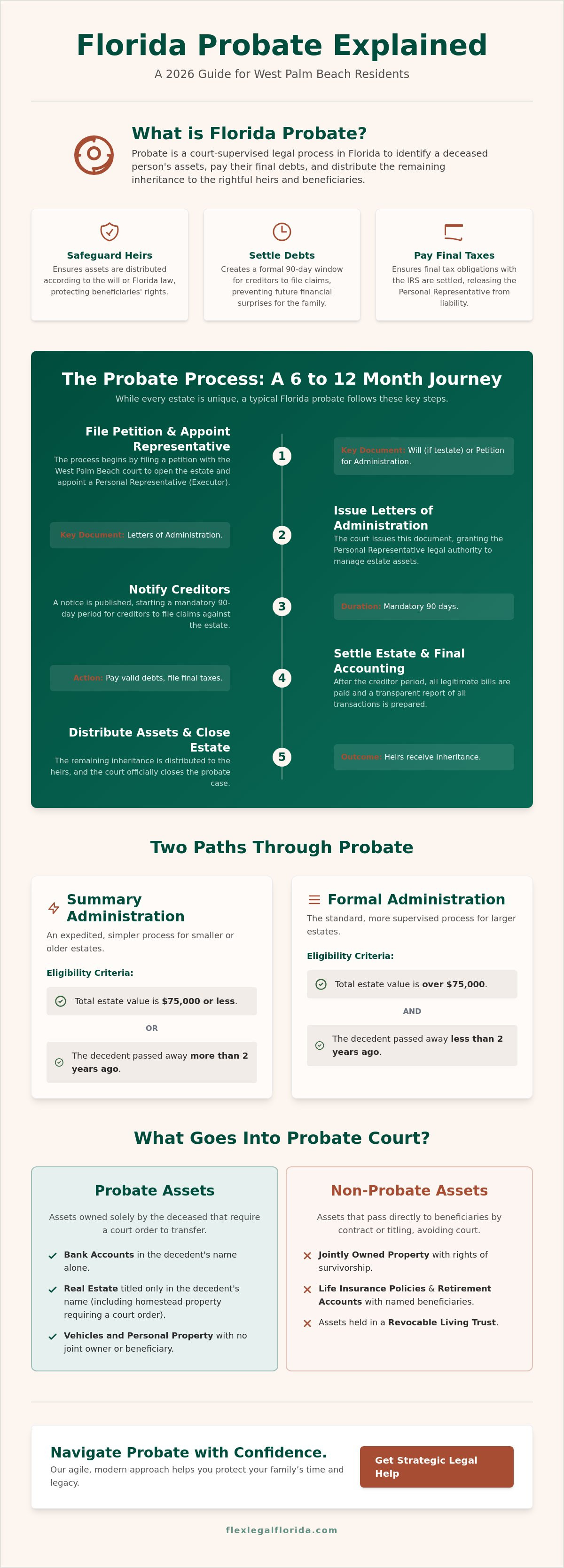
Understanding the Probate Definition is the first step toward reclaiming control during an emotional season. In Florida, probate is a court-supervised process designed to identify a deceased person's assets, pay off outstanding creditors, and distribute the remaining inheritance to the rightful heirs. It acts as a legal "reset" button that ensures every detail is handled with transparency and fairness. Florida probate is the mandatory legal path for transferring title of assets owned solely by the deceased. Having a clear probate definition helps you anticipate the requirements of the Palm Beach County court system.
Whether a family member left a detailed plan or passed away unexpectedly, the court system provides the framework for the transition. If a valid will exists, the estate is "testate." The court confirms the document’s validity and follows the decedent's wishes. If there's no will, the estate is "intestate." In these cases, Florida statutes determine the distribution based on a set family hierarchy. To manage these moving parts, a West Palm Beach judge appoints a Personal Representative. This individual, known elsewhere as an executor, takes on the responsibility of gathering assets and communicating with the court to ensure a seamless transition of the estate.
The Core Purpose of the Probate Process
Probate serves three primary functions that protect your family’s legacy. First, it safeguards the rights of beneficiaries and heirs, ensuring that the distribution of assets follows the law or the specific instructions in a will. Second, it creates a structured, 90-day window for legitimate creditors to file claims. This timeframe prevents unexpected debts from appearing years after the estate is closed. Finally, the process ensures that all final tax obligations with the IRS are settled. This is a critical step because it releases the Personal Representative from personal liability for the decedent's taxes, offering a clean slate for the heirs.
Why Florida Residents Can't Always Avoid It
Many families hope to bypass the court, but Florida law often makes it a necessity for achieving "clear title." Banks and the Palm Beach County Clerk cannot legally transfer ownership of accounts or real estate that are held in an individual's name without a court order. Florida's unique homestead laws add another layer of complexity. While these laws offer strong protections for a primary residence, a judge must officially declare the property as homestead before it can be transferred to heirs. Without this judicial confirmation, the property stays in legal limbo, preventing you from selling or refinancing the home. Our strategic approach focuses on navigating these requirements with efficiency, moving you through the court system without the traditional delays often found in rigid, older law firms.
How the Florida Probate Process Works in 2026
Moving beyond a basic probate definition requires looking at the actual mechanics families face when a loved one passes away. The process begins with the filing of a petition in the West Palm Beach court system to officially open the estate. Once the judge reviews the initial documents, they issue the "Letters of Administration." This essential document serves as the legal proof that the Personal Representative has the authority to manage bank accounts, sell real estate, and interact with tax authorities. It effectively gives the person in charge the keys to the decedent's financial world.
Following the Florida Probate Rules, the estate then enters a mandatory 90-day creditor period. During this window, we publish a formal notice in a local Palm Beach County newspaper to alert potential creditors. This step is designed to settle all legitimate debts and protect the heirs from future claims. Once the 90 days pass and all valid bills are paid, the Personal Representative provides a final accounting. This transparent report details all estate transactions and concludes with the final distribution of the remaining inheritance to the family.
Formal vs. Summary Administration
Estates in Florida generally follow one of two paths based on their size and complexity. Summary Administration is an expedited option reserved for estates valued at $75,000 or less, or for cases where the individual has been deceased for more than two years. For larger West Palm Beach estates, Formal Administration is the standard requirement. This path provides more robust court oversight, which is often necessary for complex families or business owners. You'll find that probate fees and timelines vary significantly between these two paths, so choosing the right structure early is vital for efficiency.
The Role of the West Palm Beach Probate Court
The 15th Judicial Circuit oversees all estate matters in Palm Beach County. In 2026, the court has fully embraced digital filing systems, which has modernized the experience and reduced the need for physical court appearances. Despite these technological updates, Florida law still requires most Personal Representatives to be represented by a probate lawyer palm beach county. This rule ensures that every legal filing meets the court's strict standards, preventing the administrative errors that often cause long delays. If you're looking for a more streamlined experience, working with an agile legal partner can help you move through these requirements with much less friction.
Probate vs. Non-Probate Assets: What Stays Out of Court?
A functional probate definition must also account for what stays out of the courtroom. While the court supervises many assets, it doesn't touch everything. Probate assets are strictly those held in a decedent's individual name without a designated beneficiary or a co-owner. If a family member owned a West Palm Beach condo solely in their name, it's a probate asset. However, non-probate assets pass automatically to heirs by operation of law or through a pre-existing contract. This legal distinction is why some families receive their inheritance in weeks while others wait nearly a year for the court to finalize the estate.
The most effective way to reclassify your property and avoid court intervention is through a revocable trust. This strategic tool acts as a private vessel for your belongings. By retitling accounts and real estate into the name of the trust, you ensure they remain outside the court's jurisdiction after you pass. This isn't just about speed. It's about maintaining your family's privacy and keeping your financial details out of public records. Beyond trusts, simple beneficiary designations on life insurance policies and IRAs achieve similar results, allowing funds to move directly to your loved ones without a judge's signature.
Common Non-Probate Assets in Florida
Florida law offers several streamlined paths for asset transfer that bypass the standard probate definition. Joint Tenancy with Right of Survivorship (JTWROS) is a frequent choice for West Palm Beach real estate. When one owner passes, the title shifts to the survivor instantly. For married couples, Tenancy by the Entireties provides even stronger protections, treating the couple as a single legal entity. You can also label bank accounts as "Payable on Death" (POD) or brokerage accounts as "Transfer on Death" (TOD). These designations require only a death certificate for the beneficiary to claim the assets, providing an agile solution for immediate liquidity.
The 'Homestead' Exception in Palm Beach County
Your primary Florida residence receives special treatment that sets it apart from other assets. While it's technically part of the estate if owned individually, it isn't used to pay most creditors. To secure this protection, we file a "Petition to Determine Homestead" with the 15th Judicial Circuit. West Palm Beach judges typically prioritize these petitions to ensure the family home remains safe for the heirs. Once the judge signs the order, the home's exempt status is confirmed, and the title can be transferred clearly. This specific judicial step is vital for protecting the roof over your family's head while moving through the broader administrative process.
Timeline and Costs: What to Expect in West Palm Beach
A comprehensive probate definition isn't complete without discussing the investment of time and resources required to close an estate. In 2026, most Formal Administration cases in West Palm Beach follow a six to twelve month timeline from the initial petition filing to the final distribution. This window accounts for the mandatory 90-day creditor period and the time needed to liquidate assets or resolve final tax filings. While a year might sound like a significant commitment, it's the standard timeframe ensuring all legal boxes are checked and heirs are protected from future liabilities.
Costs are another primary concern for families. Florida Statutes 733.6171 and 733.617 outline a fee schedule that the court considers "presumptively reasonable" for both attorneys and Personal Representatives. These fees are typically calculated as a percentage of the estate's value. For example, for estates valued between $100,000 and $1 million, the statutory fee is generally 3 percent. Fortunately, who pays probate attorney fees in florida is usually the estate itself. The individual family members don't have to pay out of pocket to start the process, as the costs are deducted from the estate assets before the final inheritance is distributed.
Factors That Delay Probate in Florida
While we aim for efficiency, certain variables can push the timeline beyond the twelve-month mark. Identifying and locating heirs can be difficult, especially with West Palm Beach's large population of out-of-state beneficiaries. If the decedent owned complex business interests or required a final federal estate tax return, such as IRS Form 706, the process naturally slows down to accommodate federal review. Additionally, any litigation or "will contests" filed in the 15th Judicial Circuit will halt distribution until a judge makes a final ruling. These disputes often turn a straightforward administration into a multi-year ordeal.
Minimizing Expenses with Modern Legal Support
You can take proactive steps to reduce the financial impact on your heirs. Modern estate planning often utilizes flat-fee structures, which provide cost certainty and prevent the billable-hour surprises common at traditional firms. Our tech-forward approach in West Palm Beach speeds up filings by using digital signatures and integrated court portals, cutting weeks off the administrative phase. We recommend reviewing our essential planning checklist to see if your current documents are prepared for the 2026 legal landscape. If you're ready to protect your legacy without the friction of a rigid law firm, schedule a strategic consultation with our team today.
Flex Legal: Your Agile Ally in Florida Probate
Choosing the right legal partner changes your entire perspective on the probate definition. Traditional law firms often rely on outdated, slow-moving models that leave families waiting for answers and feeling disconnected from the process. Flex Legal Florida offers a modern alternative built on the principles of speed and accessibility. Jennifer L. Flexer's deep roots in the West Palm Beach court system allow us to anticipate judge requirements in the 15th Judicial Circuit before they become obstacles. Our approach isn't just about following the law; it's about providing a tailored experience that fits your family's unique needs in 2026.
We believe that legal support should feel like a partnership rather than a transaction. By combining professional authority with a solution-oriented mindset, we strip away the intimidating atmosphere often found in the legal industry. We use a clear probate definition to anchor our strategies, ensuring you always know where the estate stands and what comes next. Our firm acts as an agile ally, prioritizing your comfort and clarity while we handle the complex administrative tasks required by the state of Florida.
Tailored Probate Administration
We recognize that being named a Personal Representative is a heavy lift during an already difficult time. Our team handles the technical heavy lifting, from filing the initial petition to coordinating with the Palm Beach County Clerk. We're committed to clear communication and removing the legal friction that often causes unnecessary stress. By streamlining the workflow, we ensure that you don't have to spend your days worrying about court deadlines or complex filings. This efficiency allows your family to focus on grieving and healing rather than managing a mountain of paperwork. We provide the dynamic support system you need to move through the 2026 probate process with total confidence.
Strategic Planning to Avoid Future Probate
Our commitment to your family extends beyond the immediate administration of an estate. We use our local West Palm Beach knowledge to build strategic plans that keep your loved ones out of court in the future. By utilizing modern tools like revocable trusts and sophisticated asset protection, we create a seamless transition of wealth that bypasses the public court system entirely. Flexibility is a core value at Flex Legal; we don't believe in one-size-fits-all documents. Instead, we design modern solutions that reflect the evolving needs of Florida residents and business owners. Securing your family's future today prevents the costs and delays we've discussed throughout this guide.
Take the first step toward a more efficient legal experience by simplifying your specific situation. We invite you to schedule a strategic consultation with our team to discuss your goals. Whether you're currently facing the court process or looking to protect your legacy for the next generation, we're ready to act as your responsive and forward-thinking expert in West Palm Beach.
Take Control of Your Family's Legal Future
A clear probate definition provides the foundation for a smoother transition of your loved one's legacy. You've seen how identifying non-probate assets and understanding the 15th Judicial Circuit's requirements can significantly reduce the stress of estate administration. Whether you're managing a Formal Administration or looking to avoid court through strategic trust planning, the right support makes all the difference.
Flex Legal Florida offers a modern, tech-forward approach that prioritizes your family's peace of mind. Founded by Jennifer L. Flexer, Esq., our firm specializes in Palm Beach County probate with an empathetic, agile mindset that traditional firms often lack. We focus on transparency and efficiency, ensuring you aren't left in the dark during the six to twelve month standard timeline. You don't have to navigate these complex legal waters alone.
Schedule a Consultation with Flex Legal to Simplify Your Florida Probate. Let us help you protect your inheritance and build a flexible plan that secures your family's future today.
Frequently Asked Questions
What is the simplest definition of probate in Florida?
The simplest probate definition is a court-supervised legal process that confirms a person’s death, settles their outstanding debts, and transfers their assets to the rightful heirs. It acts as the official bridge between a decedent’s individual ownership and the heirs' legal right to those assets. Without this process, families often cannot access bank accounts or sell real estate that was held solely in the deceased person's name.
Is probate required if there is a will in West Palm Beach?
Yes, having a will does not bypass the court; instead, it provides the court with a roadmap for the distribution of assets. A will must be "admitted to probate" by a judge in the 15th Judicial Circuit to be legally recognized. Once the judge validates the document, they grant the Personal Representative the authority to carry out the specific instructions left behind by your loved one.
How long does the average probate process take in Palm Beach County?
The average Formal Administration in Palm Beach County takes between six and twelve months to conclude. This timeline is largely dictated by the mandatory 90-day creditor period required by Florida law and the speed of the local court's digital filing system. If the estate is eligible for Summary Administration, the process can often be completed in significantly less time, sometimes as quickly as 30 to 60 days.
Can I avoid probate in Florida without a trust?
You can avoid probate without a trust by using specific asset designations such as "Payable on Death" (POD) for bank accounts or "Transfer on Death" (TOD) for brokerage accounts. Additionally, real estate held as Joint Tenants with Right of Survivorship or through a "Lady Bird" deed passes automatically to the survivor. These methods ensure assets move by contract or operation of law rather than through the court system.
What happens if someone dies without a will in West Palm Beach?
When someone dies without a will, the estate is considered "intestate" and assets are distributed according to the hierarchy in Florida Statute Chapter 732. The law typically prioritizes the surviving spouse and children, followed by other close relatives if no immediate family exists. A West Palm Beach judge will appoint a Personal Representative to manage this distribution based strictly on these state laws rather than personal preferences.
Does the court take a percentage of the estate during probate?
No, the Florida court system does not take a percentage of the estate’s value as a fee. Instead, you'll pay fixed filing fees to the Palm Beach County Clerk of the Circuit Court, which generally range between $235 and $400 depending on the type of administration. While attorney and Personal Representative fees are often calculated as a percentage of the assets, the court's own costs are administrative and predictable.
Who is in charge of the probate process in Florida?
The Personal Representative is the individual in charge of managing the estate under the direct supervision of a judge. This person is responsible for gathering assets, notifying creditors, and ensuring that all final taxes are paid to the IRS. In West Palm Beach, the Personal Representative must be represented by a licensed attorney in nearly all cases to ensure every filing meets the strict requirements of the Florida Probate Code.
What is the difference between an executor and a personal representative?
There is no functional difference in Florida; the state simply uses the term "Personal Representative" instead of "executor." While many other states and popular media use the word executor, the Florida Probate Code officially adopted the term Personal Representative to describe the person appointed to oversee an estate. Whether a will uses the old terminology or the new, the duties and legal responsibilities remain exactly the same in our local courts.


Comments