
Difference Between Medicare and Medicaid: A 2026 West Palm Beach Guide
- Kelly Mata
- Apr 30
- 12 min read

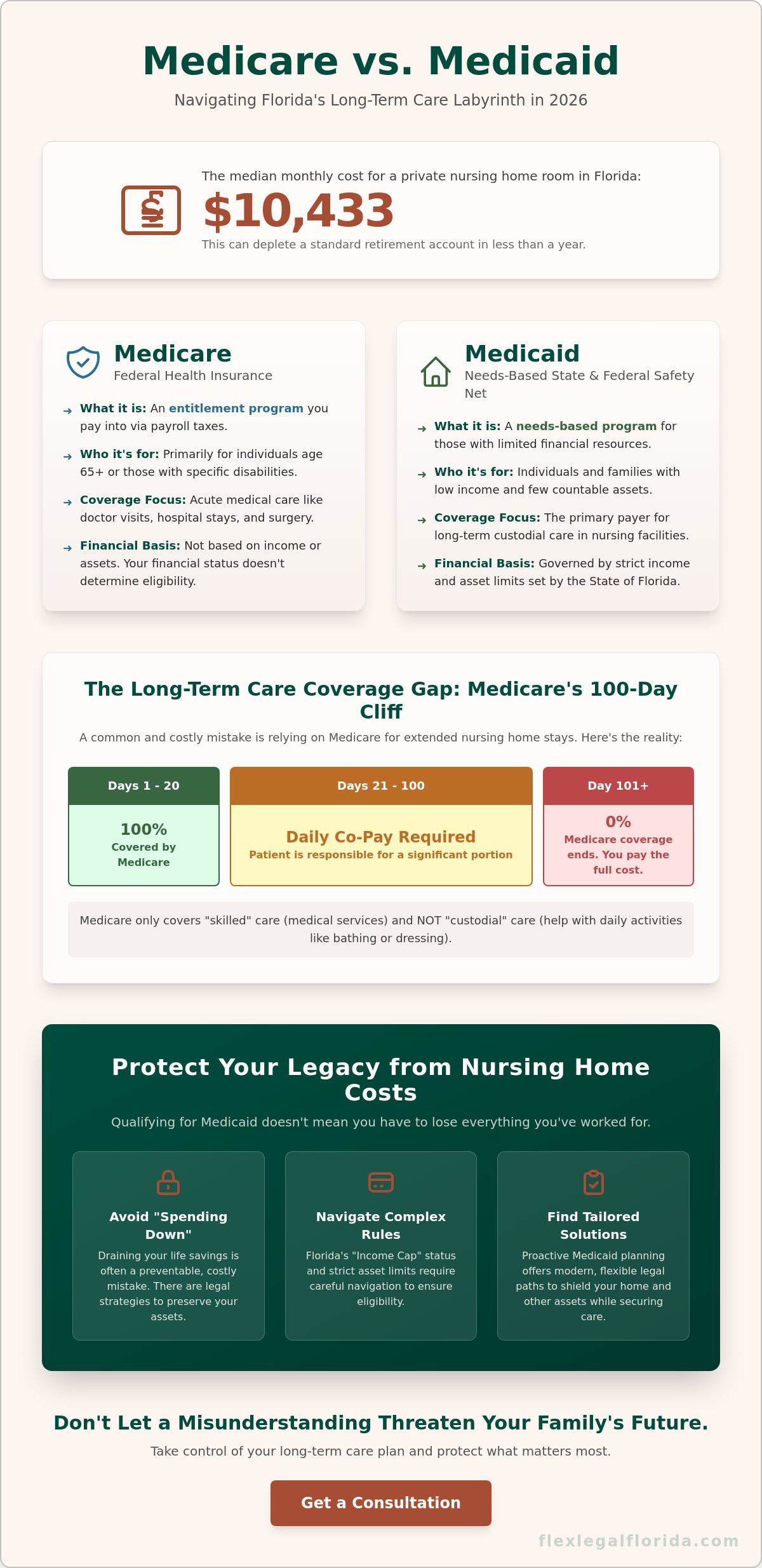
What if the biggest threat to your West Palm Beach home isn't a hurricane, but a simple misunderstanding of a single letter? Many Florida families mistakenly believe their health coverage automatically covers long term care, only to discover that the difference between medicare and medicaid is the line between staying in your home or losing it to rising medical costs. In 2024, the median cost for a private room in a Florida nursing facility climbed to $10,433 per month, a figure that can drain a standard retirement account in under twelve months.
It's natural to feel anxious about these strict Florida eligibility rules and the "M" word confusion that leaves so many seniors vulnerable. You've spent decades building your legacy, and the fear of it vanishing to a nursing home is a burden you shouldn't carry. This guide will help you protect your assets while qualifying for the specific care you require. We'll explore the 2026 Florida income limits, show you how to safeguard an inheritance, and clarify exactly which program pays for your specific needs.
Key Takeaways
Understand the fundamental difference between medicare and medicaid to determine which program aligns with your health needs and financial situation in 2026.
Discover why relying on Medicare for long-term nursing care is a common misconception and how to identify the specific coverage gaps Palm Beach County seniors face.
Navigate Florida’s complex "Income Cap" status and updated 2026 asset limits to ensure your application meets strict eligibility requirements.
Learn why "spending down" your life savings is often a preventable financial mistake and explore strategic legal paths to shield your family home.
Identify tailored solutions to secure the care you need while protecting your hard-earned assets through a modern, flexible approach to Medicaid planning.
Table of Contents What is the Difference Between Medicare and Medicaid in Florida? Medicare in 2026: What Palm Beach County Seniors Need to Know Medicaid in Florida: Navigating Strict Eligibility Rules Medicare vs. Medicaid: A Comparison Table for 2026 Protecting Your Assets While Qualifying for Medicaid
What is the Difference Between Medicare and Medicaid in Florida?
The
difference between medicare and medicaid
is often the most critical hurdle for families planning for the future in West Palm Beach. While both programs provide essential health coverage, they operate on entirely different eligibility tracks and serve distinct medical needs. Medicare is an entitlement program. You've paid into it through years of payroll taxes, and it becomes available once you reach age 65 or meet specific disability criteria. Your income doesn't dictate your eligibility. Medicaid functions as a needs-based safety net. It's designed for individuals and families with limited income and assets. In Florida, the two programs frequently work together, but they address different phases of care. Medicare is your primary tool for acute medical issues, such as a sudden illness or a necessary surgery. Medicaid, however, is often the only viable solution for long-term custodial care, which includes stays in skilled nursing facilities that Medicare typically won't cover beyond 100 days.
Medicare: The Federal Health Insurance Foundation
Medicare provides a standardized level of care across all 50 states. Whether you are in West Palm Beach or Seattle, your Part A and Part B benefits remain consistent. It covers individuals aged 65 and older, along with younger people who have specific disabilities like End-Stage Renal Disease or ALS. The program relies on a combination of federal funding from FICA taxes and monthly premiums paid by beneficiaries. It's a reliable foundation for hospital stays, doctor visits, and diagnostic tests. It doesn't offer much flexibility for long-term living assistance. If you require a home health aide for daily tasks, Medicare's role is limited. It focuses on recovery and rehabilitation rather than permanent residency in a care facility.
Medicaid: The Florida Safety Net for Care
Medicaid is a joint venture between the federal government and the state of Florida. This means the rules can feel more complex because they are highly localized. The Florida Department of Children and Families (DCF) administers the program, setting strict financial limits on who can qualify.
requires a look at both your monthly income and your total countable assets, which are updated every year to reflect economic shifts. For many seniors in West Palm Beach, Medicaid is the strategic choice for covering costs that standard health insurance excludes. While Medicare handles the doctors, Medicaid handles the room and board in a long-term care setting. It's a vital resource for those who need a higher level of daily support but lack the private funds to pay out-of-pocket for years of professional care. Because the
difference between medicare and medicaid
Medicare in 2026: What Palm Beach County Seniors Need to Know
Understanding the Medicare and Medicaid Differences starts with a clear look at how Medicare functions as a standalone program. By 2026, a significant portion of the 200,000+ seniors in Palm Beach County will rely on this federal system for their primary health needs. Medicare is designed as an insurance program for those 65 and older, yet it operates through distinct "Parts" that each handle different aspects of your health care.
Hospital vs. Medical Coverage (Parts A & B)
Part A serves as your hospital insurance. It covers inpatient hospital stays, hospice care, and limited time in a skilled nursing facility. Most West Palm Beach residents qualify for premium-free Part A if they or their spouse paid Medicare taxes for at least 10 years. Part B covers your medical insurance. This includes doctor visits, outpatient services, and durable medical equipment like wheelchairs or oxygen. In 2026, Part B requires a monthly premium and carries an annual deductible that typically increases slightly each year based on federal adjustments.
The Limits of Medicare for Long-Term Care
Many families mistakenly assume Medicare will pay for extended nursing home stays. It won't. Medicare only pays for "skilled" care, which refers to medical services provided by trained professionals like nurses or therapists. It does not pay for "custodial care," such as assistance with bathing, dressing, or eating. Coverage is also strictly time-limited. Medicare pays 100% of the cost for only the first 20 days of a skilled nursing stay. From day 21 through day 100, you're responsible for a daily co-insurance payment. Once you hit day 101, Medicare coverage ends entirely, leaving the patient to pay the full cost out of pocket.
West Palm Beach has one of the most active markets for Part C, commonly known as Medicare Advantage. These private plans bundle Parts A and B, often adding dental, vision, and Part D prescription drug coverage into one package. The 2026 landscape includes a major financial relief for seniors. The traditional "donut hole" or coverage gap has been replaced by a $2,000 annual out-of-pocket cap on prescription drugs. This change ensures that seniors with high-cost medications have a predictable limit on their spending.
Knowing the specific difference between medicare and medicaid is vital for local residents because Medicare's financial gaps often require a transition to Medicaid for long-term support. If you're feeling overwhelmed by these timelines and costs, a tailored legal strategy can help protect your assets while planning for future care needs. We focus on providing clear, modern solutions that remove the friction from complex healthcare planning.
Medicaid in Florida: Navigating Strict Eligibility Rules
Florida operates as an "Income Cap" state. This means if your monthly income exceeds the state’s limit by even a single dollar, you're technically ineligible for long-term care Medicaid. The Florida Department of Children and Families (DCF) manages these applications and enforces rigorous standards that differ significantly from federal Medicare guidelines. Understanding the primary difference between medicare and medicaid becomes vital here; while Medicare covers short-term recovery, Medicaid serves as the primary payer for over 60% of Florida nursing home residents who require permanent, long-term support.
Florida's 2026 Income and Asset Thresholds
For 2026, West Palm Beach residents must pass two distinct financial tests to qualify for benefits. The individual countable asset limit remains strictly set at $2,000. For married couples where both spouses apply, this limit typically increases to $3,000. If your monthly gross income exceeds the 2026 limit, which is projected to be approximately $2,829, you aren't automatically disqualified. Instead, you must establish a Qualified Income Trust, often called a Miller Trust. This legal tool allows you to funnel excess income into a specific account to maintain eligibility.
Certain assets are exempt from these calculations. Your primary residence in West Palm Beach is generally protected if your equity remains below the 2026 threshold of approximately $713,000. Other exemptions include one vehicle and specific personal effects. To start the process, you can submit a Florida Medicaid Application through the official DCF portal to determine your specific standing.
The 5-Year Look-Back Period Explained
The DCF performs a comprehensive audit of your financial history spanning the 60 months before your application date. This 5-year look-back period ensures you didn't transfer assets simply to meet the $2,000 limit. Gifting $30,000 to a relative or selling property below market value triggers a "transfer penalty." This penalty creates a period of time where Medicaid won't pay for your care, leaving you to cover nursing home costs that often exceed $10,000 per month in South Florida.
A strategic legal partner identifies these red flags before they lead to a denial. We use tailored solutions to address previous gifts and protect your family’s legacy while ensuring you meet the state's criteria. Planning early clarifies the difference between medicare and medicaid long before a medical crisis forces a rushed, expensive decision. Our focus is on providing a seamless path toward eligibility without sacrificing everything you've worked to build.
Medicare vs. Medicaid: A Comparison Table for 2026
Clarifying the difference between medicare and medicaid helps you avoid costly mistakes during the 2026 enrollment period. While both programs provide vital health coverage, they serve different purposes and follow distinct rules. Medicare acts as your primary health insurance, while Florida Medicaid steps in to provide a safety net for long-term care and financial assistance.
Primary Focus: Medicare covers acute medical care, including doctors and hospitals. Medicaid covers long-term care and social support services.
Eligibility: Medicare is for those 65 or older or individuals with specific disabilities. Medicaid is means-tested, requiring applicants to meet strict Florida-specific income and asset limits.
Administration: Medicare is a federal program with uniform rules across the country. Medicaid is state-administered, meaning Florida’s 2026 guidelines differ from those in other states.
Costs: Medicare involves premiums, deductibles, and 20% coinsurance. Medicaid often has little to no cost for those who qualify.
Who Qualifies and What is Covered?
Medicare remains the foundation of senior healthcare, but it has significant gaps. It typically covers 80% of outpatient costs and limited skilled nursing stays. The fundamental difference between medicare and medicaid lies in their financial requirements and the types of care they prioritize. For a senior entering a Palm Beach County facility, Medicare might cover the first 20 days of rehabilitation at 100%. By day 101, Medicare coverage for skilled nursing ends completely. Florida’s Medicaid program is designed for medical and financial necessity, covering long-term room and board in a licensed facility once eligibility is established.
The Intersection: Dual Eligibility
Many residents in West Palm Beach qualify for both programs simultaneously. This status, known as dual eligibility, creates a comprehensive healthcare shield. Medicaid can pay for Medicare Part B premiums, which remain a significant monthly expense for retirees. It also covers the deductibles and co-pays that Medicare leaves behind, ensuring that a medical crisis doesn't lead to financial ruin.
Dual eligibles automatically qualify for "Extra Help," a federal program that slashes prescription drug costs. In Florida, these individuals often enroll in Dual Eligible Special Needs Plans (D-SNPs). These plans coordinate benefits to ensure seamless transitions between home health care and specialized facilities. Having both programs ensures that high-quality care remains accessible without exhausting a family's entire inheritance. If you need to navigate these complex requirements, secure your future with a tailored legal plan that addresses your unique needs.
Protecting Your Assets While Qualifying for Medicaid
Many families mistakenly believe they must exhaust every penny of their life savings before accessing long term care benefits. This "spend down" approach is often a catastrophic financial mistake that leaves spouses and heirs with nothing. Understanding the primary difference between medicare and medicaid is vital; while Medicare covers short term recovery, it does not pay for long term nursing care. In 2024, the average cost of a private room in a Florida nursing home reached approximately $11,500 per month. Without a strategic plan, a lifetime of wealth can vanish in less than a year. Professional asset protection lawyers near me in West Palm Beach provide the legal framework to shield your home and retirement accounts while maintaining eligibility for necessary care.
Special Needs Trusts and Asset Protection
Crafting a legacy for a vulnerable family member requires precision and empathy. A special needs planning attorney uses specific trust structures to ensure a loved one receives supplemental care without disqualifying them from essential government assistance. It's a common misconception that a standard revocable trust hides assets from Medicaid. Because you maintain control over those assets, the state generally counts them toward your eligibility limit. For West Palm Beach homeowners, an Enhanced Life Estate Deed, frequently called a Lady Bird Deed, serves as a powerful alternative. It allows you to retain full property rights during your lifetime while ensuring the home transfers automatically at death. This bypasses probate and effectively shields the property from Medicaid estate recovery efforts.
Strategic Planning with Flex Legal
Effective planning for 2026 demands a proactive and agile stance. A robust durable power of attorney is the most critical document in your toolkit. It grants a trusted representative the specific authority to move assets or create trusts if you become incapacitated, which is essential for managing the 5 year look back rule. At Flex Legal, we reject the traditional billable hour model that creates unnecessary stress for families. Our flat fee models provide total cost certainty from the start. We focus on modern solutions that reflect the current difference between medicare and medicaid regulations in Florida. You deserve a partner who prioritizes your family's security over rigid institutional traditions. Schedule a consultation with Flex Legal to secure your future and protect what you've worked a lifetime to build.
Take Control of Your 2026 Healthcare Strategy
Understanding the difference between medicare and medicaid is the first step toward a secure retirement in West Palm Beach. While Medicare provides essential health coverage for those 65 and older, Florida’s Medicaid program requires strict adherence to asset limits to qualify for long term care. Navigating these rules doesn't have to be overwhelming or intimidating. You need a strategy that protects your hard earned assets while ensuring you meet the 2026 eligibility criteria set by the Florida Department of Children and Families.
Flex Legal Florida offers a modern approach to estate planning that prioritizes your clarity and comfort. Led by Jennifer L. Flexer, Esq., our firm provides the local expertise you need to stay ahead of changing regulations. We believe in transparency; that's why we utilize a flat-fee model to eliminate financial surprises. You deserve a partner who acts as an agile ally in your corner.
Your future deserves a solid foundation, and we're ready to help you build a flexible plan that lasts.
Frequently Asked Questions
Can I have both Medicare and Medicaid at the same time in Florida?
Yes, you can qualify for both programs simultaneously, a status often called dual eligibility. This combination provides a comprehensive safety net for West Palm Beach seniors. Medicare acts as your primary insurance for medical visits and hospital stays, while Medicaid covers the gaps, such as long-term care and premiums. Understanding the difference between medicare and medicaid is crucial here because Medicaid helps pay for costs that Medicare excludes.
Does Medicare pay for nursing home care in West Palm Beach?
Medicare doesn't pay for long-term nursing home residency. It strictly covers rehabilitative services for up to 100 days following a qualifying three-day hospital stay. For the first 20 days, you pay nothing. From day 21 to 100, you're responsible for a daily coinsurance rate, which was $204 in 2024. After 100 days, you must pay the full cost out of pocket unless you have Medicaid or private long-term care insurance.
What is the 5-year look-back rule for Florida Medicaid?
The 5-year look-back rule is a 60-month period where Florida officials audit your financial records before your Medicaid application date. If you transferred assets for less than fair market value during this window, you face a penalty period of ineligibility. This penalty is calculated by dividing the gifted amount by the state’s transfer of assets divisor, which was $11,548 in 2024. We help you navigate these rules to avoid unexpected delays.
Will Medicaid take my house if I go into a nursing home?
Your home is typically protected and won't be seized while you or your spouse live there. In 2024, Florida allows you to keep your primary residence if your equity is under $713,000. However, the Florida Medicaid Estate Recovery Program can file a claim against your estate after you pass away to recoup care costs. Strategic legal planning can often protect your home for your heirs through specific deeds or trusts.
What is a Miller Trust and do I need one in Florida?
A Miller Trust is a specialized legal document required if your gross monthly income exceeds the Florida limit of $2,829 as of 2024. Because Florida is an income cap state, you can't simply pay the excess income to the nursing home without this trust. By depositing your surplus income into a Miller Trust, you remain eligible for benefits. It's a standard solution we use to ensure our West Palm Beach clients meet strict criteria.
How much money can I have in the bank and still get Medicaid in 2026?
You can generally have no more than $2,000 in countable assets as a single applicant in 2026. This includes bank accounts, stocks, and secondary real estate. If you're married and only one spouse applies, the non-applicant spouse can keep up to $154,140 in assets based on 2024 standards. We focus on reallocating assets legally so you don't have to lose your life savings to qualify for the care you need.
Is Medicare free for everyone over 65?
Medicare isn't entirely free for most West Palm Beach residents. While 99 percent of seniors receive Medicare Part A without a premium because they worked for at least 10 years, Part B requires a monthly payment. In 2024, the standard Part B premium is $174.70. You also face deductibles, copayments, and costs for Part D prescription plans. High-income earners may pay even more due to federally mandated income adjustments.
How do I apply for Medicaid in Palm Beach County?
You can submit your application through the Florida Department of Children and Families ACCESS website or visit a local service center in Palm Beach County. The process requires extensive documentation of your identity, residency, and every financial transaction from the last 60 months. A clear understanding of the difference between medicare and medicaid ensures you apply for the right program. Our team streamlines this complex process to ensure your application is accurate.


Comments