
How to Fund a Living Trust in Florida: The 2026 Step-by-Step Guide

A living trust is essentially an empty bucket; it only protects your family if you take the time to fill it. You might have the most sophisticated legal documents in West Palm Beach, but if your assets remain in your individual name, they're still headed straight for probate court. Learning how to fund a living trust in Florida is the critical final step that transforms a static document into a functional shield for your legacy. It's natural to feel a bit overwhelmed by the prospect of retitling deeds or dealing with bank bureaucracy, but leaving the job half-finished is the only real mistake you can make.
We understand that you want the peace of mind that comes with a plan that actually works, especially when it comes to protecting your primary residence. This 2026 guide provides a clear, step-by-step path to moving your bank accounts, investments, and real estate into your trust. We'll confirm exactly how to keep your Florida homestead exemption safe and provide a straightforward checklist of assets to transfer. By the end of this guide, you'll have a functional trust and the certainty that your estate is truly secure.
Table of Contents
What Does it Mean to Fund a Living Trust in Florida?
Funding is the formal process of retitling your assets from your individual name into the name of your trust. While the legal definition of a trust involves a fiduciary relationship where a trustee holds title for a beneficiary, the practical reality is much simpler. It's the administrative "heavy lifting" that ensures your plan actually works when your family needs it most. If you don't understand how to fund a living trust in florida, you've essentially created a set of instructions for a car that doesn't have an engine.
Without assets, your trust is a "hollow" document. Florida law requires that for a trust to govern an asset, that asset must be properly titled in the trust's name or designated to pay into the trust upon your death. Failing to complete this step means your property remains part of your "probate estate." This oversight forces your loved ones to hire a probate lawyer palm beach county families often dread dealing with, simply to move assets that should have been private from the start.
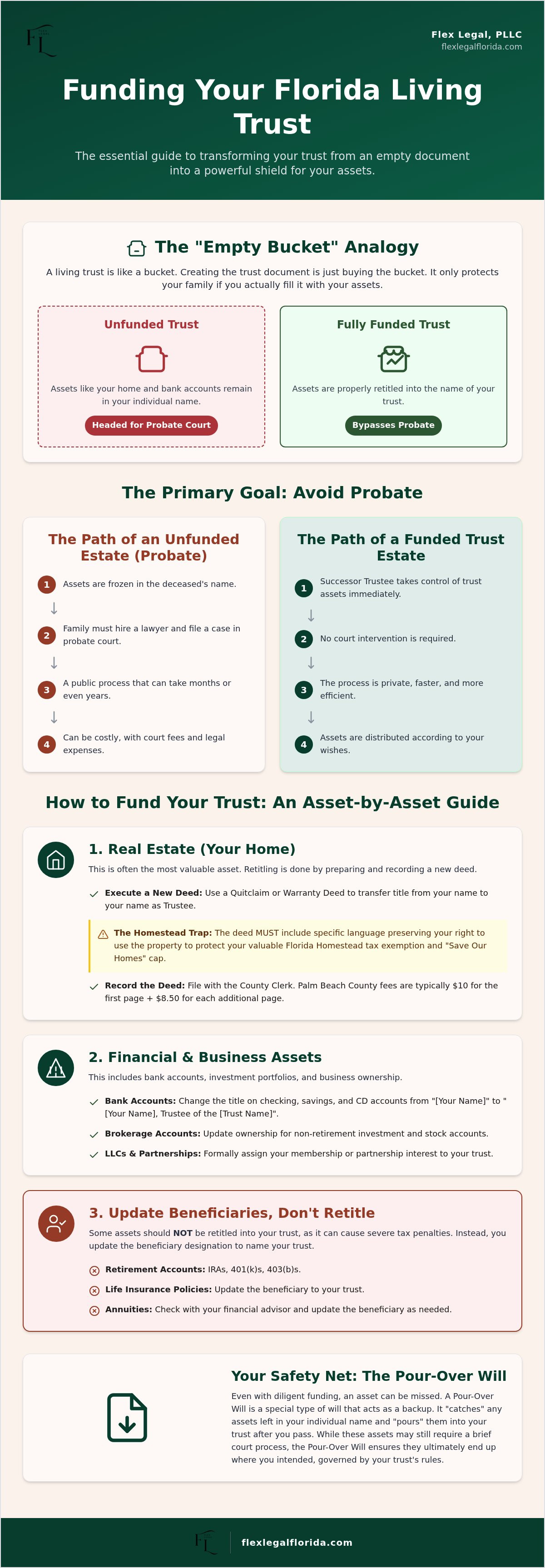
The 'Empty Bucket' Analogy
Think of your trust as a sturdy, high-tech bucket designed to carry your wealth safely to the next generation. Signing your trust documents is like buying the bucket. It's a great first step, but a bucket carries nothing if it's empty. Many people suffer from "funding fatigue" after the initial planning phase, assuming the job is done once the ink is dry. However, the signing ceremony is only the halfway point. To secure your West Palm Beach estate, you must manually place your "water", your house, bank accounts, and investments, into that bucket.
Probate Avoidance: The Primary Goal
The main reason you likely chose a revocable trust was to keep your affairs out of the public eye and away from court intervention. Titled assets like real estate and bank accounts are the primary triggers for probate. If an account is in your name alone when you pass, the bank cannot simply hand the keys to your heirs without a court order. Funding changes this dynamic. By retitling assets, you shift from "owning" them individually to "controlling" them as a trustee. This subtle shift is what allows for a seamless transition without a judge's permission.
Even with the best intentions, it's easy to forget a small savings account or a new investment. This is where the Pour-over Will acts as your secondary safety net. This specific type of Will "catches" any stray assets left in your individual name and "pours" them into your trust. While these forgotten items may still have to go through a brief court process, the Pour-over Will ensures they eventually reach the right destination according to your trust's rules. It's an essential backup, but it's no substitute for the efficiency of a fully funded trust.
Retitling Florida Real Estate and the Homestead Trap
Transferring real estate is the centerpiece of learning how to fund a living trust in florida. It's not enough to simply list your home in your trust document; you must execute and record a new deed to move the legal title. Most homeowners use a Quitclaim Deed or a Statutory Warranty Deed to shift ownership from their individual names to themselves as trustees. This process of transferring assets requires absolute precision to be effective. In Palm Beach County, the Clerk of the Circuit Court handles the recording. You should prepare to pay $10.00 for the first page and $8.50 for each additional page. Additionally, you must account for documentary stamp taxes, which are $0.70 per $100 of consideration for most Florida counties.
Moving your home isn't just about the paperwork. It's about avoiding the "Homestead Trap." Florida provides some of the strongest property tax protections in the country, but these benefits are fragile. One small drafting error can lead to a massive financial headache.
Protecting Your Florida Homestead Exemption
To maintain your Homestead exemption and the "Save Our Homes" assessment cap, your new deed must include specific language. This text must explicitly state that the settlor retains the right to use and occupy the residence for life. If this language is missing, the Property Appraiser may treat the transfer as a "change of ownership." This triggers a full reassessment of your home at current market value, which can cause your property taxes to skyrocket overnight. Once the deed is recorded, we recommend sending a copy to the local property appraiser's office. This proactive step ensures your tax benefits stay locked in place without interruption.
Lady Bird Deeds vs. Trust Funding
An Enhanced Life Estate Deed, commonly known as a "Lady Bird Deed," is a strategic alternative to traditional trust funding for some Florida residents. Unlike a standard deed, it allows you to retain total control over the property during your lifetime, including the right to sell or mortgage it, while naming a beneficiary to inherit it automatically at death.
Lady Bird Deed: This keeps the asset out of the trust during your life but avoids probate at death. It's often a streamlined choice for those with a single primary residence.
Trust Funding: This provides superior protection if you become incapacitated. A successor trustee can manage or sell the home for your benefit without the need for a guardianship proceeding.
Every estate is different. We look at your entire portfolio to determine which deed aligns with your broader goals and family dynamics. If you want to ensure your house stays protected without the traditional bureaucracy, Flex Legal can help you navigate these options with a modern, agile approach.
Transferring Financial Assets: Banks, Stocks, and LLCs
Retitling your financial portfolio is just as vital as recording a new deed for your home. While real estate is often the most visible asset, your liquid wealth and business interests are what keep your estate running. Understanding how to fund a living trust in florida for these assets involves moving beyond simple beneficiary designations to changing the actual ownership of the accounts. This funding a trust process ensures that if you become incapacitated, your successor trustee can step in immediately to pay bills and manage investments without a court order.
For most checking and savings accounts, you'll change the title from your individual name to your name "as Trustee" of your trust. Your bank will likely ask for a "Certificate of Trust." This condensed version of your estate plan proves the trust exists and identifies who has the power to act, all without revealing the private details of who inherits your money. It's a powerful tool for maintaining privacy while dealing with institutional red tape.
Navigating Bank Bureaucracy
When you visit your West Palm Beach bank branch, don't just ask to add the trust as a beneficiary. That's a "Pay on Death" (POD) designation, which only works when you pass away. To truly fund the trust, you must retitle the account so the trust owns it now. Bring your Certificate of Trust, your tax identification number (usually your Social Security number for revocable trusts), and your identification. If you have a safe deposit box, remember to retitle that as well. This ensures your trustee can access important documents or family heirlooms if you're unable to do so yourself.
Business Succession and Your Trust
If you own a Florida LLC or S-Corp, your business interests shouldn't be left to chance. You can move these into your trust bucket by drafting a document called an "Assignment of Interest." This formally transfers your membership or shares to the trust. You should also update your company's operating agreement to reflect the trust as the new member or owner. This step is a cornerstone for asset protection lawyers near me when they design a strategy to shield your West Palm Beach wealth from personal liabilities. It creates a seamless transition for your business, allowing it to continue operating without the friction of a probate stay.
Beneficiary Designations: What NOT to Fund
Funding isn't a universal rule for every asset you own. While we've discussed retitling homes and bank accounts, certain assets should never be "owned" by your trust during your lifetime. Retirement accounts, such as IRAs and 401(k)s, are the primary exceptions. If you try to change the owner of these accounts to your trust, the IRS will treat it as a full distribution of the entire balance. This mistake triggers an immediate and massive tax bill. Understanding how to fund a living trust in florida means knowing when to use a beneficiary designation instead of a title change.
The Retirement Account Tax Trap
Retirement accounts are tax-deferred vehicles tied to you as an individual. To keep the tax-advantaged status, you must remain the owner. Instead of retitling the account, you'll update the beneficiary forms provided by your custodian. Since the SECURE Act took effect, most non-spouse beneficiaries are now required to withdraw the full balance of an inherited IRA within 10 years. This makes the language inside your trust critical. If your beneficiaries include someone with a disability, you should work with a special needs planning attorney to ensure the trust is drafted as a "See-Through Trust." This protects their eligibility for government benefits while managing the mandatory 10-year payout.
Life Insurance and Annuities
Life insurance policies are handled similarly to retirement accounts. You don't usually retitle the policy itself; instead, you name the trust as the primary or contingent beneficiary. This strategy provides your successor trustee with immediate liquidity to pay for final expenses, debts, or estate taxes without waiting for probate. It's a clean, efficient way to get cash into the trust "bucket" the moment it's needed most.
You should also ensure your durable power of attorney specifically grants your agent the authority to update these beneficiary designations. If you become incapacitated and your plan needs a quick adjustment, this power prevents your family from being locked out of making necessary changes. Coordinating these designations is the final piece of the puzzle in how to fund a living trust in florida effectively. If you're ready to ensure your retirement and insurance assets are perfectly aligned with your trust, contact Flex Legal today to review your plan with a modern perspective.
Next Steps: Simplifying Your Funding with Flex Legal
Completing your trust documents is a significant milestone, but the security of your estate depends on the final follow-through. A "Funding Checklist" serves as your final review to ensure no asset is left behind in West Palm Beach. You should audit your bank accounts, brokerage statements, real estate deeds, and business interests to confirm every title reflects your trust's name. This proactive audit prevents the "empty bucket" syndrome we discussed earlier, ensuring your plan is fully operational from day one.
Many people find the paperwork involved in how to fund a living trust in florida to be the most tedious part of the process. This is where Flex Legal acts as your agile ally. We don't just hand you a stack of papers and wish you luck. We provide the streamlined support needed to handle the administrative retitling, from preparing new deeds to guiding you through bank requirements. Our goal is to remove the friction that often leads to funding fatigue, giving you the peace of mind that your family is truly protected.
Our flat-fee estate planning packages are designed to eliminate "billable hour" anxiety. You'll know exactly what you're paying upfront, allowing you to ask questions and seek guidance on asset transfers without watching the clock. Funding is also a dynamic process that evolves as your life changes. Whether you buy a new home in Palm Beach County or open a new investment account, your trust must be updated to reflect these changes. We recommend annual reviews to keep your funding status current and your asset protection strategy sharp.
The Flex Legal Advantage
We pride ourselves on modern, accessible communication that cuts through the stiffness often found in traditional professional services. Jennifer L. Flexer, Esq. provides personalized, peer-level guidance to ensure your trust bucket remains full and functional. We understand the unique needs of West Palm Beach families and business owners, offering a partnership-based approach that prioritizes your comfort and clarity over rigid legal jargon. We're here to make the complex simple and the transition smooth.
Start Your Estate Plan Today
If you're ready to move beyond "hollow" documents, you can schedule a consultation for trust creation or a comprehensive "funding audit" of your existing plan. To hit the ground running, bring a current list of your assets, including bank statements and copies of your current property deeds. This allows us to map out a clear, adaptable path forward for your estate. Schedule your West Palm Beach estate planning consultation with Flex Legal today.
Protect Your Future with a Fully Funded Trust
You've worked hard to build your assets; don't let a lack of follow-through leave them vulnerable to the probate court. Understanding how to fund a living trust in florida is the difference between a plan that looks good on paper and one that actually delivers results. By retitling your real estate correctly to preserve homestead benefits and updating your financial accounts, you ensure a seamless transition for your loved ones. Remember that retirement accounts and life insurance require a different strategy to avoid unnecessary tax hits and maintain your family's long-term security.
At Flex Legal, we believe estate planning should be straightforward and stress-free. Our West Palm Beach local expertise allows us to navigate complex deed transfers and bank requirements with a modern, client-first approach. We offer flat-fee pricing certainty so you can focus on your family's future instead of worrying about hourly bills. Secure your legacy with a flat-fee Florida living trust. Contact Flex Legal today. You've taken the first step by learning the process; now let's make your plan official.
Frequently Asked Questions
Do I need to get a new tax ID number (EIN) for my revocable living trust in Florida?
No, you generally don't need a new Employer Identification Number (EIN) for a standard revocable living trust while you're alive. You'll continue to use your Social Security number for tax reporting. This keeps your tax filings simple and avoids the need for a separate trust tax return. The trust only requires its own EIN after you pass away, at which point it becomes irrevocable and a separate taxable entity.
What happens if I forget to fund an asset into my trust before I pass away?
If you forget to fund an asset, that specific property will likely have to go through the Florida probate process. Your Pour-over Will acts as a safety net to eventually move the asset into the trust, but it won't skip the court's involvement. This leads to the very delays and costs you were trying to avoid. Regularly auditing your assets is the best way to ensure your West Palm Beach estate remains private.
Can I still sell my house if it is titled in the name of my living trust?
Yes, you retain full control over your property and can sell your house at any time. When a home is titled in your living trust, you simply sign the closing documents in your capacity as the Trustee rather than as an individual. This process is common in West Palm Beach real estate transactions and doesn't complicate the sale. Your ability to move, refinance, or sell your residence remains exactly the same as before.
Does funding my trust in Florida protect my assets from creditors or lawsuits?
Funding a revocable living trust doesn't provide asset protection from your own creditors during your lifetime. Because you maintain total control over the assets, Florida law views them as still belonging to you for debt purposes. If you're specifically seeking to shield wealth from lawsuits, you should discuss specialized asset protection planning with our team. We can explore more advanced structures that go beyond the basic probate avoidance of a standard revocable trust.
How much does it cost to record a deed for trust funding in Palm Beach County?
In Palm Beach County, the Clerk of the Circuit Court charges a recording fee of $10.00 for the first page of a deed and $8.50 for each additional page. You must also account for Florida's documentary stamp tax at $0.70 per $100 of consideration. Understanding these costs is a vital part of learning how to fund a living trust in florida without facing unexpected financial surprises during the retitling process.
Do I need to retitle my car into my Florida living trust?
Most residents don't need to retitle their everyday vehicles into their trust. The Florida HSMV provides a relatively simple process for heirs to transfer a car title after a death without full probate. However, if you own a high-value classic car or a significant fleet, retitling might be appropriate. For the average West Palm Beach family, the administrative effort of updating insurance and registrations often outweighs the benefits of including a standard vehicle.
Will funding my trust affect my mortgage or trigger a 'due on sale' clause?
Funding your trust won't trigger a "due on sale" clause for your primary residence. Federal law, specifically the Garn-St Germain Act, prevents lenders from calling a loan due when you transfer a residential property with fewer than five units into your revocable living trust. You don't need your lender's permission for this transfer, though it's often helpful to notify your insurance company to ensure your homeowner's policy correctly reflects the trust as an additional insured.
How often should I review my trust funding to ensure it is up to date?
You should review your trust funding at least once a year or whenever you experience a major life event. Acquiring a new home, opening a new investment account, or starting a business in West Palm Beach are all triggers to update your titles. Many families find that a quick annual audit is the best way to ensure they've mastered how to fund a living trust in florida, preventing any new assets from accidentally slipping into the probate estate.



Comments