
How to Handle Beneficiary Disputes in Florida: A Practical Guide

A beneficiary asks for an accounting, but the trustee doesn’t respond. Another family member says the will tells a different story. When an inheritance dispute begins, filing a lawsuit may not be the first step. Knowing how to handle beneficiary disputes in Florida starts with identifying the asset and document involved, then preserving the records that can help clarify what happened.
It can be frustrating to be unsure who has authority, which paperwork controls, or whether assets are being managed properly. The right next step depends on whether the dispute concerns probate assets, a trust, or a fiduciary’s actions. Each situation can involve different rules and timelines.
This guide explains how to identify common dispute types and the relevant decision-maker, organize documents and communications, and compare direct discussion, mediation, and court action. You’ll also learn when reviewing the governing documents and Florida law may help you choose a practical path forward.
Table of Contents
How beneficiary disputes in Florida begin, and why the asset matters
Uncertainty about an inheritance can put pressure on family relationships while raising practical questions about what happens next. A beneficiary dispute may concern who is entitled to an asset, how it is being administered, what a governing document means, or how property should be distributed. Before deciding how to handle beneficiary disputes in Florida, identify the specific asset involved. That can point you to the document and process that matter.
Probate-estate disputes concern property handled through a court-supervised estate administration, while trust-administration disputes concern assets held and managed under a trust. Some property may pass under a separate beneficiary designation rather than under a will. This can explain why assets connected to the same person follow different directions.
Is the dispute about probate, a trust, or a beneficiary designation?
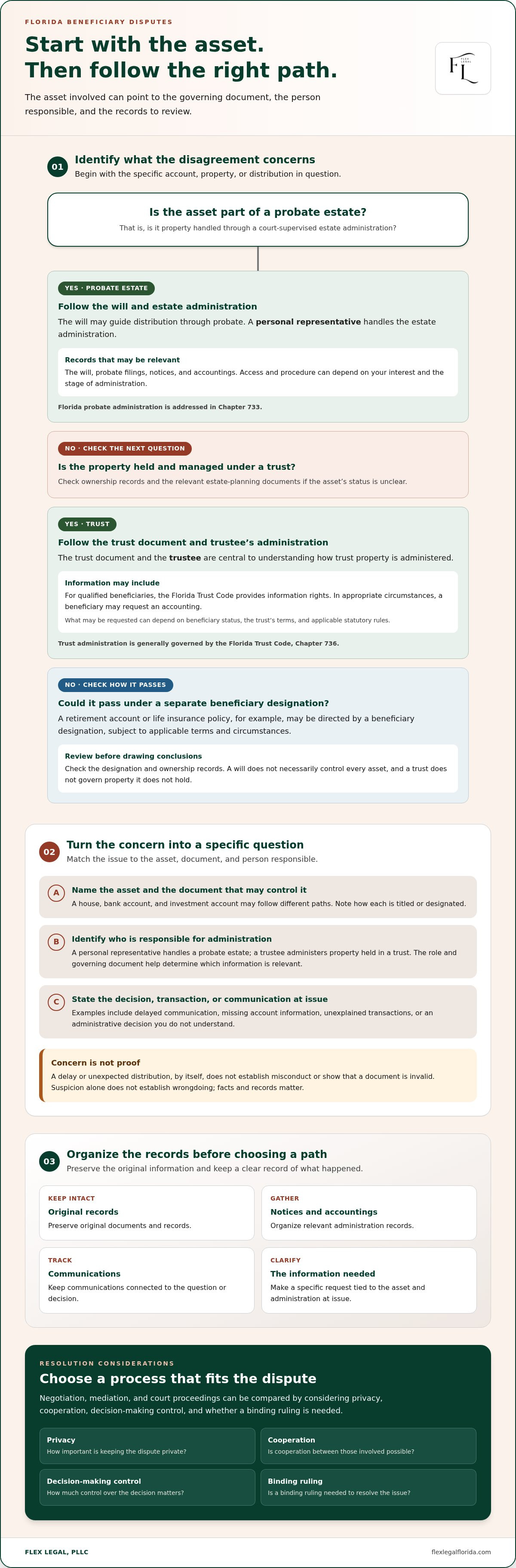
Start with the account, property, or distribution at the center of the disagreement. If an asset is part of the probate estate, the will may guide its distribution through probate. A personal representative handles the estate administration. If property is held in a trust, the trust document and the trustee’s administration are central. A retirement account or life insurance policy, for example, may instead be directed by a beneficiary designation, subject to the terms and circumstances that apply.
Make a short inventory of the disputed assets and note how each appears to be titled or designated. A house, bank account, and investment account may not all follow the same path. Don’t assume that a will controls every asset or that a trust governs property it does not hold. If an asset’s status is unclear, review ownership records and relevant estate-planning documents before drawing conclusions.
What commonly triggers a Florida beneficiary dispute?
Disagreements may arise when a will, trust, or beneficiary designation seems unclear, conflicts with another document, or appears to have changed unexpectedly. Family members may interpret a distribution differently, question whether a document reflects the person’s intentions, or disagree about decisions made during administration. The underlying issue might be a misunderstanding, incomplete information, or a concern that warrants closer review.
Administration can also become a source of tension. Beneficiaries may be concerned about delayed communication, missing account information, unexplained transactions, or decisions they don’t understand. In a trust matter, questions may focus on how the trustee is managing trust property or sharing information. In probate, concerns may relate to the personal representative’s handling of estate property or the progress of the administration. The person’s role and the governing document help determine which information is relevant.
Keep concern separate from proof. A delay or unexpected distribution doesn’t, by itself, establish misconduct or show that a document is invalid. Start with what you can identify: the asset, the document that may control it, the person responsible for administration, and the specific decision or communication at issue. This gives you a clearer basis for deciding which questions need answers and which resolution path may fit.
Which Florida rights and duties may shape a beneficiary dispute?
A beneficiary’s options depend on more than their name in a will or trust. The asset, governing document, administrator’s role, and applicable Florida law all matter. A personal representative handles a probate estate, while a trustee administers property held in a trust. Those roles carry different responsibilities and may involve different procedures.
The Florida Statutes Chapter 733 addresses probate administration, including the personal representative’s role. Trust administration is generally governed by the Florida Trust Code in Chapter 736. An asset that passes under a separate beneficiary designation may raise different questions. A person’s role in an estate or trust can shape their duties, but the role alone does not establish which remedy is available.
What information can a beneficiary seek?
Connect an information request to the asset and administration at issue. In a trust matter, the Florida Trust Code provides information rights for qualified beneficiaries. These can include receiving relevant trust information and, in appropriate circumstances, requesting an accounting. The scope may depend on the person’s status, the trust’s terms, and applicable statutory rules.
Probate is different. A beneficiary may need to review the will, filings, notices, or accountings relevant to the estate, but access and procedures can depend on the person’s interest and the stage of administration. Make a request specific: for example, ask for an accounting to help explain a distribution or for information about an estate transaction. Don’t assume every document is automatically available to every interested person. Governing law, exceptions, and notice requirements can affect what may be requested and when.
When can conduct or a document be challenged?
Disagreeing with a distribution doesn’t automatically mean there is a legal claim. A concern may be more actionable when it connects to an issue recognized by law, such as an unclear document requiring interpretation, a question about a document’s validity, a disputed administrative decision, or evidence that a fiduciary may not have met a duty. Facts and records matter. Suspicion alone doesn’t establish wrongdoing.
Standing and deadlines also shape whether a challenge can proceed. For example, Florida will-contest deadlines can be short: generally 90 days after receiving a Notice of Administration, or 20 days after receiving formal notice of a Petition for Administration before the will is admitted to probate. A challenge to the validity of a revocable trust generally has a six-month deadline after the trustee sends the trust instrument and notice of its existence. The applicable deadline depends on the facts and type of claim, so prompt legal review is prudent.
To understand how to handle beneficiary disputes in Florida, match the concern to the asset, the person responsible, and the potential legal issue before choosing a response. A review through probate and trust administration guidance can help clarify the documents and available options.
How to compare negotiation, mediation, and court action
The right path depends on what’s disputed, the urgency, the available records, and whether the people involved can participate constructively. A direct conversation may be a sensible first step when the disagreement is narrow and information can be shared. Mediation can add structure when communication has stalled. Court action may be considered when a legal issue remains unresolved or a formal ruling is needed. None of these options guarantees a particular result.
Use this comparison to weigh the practical differences:
When might direct discussion or mediation be useful?
Direct discussion may help when the parties can share information and the issue might be addressed with a practical compromise, such as clarifying a transaction or agreeing on a process for updates. Mediation brings in a neutral facilitator to guide discussion, but it doesn’t compel settlement. Offers made in mediation are generally protected from use as evidence under Florida law. Informal efforts also don’t automatically pause legal deadlines, so keep timing in mind.
When might a court proceeding be considered?
A court proceeding may be considered if the parties can’t resolve a question about document interpretation, contested entitlement, or an allegation about administration or fiduciary conduct. A court can decide legal issues presented through the proper process, but an allegation is not an established finding. The appropriate filing and procedure depend on the asset and claim. The Florida Courts’ E-Filing Procedures provide information about filing documents electronically.
Urgency can change the order of options. If property may be transferred, records may be lost, or a filing deadline is approaching, extended informal talks could affect available choices. Get legal guidance promptly to assess timing and whether protective action may be appropriate. When considering how to handle beneficiary disputes in Florida, weigh privacy, cooperation, and decision-making trade-offs against the specific issue rather than following a one-size-fits-all sequence. A review of probate dispute options can help clarify a path forward.
How to prepare before acting on a Florida beneficiary dispute
A clear record helps turn a stressful disagreement into specific questions that can be assessed. Before sending demands or making decisions about property, organize what you know and preserve the source material. This preparation can help you explain the concern accurately, spot missing information, and avoid steps that complicate the dispute. If you’re deciding how to handle beneficiary disputes in Florida, focus first on facts, documents, and timing.
Which records and details should you organize?
Use a simple sequence to build a useful file:
Identify the asset. Note the account, property, or distribution in question and who appears to administer it.
Locate relevant documents. Gather the will, trust instrument, beneficiary designation, notices, accountings, and correspondence related to the asset.
Record the concern. Write a neutral chronology of key events, decisions, requests, and responses. Include dates when you know them, and distinguish what you personally observed from what someone told you.
Preserve the originals. Keep original records unchanged. Save communications in their original form, retain attachments, and make a separate working copy if you need to annotate or organize materials.
Keep the file orderly, such as by grouping documents by asset or date. Avoid editing messages, marking up originals, deleting exchanges, or creating a version that could be mistaken for the source record. If a document is missing, note that it is missing rather than trying to reconstruct it as though it were original evidence.
How should you prepare for a legal review?
Before meeting with an attorney, write down the outcome you’re seeking, such as an explanation of a transaction, access to relevant information, or review of a proposed distribution. List unanswered questions and identify any notice you received or deadline stated in a document. Share the complete notice and its date, not just a summary, so timing can be assessed promptly.
Separate firsthand facts from assumptions, family accounts, or unverified suspicions. For example, distinguish “I received no accounting” from “the trustee is hiding assets” unless you have evidence supporting that conclusion. This keeps the review focused and helps identify what information may still be needed.
Until the facts and authority are clearer, avoid transferring or withdrawing disputed property, making threats, or posting accusations publicly. These actions may escalate conflict or create additional issues. Preserve records and communicate calmly and factually instead. A legal review can help assess the documents, the concern, and possible next steps without assuming misconduct or a particular outcome.
Schedule a Free Consultation to discuss the dispute and prepare for an informed review. The consultation is an opportunity to talk through your situation; later legal work is not necessarily free.
When Florida beneficiary disputes call for legal representation
Legal representation may be useful when a disagreement turns on how a will or trust should be read, whether an administrator’s decision is permitted, or what steps are available under Florida law. An attorney can review relevant documents, explain possible procedures, and help assess risks before you respond or escalate the dispute. That guidance can bring structure to a difficult situation, but it can’t guarantee a particular outcome.
What can a legal review help clarify?
A focused review can help identify which document or legal process governs the disputed asset, what information may be relevant, and whether a notice or deadline needs prompt attention. Counsel can also discuss possible responses, from a targeted request for information to negotiation, mediation, or litigation. The appropriate option depends on the facts, the issue being raised, and the relief available under the law.
This distinction matters because a concern about trust administration may call for a different analysis than a disagreement about a probate estate. Flex Legal provides probate representation and Trust Administration Assistance. These services can help address questions tied to estate administration or trust matters and assess whether formal legal steps may be appropriate. A review should distinguish documented facts from allegations and consider your goals alongside procedural risks.
How can West Palm Beach readers take the next step?
For a consultation, bring the documents most closely connected to the dispute and a concise chronology of what happened. Include relevant notices, accountings, communications, and any stated response date. You don’t need to resolve every question beforehand. A clear summary of the disputed asset, the decision or information you’re concerned about, and what you hope to clarify can make the discussion more focused.
West Palm Beach readers can also use topic-specific resources to prepare. If the matter involves estate administration, the Palm Beach County probate lawyer guide offers related context. If a trust document is central, the Florida revocable trust guide may help explain the planning framework. For a beneficiary with disability-related planning concerns, see the West Palm Beach special needs planning guide.
Local court procedures can depend on the type of matter and applicable process, so avoid relying on assumptions about county-specific filing steps. An informed review can connect the documents and concerns to the right next questions. Understanding how to handle beneficiary disputes in Florida is easier when you know what is being challenged and which options may fit your circumstances.
Book a Free Consultation to discuss the documents, concerns, and possible next steps.
Take a clear next step toward resolution
A beneficiary dispute can feel deeply personal, but your next move can be grounded in documents, facts, and a careful assessment of your options. Knowing how to handle beneficiary disputes in Florida doesn’t mean you need to resolve every issue on your own. It means recognizing when a focused legal review could help you move forward with greater clarity.
Flex Legal offers Florida-based probate representation and Trust Administration Assistance for people facing estate and trust concerns. Client testimonials describe personalized, diligent, and responsive service. A conversation can help you explain what’s happening, identify the questions that need attention, and consider a practical path forward without assuming a particular outcome.
Book a Free Consultation to discuss your beneficiary dispute and possible next steps. With clear guidance, you can approach a difficult family matter with more confidence and purpose.
Frequently Asked Questions
Can a beneficiary challenge a will in Florida?
Yes, an interested person may challenge a will on legally recognized grounds, such as improper signing, lack of testamentary capacity, undue influence, or fraud. Disappointment with a gift or an unequal distribution alone may not establish grounds to invalidate the will. The person bringing the challenge must have the required legal interest, and strict filing deadlines may apply. A prompt review of the will and probate notices can help clarify whether a challenge may be available.
Can a beneficiary dispute a trust distribution in Florida?
Yes, a beneficiary may raise a legal challenge if a distribution appears inconsistent with the trust’s terms or connected to a potential breach of duty. For example, a dispute might concern how a trustee interpreted a distribution standard or treated a beneficiary’s share. A beneficiary generally can’t demand a different result simply because it feels unfair if the trust directs otherwise. Reviewing the relevant clauses and administration records can help distinguish a legal issue from disagreement over the outcome.
Can a beneficiary challenge a payable-on-death or life insurance beneficiary designation?
Possibly, but the challenge depends on the designation, account or policy terms, and supporting facts. A claim might involve an allegation that the designation was forged, resulted from fraud or undue influence, or was made when the person lacked capacity. The financial institution or insurer may have procedures for reviewing competing claims, but that process doesn’t decide every legal dispute. Preserve designation forms and related communications, and get legal advice before assuming the will controls the proceeds.
Can a trustee withhold information from a beneficiary in Florida?
A trustee may not be able to withhold all trust information from a beneficiary who has statutory rights to receive it. Under Florida’s Trust Code, a qualified beneficiary may have rights to relevant information, a copy of the trust, or an accounting, subject to the person’s status and applicable rules. If a request is declined or unanswered, record what was requested and when. The trust’s terms, statutory exceptions, and notice history can affect what must be provided.
How long do I have to challenge a will or trust in Florida?
Deadlines vary by claim. A will challenge is generally due within 90 days after receiving a Notice of Administration; if formal notice of a Petition for Administration arrives before the will is admitted, the period may be 20 days. A challenge to a revocable trust’s validity is generally due within six months after the trustee sends the trust instrument and notice of its existence. Other trustee claims may have different limits, so get prompt legal review.
Is mediation required for beneficiary disputes in Florida?
No, mediation isn’t automatically required in every beneficiary dispute. A court may order mediation in a case before it, and parties may also agree to try it voluntarily. Mediation uses a neutral facilitator to help participants explore settlement, but the parties decide whether to agree. If no settlement is reached, the dispute may continue through other procedures. Don’t assume that participating in informal discussions changes a filing deadline or protects a claim.
Can a beneficiary remove a trustee in Florida?
A beneficiary may ask a court to remove a trustee, but removal isn’t automatic just because the beneficiary disagrees with a decision. A court may consider legally recognized grounds, such as serious breach of trust, unfitness, or failure to administer effectively. The trust’s terms, the trustee’s conduct, and the effect on beneficiaries can matter. Before seeking removal, document the specific conduct at issue and obtain legal advice about standing, evidence, and available remedies.



Comments