
How to Create a Revocable Living Trust in Florida: A 2026 Step-by-Step Guide
- Kelly Mata
- Jul 15
- 13 min read

Updated: 3 days ago
What if the very document meant to protect your Florida home actually triggers a tax nightmare you didn't see coming? Many homeowners worry that moving their property into a trust might accidentally forfeit their Homestead tax exemptions or lead to a costly reassessment. You deserve a plan that offers total peace of mind without the stress of confusing legal jargon or the fear of the Florida probate court's notorious delays. It's completely normal to feel cautious about how to create a revocable living trust in florida when the rules seem to be constantly shifting.
This guide provides the definitive roadmap you need to navigate Florida's unique trust laws with confidence in 2026. You'll learn how to leverage modern tools like Remote Online Notarization and the new 1,000-year trust lifespan to build a legacy that lasts. We'll walk you through the essential three-phase process of drafting, executing, and funding your trust. By following these steps, you can ensure your home is protected, your family is secure, and your estate stays out of the courtroom for good.
Table of Contents
What is a Florida Revocable Living Trust?
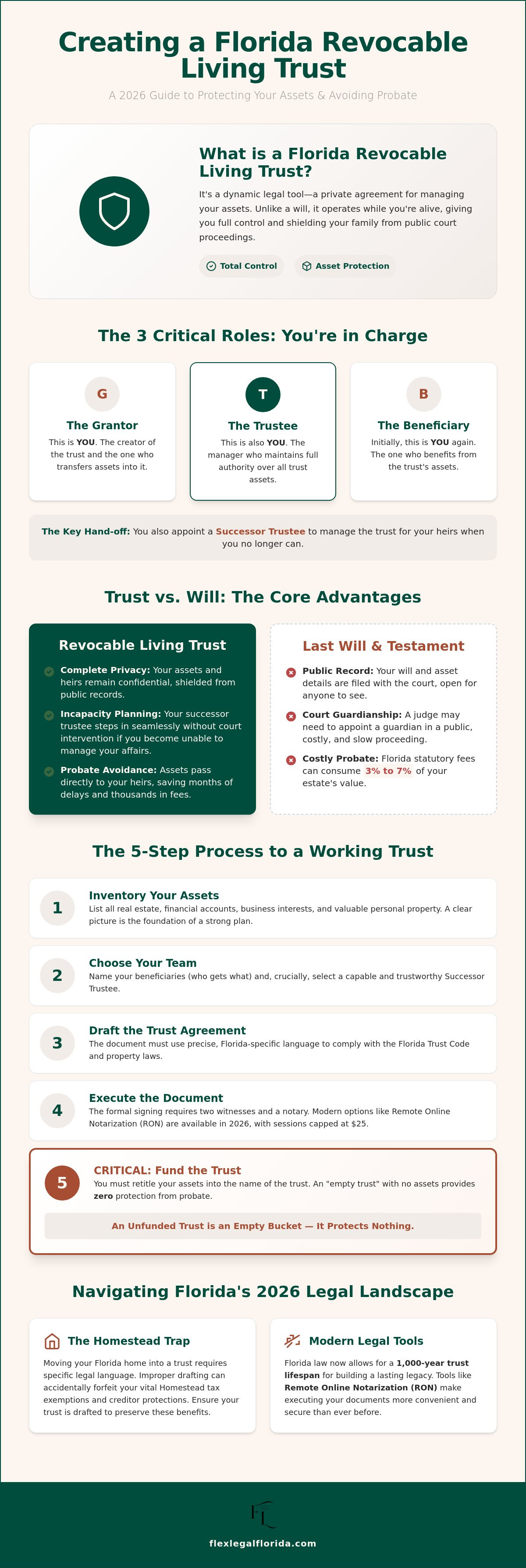
A Florida Revocable Living Trust is a dynamic legal document that acts as a private agreement for managing your assets. While the legal concept of a trust can date back centuries, modern Florida law has refined it into a powerful tool for flexibility and protection. Unlike a Last Will and Testament, which only takes effect after death and must pass through a court-supervised process, a trust operates while you're still alive. It's governed strictly by the Florida Trust Code, ensuring your intentions are legally binding and your family is shielded from unnecessary interference.
When you're researching how to create a revocable living trust in florida, it's vital to understand that "revocable" is the keyword for control. You can change, amend, or completely dissolve the trust at any time as long as you're mentally competent. This adaptability makes it a living extension of your financial life rather than a static set of rules. You retain the power to sell property, close accounts, or change your beneficiaries as your life evolves.
The Core Benefits for Florida Residents
Choosing a trust over a traditional Will offers three primary advantages that directly impact your family's stress levels and bank account. These benefits are especially relevant in our state's unique legal environment.
Privacy: In West Palm Beach and throughout Florida, a Will becomes a public record once it enters probate. Anyone can see what you owned and who inherited it. A trust remains entirely private, keeping your family's financial business behind closed doors.
Incapacity Planning: If a sudden illness leaves you unable to manage your finances, the trust provides a seamless transition. Your handpicked successor steps in without a judge needing to appoint a guardian through a public and costly court proceeding.
Probate Avoidance: Florida probate can be slow and expensive. Statutory fees for attorneys and executors often range from 3% to 7% of the estate's value. A properly funded trust bypasses this system entirely, saving your heirs months of waiting and thousands of dollars.
Grantor, Trustee, and Beneficiary: Who is Who?
To understand how to create a revocable living trust in florida, you must identify the three specific roles involved. In most cases, you'll initially wear all three hats yourself, which is why the transition feels so natural.
The Grantor: This is you. You're the person who creates the trust and transfers assets into it.
The Trustee: This is the manager. While you're alive and healthy, you serve as your own Trustee, maintaining full authority over your bank accounts and property.
The Beneficiary: This is the person who receives the benefits. Initially, that's you. After you pass, your heirs become the successor beneficiaries.
The real magic happens with the Successor Trustee. This is the person or institution you appoint to take over management when you can no longer do so. Under 2026 Florida law, the Successor Trustee holds a fiduciary duty to manage trust assets solely for the benefit of your heirs according to your specific instructions.
5 Steps to Creating Your Trust in Florida
Creating a solid estate plan isn't a one-time event; it's a series of intentional moves. When you're ready to learn how to create a revocable living trust in florida, you'll find that the process is logical but demands precision. You don't want to leave your family's future to chance by skipping a step or using an outdated template. Follow this sequence to build a trust that actually works.
Step 1: Inventory your assets. List your Florida real estate, financial accounts, and business interests. Don't forget tangible personal property like jewelry or collections.
Step 2: Choose your team. You'll need to name your beneficiaries and select a Successor Trustee who can manage things when you can't.
Step 3: Draft the agreement. Your document must use Florida-specific language to comply with the Florida Trust Code. It should also address our state's unique property laws to ensure full protection.
Step 4: Execute the document. This is the formal signing process. In Florida, this requires two witnesses and a notary. Standard in-person notary fees are $10, while Remote Online Notarization (RON) sessions in 2026 are capped at $25.
Step 5: Fund the trust. You must retitle your assets into the name of the trust. This is the most critical part of how to create a revocable living trust in florida because an empty trust provides no protection from probate.
Florida Execution Requirements: Doing it Right
The "execution ceremony" is where many DIY plans fail. Florida law requires the Grantor to sign the trust in the presence of two witnesses and a notary public. All parties must sign in each other's presence to meet the legal standards. If you're using Remote Online Notarization, the digital formalities must be followed perfectly to be valid. The Florida Bar's guide to revocable trusts offers a deep dive into these statutory requirements for those who want to see the fine print.
Choosing the Right Successor Trustee
Your Successor Trustee manages your affairs if you become incapacitated or pass away. You can choose a trusted individual or a corporate trustee for professional management. In Florida, residency matters less than financial literacy and reliability. An estate planning attorney in West Palm Beach can help you weigh these options based on your asset mix. Finding modern estate planning support makes this decision much easier and ensures your legacy is in the right hands.
Funding Your Trust: Why an Empty Trust Fails
Think of your trust as a high-tech vault designed to protect your most valuable possessions. If you build the vault but leave your gold sitting on the front porch, the vault serves no purpose. This is the reality of an "unfunded" trust. When you're learning how to create a revocable living trust in florida, signing the document is only the first half of the process. The second, and arguably more critical phase, is moving your assets into the trust's name. Without this step, your estate will likely head straight to probate court despite your best intentions.
A common safety net used in this process is a Pour-Over Will. It's a standard part of a modern estate plan that catches any assets you forgot to retitle and "pours" them into your trust after you pass. However, there's a catch. Assets caught by a Pour-Over Will must still go through the formal probate process before they can reach the trust. To avoid the 3% to 7% statutory fees and months of delay, you must proactively fund the trust while you're healthy and able. This process is governed by the Florida Trust Code, which sets the standards for how assets should be managed and transferred.
Most of your wealth should live inside the trust "bucket," including:
Florida real estate and vacation homes.
Non-retirement brokerage accounts and certificates of deposit.
Ownership interests in closely held businesses or LLCs.
Personal property with high value or sentimental importance.
Conversely, certain assets usually stay outside the trust for tax reasons. Moving an IRA, 401k, or HSA into a trust can trigger immediate and heavy income tax penalties. For these accounts, you'll use beneficiary designations instead of retitling.
Retitling Florida Real Estate
Transferring your home is a formal process that requires recording a new deed with the county. In Palm Beach County, the standard recording fee is $10 for the first page and $8.50 for each additional page. You'll also need to account for the Florida Documentary Stamp Tax, which is generally $0.70 per $100 of consideration. A Quitclaim or Warranty Deed serves as the legal vehicle that moves your property's title from your individual name into the name of your trust. It's vital to title the property correctly, typically as "The [Your Name] Revocable Trust," to ensure the chain of title remains unbroken.
Updating Beneficiary Designations
Your trust should act as the central hub for your financial life. This means coordinating your life insurance policies and "Payable on Death" (POD) bank accounts so they don't conflict with your trust's instructions. If your bank account lists a sibling as a beneficiary but your trust says everything goes to your children, the bank's designation usually wins, creating an accidental inheritance gap. For a deeper look at these technical moves, check out our revocable trust guide to ensure your funding strategy is airtight. Mastering how to create a revocable living trust in florida means ensuring every piece of your financial puzzle fits together perfectly.
The Florida Homestead Trap: Trusts and Your Primary Residence
Florida's Homestead laws are a double-edged sword. On one side, they offer world-class asset protection and significant property tax savings. On the other, they contain complex restrictions that can derail your entire estate plan if you're not careful. When you are determining how to create a revocable living trust in florida, your primary residence requires a specialized approach to avoid what experts call the Homestead Trap.
The trap occurs because the Florida Constitution limits your ability to "devise" or give away your home if you're survived by a spouse or minor children. If your trust document attempts to distribute the home in a way that violates these constitutional rules, that specific provision becomes void. Your home will then be forced into the very probate process you were trying to avoid. This creates a messy legal knot where the property might be split between a surviving spouse and children in a way you never intended. It's a common point of confusion that often requires an agile legal strategy to resolve before the documents are even signed.
While a Revocable Living Trust is the standard choice for most, some families consider a Land Trust for specific privacy needs. However, for most West Palm Beach homeowners, a properly structured revocable trust remains the most effective tool for avoiding probate while keeping homestead rights intact. The key is ensuring the trust language respects Florida's unique restrictions on the descent and devise of homestead property.
While focusing on your personal estate, it is also important to consider the management of your community; for example, My Florida HOA Manager offers specialized budget services that help Florida associations maintain the financial stability necessary to protect property values.
Preserving the Homestead Tax Exemption
Transferring your home to a trust doesn't have to mean losing your tax breaks. To keep your exemption, the Palm Beach County Property Appraiser requires specific evidence that you've retained the equitable title to the property. Your trust must include specific "Right to Occupy" language. This clause explicitly states that you have the right to reside on the property for life. This language is what allows you to maintain your Save Our Homes cap, which prevents your assessed value from rising more than 3% annually. Without these exact phrases, you risk a tax reassessment that could significantly increase your annual carrying costs.
Creditor Protection Nuances
It's a common misconception that a trust is an invisible shield against all debt. Because you maintain 100% control, a revocable trust does not shield assets from your own creditors during your lifetime. If you're in a high-risk profession and need more robust barriers, consulting with asset protection lawyers near me can help you explore more complex, irrevocable options.
The good news is that your homestead's natural protection remains. In Florida, the constitutional protection against most forced sales by creditors follows the property into the trust. As long as the trust is drafted correctly, your home remains your castle. To ensure your residence is titled correctly without losing these vital protections, you can request a deed review to confirm your trust is properly funded and compliant with the latest 2026 regulations.
Implementation: Why Professional Guidance Matters in 2026
Estate planning has evolved beyond the rigid, one-size-fits-all models of the past. Modern families in Florida now demand agility and clarity in their legal support. When you're deciding how to create a revocable living trust in florida, the partner you choose to guide you is just as important as the document itself. You need an ally who understands that your life is dynamic. At Flex Legal, PLLC, we've replaced the intimidating atmosphere of traditional law firms with an approachable, solution-oriented style that prioritizes your comfort and peace of mind.
Transparency is a core value of our partnership. This is why we utilize a flat-fee model for our services. You deserve to know exactly what your investment is without the stress of billable hours or hidden costs. This certainty allows us to focus entirely on the quality of your plan and the specific nuances of Palm Beach County probate law. Our goal is to provide a streamlined experience that moves you from uncertainty to a clear, adaptable path forward.
Avoiding the DIY Pitfalls
The "cheap" templates found online often carry hidden costs that don't appear until it's too late. A single error in execution or a failure to account for Florida's strict homestead rules can trigger expensive probate litigation or massive tax errors. Professional drafting ensures your trust is built to handle future life changes like births, deaths, or divorces without falling apart. We also emphasize the importance of a Durable Power of Attorney as a vital companion to your trust. This ensures that if you're ever unable to make decisions, your handpicked representative has the immediate legal authority to act on your behalf.
Your Next Steps for Peace of Mind
Securing your family's future shouldn't feel like a burden. To prepare for your initial consultation, start by gathering a general list of your assets and thinking about who you trust most to manage them. We'll handle the complex technical nuances of how to create a revocable living trust in florida so you can focus on what matters most. There is a profound sense of relief that comes from knowing your home is protected and your legacy is legally sound. When you're ready to move forward, we're here to act as your expert peer and guide. Secure your legacy with a West Palm Beach estate planning ally.
Secure Your Family’s Future Today
You now have a clear understanding of how to create a revocable living trust in florida. It's about more than just signing a piece of paper. It's a three-phase process that requires careful drafting, strict execution, and diligent funding. By avoiding the common homestead trap and ensuring your assets are properly retitled, you've taken the biggest step toward protecting your heirs from the delays and costs of probate.
You don't have to handle these technical details alone. Flex Legal, PLLC provides the modern, empathetic support you need to navigate these decisions with confidence. Our West Palm Beach local expertise ensures your plan respects Florida's unique statutes while our flat-fee pricing transparency removes the guesswork from your legal costs. We act as your agile ally, turning complex legal jargon into a streamlined roadmap for your legacy.
Schedule a flat-fee estate planning consultation with Flex Legal, PLLC today. Your peace of mind is worth the investment. Let's build a plan that adapts to your life and secures your family's future for generations to come.
Frequently Asked Questions
Does a revocable living trust avoid all taxes in Florida?
A revocable trust does not eliminate your tax obligations. Because you maintain full control over the assets, the IRS treats the trust's income as your personal income. Florida doesn't have a state income or estate tax, so your main focus is federal law. In 2026, the federal estate tax exemption is $15 million per individual, meaning most families won't owe federal estate taxes unless their assets exceed that threshold.
Can I be my own trustee for a Florida revocable trust?
You can absolutely serve as your own trustee. Most people act as the Grantor, Trustee, and primary Beneficiary simultaneously while they're healthy. This arrangement ensures you keep total authority over your property while you're learning how to create a revocable living trust in florida. You only need a Successor Trustee to step in if you become incapacitated or pass away.
How much does it cost to create a revocable living trust in Florida in 2026?
The cost depends on the complexity of your estate and your specific family goals. We prioritize transparency by using a flat-fee model, which eliminates the stress of unpredictable hourly billing. This approach allows you to know your total investment upfront while ensuring your plan is professionally tailored to your needs. You'll receive a clear roadmap without any hidden financial surprises.
Do I still need a Will if I have a revocable living trust?
You still need a specific type of Will called a Pour-Over Will. This document serves as a vital safety net for any assets you might forget to retitle into the trust's name during your lifetime. It directs those stray assets to "pour" into your trust after you pass. While these specific items may still face probate, the Will ensures they eventually reach your intended beneficiaries. For those who need help with these essential documents, Aiker Wills and Trusts offers dedicated legal document preparation for single and mirror wills to ensure your estate plan is complete.
Can I change my trust after it is signed and notarized?
You have the power to change your trust at any time. The "revocable" nature of the document means you can amend specific sections or restate the entire agreement as your life evolves. This flexibility is a key benefit of how to create a revocable living trust in florida, as it allows your estate plan to adapt to new marriages, births, or changes in your financial landscape.
What happens to my Florida Homestead exemption if I put my house in a trust?
Your Homestead exemption and Save Our Homes cap stay intact as long as the trust is drafted correctly. Florida law requires specific "right to occupy" language to ensure the Property Appraiser continues to recognize your tax benefits. Without these precise clauses, you could accidentally trigger a tax reassessment. A properly structured trust preserves your primary residence's unique protections and tax savings.
How long does it take to set up a trust in West Palm Beach?
The process typically takes between two and four weeks from your initial strategy session to the final signing. This timeline gives us enough room to inventory your assets, select your successor trustees, and draft the custom language required by Florida law. The speed of the process often depends on how quickly you can provide your financial details and make key decisions about your beneficiaries.
Is a trust from another state valid in Florida?
Florida generally recognizes trusts that were validly created in another state. However, moving here means your plan should be reviewed by a local expert to ensure it complies with our state's specific 2026 regulations. Florida's unique Homestead laws and probate rules often require specific amendments. Updating your out-of-state documents ensures they function as intended and provide the maximum protection under Florida's legal system.


Comments