
How to Avoid Probate in Florida with a Trust: The 2026 Guide
- Kelly Mata
- May 22
- 13 min read

Did you know that 94% of Florida's probate cases are completely uncontested, yet families still wait months for a judge to release their inheritance? It's a heavy burden for heirs to carry, especially when they're already dealing with a loss. You likely worry about your assets being frozen in a backlogged court system or your private family details becoming a matter of public record. Understanding how to avoid probate in Florida with a trust is the most effective way to bypass these hurdles and lower the total legal costs your family will face.
A trust acts as an agile ally for your estate, but it isn't a "set it and forget it" document. With Florida's probate filings increasing by nearly 23% in recent years, a proactive strategy is more important than ever. This 2026 guide explains how to use a revocable living trust to ensure the immediate transfer of your property while navigating new rules like the $150,000 summary administration threshold. You'll learn exactly how to fund your trust so your house and bank accounts stay out of court and remain exactly where they belong; with your family.
Key Takeaways
Understand the hidden costs of statutory attorney fees and why court-supervised distribution often leads to unnecessary delays for your heirs.
Discover how to avoid probate in Florida with a trust by using a legal vessel that transfers assets immediately without a judge's signature.
Compare the comprehensive protection of a Revocable Living Trust against a Lady Bird Deed to choose the right strategy for your family home.
Identify why the funding phase is the most critical step in estate planning and how to prevent your trust from becoming an empty, ineffective document.
Learn how modern, adaptable planning ensures your estate remains private and protected as Florida’s legal requirements continue to evolve.
Table of Contents
Understanding the Florida Probate "Trap" in 2026
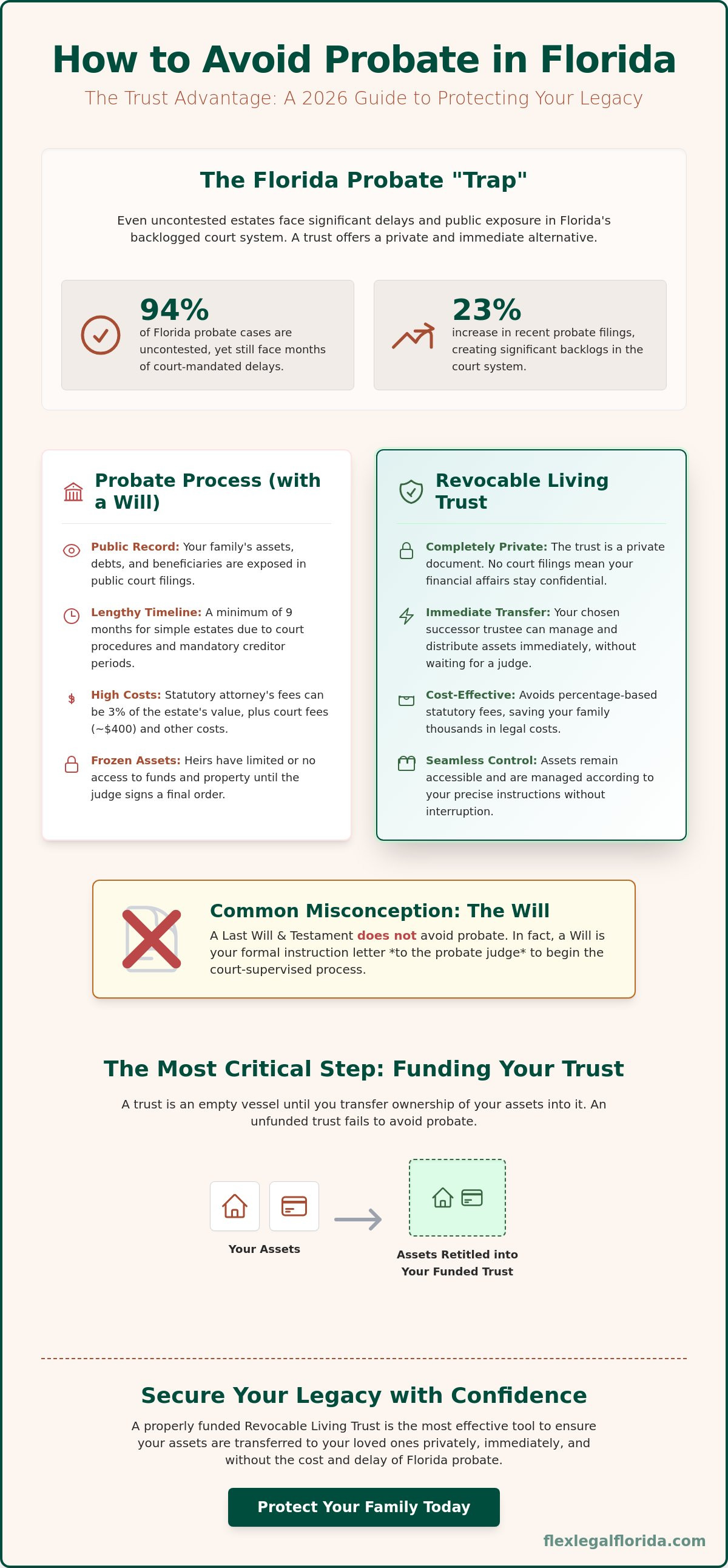
Florida probate is the court-supervised process of identifying a deceased person's assets, paying their debts, and distributing what remains to their heirs. While it sounds like a standard administrative task, it often functions more like a trap for the unprepared. In 2026, the Florida court system continues to face a significant backlog. With probate filings having increased by nearly 23% in recent years, even "uncontested" cases frequently stall. Learning how to avoid probate in Florida with a trust is more than just a legal choice; it's a strategic move to protect your family’s privacy and peace of mind.
When an estate enters probate in West Palm Beach, it becomes a matter of public record. This means anyone can access the inventory of your assets, the names of your beneficiaries, and the specific value of your legacy. This lack of privacy is a major concern for families who value discretion. Beyond the privacy issue, the timeline is a harsh reality. Most "simple" Florida estates stay stuck in court for at least nine months. During this time, your loved ones may have limited access to the funds they need for daily expenses or property maintenance. These structures are rooted in U.S. Trust Law Fundamentals, which allow assets to bypass the court's jurisdiction entirely when planned correctly.
Why a Last Will and Testament Does Not Avoid Probate
A common misconception is that having a Will keeps you out of court. It doesn't. In fact, a Will is essentially a formal letter to a judge requesting that they oversee the distribution of your property. The court must first validate the Will through a process called "proving" before your personal representative can move any assets. Because the Will only gains power after a judge signs an order, it cannot bypass the probate requirement. This is the primary reason families look for how to avoid probate in Florida with a trust before a crisis occurs.
The Financial Impact on Florida Families
The financial burden of probate is often higher than families expect. Florida Statute 733.6171 outlines statutory attorney's fees that are considered "reasonable" based on the estate's value. For an estate valued between $100,000 and $1 million, the law suggests a fee of 3% of the estate's value. This doesn't include court filing fees, which currently sit around $400, or other administrative costs. Additionally, Florida law requires a 90-day creditor claim period. This mandatory window prevents the final distribution of assets until potential creditors have had three months to come forward. This delay, combined with frozen assets, can create a significant financial strain on heirs who are already grieving.
How a Revocable Living Trust Bypasses the Court Room
Think of a Revocable Living Trust as a sophisticated legal vessel. By placing your home, bank accounts, and investments inside this vessel, you technically no longer own them in your individual name. Instead, the trust owns them. Because the trust does not "die" when you do, the assets held within it don't need a judge's permission to move to the next generation. This is the fundamental secret of how to avoid probate in Florida with a trust. It effectively removes your property from the court's jurisdiction before the probate process even has a chance to begin.
The legal backbone for this strategy is Chapter 736 of the Florida Statutes. This body of law ensures that your trust is recognized as a valid entity capable of holding title to property. The term "revocable" is vital for adaptability. It means you aren't locked into a rigid plan. You can add or remove assets, change your beneficiaries, or even dissolve the trust entirely if your life circumstances shift. This Revocable Living Trusts explained approach provides a modern alternative to the slow, public nature of traditional estate settlement. If you are curious about how this fits your specific family dynamic, exploring Revocable Living Trusts can help clarify your path forward.
The Mechanics of Asset Transfer
When you pass away, a trust offers immediate continuity. In a probate scenario, your heirs must wait for the court to issue "Letters of Administration," which can take weeks or months. With a trust, the transition is seamless. Your instructions are already written into the document, and the management of the vessel simply passes to the person you've already chosen. This process is entirely private. There are no public court filings, no published inventories of your wealth, and no long lines at the courthouse. It is a streamlined, efficient way to ensure your family has what they need without delay.
Trustee vs. Beneficiary: Who Does What?
Understanding the roles within your trust is essential for long-term success. You typically start as the Grantor (the creator) and the initial Trustee (the manager). You maintain total control. You also name a Successor Trustee, an agile ally who steps in only if you become incapacitated or pass away. This person has a fiduciary duty to act in the best interest of your Beneficiaries, the people who will ultimately receive the assets. Choosing a Successor Trustee in West Palm Beach requires selecting someone you trust to follow your roadmap with precision and integrity. This structure ensures your legacy is handled with care, far away from the friction of a courtroom.
Trust vs. Lady Bird Deed: Choosing the Right Strategy
Choosing between a Lady Bird Deed and a Revocable Living Trust often comes down to the complexity of your financial footprint. A Lady Bird Deed, formally known as an Enhanced Life Estate Deed, is a popular tool in Florida because it allows you to retain total control over your home during your lifetime while naming a beneficiary to inherit it automatically upon your death. It's a targeted solution for real estate, but it lacks the comprehensive reach of a full estate plan. While it solves the problem for a single house, it leaves other assets like bank accounts and personal property vulnerable to the court system.
One specific hurdle many overlook is the "Florida Homestead Trap." Florida’s Constitution provides unique protections for your primary residence, but these same rules can complicate how to avoid probate in Florida with a trust. If your trust is not drafted with specific homestead language, you could inadvertently jeopardize your property tax exemptions or run afoul of laws regarding how a home must be left to a spouse or minor children. Understanding the nuances of the Florida Probate Process is vital to ensuring your home stays protected and out of court. A trust needs to be an agile document that accounts for these regional legal quirks to be truly effective.
When a Lady Bird Deed is Enough
A Lady Bird Deed is often an efficient choice for those whose primary goal is simply passing their home to a single adult heir. It's generally a straightforward way to handle a single-asset estate. However, it is a rigid tool. If your named beneficiary passes away before you, the deed doesn't provide a built-in backup, potentially sending the home right back into probate. It also offers no protection if you become incapacitated, as it only triggers at death. For families with more than just a primary residence, a deed is often just one small piece of a much larger puzzle.
The Power of the Revocable Living Trust
A trust offers the level of adaptability that a deed simply cannot match. It serves as an all-in-one vessel for your entire estate, including out-of-state properties and complex financial portfolios. For families with diverse assets, learning how to avoid probate in Florida with a trust provides a much higher degree of certainty than a simple deed. Most importantly, a trust allows you to manage how minor children receive their inheritance, ensuring funds are used for their education and care rather than being handed over in a lump sum. For a deeper look at these benefits, see our Revocable Trust Guide: Protecting Your West Palm Beach Estate. This modern approach ensures every piece of your legacy is covered under one cohesive, private plan.
The Funding Phase: Why Most Trusts Fail to Avoid Probate
A trust is a powerful legal engine, but it won't go anywhere without fuel. In the legal world, this fuel is called "funding." Many families go through the effort of drafting documents only to fall into the "Empty Vessel" trap. If you don't formally transfer your property into the trust's name, the court still views those assets as yours individually. This oversight is the single most common reason people fail when trying to figure out how to avoid probate in Florida with a trust. Without proper funding, your heirs will still find themselves standing before a judge in West Palm Beach to settle your estate.
You might have a "Pour-Over Will" as part of your estate plan. While this is a vital safety net, it's not a probate bypass. A Pour-Over Will essentially tells the court, "If I forgot to put something in my trust, please put it there now." The catch is that the court has to get involved to make that happen. The asset still goes through the full probate process before it "pours over" into the trust vessel. To truly bypass the courtroom, you must audit your assets now and ensure they are titled correctly. This ensures your legacy remains private and accessible to your family immediately.
How to Transfer Assets to Your Florida Trust
Re-titling your life's work requires a methodical approach. It isn't enough to just list assets on a schedule at the back of your trust document. You must take active steps to change ownership of each individual asset:
Real Estate: You must record a new Quitclaim or Warranty Deed to move your Florida property from your individual name to the name of the trust.
Bank Accounts: Visit your local branch to update account ownership or set the trust as the primary "Payable on Death" beneficiary.
Personal Property: Use a formal "Assignment of Interest" to transfer your ownership in an LLC, corporation, or valuable personal collections into the trust.
For a deeper dive into these specific steps, read our guide on How to Fund a Living Trust in Florida.
Ongoing Maintenance of Your Estate Plan
Estate planning is a dynamic process, not a one-time event. As you buy new property or open new investment accounts, you must ensure they are titled in the name of your trust from day one. This agile approach prevents "probate leaks" where small assets accumulate outside the trust over time. Periodic reviews are essential to keep your plan aligned with your current life and any legislative updates. If you're ready to ensure your vessel is fully fueled and ready for the future, we can help you with comprehensive Trust Administration services to keep your plan on track.
Securing Your Legacy with Flex Legal, PLLC
At Flex Legal, PLLC, we believe estate planning should be a dynamic support system rather than a static set of rules. Traditional legal services often feel distant or rigid, but we take a different path. We act as an agile ally for West Palm Beach families, providing modern solutions that prioritize clarity and comfort. Understanding how to avoid probate in Florida with a trust is only the first step in a larger journey. Our firm handles the heavy lifting of drafting these instruments and providing the specific funding guidance needed to ensure your assets stay out of the public court system. We focus on results that matter, ensuring your family bypasses the delays and statutory fees discussed earlier while maintaining their total privacy.
Our partnership-based approach removes the friction from the planning process. We offer a modern, flat-fee structure for standard estate plans. This transparency means you won't face unexpected hourly surprises as we build your plan together. You receive direct access to attorney Jennifer L. Flexer to develop a personalized strategy that fits your unique family dynamic. We don't just hand you a stack of papers and send you on your way. We provide a clear, adaptable path forward that includes the critical funding steps required to keep your vessel fueled. Flex Legal, PLLC is a responsive alternative to the slower, traditional models that often leave families feeling confused or underserved.
Our Partnership-Based Approach
We see ourselves as more than just a service provider; we are your teammates in securing your future. By choosing a partnership-based model, we ensure that your revocable living trusts are built to handle the complexities of modern life. We avoid the dense, multi-clausal jargon that defines traditional law firms. Instead, we use straightforward declarations of value and active verbs to explain your options. This approach creates a flow that feels both efficient and thorough, mirroring our promise of streamlined and effective support for every client we serve.
Next Steps for West Palm Beach Residents
The 2026 Estate Audit is a perfect starting point for residents who aren't sure if their current plan is still effective. Legislative changes, such as the new summary administration thresholds or updated tax exemptions, can quickly make old documents obsolete. Your estate plan should evolve alongside your life and the law. If you are currently dealing with an estate that didn't have these protections in place, we also offer expert guidance as a Probate Lawyer in Palm Beach County. Scheduling your initial consultation is the most effective way to discuss how to avoid probate in Florida with a trust and secure your legacy for the next generation. We are ready to help you move from anxiety to action with a plan built for the modern world.
Take Control of Your Legacy Today
You now have the roadmap to protect your estate from the public court system and its associated delays. We've explored how a trust acts as a private vessel for your wealth and why the funding phase is the single most important step for long-term success. By taking these proactive steps, you ensure your loved ones aren't left waiting on a judge or paying unnecessary statutory fees. Learning how to avoid probate in Florida with a trust is about more than just paperwork; it’s about providing your family with immediate access and total peace of mind.
At Flex Legal, PLLC, we focus on the modern, adaptable solutions that West Palm Beach families need in 2026. We offer the local expertise and transparent pricing required to build a legacy that lasts. Secure your family’s future with a flat-fee Florida trust at Flex Legal, PLLC. Our team is ready to act as your agile ally, helping you transition from the anxiety of the unknown to the confidence of a plan that works. You've spent a lifetime building your estate; let's make sure it stays exactly where it belongs.
Frequently Asked Questions
Does a revocable living trust protect assets from creditors in Florida?
Generally, a revocable living trust does not provide asset protection from your own creditors while you're alive. Because you maintain total control and can revoke the trust at any time, Florida law views these assets as part of your personal estate. However, the trust can include specific provisions to protect the inheritance you leave for your beneficiaries after you pass away.
How much does it cost to set up a trust to avoid probate in Florida?
The investment for a comprehensive estate plan varies based on the size of your estate and the complexity of your family's needs. Many modern firms prefer transparent, flat-fee models over hourly billing so you know exactly what to expect. This approach ensures you receive a customized plan for how to avoid probate in Florida with a trust without the stress of unpredictable legal bills.
Can I be my own trustee for a revocable living trust?
Yes, you can and usually should serve as your own trustee. This allows you to maintain full control over your bank accounts, real estate, and investments just as you did before the trust was created. You'll name a successor trustee to step in only if you become incapacitated or pass away, ensuring a smooth transition without court intervention.
What happens if I forget to put an asset into my trust?
If an asset isn't titled in the name of the trust, it will likely require a probate proceeding to be transferred to your heirs. While a Pour-Over Will acts as a safety net to catch these items, they must still pass through court before reaching the trust. This highlights why the funding phase is the most critical part of an agile estate plan.
Do I still need a Will if I have a revocable living trust?
Yes, you still need a specific type of Will called a Pour-Over Will. It serves as a backup to ensure any assets left outside your trust are eventually moved into it through the court process. While the trust handles the private distribution of most property, the Will is an essential piece of a complete and responsive plan.
How long does it take to set up a trust in West Palm Beach?
The timeline for creating a trust in West Palm Beach typically ranges from a few weeks to a month. This period includes your initial consultation, the drafting of your custom documents, and the formal signing ceremony. The speed often depends on how quickly you can gather your financial details and choose your successor trustees.
Can a trust hold my Florida Homestead property?
A trust can absolutely hold your Florida Homestead property. It's vital to use specific language in the trust document to ensure you don't lose your property tax exemptions or constitutional creditor protections. When done correctly, this is a central strategy for how to avoid probate in Florida with a trust while keeping your primary residence safe.
Is a trust from another state valid to avoid probate in Florida?
Florida generally recognizes trusts that were validly created in other states according to those states' laws. However, it's highly recommended to have a local expert review it. Florida has very specific rules regarding homestead property and spousal inheritance that an out-of-state document might not address, which could lead to unexpected friction later.


Comments