
Florida Probate for Small Estates: Which Process Fits Your Situation

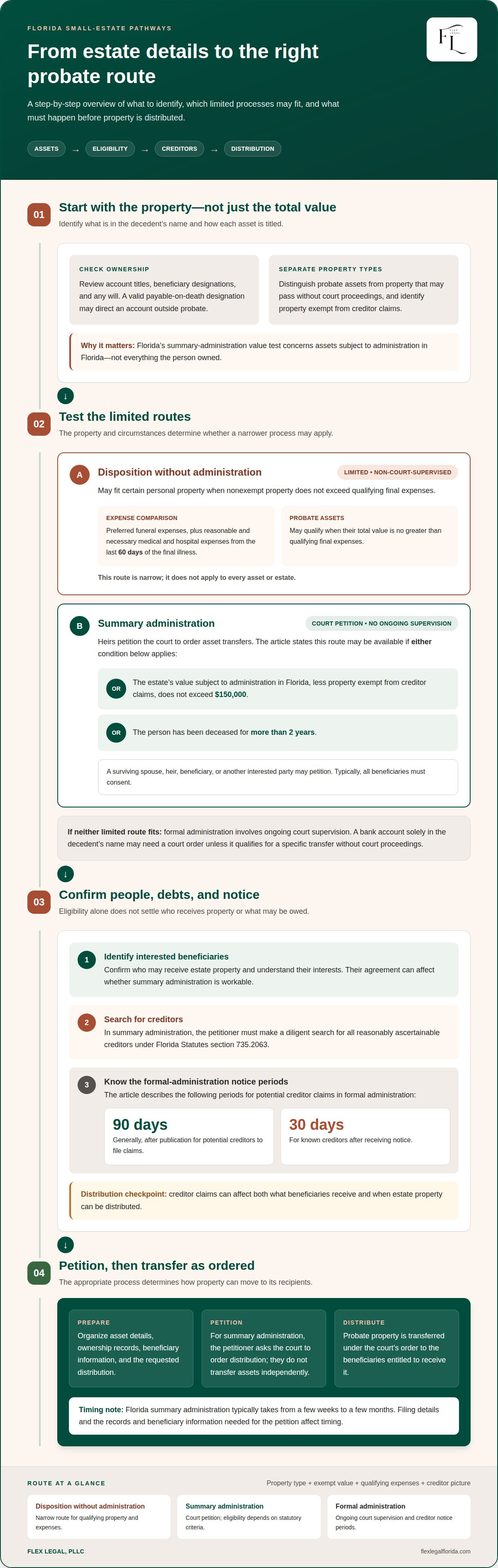
A small estate may not need full formal probate, and some property may pass without court proceedings. According to the Florida Legislature, summary administration may be available when the estate’s value subject to administration, less exempt property, does not exceed $150,000, or the person has been deceased for more than two years. A separate, limited process may apply when probate assets are no greater than qualifying final expenses.
It’s understandable to hope that a smaller estate means a simpler transfer. But the right Florida probate process for small estates depends on more than total value: asset ownership, exempt property, and possible creditor claims all matter.
This guide explains when disposition without administration may apply, how summary administration differs from formal probate, and how creditor claims can affect recipients. You’ll get a clearer picture of which process may fit and when legal support can help move the estate forward.
Table of Contents
Disposition Without Administration: When Does It Make Sense?
Florida has limited routes for smaller estates, but the right option depends on asset type, value, and creditor claims. The key question is whether property needs a court order or can pass through a narrower process.
Personal Property Disposition Without Administration
Disposition of personal property without administration is a limited, non-court-supervised proceeding for certain estate property. It may fit when nonexempt personal property does not exceed preferred funeral expenses plus reasonable and necessary medical and hospital expenses from the last 60 days of the final illness. Probate assets may qualify when their total value is no greater than qualifying final expenses. This route matters when a small account or personal item remains in the decedent’s name, but it does not apply to every asset or estate.
Summary Administration Eligibility
Summary administration is a court process that lets heirs petition to transfer assets without ongoing court supervision. According to The Florida Legislature, it may be used when the estate’s value subject to administration in the state, less property exempt from creditor claims, does not exceed $150,000 or the decedent has been dead for more than 2 years. The Florida Legislature also states that summary administration is available when the estate’s value, after excluding exempt property, does not exceed $150,000 or the decedent has been dead for more than 2 years. These criteria help distinguish summary administration from formal administration.
Petitioners and Required Signatures
A surviving spouse, heir, beneficiary, or another interested party may file a summary administration petition. Typically, all beneficiaries must consent, so it is important to identify everyone who may receive estate property and understand their interests. A spouse’s status can also affect which property is exempt from creditor claims. The petitioner asks the court to order distribution; they do not transfer assets independently. Agreement among beneficiaries can therefore determine whether this simplified route is workable.
Formal administration involves ongoing court supervision. With summary administration, heirs petition the court directly for asset transfers. Disposition without administration is narrower, applying only to qualifying property and expenses. A bank account held solely in the decedent’s name may need a court order unless it qualifies for a specific transfer without court proceedings. To compare the options, first identify probate assets, exempt property, qualifying expenses, and interested beneficiaries.
What Makes Summary Administration Simpler Than Larger Estate Probate?
Summary administration can reduce ongoing court supervision by allowing heirs to petition for asset transfers. The first step is to match each asset with its ownership and beneficiary records.
Asset Transfers and Beneficiary Information
Asset transfer means moving property from the decedent’s ownership to the people entitled to receive it. A probate professional reviews account titles, beneficiary designations, and any will to identify the correct recipients. For example, a payable-on-death account may pass according to its designation rather than through probate. Accurate beneficiary information helps distinguish those assets from property that needs a court order.
Nonexempt Asset Value Thresholds
Nonexempt asset value is the value of estate property counted toward summary administration eligibility after exempt property is excluded. Florida’s statutory threshold concerns estate assets subject to administration in Florida, not everything the decedent owned. A professional separates exempt property from other assets before assessing eligibility. The date of death also affects eligibility under Florida law, so both criteria matter.
Distribution of Estate Assets
Distribution is the transfer of probate property, under the court’s order, to the beneficiaries entitled to receive it. Before preparing the petition, a professional organizes asset details and beneficiary information so the requested distribution reflects the estate. A bank account titled only in the decedent’s name may require court authorization, while an asset with a valid beneficiary designation may pass outside probate. Disposition without administration is a separate, limited route.
Process Steps and Timing
For the Florida small-estate process, a probate professional identifies assets, reviews ownership and beneficiary records, assesses eligibility, prepares the petition, and coordinates the requested transfer. This helps determine whether summary administration fits before estate assets are distributed. Florida summary administration typically takes from a few weeks to a few months. The filing and the estate’s details, including the records and beneficiary information needed for the petition, affect timing.
When a court petition and coordinated transfers are needed, probate administration support can help organize the process.
Creditor searches, claims, and notice
Creditor issues affect what beneficiaries receive and when estate property can be distributed. Florida law distinguishes known creditors, other potential claimants, and exempt property.
Creditor Searches and Notice
In summary administration, a petitioner must make a diligent search for all reasonably ascertainable creditors under Florida Statutes section 735.2063. This search helps identify debts before assets are transferred. Formal administration uses notice periods: potential creditors generally have 90 days after publication to file claims, while known creditors have 30 days after receiving notice. Those periods make accurate creditor information important to the estate’s administration.
Creditor Claims and Estate Debts
Creditor claims are requests for payment from the estate, and they must be addressed before estate assets are distributed. A probate lawyer can organize known debts and potential claims and account for them during the estate process. In summary administration, recipients may be personally liable for a pro rata share of lawful estate claims, limited to the value of estate property they actually received, excluding exempt property. In other words, potential liability is tied to what each recipient received.
Exempt Property and Creditor Claims
Exempt property is property Florida law shields from creditor claims in specified circumstances. When a decedent has a spouse or children, Florida law identifies two vehicles as exempt from creditor claims and exempts up to $1,000.00 in personal property. These rules can affect which assets count toward estate administration and which remain protected. Identifying the decedent’s family circumstances and property helps clarify the effect of claims.
Tax and Creditor Concerns
Tax-related funds can involve separate eligibility rules from ordinary creditor claims. Florida law allows a federal income tax overpayment refund of no more than $5,000 to be paid to a qualifying surviving spouse or, without one, a designated child among the decedent’s children over age 14. Separately, creditors can no longer file claims against an estate after the decedent has been dead for more than two years. A probate lawyer can account for these distinct rules before distribution.
Bank account payment to a successor without court proceedings
A limited bank-payment option may allow certain funds to be released without a court case. A probate professional can assess whether the account and family circumstances fit this route before pursuing a court petition.
In Florida, a financial institution may pay a qualifying family member the deceased person’s combined funds in qualified accounts held at that institution when the total does not exceed $2,000. The institution cannot make this payment earlier than 6 months after the date of the decedent’s death. The limit applies to the combined funds in qualified accounts at that institution, not automatically to every account or asset the deceased owned.
A probate professional can identify the institution and accounts, review which family members may qualify, and organize the information supporting a payment request. They can also distinguish this route from summary or formal administration, which involve court filings. If the account or circumstances do not fit the bank-payment option, another process may be needed to transfer ownership.
An affidavit alone does not give an heir legal rights to estate assets in Florida. Florida does not provide an heir affidavit for that purpose. When court authorization applies, a court order is required to grant those rights. This distinction matters: a request to a bank under the limited payment option is not the same as using an affidavit to claim any estate property.
For a court proceeding, the filing fee is paid to the clerk when the probate case is filed. Courts often require proof of the deceased person’s assets and debts, a death certificate, and beneficiary information. Florida law generally requires a petitioner to have an attorney in probate matters, including summary administration, unless the petitioner is the sole beneficiary and sole heir. A personal representative may be involved in formal administration, but the bank-payment route does not itself appoint one.
If a court filing is needed, contact Flex Legal, PLLC about probate administration for help evaluating the estate’s transfer options.
Flex Legal, PLLC: Probate Administration
Flex Legal, PLLC helps families with probate administration when an estate needs a court petition, creditor coordination, or an authorized asset transfer. Support can include organizing estate and beneficiary information, preparing the probate filing, and guiding administration toward distribution. This is useful when the estate does not qualify for a limited transfer without court proceedings or beneficiaries need a clear path through the process.
The right approach depends on the estate’s assets, debts, and eligible recipients. Flex Legal, PLLC can assess those details and handle the probate work involved. If a beneficiary has disabilities, Special Needs Planning may also help address the family’s long-term planning needs.
Contact Flex Legal, PLLC to discuss probate administration for your situation.
Choose a Clear Path Forward
The next step is to turn uncertainty into a practical plan for the people and property involved. Choosing the right Florida probate process for small estates starts with understanding what must happen next, who needs to be involved, and how estate administration relates to your family’s longer-term needs.
Flex Legal, PLLC can help families address probate administration and future planning together. Revocable Living Trusts may be part of planning for asset transitions, while Special Needs Planning and Guardianship Proceedings can address particular family circumstances. The right focus depends on what your family needs now and what you want to prepare for.
For guidance on the estate’s next steps, contact Flex Legal, PLLC. A clear conversation can help you move forward with greater confidence and a plan suited to your family.
Frequently Asked Questions
What Counts as a “Small Estate” in Florida?
Florida’s small-estate options depend on the process, rather than one definition that fits every situation. An estate, for example, may meet the value test for summary administration, while a separate route may apply to certain personal property and final expenses. A bank may also pay qualifying funds under a limited rule. The asset type and ownership determine which option to consider.
What Is Probate?
Probate is the court process for handling assets that need legal authority to transfer after someone dies. A solely owned account without a beneficiary designation, for example, may require a court order before a bank releases it. By contrast, jointly owned property with automatic succession or an account with a valid beneficiary may pass outside probate. Reviewing ownership records helps identify which assets require court involvement.
What Qualifies as a Small Estate in Florida Probate?
The Florida Legislature says summary administration may be used when the estate’s value subject to administration in the state, less property exempt from creditor claims, does not exceed $150,000, or the decedent has been dead for more than 2 years. The Florida probate process for small estates also includes separate limited options that depend on property type and qualifying expenses. A value calculation should focus on assets subject to administration, not every asset the person owned.
What Is Florida Summary Administration and Who Is Eligible?
Summary administration is a court-supervised route for requesting estate distribution without ongoing court supervision. A surviving spouse, heir, beneficiary, or another interested party may petition. Typically, all beneficiaries must consent, so disagreements can affect whether this route is workable. Eligibility also depends on the estate’s value after exempt property is excluded or on the time since the decedent’s death.
What Is Florida Disposition of Personal Property Without Administration?
Disposition of personal property without administration is a limited process that may allow qualifying property to be handled without a court-supervised estate administration. It can apply when nonexempt personal property does not exceed preferred funeral expenses plus reasonable and necessary medical and hospital expenses from the last 60 days of the final illness. For instance, a small asset may be relevant if qualifying final expenses meet or exceed its value.
What Documents Are Required for Florida Summary Administration?
Florida courts often require proof of the decedent’s assets and debts, a death certificate, and beneficiary information. These records support the petition and clarify who should receive estate property. The filing also needs enough asset detail to assess eligibility and proposed distribution. Florida law generally requires a petitioner to have an attorney in probate matters, including summary administration, unless the petitioner is the sole beneficiary and sole heir.


Comments