
Contested Will Attorney in Florida: A 2026 Guide to Challenging an Invalid Will

Imagine discovering that your loved one's final wishes were altered in their final days, leaving you with a signature that doesn't look right and a feeling of complete betrayal. It's a heavy burden to carry, especially when you're already grieving and facing the pressure of Florida's notoriously tight legal deadlines. If you suspect fraud or undue influence, partnering with a contested will attorney Florida is the first step toward restoring the integrity of the estate. You deserve a clear path forward that prioritizes the truth over complex jargon.
We understand that the fear of high hourly fees and permanent family rifts can make you hesitate. This guide is designed to replace that anxiety with actionable facts about your rights and the specific legal grounds for a contest in 2026. You'll learn how to navigate the critical 90-day notice period and what it takes to successfully invalidate a suspicious will. By focusing on modern, agile solutions rather than rigid traditional models, we'll show you how to protect your inheritance and honor your family's true legacy with confidence.
Table of Contents
What is a Will Contest in Florida and Who Can File One?
A will contest is a formal legal objection to the validity of a Last Will and Testament filed within a Florida probate court. This process isn't a simple disagreement over an inheritance; it's a specific type of lawsuit designed to prove that the document presented to the court doesn't actually represent the deceased person's true final wishes. What is a will contest? At its core, it's a mechanism to ensure the integrity of the probate system by weeding out documents born from fraud, duress, or mental incapacity.
When you work with a contested will attorney Florida, the first step is determining if you meet the state's "interested person" standard. Florida law doesn't allow just anyone to challenge a will. You must have a direct financial stake in the outcome of the estate. This includes heirs who would inherit under state law if no will existed, beneficiaries named in a previous version of the will, and even certain creditors. Since probate litigation is typically billed hourly, identifying your standing early is a strategic investment in your case's success.
You cannot challenge a will in Florida while the person who wrote it is still alive. The law protects a living person's right to change their estate plan privately and frequently without facing constant litigation from expectant heirs. Once the individual passes and the probate process begins, the court appoints a Personal Representative. This individual has a fiduciary duty to defend the will's validity, but they must also remain impartial. If a contest is filed, the Personal Representative's role becomes complex as they balance estate administration with the ongoing legal dispute.
Legal Standing: Do You Have the Right to Sue?
Standing is the threshold requirement for any Florida probate litigation. Without it, the court will dismiss your case before it even begins. Generally, standing is granted to:
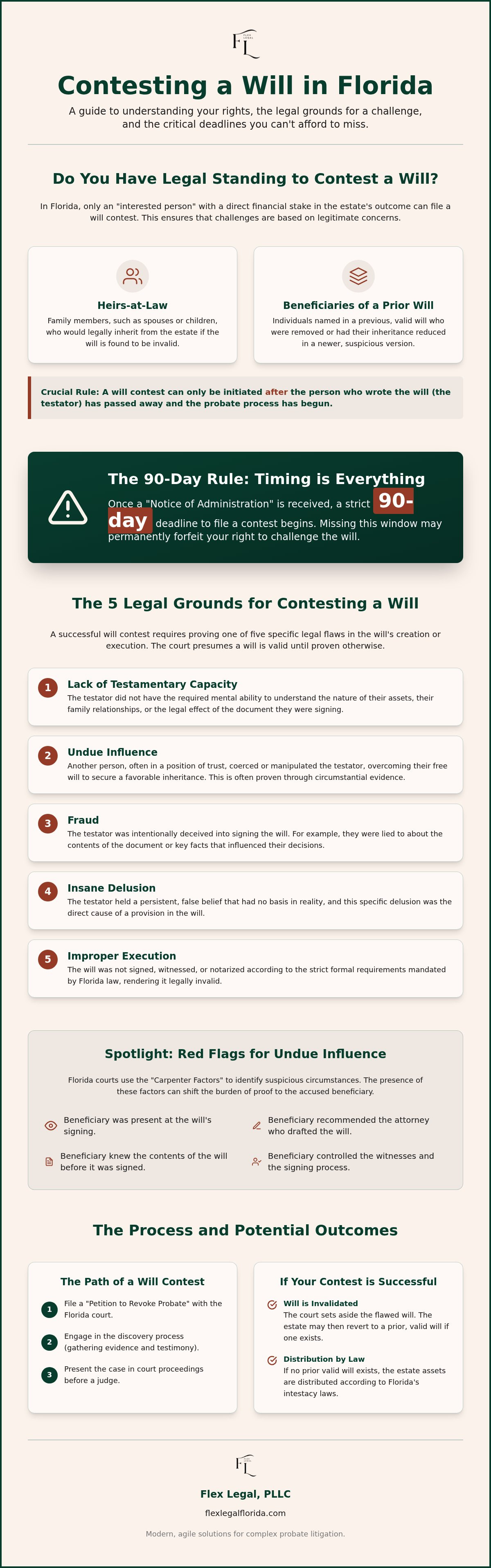
Heirs-at-law: These are family members, like children or spouses, who are legally entitled to inherit assets under Florida's intestacy laws if the will is tossed out.
Beneficiaries of a prior will: If a newer, suspicious document suddenly removes you or reduces your share compared to a previous version, you have the right to challenge the change.
The Objective: What Happens if You Win?
The primary goal of a will contest is the revocation of probate. If the court agrees the will is invalid, the entire document is set aside. In some cases, the court may order a partial invalidation, where only specific clauses or bequests are removed while the rest of the will remains intact. Depending on the evidence, the estate will then either revert to a prior, valid version of the will or be distributed according to Florida's default intestacy laws. This ensures that the assets are protected from those who may have used undue influence to secure a windfall.
The 5 Legal Grounds for Contesting a Will in Palm Beach County
Challenging a will in Palm Beach County isn't just about fairness; it's about proving one of five specific legal flaws. A skilled contested will attorney Florida will analyze the circumstances surrounding the document's creation to determine which ground offers the strongest path forward. Florida law requires precise evidence to overturn a will, as the court starts with the presumption that the document is valid.
Lack of testamentary capacity is a common starting point. This means the person who wrote the will didn't understand the nature of their property, who their family members were, or the practical effect of the document they signed. This is distinct from an "insane delusion." In delusion cases, a testator holds a persistent, false belief despite all evidence to the contrary, and that specific delusion dictates the terms of the will. Proving these mental states requires a deep dive into medical records and witness testimony from the time of signing.
Proving Undue Influence: The Carpenter Factors
Undue influence occurs when a person in a position of trust overcomes the testator's free will to secure a favorable inheritance. Because this often happens behind closed doors, Florida courts use the "Carpenter Factors" to identify suspicious behavior. These include:
The beneficiary's presence at the execution of the will.
The beneficiary recommending the attorney who drafted the document.
Prior knowledge of the will's contents by the beneficiary.
The beneficiary securing the witnesses or controlling the signing process.
If these factors are present, the burden of proof may shift, requiring the beneficiary to prove the will wasn't the result of their influence. A contested will attorney Florida can help you gather the depositions and records needed to build this case, which is a strategic investment in protecting your family's legacy.
Fraud and duress are also powerful grounds for a contest. Fraud involves active deception, such as someone lying about a family member's behavior to get them disinherited. Duress involves threats or physical force used to coerce a signature. Both are high bars to prove but essential for maintaining the integrity of the estate.
Execution Formalities: Why Florida is Strict
Florida is one of the strictest states regarding how a will is signed. According to The Florida Bar's Guide to Probate, a will must strictly adhere to Florida Statute 732.502. This means the testator must sign at the end of the document in the presence of at least two witnesses, who must then sign in the presence of the testator and each other. Even a minor technical flaw can invalidate an entire Florida will. If you suspect the signing didn't follow these rules, it's worth discussing your options with a modern expert in probate administration and litigation.
The 90-Day Rule: Why Timing is Everything in Florida Probate
In Florida probate litigation, speed is often more important than the strength of your evidence. The state prioritizes the efficient transfer of assets, which means the window to challenge an invalid will is incredibly narrow. Once a will is admitted to probate and the administration begins, the law imposes a strict countdown. If you miss this window, your right to object is usually lost forever, regardless of how much proof of fraud or undue influence you possess.
The primary trigger for this countdown is a document called the Notice of Administration. Under Florida law, you have exactly three months, or 90 days, from the date you're served with this notice to file a formal petition to revoke probate. This is known as the "forever barred" rule. Florida courts rarely grant extensions for this deadline. Unless you can prove active intentional misrepresentation that prevented you from filing, the court will likely dismiss any late claims. Working with a contested will attorney Florida ensures that you don't just meet these deadlines, but that your filing is strategically sound from day one.
The Notice of Administration Explained
The Personal Representative is responsible for sending the Notice of Administration to all "interested persons," including the surviving spouse, beneficiaries, and heirs-at-law. This document is a formal signal that the probate process is moving forward. You must act immediately when this arrives in your mail. Gathering medical records, interviewing witnesses, and reviewing prior estate plans takes time. Waiting until day 60 or 70 to seek legal counsel puts your case at a significant disadvantage. For a deeper look at how the administration process works, see our guide on a Probate Lawyer in Palm Beach County: A 2026 Guide.
The 20-Day Rule for Formal Notice
While the 90-day rule is the most common deadline, an even shorter 20-day window exists in certain circumstances. If a petitioner chooses to serve you with "Formal Notice" of the petition for administration before the will is even admitted to probate, you only have 20 days to file your objection. This tactic is often used by those who expect a challenge and want to force a quick resolution. Receiving legal notice via certified mail is a major red flag for potential litigants. You should always timestamp the receipt of any legal notice from a probate court to ensure your contested will attorney Florida can calculate your deadlines accurately. This proactive step is a simple but vital part of your strategic investment in the estate's protection.
The Process of Challenging a Will: What to Expect in Court
The journey through a Florida probate court follows a specific, logical path designed to uncover the truth. Your contested will attorney Florida acts as your strategic partner, moving through these phases with an agile approach that prioritizes results over rigid tradition. Because litigation is billed hourly, every step is a calculated investment in reclaiming the estate's integrity and ensuring the deceased person's true intent is honored.
The process begins with a deep-dive consultation and case evaluation. We look for the red flags mentioned earlier, like suspicious timing or sudden changes in beneficiaries. Once we establish standing, we file a 'Petition to Revoke Probate' in the circuit court where the estate is being settled. This document formally notifies the court and the Personal Representative that the will's validity is being challenged, effectively pausing certain distribution activities.
The Importance of Discovery
Discovery is the engine of your case. This phase involves subpoenaing medical records to analyze the testator's mental state and bank statements to trace any unusual financial transfers made just before the will was signed. We often use medical experts to testify whether the deceased had the cognitive capacity to understand their decisions. Gathering 'clear and convincing' evidence is the only way to overcome the court's initial presumption that the will is valid. After discovery, we conduct depositions. We question witnesses, the drafting attorney, and the individuals accused of exerting influence under oath to build a record of the facts.
Mediation: The Faster Path to Resolution
Most Florida probate disputes never reach a judge for a final trial. Florida courts often mandate mediation, where a neutral third party helps both sides reach a settlement. This private resolution is usually faster and less emotionally draining than a public court battle. It allows families to move forward without the friction of a prolonged, public legal fight. If you're looking to prevent these issues before they start, consulting an Estate Planning Attorney in West Palm Beach can help you create a more secure plan for the future.
Ready to protect your inheritance and seek the truth? Schedule a strategy session with our West Palm Beach team to begin your case evaluation.
Choosing a Contested Will Attorney in West Palm Beach: The Flex Legal Approach
Finding the right contested will attorney Florida means looking for more than just a list of credentials. You need a partner who understands that probate litigation is as much about family dynamics as it is about statutory law. At Flex Legal, we’ve moved away from the rigid, intimidating models of traditional professional services. We offer a sophisticated balance of professional authority and modern accessibility. This approach ensures you feel like a partner in your own case rather than a spectator in a distant, formal process.
Jennifer L. Flexer, Esq. founded our firm on the principle of agility. We act as your forward-thinking ally, providing streamlined support that adapts to the unique challenges of your specific dispute. We prioritize clarity and comfort, using direct communication to explain complex legal concepts without the dense jargon that often alienates clients. Our goal is to provide a solution-oriented experience that removes the friction from an already stressful situation.
Why a Local West Palm Beach Firm Matters
Probate rules can vary slightly by jurisdiction; having a firm rooted in West Palm Beach provides a distinct advantage. We’re deeply familiar with the procedural nuances of the 15th Judicial Circuit. This local expertise includes a working knowledge of the probate court staff and the specific expectations of local judges. These relationships allow us to navigate the system with a level of precision that outside firms might lack.
Being based in West Palm Beach also means we’re accessible for in-person strategy sessions. While we embrace modern communication, we know that reviewing sensitive documents or preparing for a deposition often benefits from face-to-face collaboration. Our deep roots in the Palm Beach County legal community allow us to move your case forward with efficiency. We aren't just representatives; we are neighbors who understand the regional landscape.
Taking the First Step Toward Resolution
Preparing for your initial consultation is the best way to start your journey toward a resolution. We suggest gathering any copies of the suspicious will, previous estate plans, and a timeline of the events that led to your concerns. This helps us provide a clear, adaptable path forward during our first meeting. We focus on identifying specific challenges early to avoid unnecessary delays.
While our estate planning services often use flat fees, litigation matters are typically billed on an hourly basis. We frame these costs as a strategic investment in protecting the estate’s assets and honoring your loved one’s true legacy. Transparency is a core value here; you’ll always be informed about the status of your case and the strategic reasoning behind every filing. Contact Flex Legal today to discuss your case and find a modern path through your probate dispute.
Securing Your Family's True Intent
Challenging a suspicious will is a significant undertaking, but you don't have to face it alone. Protecting an estate requires a swift response to strict Florida deadlines and a deep understanding of complex legal grounds like undue influence or lack of capacity. By acting within the 90-day window and utilizing the discovery process, you can ensure that a loved one's actual final wishes are the ones that stand. It's about restoring integrity to the probate process when it matters most.
Choosing the right contested will attorney Florida is about finding an ally who values speed and transparency. Led by Jennifer L. Flexer, Esq., Flex Legal, PLLC provides a specialized focus on Florida probate litigation through a modern, client-first approach. We move away from the rigid, traditional structures of the past to offer you a streamlined, agile path forward. We prioritize your comfort and clarity at every stage of the dispute.
If you're ready to move from confusion to a clear legal strategy, we're here to support you. Schedule a Consultation with Flex Legal, PLLC today to discuss your case and begin the process of honoring your family's legacy. Your peace of mind is worth the strategic investment in your future.
Frequently Asked Questions
Can I contest a will if I was left out entirely?
Yes, you can contest a will if you are considered an "interested person" under Florida law. This status typically applies to heirs-at-law, such as children or spouses, who would have inherited assets if the will didn't exist. It also applies to beneficiaries named in a previous version of the document. Being disinherited gives you the legal standing to file a petition if you have valid grounds like fraud or undue influence.
How much does it cost to contest a will in Florida?
The cost varies based on the complexity of the dispute and the amount of evidence required. Litigation matters are typically billed on an hourly basis, making it a strategic investment in protecting the estate's true value. You should also account for court costs, such as the 2026 filing fee of approximately $402 for formal administration. Other expenses include fees for expert witnesses, court reporters, and the retrieval of medical or financial records.
What is the most common reason for a will to be thrown out?
Undue influence and a lack of testamentary capacity are the most frequent reasons Florida courts invalidate a will. These cases often involve a testator who was mentally vulnerable or isolated, allowing a caregiver or relative to exert improper pressure. If you can prove the testator didn't understand the extent of their assets or the impact of the document, the court may revoke probate and revert to a previous, valid estate plan.
Do I need a lawyer to contest a will in Florida?
Yes, Florida probate rules are highly technical and generally require legal representation for adversarial proceedings. A contested will attorney Florida provides the agility needed to manage strict deadlines and navigate the procedural rules of the 15th Judicial Circuit. Attempting to handle depositions, subpoenas, and evidentiary hearings without professional counsel often leads to the permanent loss of your inheritance rights due to simple procedural errors or missed filing dates.
What evidence do I need to prove undue influence?
To prove undue influence, you must provide evidence related to the "Carpenter Factors." This includes showing the beneficiary was active in procuring the will, such as recommending the drafting attorney or being present during the signing. You'll also need medical records from the time the will was executed and testimony from witnesses who observed the testator's state of mind. Emails, text messages, and bank statements showing unusual financial transfers are also vital pieces of evidence.
How long does a will contest typically take in Palm Beach County?
A typical will contest in West Palm Beach can take anywhere from six months to two years to resolve. The timeline depends heavily on the volume of discovery needed and the court's current schedule. While many cases reach a resolution through mandatory mediation within the first year, complex disputes that go to a full trial will take longer. Early intervention and clear communication with your legal team can often help streamline the process and avoid unnecessary delays.
Can a 'No-Contest' clause stop me from challenging a will in Florida?
No, "no-contest" or in terrorem clauses are completely unenforceable under Florida law. You cannot be penalized or disinherited simply for filing a good-faith challenge against a will's validity. This protection allows you to work with a contested will attorney Florida to seek the truth without the fear of losing what you were already promised. The state prioritizes the legal integrity of the document over any language intended to prevent legitimate judicial review.
What happens to the estate while the will is being contested?
When a contest is filed, the probate process continues, but the Personal Representative is usually restricted from distributing assets to beneficiaries. Their primary duty shifts to preserving the estate's property until the court determines the will's validity. In some instances, the court may appoint a "curator," who acts as a neutral third party to manage the assets. This ensures that the inheritance remains intact and protected from mismanagement while the legal dispute is resolved in court.


Comments