
Choosing a Special Needs Trust Trustee: 2026 Florida Guide

What if the person you trust most to care for your child is the same person who accidentally disqualifies them from life-sustaining medical care? It's a heavy thought that keeps many parents awake at night. You've worked hard to build a safety net, but the "alphabet soup" of SSI, SSDI, and Florida's HCBS waivers makes every financial move feel like a gamble. You're likely worried about burdening a sibling with complex paperwork or, worse, creating a family rift over money. These fears are valid, especially when 2026 Florida Medicaid income caps for long-term care sit at $2,982 and asset limits remain a strict $2,000.
Choosing a trustee for a special needs trust is the most vital step in protecting your family's future. This guide will show you how to select a partner who safeguards your loved one's inheritance while keeping their essential government benefits fully intact. We'll break down the differences between family members and corporate professionals, explore how 2026 ABLE account rules impact your strategy, and provide a clear path to securing your child's long-term quality of life through modern, adaptable planning.
Table of Contents
The Critical Role of a Special Needs Trust Trustee in Florida
The SNT trustee is more than a money manager. They are a legal and financial gatekeeper. While a standard revocable living trust focuses on distributing assets to heirs, a Special Needs Trust (SNT) is designed to supplement, not replace, public assistance. To understand the foundation of these tools, one might ask, What is a Special Needs Trust? Essentially, it's a legal vehicle that allows a person with a disability to benefit from assets while remaining eligible for government programs. Choosing a trustee for a special needs trust requires finding someone who can balance the beneficiary's immediate quality of life with strict regulatory compliance. This person carries a heavy fiduciary duty; they must act solely in the beneficiary's interest, often for many decades.
The "alphabet soup" of SSI, SSDI, and Florida Medicaid is a constant challenge for any administrator. For example, the maximum federal SSI payment for 2026 is $994 for an individual. If a trustee makes a payment for the wrong item or in the wrong way, that monthly check could shrink or disappear entirely. This complexity makes the role far more demanding than traditional trust administration.
Protecting Means-Tested Benefits
A single improper distribution can trigger a "loss of benefits" notice from the Social Security Administration. In Florida, the countable resource limit for SSI eligibility in 2026 remains a strict $2,000 for an individual. Trustees must adhere to the "Sole Benefit" rule, ensuring every dollar spent directly assists the beneficiary. If a trustee buys a vehicle but titles it in the name of a sibling instead of the trust or the beneficiary, the Florida Department of Children and Families (DCF) may count that as a disqualifying transfer of assets. This could jeopardize Medicaid eligibility and vital Home and Community-Based Services (HCBS) waivers.
The Consequences of Poor Trustee Selection
The Florida Uniform Trust Code sets high standards for accountability and transparency. A trustee who misses a reporting deadline or fails to understand "payback" provisions in a first-party trust faces personal legal liability. Imagine a well-meaning relative who uses trust funds to pay for the beneficiary's groceries directly. Because SSI is intended to cover food and shelter, this "in-kind support and maintenance" could reduce the beneficiary's monthly income by one-third. Choosing a trustee for a special needs trust who lacks this technical knowledge can lead to accidental disqualification and significant financial loss for the family.
Family Member vs. Corporate Trustee: A Comparative Analysis
Deciding who will manage your loved one's future is a choice between the heart and the head. Family members offer an irreplaceable "intimate knowledge" of the beneficiary's daily needs and personal goals. They understand which therapy works best and which small comforts make a difference. However, choosing a trustee for a special needs trust based solely on love can be a mistake. The technical demands of the role are high. Corporate trustees, such as Florida trust companies or banks, provide "professional precision." They don't have an emotional stake, but they do have a deep understanding of the 2026 SSI resource limits and the complex Florida Uniform Trust Code.
The Sibling Trap: Avoiding Family Conflict
Naming a sibling as the sole trustee often creates a lifelong power imbalance. It shifts the relationship from one of mutual support to one of "gatekeeper and petitioner." The emotional toll of saying "no" to a brother or sister’s request for funds can lead to deep resentment. You can avoid this by involving siblings in a non-fiduciary capacity. They can serve as trust advisors or members of a care committee. This keeps the family bond intact while leaving the difficult financial decisions to a neutral party. Exploring these considerations for choosing a trustee helps preserve family harmony for generations.
When a Corporate Trustee Makes Sense
For trusts in West Palm Beach that exceed $500,000 or $1 million, professional management is usually the most resilient path. Corporate trustees in Florida typically charge annual fees ranging from 0.5% to 1.5% of the trust's assets. While this is an added expense, it provides a safeguard against the high cost of legal errors. Professional trustees offer continuity that a single person cannot. They don't get sick, retire, or pass away. They also manage specialized tax reporting. This is critical because, in 2026, the top federal income tax rate of 37% applies to trust income above approximately $16,000. Using a corporate entity ensures your loved one's inheritance isn't eroded by avoidable tax penalties or administrative mistakes.
A popular middle ground is the co-trustee arrangement. This allows a family member to provide the "heart" while a professional handles the "head." It's an adaptable strategy that ensures the trust stays compliant without losing the personal touch. If you want to see how these roles fit into a broader strategy, reviewing our modern approach to Special Needs Planning can help you build a more secure foundation.
Navigating Florida-Specific SNT Compliance Rules
Florida's regulatory environment for SNTs is unique. The Florida Department of Children and Families (DCF) monitors trust income with a sharp eye. When you're choosing a trustee for a special needs trust, you need someone who understands how DCF treats specific distributions. For example, if a trustee pays for a beneficiary's cell phone bill, it's usually permitted. If they pay for rent or groceries directly, they might trigger a reduction in SSI benefits due to "in-kind support." The Florida Uniform Trust Code also grants beneficiaries significant rights, including the right to receive annual accountings. This transparency is vital for long-term protection and prevents administrative drift.
Florida residents must also distinguish between third-party and first-party SNTs. Third-party trusts are funded by parents or grandparents and don't require a Medicaid payback. First-party trusts are funded with the beneficiary's own assets, such as a personal injury settlement, and must include a provision to reimburse the state upon the beneficiary's death. This Academy of Special Needs Planners guide on choosing a trustee offers more depth on these critical distinctions and the fiduciary duties involved.
Medicaid and the "Income Cap" in Florida
Florida is an "income cap" state. For 2026, the income limit for long-term care Medicaid is $2,982 per month. If a beneficiary’s income exceeds this, a trustee may need to manage a Qualified Income Trust (QIT), often called a Miller Trust. Without this specific tool, the beneficiary stays ineligible regardless of their medical need. Trustees must also understand how SNTs interact with ABLE accounts. As of 2026, the age of disability onset for ABLE eligibility rose to 46. This expansion allows trustees to move up to $20,000 annually into an ABLE account, where the first $100,000 is disregarded for SSI resource limits. It’s a powerful way to provide extra liquidity without risking benefits.
The Role of the Palm Beach County Probate Court
Trust administration in West Palm Beach often intersects with the 15th Judicial Circuit. If the trust was created through a court order, the trustee might face mandatory court-supervised accounting. This is especially common when navigating guardianship proceedings in Florida alongside trust duties. The Palm Beach County Probate Court requires precise annual reports that detail every penny spent. A trustee who fails to file these on time or with the correct detail risks being removed by a judge. Local expertise is non-negotiable here. It's why choosing a trustee for a special needs trust who is familiar with West Palm Beach court customs is a strategic advantage for your family.
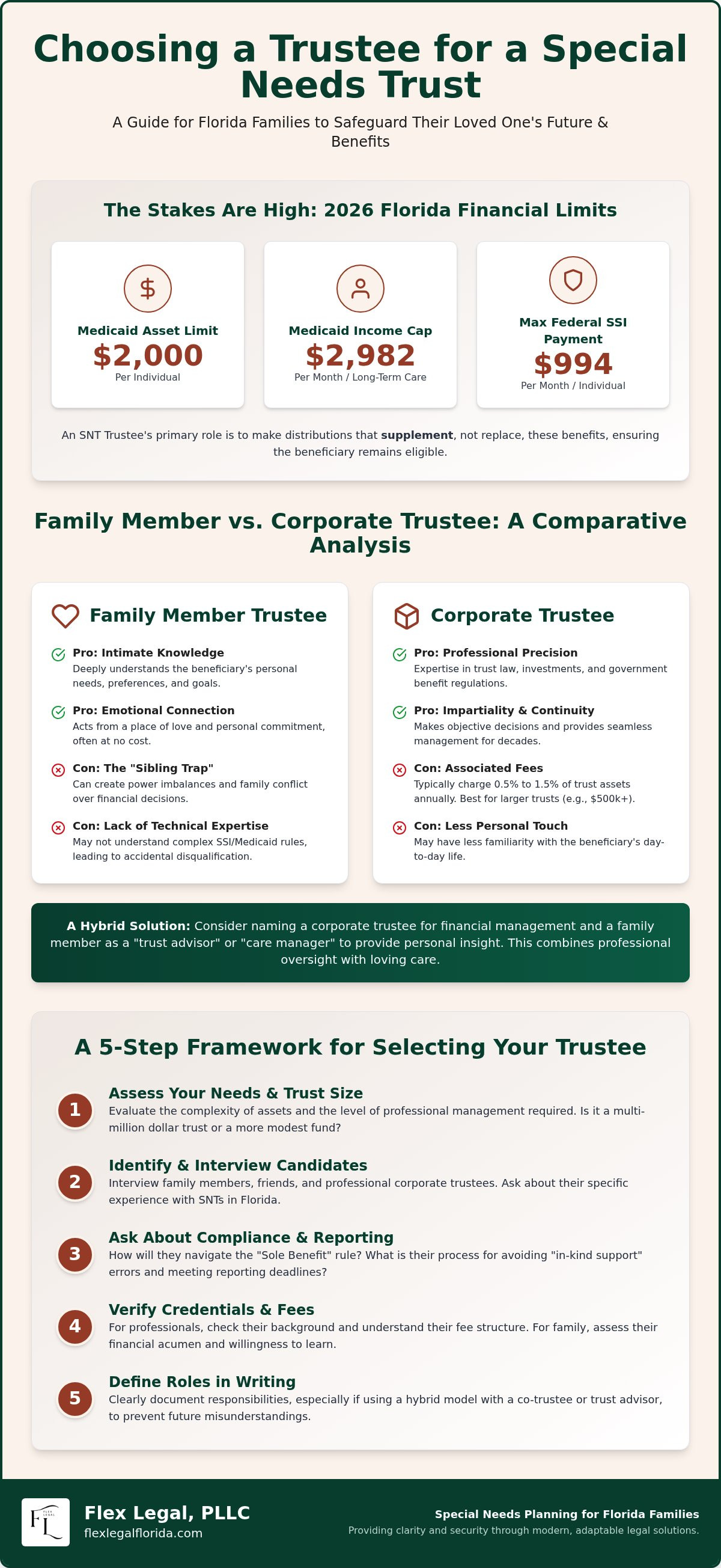
A 5-Step Framework for Selecting Your Trustee
Success in choosing a trustee for a special needs trust doesn't happen by accident. It requires a repeatable, logical process that filters out candidates who lack the necessary technical or emotional stamina. By following a structured framework, you can move from uncertainty to a confident selection that protects your loved one for decades.
Step 1: Assess technical complexity. Consider the beneficiary's reliance on 2026 Florida Medicaid waivers or SSI. If their needs involve high-frequency distributions or complex medical billing, a professional trustee might be necessary.
Step 2: Interview potential candidates. Treat this as a formal job interview. Use a specific questionnaire to gauge their understanding of fiduciary duties and benefit rules.
Step 3: Evaluate longevity. A trust might last 50 years. Ensure your candidate has a clear succession plan or a backup trustee named in the document.
Step 4: Consider geographic proximity. While not mandatory, having a trustee near West Palm Beach simplifies attending local probate court hearings or visiting the beneficiary.
Step 5: Consult with an expert. Work with a special needs planning attorney to formalize the choice and ensure the trust language is ironclad.
The 10 Questions You Must Ask a Potential Trustee
Interviews are the only way to test a candidate's readiness. You shouldn't assume a family member understands the nuances of public benefits just because they're responsible with their own money. Ask these critical questions:
Do you understand the difference between SSI and SSDI, and how trust income affects each?
Are you willing to provide detailed annual accountings to the family and the court?
What is your specific plan if you become incapacitated or can no longer serve?
Modern Solutions: The Trust Protector
The Trust Protector is an agile, modern addition to your planning team. Think of them as a "watchdog" for the family. They don't manage the money daily, but they hold the power to fire and hire trustees without the friction of going to court. This is a core value in modern planning because life changes. A trustee who is perfect today might become unresponsive or inefficient in ten years. A Trust Protector ensures the trust remains adaptable, allowing for smooth transitions as the regulatory landscape in Florida evolves. To build this kind of resilient foundation, you can start your special needs plan today with a firm that prioritizes your family's long-term harmony.
How Flex Legal Simplifies Special Needs Planning
Traditional estate planning often feels like a factory line. You're handed a stack of documents and left to figure out the rest. At Flex Legal, PLLC, we've moved beyond that "one-size-fits-all" model. We treat special needs planning as a dynamic partnership. Choosing a trustee for a special needs trust is only the first half of the equation. The second half is ensuring that trustee has the tools, knowledge, and confidence to succeed. We focus on modern, adaptable solutions that grow with your family's needs while providing the price certainty of flat-fee packages.
Our approach ensures your special needs strategy doesn't exist in a vacuum. We integrate these trusts with your broader goals, often referencing our revocable trust guide to build a total estate solution. This holistic view prevents gaps in your plan that could leave your loved one vulnerable. We don't just draft papers; we act as an agile ally for West Palm Beach families, helping you navigate the technicalities of Florida law with clarity and comfort.
Our Process for West Palm Beach Families
Everything starts with a direct discovery session with founding attorney Jennifer L. Flexer, Esq. We dive deep into your family's unique dynamics to identify potential friction points before they become legal hurdles. We then customize your trust to include specific "Quality of Life" instructions. These aren't just boilerplate legal terms. They're clear directives on how your loved one should be cared for, from their favorite social activities to specific medical preferences. Our support doesn't end when the ink is dry. We provide ongoing guidance to help your trustee navigate their first year of administration, ensuring they understand the reporting requirements of the 15th Judicial Circuit and the nuances of Florida DCF rules.
Securing the Future Today
The biggest risk in special needs planning is waiting for the "perfect" time to start. Life is unpredictable, and a delay can result in a loss of essential benefits or a chaotic transition for your child. Choosing a trustee for a special needs trust today creates a resilient foundation that protects your family's harmony. A finalized, adaptable plan offers more than just legal protection; it provides the peace of mind that comes from knowing your loved one's inheritance is safe from creditors, predators, and administrative errors. You don't have to face this complex landscape alone. Schedule a consultation with Flex Legal, PLLC today to begin building a secure, modern future for your family.
Securing Your Loved One’s Long-Term Legacy
Choosing a trustee for a special needs trust is one of the most consequential decisions you'll make for your family. It isn't just about managing money; it's about ensuring your loved one maintains their quality of life while staying within Florida’s strict 2026 Medicaid and SSI limits. By using a structured framework and considering modern safeguards like Trust Protectors, you can move from a place of worry to a position of strength. This proactive approach preserves family harmony and protects the inheritance you've worked so hard to build.
You don't have to navigate these complex legal waters alone. At Flex Legal, PLLC, we provide direct access to attorney Jennifer L. Flexer, Esq., ensuring you receive specialized Florida Special Needs Planning expertise from the start. Our transparent flat-fee estate packages provide the price certainty your family deserves. We act as your agile ally, turning a confusing "alphabet soup" of regulations into a clear, adaptable path forward. Secure your family’s future with a Special Needs Trust consultation today. Your peace of mind is within reach, and we're here to help you every step of the way.
Frequently Asked Questions
Can a parent be the trustee of a special needs trust in Florida?
Yes, a parent can serve as the trustee. Many families start this way because parents have the most intimate knowledge of their child's daily needs. However, the technical requirements for managing SSI and Medicaid compliance are high. If you are a parent choosing a trustee for a special needs trust, you must be prepared to maintain rigorous records. Many parents eventually transition this role to a professional or co-trustee to ensure long-term stability.
What happens to the money in a special needs trust when the beneficiary dies?
The outcome depends on whether it is a first-party or third-party trust. First-party trusts, funded with the beneficiary's own money, must include a Medicaid payback provision to reimburse the state of Florida. Third-party trusts, funded by family members, don't have this requirement. Any remaining funds in a third-party trust can pass directly to other siblings or heirs. This distinction is a vital part of protecting your family's multi-generational wealth and legacy.
How much does it cost to have a professional trustee manage an SNT?
Professional trustees in Florida generally charge an annual fee based on the total assets under management. These rates typically range from 0.5% to 1.5% depending on the trust's size and the level of care required. While this is an added expense, it provides professional liability protection and ensures benefit eligibility isn't accidentally lost. Families in West Palm Beach often find the cost is balanced by the peace of mind and technical precision provided.
Can a special needs trust pay for a beneficiary’s housing in Florida?
Yes, a trust can pay for housing, but it requires careful strategy. If the trustee pays for rent, mortgage, or property taxes directly, the Social Security Administration views this as In-Kind Support and Maintenance. This usually results in a one-third reduction of the beneficiary's monthly SSI check. Trustees often use ABLE accounts or other distribution methods to minimize this impact. It's a prime example of why choosing a trustee for a special needs trust requires technical expertise.
Is a trust protector the same thing as a trustee?
No, these are two distinct roles with different powers. A trustee handles the daily financial management, tax filings, and distributions to the beneficiary. A trust protector acts as a strategic watchdog. They don't manage the money but have the authority to remove an underperforming trustee or amend the trust if Florida laws change. This layer of oversight ensures the plan remains adaptable and responsive to the beneficiary's evolving needs over many decades of life.
What is the difference between an SNT and an ABLE account?
An SNT is a comprehensive legal trust with no contribution limits, while an ABLE account is a specialized savings tool. For 2026, ABLE accounts have a $20,000 annual contribution limit and a $100,000 SSI resource disregard. SNTs offer more robust asset protection and can hold much larger sums, such as an inheritance or settlement. Many West Palm Beach families use both tools together to maximize financial flexibility and maintain vital government benefit eligibility.
Can I change the trustee of an SNT after it is created?
Yes, you can change a trustee if the trust document includes specific removal and replacement provisions. Most modern special needs trusts allow a Trust Protector or a majority of family advisors to make this change without the friction of going to court. If the document is silent, you may need to petition the Palm Beach County Probate Court. Ensuring your trust is drafted with this flexibility is a core part of our partnership-based approach.
Does a trustee have to live in Florida to manage a Florida SNT?
There is no legal requirement for a trustee to reside in Florida. However, a local trustee in West Palm Beach often has a better understanding of Florida DCF customs and local service providers. If you choose an out-of-state trustee, they must still comply with the Florida Uniform Trust Code and state-specific Medicaid rules. They should also be prepared to handle annual reporting requirements for the 15th Judicial Circuit if the trust is court-supervised.


Comments