
2026 Florida Special Needs Trust Guide for Adult Children

What if the financial safety net you're building for your child actually causes them to lose their essential healthcare and housing? It's a terrifying thought that keeps many Florida parents awake at night. You want to provide a comfortable life, but you know that even a small inheritance can push them over the strict $2,000 SSI asset limit. Establishing a special needs trust for adult child with disability is about more than just managing money. It's about protecting their dignity. You shouldn't have to choose between providing for their extra comforts and keeping the Medicaid benefits they rely on for survival.
We understand the stress of clarifying Florida's 2026 regulations, from the ABLE Age Adjustment Act to the $2,982 Medicaid income cap. This guide offers a clear roadmap to secure your child's future through a framework that prioritizes both stability and quality of life. You'll learn how to choose a reliable trustee, leverage modern tools like Miller Trusts, and integrate ABLE accounts for daily expenses. We'll show you how to build a dynamic support system that adapts to your family's evolving needs, ensuring your child thrives long after you're gone.
Table of Contents
Protecting the Future: Why Your Adult Child Needs a Special Needs Trust
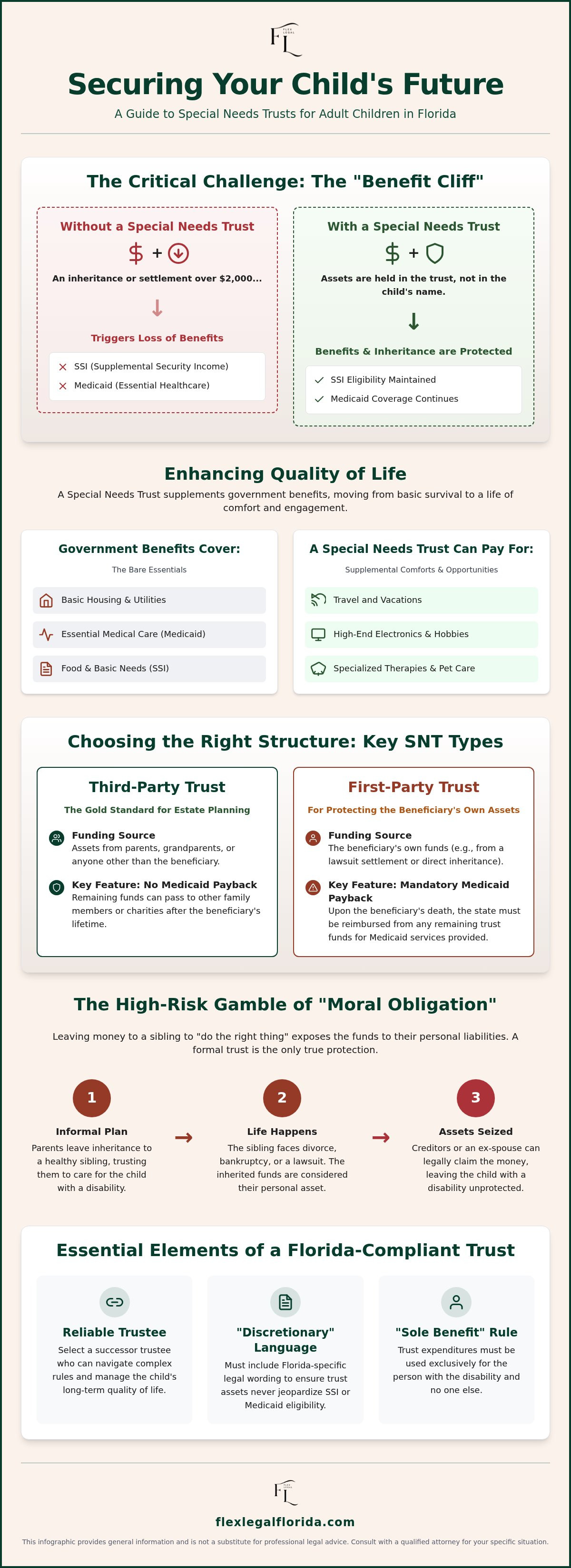
A Special Needs Trust is a strategic legal arrangement that holds assets for a person with a disability without those funds counting toward restrictive asset limits. It's a tool designed to provide financial security while maintaining eligibility for vital public assistance. For many families, this is the only way to ensure their child has a safety net that lasts a lifetime. It acts as an agile shield, protecting your child's resources from being counted as personal property by government agencies.
In 2026, the countable resource limit for individual SSI recipients remains at $2,000. This creates a "benefit cliff" where a direct inheritance of even $2,001 can trigger a total loss of SSI and Medicaid. It's a harsh reality that can leave a vulnerable person without healthcare or income overnight. Establishing a special needs trust for adult child with disability prevents this catastrophe by keeping the assets out of the child's name legally while keeping them available for their use.
The primary goal is to provide "supplemental" support. While government benefits cover the bare essentials of food and shelter, the trust pays for things that enhance quality of life. This includes travel, high-end electronics, pet care, and specialized therapies not covered by insurance. It moves the needle from basic survival to a life filled with comfort and engagement. You're not just providing money; you're providing a lifestyle that government programs don't offer.
Standard Revocable Living Trusts often fail in these situations. They are usually written to give beneficiaries direct access to funds at certain ages or milestones. For a person with a disability, that direct access is a disqualifying event. Without specific "discretionary" language tailored to Florida and federal law, a standard trust can do more harm than good. It's a common mistake that can be avoided with modern, specialized planning.
The Interaction with SSI and Florida Medicaid
Florida's 2026 rules remain exceptionally strict. The $2,000 asset limit is a hard ceiling for individual SSI recipients. When it comes to Florida Medicaid Institutional Care Programs, the state monitors how trust funds are used to ensure they don't replace what the government provides. Under the "Sole Benefit" rule, any expenditure from the trust must be used exclusively for the person with the disability and no one else.
The Danger of the 'Moral Obligation' Inheritance
Leaving money to a sibling with the expectation they'll "do the right thing" is a high-risk gamble. Life is unpredictable. If that sibling faces a divorce, a business bankruptcy, or a personal injury lawsuit, the money intended for your child's care is legally considered the sibling's asset. Creditors and ex-spouses can seize those funds. A formal special needs trust for adult child with disability creates a legal barrier that protects the money from the sibling's personal liabilities, ensuring it remains dedicated to your child's needs.
Third-Party vs. First-Party SNTs: Choosing the Right Structure
When you decide to create a special needs trust for adult child with disability, the first decision involves identifying where the money originates. The source of the funding dictates which rules apply and what happens to the money when your child no longer needs it. In Florida, we primarily deal with two distinct structures: Third-Party and First-Party trusts. Each serves a specific purpose, but they offer very different levels of flexibility for your family's future.
Third-party trusts are the gold standard for West Palm Beach families during the estate planning process. These are funded with assets belonging to someone other than the beneficiary, such as parents or grandparents. Because the child never legally owned the money, these trusts allow the beneficiary to maintain his or her eligibility for public assistance benefits without the state demanding repayment later. This structure is highly adaptable and acts as a dynamic support system for your child's supplemental needs.
A first-party trust, also called a self-settled trust, is funded with the child's own assets. This often happens if an adult child receives a personal injury settlement, a direct inheritance from a relative who didn't plan ahead, or a large lump-sum back payment from Social Security. While this trust still protects benefit eligibility, it carries a heavy trade-off: a mandatory Medicaid payback provision. Regardless of the type you choose, we always include spendthrift clauses to ensure creditors cannot seize these funds to pay off the beneficiary's debts.
The Medicaid Payback Provision Explained
The biggest difference between these structures is what happens after the beneficiary passes away. In a first-party trust, the state of Florida must be reimbursed for every dollar spent on the child's Medicaid care before any remaining funds can go to family members. Third-party trusts do not have this requirement. Parents should prioritize third-party planning whenever possible to keep assets within the family. Flex Legal helps you audit your current assets to ensure you're using the most protective vehicle available, helping you navigate these complex Florida trust rules with ease.
Pooled Special Needs Trusts
If you're managing a smaller inheritance or don't have a reliable family member to serve as trustee, a pooled trust is a viable alternative. These are managed by non-profit organizations that "pool" the assets of many beneficiaries for investment purposes while maintaining separate accounts for each individual. You gain professional management and high-level planning, though you sacrifice some of the personalized family control found in a standalone trust. If you're exploring these modern solutions for a special needs trust for adult child with disability, consulting a Special Needs Planning Attorney can help you weigh the pros and cons for your specific situation.
Comparing SNTs and ABLE Accounts for Adult Children
Florida families often view financial tools as "either/or" choices, but modern planning thrives on coordination. The ABLE account, or Florida ABLE, functions much like a specialized checking account for individuals with disabilities. It offers tax-free growth and allows the beneficiary to manage their own funds for daily needs. In contrast, a Special Needs Trust (SNT) acts as a high-security vault. It's designed to hold unlimited assets, from family homes to million-dollar inheritances, under the watchful eye of a trustee.
The 2026 landscape has made these tools even more powerful. Thanks to the ABLE Age Adjustment Act, individuals who developed their disability before age 46 are now eligible. For 2026, the annual contribution limit for an ABLE account is $19,000. While this is helpful for managing small, frequent distributions, it can't handle the scale of a full inheritance. This is where a special needs trust for adult child with disability becomes essential. The trust provides the long-term infrastructure, while the ABLE account offers the beneficiary a sense of independence and quick access to cash.
Key Differences in Flexibility and Control
Control is the most significant differentiator between these two vehicles. With an ABLE account, the beneficiary often has direct access to a debit card to pay for "qualified disability expenses." However, Social Security only ignores the first $100,000 in an ABLE account; anything above that limit will suspend SSI payments. A trust has no such ceiling. The trustee maintains total discretion over distributions, which provides a layer of protection against financial exploitation that a simple bank account cannot match.
Strategic Coordination for Florida Families
The real magic happens when you use these tools together. Normally, if a trust pays for a beneficiary's rent or groceries directly, Social Security reduces the SSI check by one-third due to "In-Kind Support and Maintenance" (ISM) rules. You can avoid this penalty by having the trust transfer funds into the ABLE account first. The ABLE account then pays the rent, and the beneficiary keeps their full SSI benefit. It's a sophisticated maneuver that maximizes every dollar available for your child's care.
Balancing these two tools requires a clear vision of your child's daily life and long-term goals. A special needs planning attorney can help you draft trust language that specifically allows for these transfers to ABLE accounts. While ABLE accounts offer low-cost administrative simplicity for small amounts, a special needs trust for adult child with disability provides the robust legal framework necessary to protect a lifetime of wealth. In terms of cost, ABLE accounts carry minimal annual fees, whereas trusts involve higher upfront setup costs but offer significantly greater asset protection and tax planning opportunities.
How to Set Up a Special Needs Trust: A Step-by-Step Guide
Setting up a special needs trust for adult child with disability is a precise legal process that ensures the vehicle is recognized by both Florida Medicaid and the Social Security Administration. It's not a project for DIY forms or generic templates. The process begins with identifying your primary and successor trustees. These roles provide the long-term stability your child needs. Next, your attorney drafts the document using Florida-specific "discretionary" language. This wording is vital; it ensures the trustee has absolute control, which prevents the assets from being counted against the beneficiary's $2,000 SSI limit.
Once the document is signed, you'll need to obtain a Tax ID (EIN) from the IRS. This step establishes the trust as a separate legal entity for tax reporting and banking. Finally, you'll fund the trust. Many families use cash, real estate, or name the trust as the beneficiary of a life insurance policy. This creates an immediate pool of resources to support your child's lifestyle without interrupting their government benefits.
Selecting the Right Trustee in West Palm Beach
Choosing between a family member and a corporate trustee involves balancing personal knowledge with professional expertise. Family members understand your child's nuances but may struggle with complex accounting or changing 2026 regulations. Corporate trustees offer professional longevity and objectivity but lack a personal connection. Many families find a middle ground by appointing a "Trust Protector." This is an independent third party who can remove or replace a trustee if they aren't meeting your child's needs. If you're also managing other family assets, a Revocable Trust Guide can help you see how these different legal tools fit together.
The Letter of Intent: Your Child's Instruction Manual
While the trust is the legal engine, the Letter of Intent is the heart of the plan. This non-legal document acts as an instruction manual for future caregivers and trustees. It should detail your child's medical history, daily routines, social preferences, and even their favorite hobbies. It's the place where you define what "quality of life" means for your child. You can update this document every year as your child's needs evolve without paying additional legal fees. It ensures that when you're no longer there, the person stepping into your shoes knows exactly how to provide the comfort and care you've always provided.
If you're ready to build a custom roadmap for your child's future, you can start your special needs plan today with a streamlined, flat-fee approach.
Modern Special Needs Planning with Flex Legal, PLLC
Complexity shouldn't stand between your family and a secure future. At Flex Legal, PLLC, we strip away the friction often found in traditional law firms to focus on what matters: your child's well-being. Establishing a special needs trust for adult child with disability requires a deep understanding of Florida's evolving 2026 regulations. We act as your agile ally, translating dense legal jargon into a clear, actionable roadmap. Our goal is to provide a streamlined experience that respects your time and provides immediate relief from the stress of long-term planning.
We've replaced the outdated billable hour model with transparent, flat-fee pricing for our estate packages. You'll never have to worry about a surprise invoice for asking a follow-up question or seeking clarification on a trust clause. This approach allows families to budget predictably while ensuring every detail of the special needs trust for adult child with disability is handled with precision. It's a modern way of practicing law that prioritizes your peace of mind over administrative overhead. By providing price certainty, Flex Legal, PLLC ensures that your resources go toward your child's care rather than unpredictable legal fees.
The Flex Legal, PLLC Partnership Model
Static documents can't keep up with a changing life. Our partnership model focuses on creating dynamic plans that adapt as your child's needs or Florida's Medicaid rules shift. We specialize in navigating the local nuances of Palm Beach County, ensuring your trust remains compliant with the specific requirements of regional agencies. By choosing an Estate Planning Attorney West Palm Beach families trust, you're securing a local expert who understands the unique landscape of our community and the specific challenges of the Florida healthcare system.
Next Steps: Securing Peace of Mind
Getting started is simpler than you might think. For your initial session, it's helpful to gather current benefit award letters, a list of existing assets, and any ideas you've gathered for your Letter of Intent. We don't work in a vacuum; Flex Legal, PLLC actively coordinates with your financial advisors and care providers to ensure every piece of your financial puzzle fits together perfectly. This holistic approach ensures your child's trust works in harmony with their ABLE account and other resources discussed in this guide. We help you move from a place of uncertainty to a position of strength and clarity.
The path to a secure future begins with a single conversation. You can schedule your special needs planning consultation with Flex Legal, PLLC today to start building a legacy that protects your child's quality of life for years to come.
A Clear Path Toward Your Child's Lifelong Security
You've seen how the right legal framework bridges the gap between basic government assistance and a thriving quality of life. By choosing a third-party structure and coordinating it with a Florida ABLE account, you're building a system that adapts as rules change. A special needs trust for adult child with disability isn't just a set of documents; it's a promise that your child will always have the extra comforts they deserve. It ensures that essential Medicaid and SSI benefits remain untouched while providing the resources for a full, engaging life.
Our approach is built on specialized special needs planning expertise and a deep commitment to the West Palm Beach community. We offer transparent flat-fee pricing packages so you can plan your budget with total confidence. This modern model ensures you get the high-level planning your family requires without the intimidation of traditional professional services. We're here to act as your agile ally, turning complex regulations into a straightforward roadmap for your family's future.
You've already taken the most important step by educating yourself on these 2026 updates. Now, it's time to put that knowledge into action and create a legacy that protects your child for decades to come.
Frequently Asked Questions
Can an adult child with a disability be their own trustee?
No, an adult child cannot serve as their own trustee if the goal is to maintain eligibility for public benefits. If the beneficiary can direct the spending of the funds, the Social Security Administration views those assets as countable resources. This would likely push them over the $2,000 individual limit. A third party must have total discretion over the special needs trust for adult child with disability to ensure the safety net remains intact.
What happens to the Special Needs Trust if the parents get divorced?
A special needs trust is a separate legal entity and is generally not considered a marital asset in a Florida divorce. Since these trusts are typically irrevocable, the assets belong to the trust for the benefit of the child, not the parents. However, West Palm Beach families should ensure their divorce decree specifies who is responsible for future funding or successor trustee appointments. We help parents navigate these transitions to ensure the care plan remains stable.
How much money should I put into a Special Needs Trust?
There is no minimum or maximum amount required, but you should fund it based on your child's expected quality of life and lifespan. Consider the costs of supplemental needs like specialized therapies, travel, and electronics that government benefits don't cover. Because a special needs trust for adult child with disability has no asset ceiling, it can hold anything from a small inheritance to a life insurance payout without jeopardizing their $2,000 SSI resource limit.
Can a Special Needs Trust pay for my child's rent or mortgage?
Yes, the trust can pay for housing, but doing so directly often triggers a reduction in SSI benefits. Social Security views direct payments for rent or mortgage as In-Kind Support and Maintenance, which can reduce a monthly check by up to one third. Many West Palm Beach families avoid this by using the trust to fund an ABLE account. The ABLE account then pays the housing costs, which preserves the full SSI payment for the beneficiary.
Is a Special Needs Trust the same as a Guardianship in Florida?
No, these are two very different legal tools used in Florida special needs planning. A trust manages financial assets and protects benefit eligibility. Guardianship proceedings, on the other hand, involve a court process to appoint someone to make personal, medical, and legal decisions for an adult who lacks capacity. While they often work together in a comprehensive plan, a trust does not give you the legal authority to make medical decisions for your adult child.
What is the difference between a pooled trust and an individual trust?
Individual trusts are customized documents managed by a trustee of your choice, such as a family member or professional. Pooled trusts are managed by non-profit organizations that combine the funds of many beneficiaries for investment purposes. While individual trusts offer maximum control and customization for West Palm Beach families, pooled trusts can be a cost effective alternative for smaller estates. Both structures are designed to protect essential government benefits while providing for supplemental needs.
Does the trust expire when the child reaches a certain age?
No, a special needs trust does not expire when your child reaches a specific age. It is designed to last for the duration of the beneficiary's life or until the assets within the trust are fully exhausted. In Florida, the trust document should clearly outline what happens to any remaining funds after the child passes away. This is particularly important for Third-Party trusts, which allow you to name other family members as remainder beneficiaries without state interference.
Can I change the trustee after the trust is established?
Yes, you can change a trustee if the trust document specifically allows for it. We often recommend including a Trust Protector role in your planning. This is an independent third party who has the legal authority to remove and replace a trustee if they are not performing their duties or if the child's needs change. This adaptability is a core value of modern planning, ensuring the trust remains a dynamic support system for decades.


Comments