
10 Costly Mistakes to Avoid in Florida Estate Planning (2026 Guide)
- Kelly Mata
- May 30
- 13 min read

Did you know that an out-of-state estate plan, while perfectly valid in New York or Ohio, could be completely rejected by a Florida court? Understanding the specific mistakes to avoid in Florida estate planning is no longer just a recommendation; it's a necessity for anyone calling the Sunshine State home. You've worked hard to build your assets, and it's natural to feel anxious about complex Homestead rules or the potential for family conflict during a probate process that typically lasts six to twelve months. It's frustrating when traditional legal advice feels rigid or outdated, especially when you're looking for a clear, modern path forward.
This 2026 guide reveals how to protect your legacy by navigating the unique legal traps that often catch families off guard. We'll explore why the updated $150,000 summary administration threshold matters and how to ensure your modern assets, from cryptocurrency to real estate, transition smoothly to your loved ones. We're moving beyond static documents to create a dynamic shield for your future. From avoiding "springing" powers of attorney to mastering the 30% elective share rule, you'll discover exactly how to keep your plan agile and effective in Florida's specific legal landscape.
Key Takeaways
Understand why generic or out-of-state documents often fail the "Florida test" and identify the specific mistakes to avoid in Florida estate planning.
Navigate the complexities of Florida Homestead laws to ensure your primary residence is protected from common legal traps and technical errors.
Learn how asset titling can cause your most valuable property to bypass your Will and how to align your accounts with your long-term legacy goals.
Shift your focus to incapacity planning to protect your own well-being and provide for heirs with special needs through modern, adaptable legal tools.
Discover how a proactive legal audit can modernize your strategy and secure your wealth against shifting regional regulations and 2026 statutory updates.
Table of Contents
Why Florida Estate Planning Requires a State-Specific Strategy in 2026
The Most Common Technical Errors: Homestead Traps and DIY Risks
Titling Troubles: Why Your Will Might Not Control Your Most Valuable Assets
Overlooking the Living: Incapacity and Special Needs Planning Mistakes
The Modern Path: How to Audit and Secure Your Florida Estate Plan
Why Florida Estate Planning Requires a State-Specific Strategy in 2026
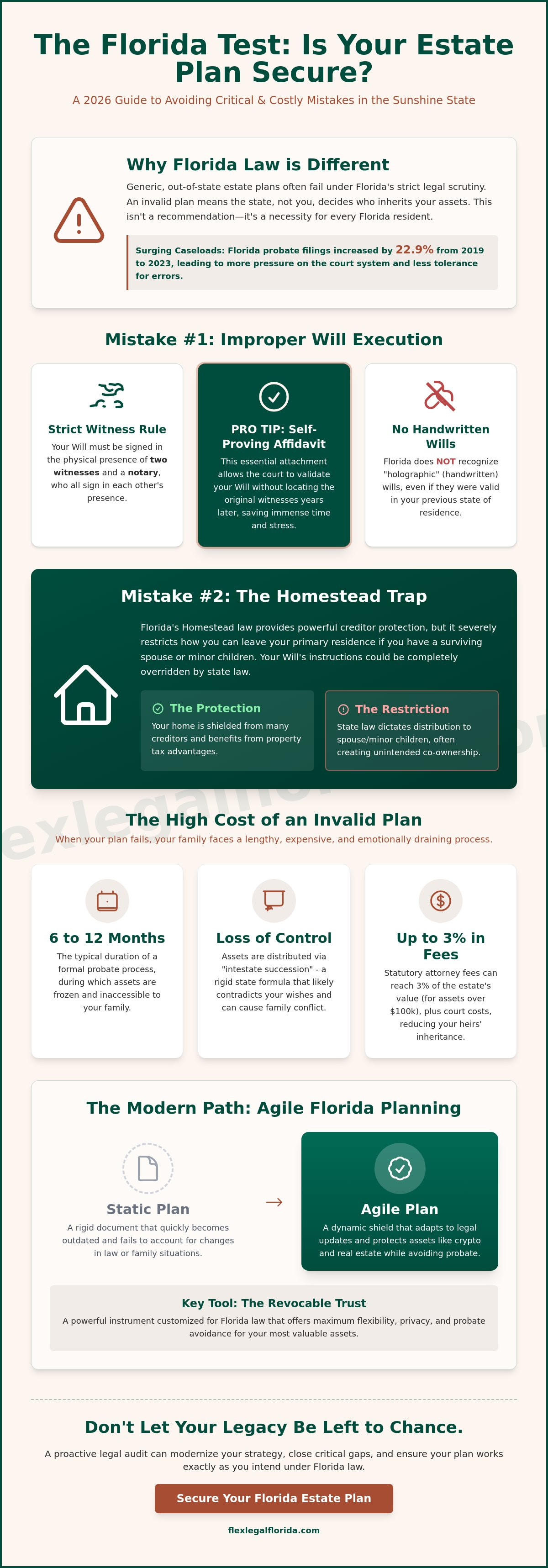
Florida isn't just another state; it's a unique legal jurisdiction with some of the most protective and complex property laws in the country. The Florida Probate Code serves as the rulebook for how assets move from one generation to the next. If you've recently moved to the Sunshine State, your existing documents might not pass the "Florida test." This isn't just about legal preference. It's about strict statutory compliance. While a comprehensive guide to estate planning provides a solid foundation, local nuances can make or break your legacy. One of the most frequent mistakes to avoid in Florida estate planning is assuming that a strategy built for another state will hold up under local scrutiny.
We advocate for "Agile Planning." This modern approach treats your estate plan as a dynamic shield rather than a static folder in a desk drawer. With probate filings in Florida increasing by 22.9% between 2019 and 2023, the court system is under more pressure than ever. An agile plan adapts to legislative shifts, ensuring your family stays out of the courtroom and your assets remain protected under the latest 2026 regulations.
The Strict Execution Requirements of Florida Law
Florida law is notoriously unforgiving regarding how a Will is signed. To be valid, a Last Will and Testament must be signed by the principal in the presence of two witnesses and a notary, all of whom must sign in each other's presence. We also prioritize the "Self-Proving Affidavit." This essential attachment allows the probate court to accept the Will as valid without the need to track down witnesses years later. You should also know that Florida does not recognize "holographic" or handwritten wills. Even if a handwritten Will was legal in your previous state, Florida courts will likely reject it, leaving your estate vulnerable.
The Consequences of an Invalidated Estate Plan
When a plan fails, your assets fall into "intestate succession." This means the state's default laws decide who inherits your property, often leading to results you never intended. The emotional and financial toll of probate litigation can be devastating for families already grieving a loss. Beyond the statutory attorney fees, which can reach 3% of the estate's value for assets over $100,000, the delay can tie up resources for six to twelve months. A modern, state-specific approach prevents "accidental" disinheritance and ensures your wealth transitions exactly how you envisioned. Avoiding common mistakes to avoid in Florida estate planning starts with recognizing that Florida's rules are designed to be a barrier for the unprepared but a benefit for those who plan with precision.
The Most Common Technical Errors: Homestead Traps and DIY Risks
Florida's Homestead laws are often celebrated for their robust creditor protections and property tax benefits. However, they represent the most misunderstood area of state law for homeowners. A primary residence in Florida is not just another asset; it is a constitutionally protected entity with strict rules regarding how it can be transferred. One of the most critical mistakes to avoid in Florida estate planning is assuming you have total freedom to leave your home to whomever you choose. Florida statutes place heavy restrictions on the "devise" of a homestead if you are survived by a spouse or minor children. Ignoring these rules doesn't just complicate things; it can trigger an automatic legal distribution that contradicts your actual wishes.
Many residents fall into the "Snowbird Gap" by relying on plans drafted in New York, New Jersey, or the Midwest. While those documents might be valid in their state of origin, they often lack the specific language required to handle Florida's unique property landscape. To bridge this gap and ensure a seamless transition, many families utilize a revocable trust. This tool offers the adaptability needed to manage complex property rights while keeping your affairs private. According to The Florida Bar on Revocable Trusts, these instruments are highly effective for avoiding probate, provided they are customized to meet Florida's rigorous standards.
The Florida Homestead Devise Restriction
The "Homestead Trap" often catches blended families and second marriages off guard. If you have a minor child, Florida law prevents you from leaving your home to anyone else, including your spouse, via a Will. If you attempt to do so, the law may override your Will, granting your spouse a "life estate" and your children the remaining interest. This can create a logistical nightmare where a surviving spouse is forced to share ownership decisions with children or stepchildren. We help families use modern strategies, such as specific trust provisions or nuptial agreements, to maintain control over the family home while still providing for every loved one.
DIY Estate Planning vs. Professional Legal Design
Generic online forms and DIY templates are tempting because of their low upfront cost. However, these "one size fits all" solutions often fail at the most critical moment. A standard template might miss Florida-specific asset protection triggers or fail to include the necessary self-proving affidavits mentioned in our previous section. Professional legal design focuses on your specific family dynamics and utilizes flat-fee models to ensure you get a comprehensive, high-quality plan without hidden costs. If you want to ensure your documents are truly Florida-ready, consulting with an agile legal ally is a proactive way to secure your future. Mistakes to avoid in Florida estate planning often stem from a lack of customization, making professional oversight a valuable investment in your family's peace of mind.
Titling Troubles: Why Your Will Might Not Control Your Most Valuable Assets
Many people spend weeks perfecting a Last Will and Testament, only to realize later that it doesn't actually control their most valuable property. This is the "Silent Killer" of legacy planning. If an asset has a beneficiary designation or is titled as "Joint Tenants with Rights of Survivorship," it bypasses the probate court entirely. While avoiding probate is a common goal, it becomes one of the major mistakes to avoid in Florida estate planning when those titles conflict with your actual intentions. If your Will says your assets should be split equally among three children, but your primary bank account is joint with only one, that child legally owns the entire account upon your death. The Will cannot override that title.
Understanding the difference between probate and non-probate assets is essential. Probate assets are those held in your name alone with no designated beneficiary. Non-probate assets move by contract or law. If your titling isn't aligned with your strategy, even a skilled probate lawyer in palm beach county cannot force a life insurance policy or a joint account to follow the instructions in your Will. This makes "Trust Funding" a non-negotiable step. A Revocable Living Trust only protects the assets you've legally retitled into the trust's name. An empty trust is just an expensive stack of paper.
Beneficiary Designation Blunders
Outdated beneficiaries on 401(k) plans and life insurance policies are a frequent trap for Florida families. Life changes like marriage, divorce, or the birth of a grandchild require an agile update to these forms. A common error is naming "The Estate" as a beneficiary. This mistake pulls those assets back into the probate process, exposing them to creditors and unnecessary delays. In 2026, the SECURE Act rules remain a critical factor; most non-spouse beneficiaries must withdraw all funds from an inherited IRA within ten years. Precise planning ensures your heirs aren't hit with a massive, unexpected tax bill during that window.
The Danger of Adding Heirs to Your Deed
Adding your children to your home's deed might seem like a simple way to avoid probate, but it's often a high-stakes gamble. When you add a child to your deed, you're giving them a current ownership interest. If they face a lawsuit, a divorce, or a tax lien, your home could be targeted by their creditors. Instead, we utilize the "Lady Bird Deed," also known as an Enhanced Life Estate Deed. This Florida-specific tool allows you to maintain total control, keep your homestead tax exemption, and sell the property without anyone's permission, all while ensuring the home transfers automatically to your heirs. It's a modern, secure alternative to the risks of traditional joint titling.
Overlooking the Living: Incapacity and Special Needs Planning Mistakes
Estate planning is often misunderstood as a task focused solely on what happens after you're gone. In reality, it's a vital support system for the living. One of the most heartbreaking mistakes to avoid in Florida estate planning is failing to account for the potential of your own incapacity or the long-term needs of a vulnerable family member. Without a proactive strategy, you risk leaving your healthcare and financial decisions to a court-appointed stranger in a guardianship proceeding. A modern plan acts as an agile shield, protecting your autonomy while you're still here to make your wishes known.
If you have a loved one with disabilities, a simple inheritance can be a disaster. Leaving assets directly to them often results in immediate disqualification from essential benefits like Medicaid or Supplemental Security Income (SSI). Working with a special needs planning attorney allows you to create a Third-Party Special Needs Trust. This tool provides for a beneficiary's quality of life without jeopardizing their government support. It requires a successor trustee who acts as an agile ally, adapting to changing medical needs and legal regulations to ensure your loved one is always cared for.
The Special Needs Planning Oversight
A Third-Party Special Needs Trust is essential because it holds assets for the beneficiary's benefit without those assets counting against asset limits for government programs. This ensures that your gift enhances their life rather than replacing the basic support they already receive. Choosing a trustee who understands this "agile" philosophy is critical. They must be capable of making discretionary distributions for things like specialized therapy, travel, or technology while strictly following the complex rules that govern Medicaid and SSI eligibility.
Incapacity Planning: Surrogates and Proxies
Planning for your own future requires more than just a Will. A durable power of attorney is your first line of defense against a loss of control. Florida law generally does not recognize "springing" powers created after October 1, 2011; your document must be effective immediately to be reliable. It also requires specific "superpowers" that you must initial to allow your agent to perform advanced tasks like retitling assets or modifying trusts.
You also need a Designation of Health Care Surrogate to name a medical decision-maker and a Living Will to outline your end-of-life preferences. For Palm Beach residents, a Designation of Pre-need Guardian serves as a final safety net. It tells the court exactly who you trust to care for you if a guardianship ever becomes necessary. If you haven't reviewed these documents recently, connect with our team for a modern plan audit. These safeguards are essential components of the mistakes to avoid in Florida estate planning because they keep control in your hands, not the court's.
The Modern Path: How to Audit and Secure Your Florida Estate Plan
Identifying specific legal traps is the first step toward a secure legacy. However, knowing the risks isn't the same as fixing them. To bridge this gap, we offer the "Flex Legal Audit." This process is designed to transform static, outdated documents into an agile shield for your family. For West Palm Beach families, the support of asset protection lawyers near me provides more than just a legal service; it offers a partnership-based approach to wealth preservation. Proactively addressing the mistakes to avoid in Florida estate planning allows you to replace anxiety with a logical, adaptable path forward.
Your 5-Step Estate Plan Health Check
A resilient plan requires regular maintenance to stay effective. Use this checklist to evaluate your current readiness:
Step 1: Verify Florida execution standards. Ensure your Will and Trust meet the strict two-witness and notary requirements discussed in our opening section.
Step 2: Confirm Homestead alignment. Check if your primary residence is titled correctly to avoid the devise restrictions that often impact blended families or those with minor children.
Step 3: Review beneficiary designations. Align your life insurance and retirement accounts with your overall plan to maximize tax efficiency under current 2026 federal rules.
Step 4: Audit Powers of Attorney. Confirm your documents include the specific "superpowers" required by modern Florida banks to prevent a loss of control during incapacity.
Step 5: Schedule a professional consultation. Connect with a qualified estate planning attorney in West Palm Beach to finalize your strategy and ensure every document is fully optimized for Florida law.
Embracing Modern, Agile Estate Solutions
Traditional legal models often rely on hourly-billing structures that create unnecessary friction and anxiety. We've moved away from that outdated approach. Our model prioritizes transparency through result-oriented flat fees, so you know exactly what to expect from the start. This streamlined communication ensures your plan remains as dynamic as your life. You deserve a legal ally that treats your legacy as a living priority rather than a one-time transaction. Securing your future should feel empowering, not intimidating. By choosing a modern, responsive alternative, you ensure your family is protected by a plan that works when it matters most.
Take Control of Your Legacy Today
Florida law moves fast, and your estate plan must keep pace. We've explored how technical Homestead traps and outdated beneficiary designations can derail even the most well-intentioned legacy. By understanding the critical mistakes to avoid in Florida estate planning, you've already taken the first step toward protecting your family's long-term financial health. Now, it's about shifting from theory to action with a strategy that reflects the specific legal realities of 2026. Your plan shouldn't just be a stack of paper; it should be a dynamic shield that evolves with your life.
Our team combines specialized special needs expertise with deep West Palm Beach local knowledge to ensure your documents are both legally sound and highly personal. We believe in flat-fee transparency, removing the friction of hourly billing so you can focus on building a partnership that lasts. It's time to move toward a more agile, modern approach to your legal security. Secure Your Legacy with a Flat-Fee Estate Plan Audit today and feel confident that your assets are exactly where they belong. Your peace of mind is a valuable asset, and we're here to help you protect it.
Common Questions About Florida Estate Planning
Is my out-of-state Will valid in Florida?
Yes, your out-of-state Will is often legally valid if it met the requirements of your previous state at the time it was signed. However, Florida’s strict execution standards and unique property laws mean it might not function as you expect once you become a resident. To prevent common mistakes to avoid in Florida estate planning, you should have a local expert review your documents to ensure they include essential Florida-specific provisions and self-proving affidavits.
What is the "Florida Homestead Trap" for second marriages?
The "Homestead Trap" occurs when you try to leave your primary residence to someone other than your spouse or minor children. If you have a minor child, Florida law prevents you from leaving the home to anyone else via a Will. In a second marriage, this often results in a surviving spouse receiving a life estate while the children inherit the remainder. This can create significant family conflict and unintended ownership structures between step-parents and step-children.
Can I use a DIY online form for my Florida estate plan?
You can use a DIY form, but it is rarely advisable due to the high risk of technical failure. Generic templates often overlook critical Florida statutes regarding homestead property and specific execution requirements. A single missing signature or vague clause can invalidate your entire plan, leading to a probate process that can take six to twelve months to resolve. Professional legal design ensures your documents are tailored to your specific family dynamics.
Why won’t my bank accept my Power of Attorney from another state?
Florida banks often reject out-of-state documents because they don't include the specific "superpowers" required by the Florida Power of Attorney Act. Additionally, Florida generally doesn't recognize "springing" powers created after October 1, 2011. Your document must be effective immediately and meet strict witnessing and notarization standards to be reliably accepted by local financial institutions. Updating your Durable Power of Attorney to comply with local laws is a vital step for new residents.
How does a Special Needs Trust protect my child’s benefits in Florida?
A Special Needs Trust holds assets for your child’s benefit without those assets counting toward the strict asset limits for Medicaid or SSI. This ensures your inheritance enhances their quality of life rather than replacing their government support. It’s an essential tool for families who want to provide long-term care, specialized therapy, or travel opportunities for a disabled loved one without jeopardizing their access to vital medical and financial assistance.
What happens if I die in Florida without a Will?
If you die without a Will, Florida’s intestacy laws determine who inherits your assets based on your family structure. This often leads to results that don't align with your wishes, such as assets being divided between a spouse and children from a previous marriage. Your surviving spouse is also legally entitled to a 30% elective share of your estate. This statutory protection ensures a spouse isn't completely disinherited, regardless of what other documents might say.
Does a Revocable Living Trust avoid probate in Palm Beach County?
A Revocable Living Trust is specifically designed to avoid the time and public nature of probate in Palm Beach County. For this to work, you must properly "fund" the trust by retitling your assets into the trust's name. When handled correctly, your estate can be administered privately and efficiently. This bypasses the court system entirely, avoiding the typical six to twelve-month probate timeline and the statutory attorney fees associated with formal administration.
How often should I update my Florida estate plan?
We recommend reviewing your plan every three to five years or whenever you experience a major life event. Changes in your family structure, a move into Florida, or updates to federal tax laws, such as the 2026 exemption changes, can all impact your strategy. Staying proactive helps you identify and correct mistakes to avoid in Florida estate planning before they become costly problems for your heirs or result in a loss of control during incapacity.


Comments