
What Happens If You Die Without a Will in West Palm Beach? Florida Intestacy Explained
- Kelly Mata
- May 25
- 12 min read

What if the state of Florida has already written your will without your input? It's a common worry that the government might simply take everything if you pass away without a plan. You're likely feeling anxious about how your assets will be split or how long the probate process might drag on in Palm Beach County. Understanding exactly what happens if you die without a will in West Palm Beach is the first step toward protecting your family from Florida's rigid "intestacy script." This default legal process often ignores the unique needs of modern families, but you don't have to leave your legacy to chance.
We're here to help you regain control by explaining how Florida's inheritance laws distribute property and which assets can bypass the court system entirely. You'll learn about the latest 2026 updates, including the increased $150,000 threshold for summary administration that can save your family significant time and money. This guide covers the essential steps to move from confusion to a clear, adaptable plan for your family's future.
Key Takeaways
Florida’s "intestacy script" takes control of your assets by default, but you can learn how to pivot toward a plan that reflects your actual priorities.
Discover how surviving spouses and children from previous marriages are prioritized, preventing unexpected distribution errors in blended family scenarios.
Uncover the "Homestead Trap" and identify which specific assets can bypass the probate court to reach your loved ones faster.
Understand what happens if you die without a will in West Palm Beach and how to navigate the local probate filing process with an agile legal ally.
Learn how modern estate planning tools like Revocable Living Trusts provide a streamlined alternative to the traditional, often slower, probate model.
Table of Contents
Understanding Intestacy: When Florida Writes Your Estate Plan
When you don't have a plan, the state has one for you. For residents of West Palm Beach, dying without a valid legal document means your estate enters a status known as Intestacy. This isn't a rare occurrence, but it's often misunderstood. Many people worry that the government will seize their bank accounts or their home on Flagler Drive. In reality, Florida doesn't usually take your money. Instead, it takes the wheel. The Florida Probate Code acts as a rigid, one-size-fits-all script that decides who gets what, regardless of what you might have promised a friend or intended for a partner.
The question of what happens if you die without a will in West Palm Beach is answered by the Florida statutes, which prioritize biological relatives over personal bonds. This legal framework is overseen by the Palm Beach County Circuit Court, ensuring that every asset is accounted for according to the law's specific hierarchy.
The Legal Vacuum: Why 'Doing Nothing' is a Choice
Choosing not to create a Last Will and Testament is, in effect, choosing the state’s default plan. This "default will" is strictly based on bloodlines and legal marriages. It's an old-fashioned system that often fails to account for the complexities of modern life. If you have a long-term partner you aren't married to, or a close friend who has been like family, the law simply doesn't recognize them. They'll receive nothing.
The impact is immediate. Once someone passes, their individual bank accounts are often frozen. Physical property, like a vehicle or a family home, enters a legal limbo. Without a clear directive, your family must wait for the court to grant someone the authority to even pay the utility bills or manage property taxes. This creates unnecessary friction during an already emotional time.
Intestacy vs. Probate: Clearing the Confusion
There's a common misconception that avoiding a will helps you avoid the court system. The opposite is true. Understanding what happens if you die without a will in West Palm Beach starts with realizing that probate is still mandatory for most assets. The difference lies in how the estate is administered.
If you have a will, the process is "testate" and follows your specific instructions. Without one, it's "intestate" administration. This process is often more complex because the court must first verify your legal heirs and appoint a personal representative without your guidance. Intestate probate is the court-supervised distribution of assets when no valid will exists. It ensures that creditors are paid and remaining property reaches the relatives Florida deems appropriate, even if those aren't the people you would have chosen.
Who Inherits? Decoding Florida’s Intestate Succession Rules
Florida law doesn't care about your family's personal dynamics; it cares about bloodlines. If you're wondering what happens if you die without a will in West Palm Beach, the answer lies in a rigid hierarchy. The distribution is dictated by Florida’s Intestate Succession Rules. This statutory framework ensures your assets follow a specific path, starting with your immediate family and moving outward. It's a precise system, but it's often far from what a resident would choose for themselves.
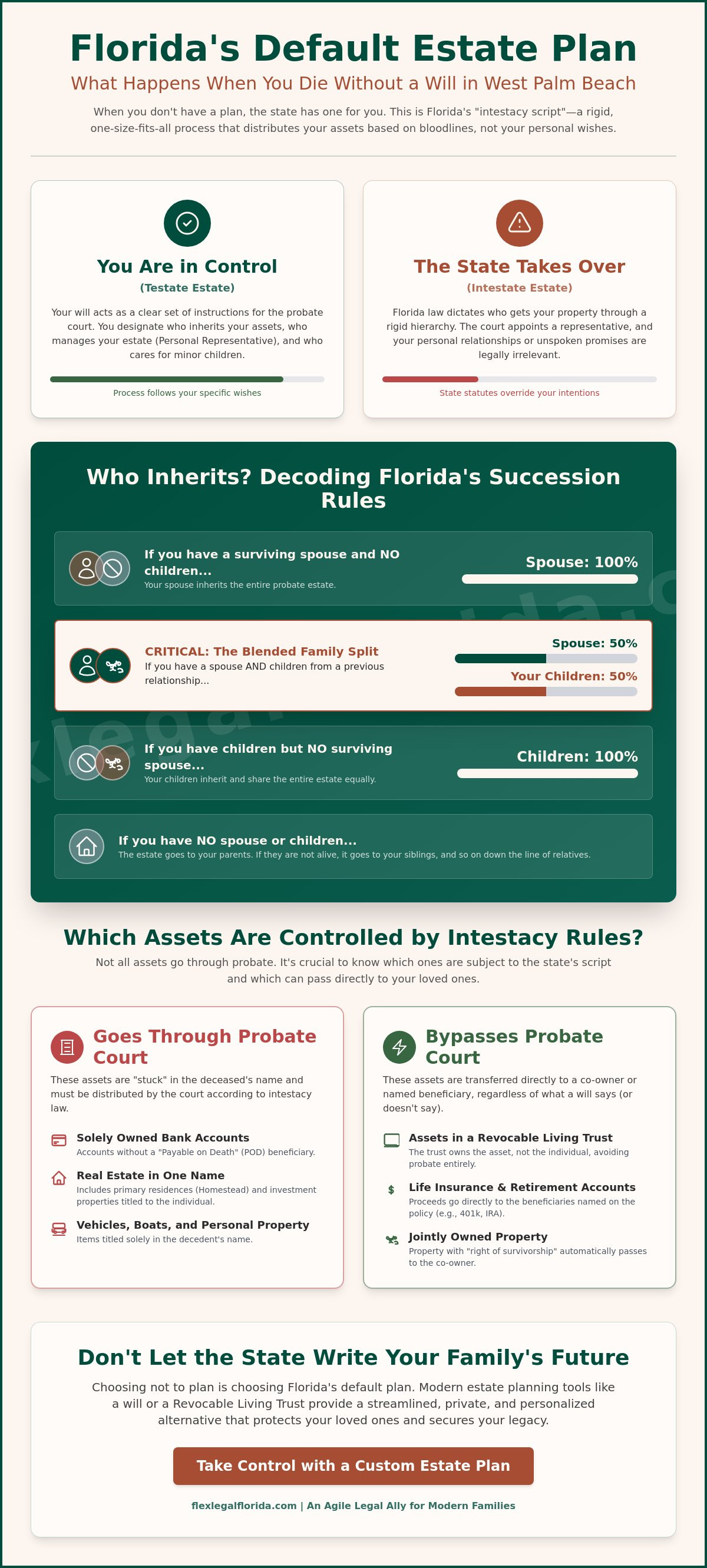
A surviving spouse's share depends entirely on the presence of children from outside the marriage. If all your children belong to both you and your spouse, the spouse typically inherits everything. However, if you have children from a previous relationship, the math changes instantly. In this case, your spouse receives 50% of the probate estate, and your children share the remaining 50%. This split can be particularly challenging for local families, as it may require liquidating property or businesses to divide the value fairly. If your family structure is non-traditional, exploring Probate Administration options early can help clarify these complex heir-at-law identifications.
Spousal Rights and the Blended Family Split
The 50/50 split in blended families is one of the most common sources of friction in Palm Beach County courts. When a spouse and children from a different relationship are involved, the law assumes a split is the fairest outcome. This often ignores the surviving spouse's need for ongoing support or the deceased's specific wishes. Legally adopted children are treated exactly like biological children and have full inheritance rights. Conversely, step-children have no automatic legal right to your estate, no matter how long you've been in their lives. This often leads to heart-wrenching situations where someone you raised is legally barred from receiving an inheritance.
When No Spouse or Children Exist
If you pass away without a spouse or descendants, the law looks "up" and then "out." Your parents are next in line. If they are no longer living, your siblings share the estate. This search continues through grandparents and more distant relatives like aunts or uncles. The legal community sometimes refers to "laughing heirs," which are distant relatives who inherit a windfall despite having little to no relationship with the deceased.
The final, rarest stop is "escheat." This occurs only when the state determines that absolutely no legal heirs can be found. In these cases, the State of Florida actually receives the assets. While rare, the mere possibility of this outcome highlights why identifying your heirs at law is a critical first step in the probate process.
The West Palm Beach Homestead Trap and Non-Probate Assets
Your home is likely your most valuable asset. In Florida, the "Homestead" designation offers incredible tax breaks and creditor protection while you're alive. However, it becomes a complex legal puzzle after death. If you're curious about what happens if you die without a will in West Palm Beach, you'll find that your primary residence is treated very differently than your bank account or car. The law creates specific restrictions on how homestead property passes, which can lead to unintended consequences for your closest family members.
The Unique Status of Your Primary Residence
The Florida Constitution prevents you from leaving your home to just anyone if you're survived by a spouse or minor children. Without a will, the "Homestead Trap" often kicks in. By default, a surviving spouse receives a "life estate," meaning they can live in the home for the rest of their life, while the children receive the "remainder" interest. This often leaves the spouse responsible for all maintenance, insurance, and taxes but unable to sell or refinance the property without the children's consent. Alternatively, the spouse can elect to take a 50% undivided interest in the property within six months of the death. To avoid these rigid defaults and ensure your spouse has total control, many residents utilize a Revocable Trust to maintain flexibility and privacy.
Probate vs. Non-Probate Assets
Not everything you own is subject to the court's distribution rules. Assets with a named beneficiary or a "Transfer on Death" (TOD) designation transfer automatically to the person you've chosen. Non-probate assets pass by contract, overriding any Florida’s Intestate Succession Rules. While this sounds simpler, joint tenancy with right of survivorship can be a double-edged sword. It avoids probate, but it also exposes the asset to the co-owner's creditors or legal troubles while you're still alive.
Tools like "Lady Bird Deeds" allow you to keep control of your home during your life while ensuring it transfers to your heirs instantly upon death, bypassing the Palm Beach County court entirely. Knowing what happens if you die without a will in West Palm Beach allows you to identify these traps before they become your family's burden.
Navigating the Palm Beach County Probate Court Without a Will
If your family hasn't found a will, the legal journey begins at the Palm Beach County Clerk of the Circuit Court. This process isn't just about moving boxes; it's a formal legal proceeding that requires filing a Petition for Administration at the West Palm Beach courthouse. When you are trying to understand what happens if you die without a will in West Palm Beach, the reality is a structured, court-supervised timeline that ensures all debts are settled before any relative receives a dime. This isn't a process that can be rushed, as Florida law requires specific windows for creditors to make claims against the estate.
Who Leads the Process? Appointing a Personal Representative
Without a will to name an executor, the court must appoint a "Personal Representative" to manage the estate. Florida law follows a strict order of preference for this role. The surviving spouse has the first right to serve. If there is no spouse or they decline, the person selected by a majority of the heirs takes the lead. Finally, if the heirs cannot agree, the court will appoint the "best qualified" person. It's vital to remember that a Personal Representative must be either a Florida resident or a close blood relative. If you are feeling overwhelmed by these requirements, a Probate Lawyer in Palm Beach County: A 2026 Guide to Florida Estate Administration can provide the clarity you need to move forward.
Timeline and Costs of Intestacy
Intestate probate is often more time-consuming than its testate counterpart. The court must spend extra time identifying and verifying "heirs at law" to ensure the distribution matches the state's hierarchy. For most routine estates in West Palm Beach, Formal Administration takes between 6 to 12 months. You'll need to account for court costs, such as the $402 filing fee for Formal Administration, along with statutory attorney fees which are often calculated as a percentage of the estate's value.
One of the most significant hurdles is the mandatory 90-day creditor period. Once a "Notice to Creditors" is published, the estate must remain open for three months to allow any potential claimants to come forward. Only after this window closes and all valid debts are paid can the Personal Representative move toward final distribution and discharge. If you're currently facing this complex process, you don't have to do it alone. You can reach out for professional Probate Administration support to ensure every filing is handled with precision and speed.
Securing Your Legacy with Flex Legal: Beyond the Default Script
Understanding what happens if you die without a will in West Palm Beach is the first step, but taking action is what secures your family’s peace of mind. While the state’s default laws provide a safety net, they lack the precision needed to protect your unique legacy. Flex Legal acts as an agile ally, helping you transition from the rigid "state plan" to a customized strategy that reflects your values. We believe that estate planning should be accessible and transparent, which is why we prioritize fixed-fee arrangements. This ensures West Palm Beach families know exactly what to expect without the stress of unpredictable hourly billing.
One of the most critical reasons to move beyond the default script involves Special Needs considerations. If a disabled heir inherits assets through intestacy, the sudden influx of cash can disqualify them from essential government benefits like SSI or Medicaid. This is often a disaster for families who rely on those support systems. Through proactive Special Needs Planning, we ensure your loved ones are cared for without jeopardizing their eligibility for public assistance. We focus on building a dynamic support system that adapts as your life and the law evolve.
Proactive Planning to Avoid the Intestacy Script
You don't have to let the court take the wheel. A simple Last Will and Testament puts you back in control, allowing you to name your own Personal Representative and distribute assets according to your wishes. For those looking to avoid the public and often lengthy probate process altogether, Revocable Living Trusts offer a streamlined alternative. These tools keep your private matters out of the courthouse and ensure a faster transition of wealth to your heirs. If you're ready to explore your options, our Estate Planning Attorney in West Palm Beach: The 2026 Buying Guide provides a clear path forward.
The Flex Legal Difference: Modern, Accessible Support
Jennifer L. Flexer founded Flex Legal to provide a different kind of legal experience. We move away from the intimidating, formal atmosphere of traditional firms to offer a partnership-based approach. We handle the heavy lifting of Probate Administration so you can focus on your family during difficult times. Our process is steady, logical, and designed to remove friction from complex legal requirements. Don't leave your family’s future to a one-size-fits-all law. Schedule a consultation with Flex Legal today and let’s start building a plan that works for you.
Take Control of Your Family's Future Today
You've seen how Florida's default laws can take the wheel if you haven't made your own plan. From the complex "Homestead Trap" to the rigid distribution rules for blended families, the state's script is rarely the one you would write for yourself. Now that you understand what happens if you die without a will in West Palm Beach, you have the power to replace those defaults with a customized strategy. Whether you need to protect a primary residence or ensure a disabled heir's benefits remain secure through specialized Special Needs Planning, the right tools are within reach.
Flex Legal is your local West Palm Beach ally. We offer fixed-price packages that prioritize transparency and modern efficiency. We believe in adaptable solutions that grow with you, moving away from the rigid and intimidating models of the past. Take control of your legacy with Flex Legal’s flat-fee estate planning. You've worked hard for your legacy, and we're here to help you protect it with confidence.
Frequently Asked Questions
Does my spouse automatically inherit everything if I die without a will in Florida?
No, your spouse does not always inherit everything. If you have children from a previous relationship, Florida law splits the probate estate 50/50 between your surviving spouse and those children. However, if all your children are also the children of your surviving spouse, then the spouse typically inherits the entire estate. This rule is designed to balance the needs of the spouse with the rights of biological or adopted descendants.
What happens to my house in West Palm Beach if I don't have a will?
Your primary residence is subject to strict Florida homestead protections. If you're survived by a spouse and children, the spouse usually receives a "life estate" while the children receive the "remainder" interest. This is a common point of confusion when people ask what happens if you die without a will in West Palm Beach, as it can prevent the spouse from selling the home without the children's full cooperation.
How long does the probate process take in Palm Beach County without a will?
For a routine estate, Formal Administration in Palm Beach County generally takes between 6 and 12 months. If the estate's non-exempt assets are valued under $150,000, which is the new threshold starting July 1, 2026, you might qualify for Summary Administration. This simplified process is much faster, often concluding within 3 to 6 months, though it still requires specific court filings and judicial oversight.
Can my step-children inherit my estate if I don't have a will?
No, step-children do not have inheritance rights under Florida's intestacy laws. The state only recognizes biological children and legally adopted children as heirs at law. If you wish to provide for a step-child, you must specifically name them in a Last Will and Testament or a Revocable Living Trust. Without these documents, they will be legally excluded from your estate distribution during the probate process.
Who pays the funeral expenses if there is no will or immediate access to funds?
The person who signs the contract with the funeral home is initially responsible for the costs. However, Florida law treats funeral expenses as a "Class 1" priority claim against the estate. This means the individual who paid can seek reimbursement from the probate assets before most other creditors or heirs receive their shares, provided the estate has sufficient liquid funds available to cover the debt.
What is the difference between a 'heir' and a 'beneficiary' in Florida law?
An "heir" is a person entitled to inherit assets under state law when someone dies without a will. In contrast, a "beneficiary" is someone you specifically name in a legal document, such as a trust or life insurance policy. When there's no will, the court only looks for your legal heirs at law to distribute your property according to the hierarchy established by the Florida statutes.
Do I need a lawyer for probate in West Palm Beach if there is no will?
Yes, Florida law generally requires a personal representative to be represented by an attorney. The probate process involves technical legal requirements, including publishing notices to creditors and filing detailed accountings with the court. Having a lawyer ensures these steps are completed accurately, protecting you from personal liability and ensuring the estate moves through the Palm Beach County court system as efficiently as possible.
What happens to my minor children if both parents die without a will?
If both parents pass away without a will, the court will initiate Guardianship Proceedings to appoint someone to care for the children. A judge will make this decision based on what they believe is in the children's best interests. To maintain control over this choice, parents should create a Designation of Pre-need Guardian to name the person they trust most to step in and care for their children.


Comments