
What Happens If You Die Without a Will in Florida? (2026 Guide)

If you haven't created a formal estate plan, the State of Florida has already written a default one for you. This "one-size-fits-all" approach rarely accounts for the nuances of modern families or your specific wishes. It's common to feel a sense of unease when considering what happens if you die without a will in Florida, especially with the fear that your assets could be tied up in a rigid probate process or that family conflict might erupt over your legacy. You've worked hard to build your life, and you deserve to know that your property will support the people you love rather than being distributed by a generic statutory formula.
This 2026 guide provides the clarity you need to move forward with confidence. We'll explore the current intestate succession laws, including the updated $150,000 threshold for summary administration and the specific hierarchy of heirs. You'll learn which assets can bypass the court system entirely and why modern tools like Revocable Living Trusts offer a more adaptable path than the state's default rules. By understanding the legal landscape, you can transform a confusing court process into a streamlined plan that protects your family and secures your future.
Table of Contents
Understanding Intestate Succession: Florida’s Default Plan for Your Estate
Many people assume their spouse or children will naturally step in to handle their affairs. However, if you haven't documented your intentions, the legal system takes over. Intestate succession is the statutory default that applies when no valid Last Will and Testament exists. In our local community, the Florida Probate Court in West Palm Beach oversees this process, ensuring that assets are distributed according to a rigid set of rules rather than your personal preferences. Understanding what happens if you die without a will in Florida is the first step toward regaining control over your legacy.
The Legal Reality of Chapter 732
Florida Statutes Chapter 732 serves as the state’s backup plan. This framework relies on Intestate Succession, which prioritizes biological and legal bloodlines above all else. While some worry the state will immediately seize their home or bank accounts, this is a common misconception. The state only claims assets in extremely rare cases where no living relatives can be found. The real danger isn't the state taking your money; it's the state giving it to the wrong person. These laws favor biological children and spouses, often leaving out long-term partners, stepchildren, or close friends you may have intended to support.
Why Intestacy is More Common (and Costly) Than You Think
Most Floridians don't set out to leave their estate to chance. Life moves fast, and estate plans often fall to the bottom of the to-do list. Unfortunately, the financial consequences of this delay are steep. Without a will, your family must navigate a formal probate process that can last 6 to 12 months or longer. Even with the 2026 update increasing the summary administration threshold to $150,000, many estates still require full court oversight. This leads to higher attorney fees and court costs that eat away at the inheritance you intended for your loved ones.
The "modern family" gap is perhaps the most significant challenge in 2026. Florida’s statutes were designed decades ago and don't always reflect the complexities of blended families or non-traditional partnerships. When the law follows a 100-year-old script, it fails to recognize the unique bonds you've built. Transitioning from this default plan to a customized strategy, like a Revocable Living Trust, ensures your family avoids the friction and expense of the West Palm Beach court system. By acting now, you replace a rigid legal mandate with a dynamic support system tailored to your specific life.
The Florida Intestate Distribution Hierarchy: Who Inherits What?
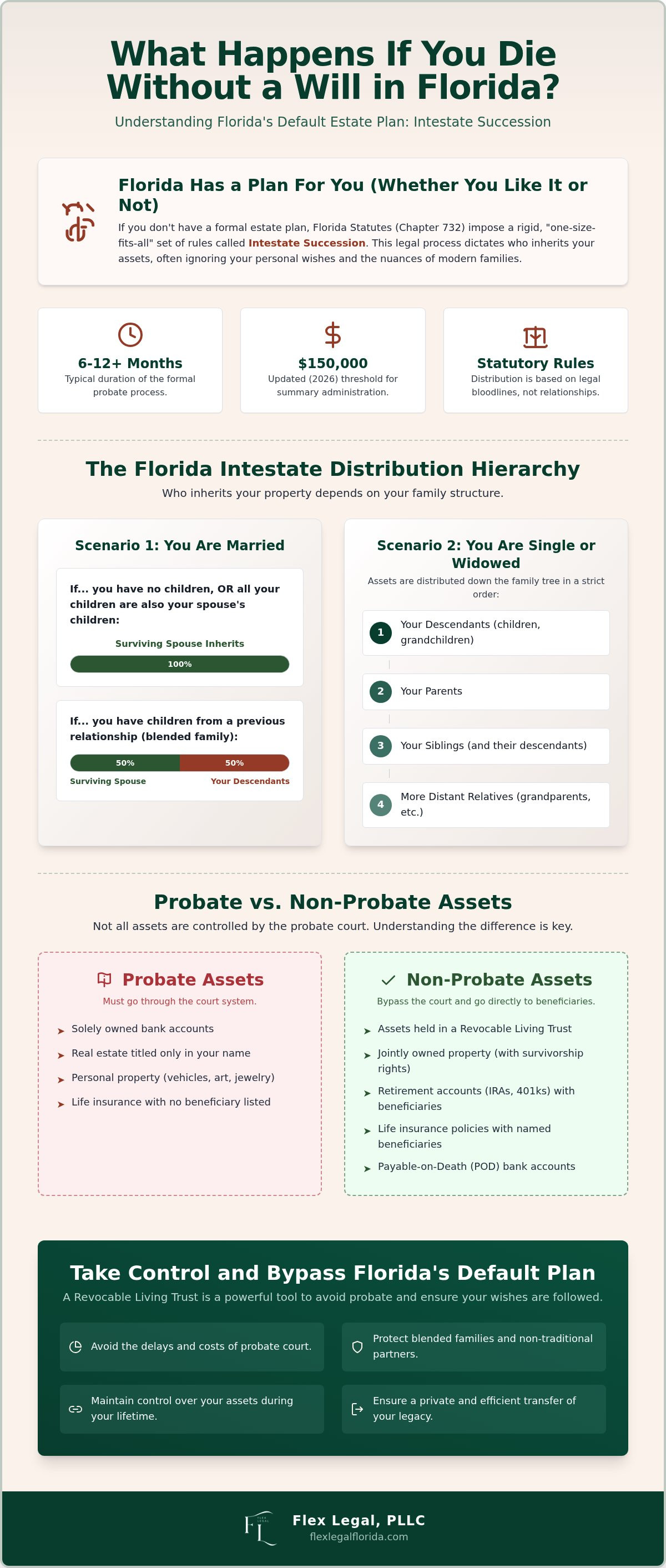
Florida law doesn't leave the distribution of your estate to guesswork. Instead, the state uses a rigid hierarchy to determine who receives your assets. When exploring what happens if you die without a will in Florida, you'll find that the court follows the Florida Intestate Succession Laws with zero room for deviation based on personal relationships or verbal promises. This statutory "order of operations" ensures that assets move through your family tree in a predictable, if inflexible, manner.
Scenario 1: You are Married
Surviving spouses enjoy significant protections, but the specific distribution depends on your family structure. If you have no children, or if all your children are also the children of your surviving spouse, that spouse typically inherits 100% of the intestate estate. However, the rules change drastically for blended families. If you have children from a previous relationship, the surviving spouse receives 50%, and your descendants split the remaining 50%. This 50/50 split rule often surprises families and can lead to unintended financial strain for a spouse who expected to maintain their full standard of living.
Scenario 2: You are Single or Widowed
If you aren't married at the time of your death, the law looks toward your lineal descendants. Florida uses a per stirpes distribution method. This means if a child has passed away before you, their share of the inheritance passes down to their own children. If you have no children or grandchildren, the hierarchy moves upward to your parents. If your parents are no longer living, the estate is divided among your siblings and their descendants. This search continues through more distant relatives, including grandparents and aunts or uncles, until an heir is identified.
The search for heirs can become quite complex, sometimes reaching distant relatives who may have never even met you. In the extremely rare event that no living relatives can be found anywhere in your family tree, the assets "escheat" to the state. This means the state of Florida takes ownership of the property for the benefit of the state's school fund. To avoid these rigid outcomes, many families choose probate administration support to navigate existing cases or proactive planning to bypass the hierarchy entirely. By taking action now, you ensure your estate supports the people you actually care about rather than following a generic legal script.
Probate vs. Non-Probate Assets: What a Will Actually Controls
To accurately predict what happens if you die without a will in Florida, you must first distinguish between probate and non-probate assets. Florida’s intestate succession laws only apply to probate assets. These are properties or accounts held exclusively in your individual name without a designated beneficiary. Assets that have a built-in transfer mechanism pass directly to the recipient, bypassing the court entirely. This distinction is vital because it determines how quickly your loved ones can access the support they need.
Life insurance proceeds and retirement accounts like 401(k)s or IRAs are classic examples of non-probate assets. Because these contracts require you to name a beneficiary, the funds move automatically upon your death. Similarly, bank accounts with a "Payable on Death" (POD) designation or brokerage accounts with a "Transfer on Death" (TOD) instruction remain outside the reach of the probate judge. This automatic transfer provides your family with immediate liquidity during a difficult time, avoiding the delays often associated with the West Palm Beach court system.
Common Non-Probate Assets in Florida
Most modern estate plans rely on these automatic transfers to simplify the transition of wealth. In Palm Beach County, common non-probate assets include:
Life Insurance: Proceeds go directly to the named person, provided the estate itself isn't listed as the beneficiary.
Jointly Held Property: Real estate held as "Joint Tenants with Right of Survivorship" or "Tenants by the Entirety" transfers to the surviving owner instantly.
Retirement Accounts: IRA and 401(k) balances follow the specific beneficiary forms you filed with the financial institution rather than state law.
The Trap of the "Individual Account"
The most frequent cause of unexpected court involvement is the "individual account" trap. You might have a checking account used for daily expenses that lacks a POD designation. Even if the balance is modest, it remains a probate asset. As of July 1, 2026, the limit for a family member to request funds from a bank without court proceedings is only $2,000. Anything above that amount typically requires legal intervention to release, even if the money is clearly intended for a surviving spouse.
Verifying the titles on your West Palm Beach property deeds is another critical step in your planning. If a deed isn't structured correctly, your home could be subject to the default state plan. Consulting a Probate Lawyer in Palm Beach County: A 2026 Guide to Florida Estate Administration can help you identify these hidden triggers. By aligning your account titles with your overall goals, you ensure that your legacy is defined by your choices rather than a legal default.
Common Complications: Blended Families, Stepchildren, and the Homestead Trap
When families aren't structured in the traditional sense, the state's default plan often creates significant friction. What happens if you die without a will in florida is especially complicated for blended families where loyalties and legal rights may conflict. The law prioritizes biological and legal bonds, which can lead to accidental disinheritance for those you love most. Stepchildren, for instance, have no legal standing to inherit under Florida's intestate rules, even if you raised them as your own since they were toddlers. This rigid adherence to bloodlines ignores the reality of many modern West Palm Beach households.
The Florida Homestead Trap
Florida Homestead property is subject to unique constitutional protections that limit how it can be devised or inherited. If you die intestate with a spouse and descendants, your primary residence doesn't just pass to your spouse in its entirety. Instead, the surviving spouse typically receives a life estate, which allows them to live there for their lifetime, while the children receive the "remainder" interest. Alternatively, the spouse can elect to take a 50% interest as a tenant in common with the children. This often turns a family home into a legal battlefield between a stepparent and stepchildren, especially in second or third marriages where relationships may be strained. Without a clear plan, your spouse could find themselves forced to share ownership of their home with your adult children from a previous relationship.
Unmarried Partners and Modern Relationships
Florida doesn't recognize common law marriage, regardless of how many years you've lived together or how many assets you share. If you aren't legally married, your partner has zero right to your intestate assets. This total exclusion can leave long-term partners without a home or financial support at the exact moment they are most vulnerable. For families with complex needs, such as those requiring a Special Needs Planning Attorney in West Palm Beach: A 2026 Guide for Families, the lack of a formal plan is even more dangerous. Without clear legal designations, the court also steps in to appoint guardians for minor children. This means a judge who doesn't know your family dynamics will decide who raises your children, potentially choosing a biological relative you would never have trusted with that responsibility.
These complications highlight why "good enough" isn't an option for modern families. You can replace these rigid outcomes with a plan that reflects your actual life and protects your chosen loved ones. Secure your family's future and avoid the homestead trap by starting your estate planning today.
Taking Control: How to Bypass Florida’s Default Succession
Understanding what happens if you die without a will in Florida is the first step toward reclaiming your family’s future. While the state’s default plan provides a safety net, it’s rarely the most efficient or compassionate way to handle your legacy. Relying on statutes often leads to unnecessary delays, public court records, and family friction. You have the power to replace this rigid legal framework with a customized strategy that prioritizes speed, privacy, and your specific family dynamics.
Many people believe that a Last Will and Testament is the final word in estate planning. While a will is an essential document, it’s important to realize that it still requires the oversight of the West Palm Beach probate court. A will essentially acts as a letter to a judge, who then supervises the distribution of your assets. This process can take 6 to 12 months for formal administration, during which time your assets may be restricted and your family’s private business becomes a matter of public record.
Wills vs. Trusts in Palm Beach County
For those seeking a more streamlined alternative, the Revocable Living Trust is often considered the "Gold Standard" of modern planning. Unlike a will, a trust allows your assets to pass to your beneficiaries immediately upon your death without court intervention. This bypasses the probate process entirely, saving your family from the stress of court hearings and the expense of statutory fees. In our Revocable Trust Guide: Protecting Your West Palm Beach Estate in 2026, we explore how these documents provide the adaptability needed to handle changing life circumstances.
Adaptability is the core value of a forward-thinking plan. A complete strategy doesn't just address what happens after you're gone; it protects you while you’re alive. Documents like a Durable Power of Attorney and a Designation of Health Care Surrogate ensure that if you’re ever unable to make decisions, someone you trust is already legally empowered to act on your behalf. This prevents the need for costly guardianship proceedings and keeps your care in the hands of your chosen allies.
Next Steps for West Palm Beach Residents
The path to a secure future begins with a comprehensive review of your current assets and family goals. At Flex Legal, PLLC, we focus on providing modern, transparent solutions that remove the intimidation factor from professional legal services. We offer fixed-price packages for document preparation, ensuring you know exactly what to expect without the surprise of hourly billing. This flat-fee model provides the certainty you need when building a dynamic support system for your loved ones.
Don’t let a generic state statute define your family’s future. Your legacy should be a reflection of your values and the love you have for your family, not a one-size-fits-all legal formula. You can schedule a consultation with Flex Legal, PLLC today to begin designing a plan that keeps you in control and your family out of court.
Securing Your Family’s Future Beyond the Default Plan
Florida’s intestate laws provide a basic structure, but they lack the nuance required for modern families. Relying on these statutes means accepting a rigid hierarchy that often ignores the needs of stepchildren, long-term partners, and blended family dynamics. By distinguishing between probate and non-probate assets, you can see a path that bypasses the friction of the court system entirely. Understanding exactly what happens if you die without a will in florida is the first step toward building a strategy that reflects your actual life and values.
You don't have to navigate these complex requirements alone. Flex Legal, PLLC acts as an agile ally, providing modern legal solutions that prioritize clarity and comfort. With our specialized expertise in West Palm Beach probate and trust administration, we offer the adaptability your family deserves. Our flat-fee pricing ensures you have total peace of mind throughout the planning process. Secure your family’s future with a custom estate plan from Flex Legal, PLLC. Taking this step today ensures your legacy is protected by design rather than left to a generic state formula. You have the power to protect what matters most.
Frequently Asked Questions
Does my spouse automatically inherit everything in Florida if I die without a will?
Not necessarily. While a surviving spouse inherits the entire estate if there are no children or if all children are from that marriage, the rules change for blended families. If you have children from a previous relationship, your spouse receives 50% of the intestate estate, and your descendants split the remaining 50%. This split can create unexpected financial challenges for a spouse who expected to maintain full control over marital assets.
What happens to my house if I die without a will in Florida?
Your primary residence is governed by strict homestead laws. If you have a spouse and descendants, the spouse typically receives a life estate, allowing them to live in the home for their lifetime, while the children hold the remainder interest. Alternatively, the spouse can elect to take a 50% ownership stake. This complex structure often requires legal guidance to ensure the home doesn't become a source of family conflict.
Can stepchildren inherit under Florida intestate laws?
No, stepchildren have no legal right to inherit under Florida’s default rules unless they were formally adopted. This is a common point of friction in modern families. Even if you raised a stepchild as your own for decades, the law will bypass them in favor of biological relatives. To include stepchildren in your legacy, you must move beyond the state's plan and create a customized estate document.
How long does the intestate probate process take in Palm Beach County?
The timeline varies based on the estate's complexity and value. For estates under the updated 2026 threshold of $150,000, summary administration can often be completed in about 8 weeks. However, formal probate administration for larger or contested estates in West Palm Beach typically takes 6 to 12 months. Factors like creditor claims and the search for distant heirs can extend this process even further, delaying the distribution of assets.
What is the "Homestead Trap" in Florida probate?
The "Homestead Trap" refers to constitutional restrictions that limit how you can distribute your primary residence. If you have a spouse or minor children, you cannot legally leave your home to anyone else, even in a written will. When considering what happens if you die without a will in florida, the trap often forces a surviving spouse to share ownership with adult children, potentially leading to forced sales or litigation.
Does a domestic partner have inheritance rights in Florida?
No, Florida law does not recognize domestic partnerships or common law marriages for inheritance purposes. Regardless of how long you have lived together or shared finances, an unmarried partner is completely excluded from your intestate estate. Without a Revocable Living Trust or a Last Will and Testament, your partner could be left without financial support or even lose access to a shared home during the probate process.
What happens if no heirs can be found for a Florida estate?
In the rare event that the court cannot identify any living relatives within the legal hierarchy, your assets will "escheat" to the state. This means the state of Florida takes ownership of your property, and the proceeds are deposited into the State School Fund. This outcome is a last resort, but it highlights the importance of naming specific beneficiaries to ensure your hard-earned assets support the people or causes you care about.
How can I avoid Florida’s intestate succession laws entirely?
You can bypass the state's default plan by proactively titling your assets and using modern planning tools. A Revocable Living Trust is the most effective way to keep your estate out of the court system entirely. Additionally, you should verify that your bank accounts have "Payable on Death" (POD) designations and that your retirement accounts have updated beneficiary forms. These steps ensure your assets transfer automatically, providing your family with immediate support.



Comments