
What Does a Probate Lawyer Do in Florida? A 2026 Guide for Families
- Kelly Mata
- Jul 2
- 11 min read

Updated: Jul 20
What if the legal process you've been dreading is actually the key to securing your family's future with more transparency than ever before? You likely feel the weight of protecting a legacy while worrying about the mandatory court requirements that seem designed to slow you down. If you're asking what does a probate lawyer do in Florida, you're looking for more than just a signature on a document. You want a strategic ally who can navigate the 2026 legislative shifts and keep your inheritance on track.
This guide provides a clear roadmap to help you protect assets from creditors and avoid common administrative delays. You'll learn how a modern legal partner uses the new $150,000 summary administration threshold to streamline your case. We'll preview the essential duties of a Florida probate attorney and explain how our approach in Palm Beach County prioritizes your peace of mind through every step of the process. By the end, you'll understand how to transform a complex legal burden into a smooth, efficient transition for your family.
Table of Contents
The Essential Role of a Florida Probate Lawyer: More Than Just Paperwork
A probate lawyer serves as the authorized legal representative for the estate's Personal Representative. In the high-stakes environment of Florida law, they act as the primary conduit between your family and the court system. Many families ask, what does a probate lawyer do in Florida beyond filing standard forms? They ensure every action taken by the Personal Representative complies with strict fiduciary standards. This protects you from personal liability while ensuring the decedent's wishes are honored.
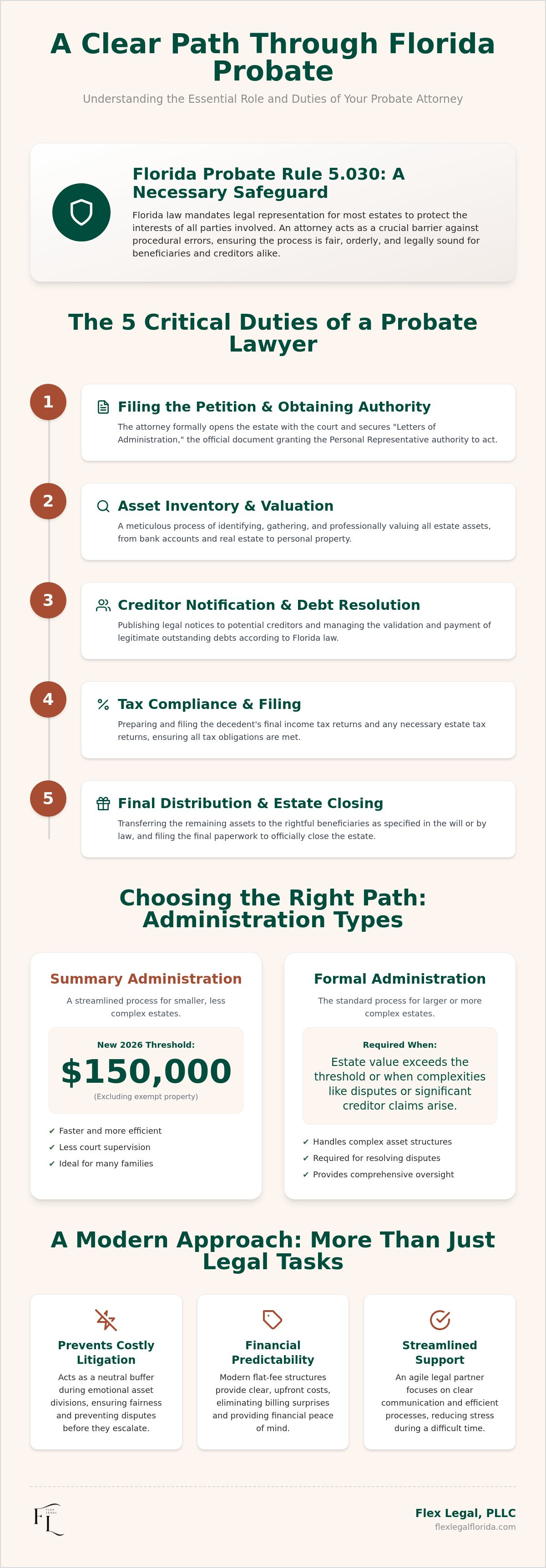
Florida Probate Rule 5.030 is a unique cornerstone of the state's legal system. It mandates that nearly every estate must be represented by an attorney. This requirement exists because the Probate process involves technical legal procedures that impact the rights of third parties, including creditors and taxing authorities. Without a licensed attorney, the risk of procedural errors is high. These mistakes can invalidate an inheritance or leave the estate vulnerable to long-term legal challenges.
It's vital to distinguish between Probate Administration and probate litigation. When people ask what does a probate lawyer do in Florida, they are usually looking for help with administration. This is the orderly process of settling an estate. Litigation, on the other hand, occurs when disputes arise. By acting as a strategic navigator, a lawyer focuses on smooth administration to prevent the need for litigation from the start.
Why Florida Requires Legal Representation
The court views a licensed attorney as a necessary safeguard for the rights of everyone involved. This includes distant beneficiaries who may not be present and creditors who are legally entitled to payment from estate assets. Professional oversight ensures that fiduciary duties are met without fail. This professional barrier also prevents non-lawyers from accidentally engaging in the unauthorized practice of law. Such errors often lead to significant legal setbacks, increased costs, and extended court timelines.
Ensuring that estates are handled by high-caliber legal professionals is a priority across the industry, and organizations like Esquire Talent Consultants play a key role in connecting top legal talent with the firms that serve families in transition.
The Concept of an Agile Legal Ally
Modern families often find traditional legal models to be slow and intimidating. An agile legal ally shifts this dynamic by prioritizing efficiency and accessibility. This approach moves away from dense legal jargon and toward clear, empathetic communication during the grieving process. At Flex Legal, we believe probate shouldn't feel like a rigid set of rules. Instead, it should be a dynamic support system that adapts to your family's specific needs. We focus on providing a streamlined path forward that values your time and your peace of mind.
Navigating the Florida Probate Process: 5 Critical Lawyer Duties
When you step into the role of a personal representative, the procedural weight can feel immense. You might find yourself asking, what does a probate lawyer do in Florida to actually move things forward? Their work begins with filing the Petition for Administration. This document officially introduces the estate to the court and triggers the legal timeline. Following Florida's official probate process ensures that every step, from the initial inventory phase to the final distribution, meets the state's rigorous standards.
A lawyer's duties are diverse and highly technical. They act as the engine behind the scenes, ensuring five critical milestones are reached:
Filing the Petition: Formally opening the estate and requesting the court's recognition.
Asset Inventory: Identifying, gathering, and valuing every piece of property the decedent owned.
Creditor Management: Publishing the required legal notices and resolving outstanding debts.
Tax Compliance: Calculating and filing necessary estate, income, and inheritance tax returns.
Final Distribution: Transferring assets to the rightful beneficiaries and obtaining a court order to close the estate.
The Petition and Letters of Administration
Letters of Administration are the "golden ticket" of the probate world. These court-issued documents grant the personal representative the legal authority to access bank accounts and sell property. Your attorney verifies the validity of the Last Will and Testament to ensure it meets Florida's strict signing requirements. If no will exists, the estate is considered "intestate." In these cases, your lawyer applies Florida's intestacy laws to determine the rightful heirs based on a fixed legal hierarchy. This ensures the estate moves forward even without a written plan.
Managing Creditors and Asset Inventory
Once the estate is open, your lawyer publishes a "Notice to Creditors" in a local newspaper. This starts a strict 90-day window for creditors to file claims against the estate. Managing these timelines is a primary reason why people wonder what does a probate lawyer do in Florida when it comes to debt resolution. Your attorney acts as a defensive shield by scrutinizing every claim to ensure the estate doesn't pay invalid or expired debts. They also coordinate with professional appraisers to determine the fair market value of real estate or business interests. For families seeking a modern, streamlined approach to these tasks, our Probate Administration services provide the agility needed to resolve estates without unnecessary friction.
Choosing the Right Path: Summary vs. Formal Administration in West Palm Beach
Deciding between Summary and Formal Administration is the first major strategic hurdle for any estate. Many families wonder, what does a probate lawyer do in Florida to simplify this choice? Your attorney analyzes the total value of non-exempt property and the time elapsed since the date of death to find the most efficient route. Following The Florida Bar's guide to probate, the goal is to select the path that offers the most protection while minimizing time in the court system. In West Palm Beach, the local court has specific filing preferences that an experienced local attorney handles to prevent administrative rejections and delays.
As of July 1, 2026, the legislative landscape in Florida has shifted significantly. The threshold for Summary Administration has increased from $75,000 to $150,000. This expansion means more families can now qualify for a streamlined process that often concludes in weeks rather than months. Your lawyer ensures that all exempt property, such as the decedent's primary residence, is correctly excluded from this calculation to maximize your eligibility for this faster route. This strategic planning is a core part of how an agile legal ally protects your family's legacy.
When Summary Administration is the Smart Choice
Summary Administration is often the most efficient option for smaller estates or those where the decedent passed away more than two years ago. Even in these seemingly simple cases, legal oversight is vital to ensure all beneficiaries are accounted for and that the court order correctly transfers title to assets. For deeper insights into navigating the Palm Beach County court system, consult our specialized probate lawyer in Palm Beach County guide. This fast-track option saves time, but it requires precise documentation to satisfy local judges who oversee the process in the Fifteenth Judicial Circuit.
Managing the Complexity of Formal Administration
Formal Administration remains the standard for estates exceeding $150,000 or those with ongoing business interests. In these cases, the question of what does a probate lawyer do in Florida becomes even more critical. They manage the full court-ordered accounting and ensure the personal representative is protected from personal liability throughout the process. Formal administration is also a powerful tool for resolving complex creditor issues, as it provides a structured environment to negotiate or contest claims effectively. Your attorney takes the lead in maintaining estate property and managing recurring expenses, ensuring that assets are preserved until the final distribution can occur safely.
Protecting Beneficiaries: How a Lawyer Prevents Costly Litigation
Inheritance often brings complex emotions to the surface, turning a legal process into a family crisis. Many clients ask, what does a probate lawyer do in Florida to keep the peace? Beyond filing paperwork, they act as a neutral buffer. This role is essential for preventing the costly litigation that often drains estate assets. By providing transparent accounting and clear communication, an attorney ensures that every beneficiary feels heard and respected. This transparency is the best defense against "Breach of Fiduciary Duty" claims, which often arise from simple misunderstandings or a lack of information.
For families with vulnerable members, the stakes are even higher. Integrating special needs planning within the probate context ensures that an inheritance doesn't accidentally disqualify a loved one from essential government benefits. This level of customization transforms a standard probate case into a comprehensive protection plan for the next generation.
Mediating Family Conflicts and Disputes
Proactive communication is the cornerstone of conflict prevention. An agile legal partner provides regular updates to all beneficiaries, not just the personal representative. This approach neutralizes suspicion before it grows into a formal challenge. When a will is contested or a personal representative's actions are questioned, the lawyer provides the legal framework to resolve the issue through mediation rather than a courtroom battle. Clear legal boundaries naturally reduce the emotional friction that often leads to long term family estrangement.
Asset Protection and Business Succession
Probate shouldn't mean a family business comes to a halt. Your attorney works to ensure business continuity by securing court orders that allow for ongoing operations and payroll. They also integrate asset protection strategies to safeguard the inheritance from external threats like creditors or future lawsuits. This involves coordinating with existing trusts to ensure a seamless transition of wealth and authority. When you look at what does a probate lawyer do in Florida, their ability to protect the value of an estate while it's in transition is perhaps their most strategic contribution.
Protect your family's legacy with a partner who values clarity over conflict. Explore our Probate Administration services to see how we can streamline your transition.
Modern Probate Solutions with Flex Legal, PLLC
Settling an estate shouldn't feel like navigating a maze of outdated traditions. Jennifer L. Flexer, Esq. founded Flex Legal, PLLC with a clear mission: to provide an agile, tech-forward approach to Florida law that prioritizes the family experience. When people ask what does a probate lawyer do in Florida to make a difference, the answer lies in adaptability. We move away from the rigid, one-size-fits-all models of the past. Instead, we offer a dynamic support system that uses modern communication and streamlined workflows to resolve estates with speed and precision.
West Palm Beach families choose our firm because we bridge the gap between sophisticated legal authority and genuine accessibility. We understand that you're managing more than just a court case; you're managing a major life transition. Our roadmap development process begins with an initial consultation where we identify your specific challenges and build a customized path forward. This ensures that every step we take is purposeful and aligned with your family's unique goals.
Transparency in Probate Fees
One of the most significant 2026 updates in Florida probate law focuses on fee transparency. New regulations reinforce that there is no mandatory statutory fee for attorneys. While many traditional firms still rely on a percentage of the estate's value, we offer flat-fee arrangements for predictable estate administration. This provides price certainty in what can otherwise be an uncertain process. By choosing a flat-fee model, you eliminate the anxiety of hidden costs and billable hour surprises. This financial clarity allows you to focus on your family's well-being rather than the cost of every phone call or email.
Your West Palm Beach Probate Partner
Local expertise matters when you're dealing with the Palm Beach County judicial circuit. We understand the specific preferences of local judges and the administrative nuances of our regional courts. This local insight allows us to anticipate potential friction points before they cause delays. Our commitment is to make the legal process feel human and manageable, acting as your peer and partner through every court filing and asset distribution. We don't just process paperwork; we protect your peace of mind. If you're ready for a more responsive legal experience, schedule your consultation with Flex Legal today and let us help you secure your family's legacy.
Moving Forward with Confidence and Clarity
Navigating the transition of an estate is a significant responsibility, but you don't have to manage it alone. By understanding what does a probate lawyer do in Florida, you've taken the first step toward protecting your family’s inheritance and ensuring a smooth administrative process. From leveraging the new 2026 summary administration thresholds to resolving complex creditor claims, the right legal partner transforms a mandatory court process into a strategic asset for your family.
Flex Legal, PLLC, led by Jennifer L. Flexer, Esq., specializes in Florida Probate and Special Needs Planning with a focus on modern, agile solutions. We prioritize your peace of mind by offering flat-fee pricing models for estate services, ensuring you never face unexpected financial hurdles during a difficult time. Our team acts as your dedicated ally in West Palm Beach, providing the professional authority and empathetic support you deserve.
Secure your family's future with a West Palm Beach probate ally. We are ready to help you turn a complex legal requirement into a clear, manageable path forward.
Frequently Asked Questions
Is a lawyer required for probate in Florida?
Yes, Florida law generally mandates that every personal representative be represented by an attorney. Florida Probate Rule 5.030 requires this because the process affects the legal rights of creditors and beneficiaries who aren't present in court. Only very small estates, such as those qualifying for a Disposition without Administration, can typically proceed without formal legal counsel.
How much does a probate lawyer typically cost in West Palm Beach?
Attorney fees in Florida are negotiable and aren't set by a mandatory state schedule. While some traditional firms use a percentage based on the estate's value, modern practices often offer flat-fee arrangements for better predictability. You should always receive a written agreement that clearly outlines the billing methods to ensure full transparency throughout the process.
How long does the probate process take in Florida with a lawyer?
The timeline depends on the type of administration your estate requires. Summary administration for estates under the $150,000 threshold can often be completed in just a few weeks. Formal administration is more complex and typically lasts six to twelve months; this accounts for the mandatory 90-day creditor claim period and the time needed for final tax filings.
Can a probate lawyer help if there is no will (intestacy)?
Yes, an attorney is essential when someone dies without a will, which is known as dying intestate. In these cases, the lawyer helps the court identify the legal heirs based on Florida’s specific intestacy statutes. They ensure the estate follows the state's default distribution plan while managing the same administrative duties as an estate with a valid will.
Who is responsible for paying the probate attorney's fees?
Attorney fees are considered an administrative expense of the estate. This means the estate's assets pay for the legal services before the remaining funds are distributed to beneficiaries. If a personal representative pays out of pocket to start the process, they are typically entitled to full reimbursement from the estate’s funds once the court grants them access.
What happens if a beneficiary disagrees with the probate lawyer's actions?
It's important to understand that the probate lawyer represents the Personal Representative, not the individual beneficiaries. If you're a beneficiary and disagree with how the estate is being managed, you have the right to hire your own independent counsel. Your lawyer can then file objections or challenge specific actions in court to protect your inheritance rights.
Can a lawyer help speed up the Florida probate process?
A lawyer speeds up the process by preventing procedural errors that lead to court rejections. When asking what does a probate lawyer do in Florida to save time, their primary value is managing the strict 90-day creditor window and ensuring all documentation is accurate. Their local knowledge of the West Palm Beach court system helps avoid the administrative bottlenecks that often stall cases.
What is the difference between an estate planning lawyer and a probate lawyer?
These roles focus on different stages of your legacy. An estate planning lawyer helps you create documents like wills and trusts while you're alive to minimize future court involvement. A probate lawyer steps in after a death to guide the family through the court-supervised process of settling the estate according to those documents or state law.
While probate and estate planning address legacy and asset distribution, other legal needs such as personal injury or premises liability require separate expertise; for these matters, Fenderson Law Firm provides dedicated advocacy for Florida residents.


Comments