
Trust Administration vs. Probate in Florida: A 2026 Comparison Guide

What if the traditional path for settling a Florida estate is actually the most expensive and public way to handle your family's legacy? Most people assume that having a will is enough to keep things simple, but the reality of the court system often tells a different story. You're likely feeling the pressure of protecting assets while worrying about potential family disputes or personal liability for a technical oversight. It's a heavy burden to carry during an already emotional time.
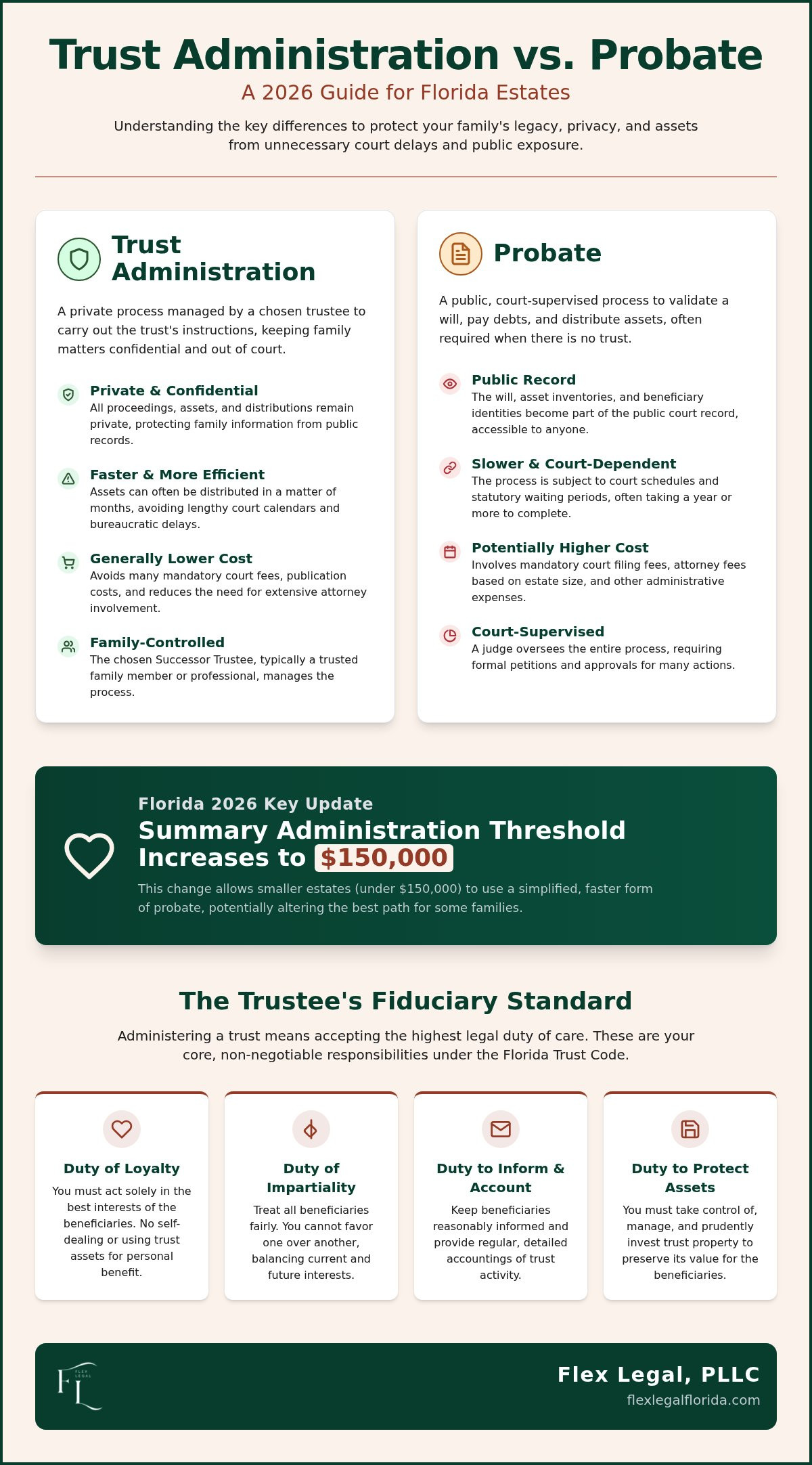
We understand that you need clarity, not more jargon. This guide explores the critical differences in trust administration vs probate florida, specifically looking at the 2026 legal environment. With the recent increase in the summary administration threshold to $150,000, your options for a streamlined process have evolved. We'll provide a clear roadmap of your legal duties and the costs involved in each path. By the end of this comparison, you'll have the confidence to fulfill your fiduciary role while minimizing taxes and avoiding unnecessary legal friction.
Table of Contents
What is Trust Administration in Florida?
Trust administration is the practical process of carrying out the instructions left behind in a trust document. While many people focus on the creation of the trust, the administration phase is where the plan actually comes to life. It involves managing, protecting, and eventually distributing assets when the grantor, the person who created the trust, passes away or becomes unable to handle their own affairs. Unlike the public court process, this is a private legal relationship designed to keep family matters out of the spotlight.
When comparing trust administration vs probate florida, the primary difference lies in control and speed. Administration is necessary because assets don't just move themselves. A Successor Trustee must step in to act as the manager of the legacy. This individual holds a significant responsibility to ensure that asset protection strategies remain intact and that federal estate taxes are minimized according to the original plan. The primary goals are clear: protect the assets, minimize the tax burden, and distribute the inheritance exactly as intended.
The Legal Basis: The Florida Trust Code
In Florida, trusts aren't just governed by personal wishes; they're backed by Florida Statutes Chapter 736, known as the Florida Trust Code. This body of law provides the framework for how trustees must behave and what rights beneficiaries hold in a 2026 legal context. While the statute provides the guardrails, the trust document itself serves as the "private law" for the family. It dictates exactly how the Grantor wants their Successor Trustee to handle specific situations, from the timing of distributions to the management of modern assets. This legal structure ensures that the trustee's actions remain transparent and accountable to the beneficiaries.
Why Administration Matters for West Palm Beach Families
Managing an estate in Palm Beach County requires an understanding of local nuances that national guides often overlook. For many families in our area, the most significant asset is the family home. Florida’s unique homestead laws create specific protections and restrictions that impact how property is handled within a trust. If these rules aren't followed precisely, the intended protections could vanish. It's a complex landscape that requires a steady hand.
Working with an agile ally who understands the local landscape ensures that these complexities don't turn into roadblocks. Properly managing these assets is a core part of a broader strategy, which you can explore further in our Revocable Trust Guide: Protecting Your West Palm Beach Estate in 2026. Understanding the nuances of trust administration vs probate florida helps families avoid the delays of the court system while ensuring that every statutory notice requirement is met with precision.
The Fiduciary Standard: Legal Duties of a Florida Trustee
Being named a successor trustee is a significant responsibility that carries a heavy legal weight. In Florida, you're held to a fiduciary standard, which is the highest level of care recognized by our legal system. This isn't just a set of suggestions; it's a strict mandate to act with total integrity and diligence. When you're weighing the pros and cons of trust administration vs probate florida, it's vital to realize that while you avoid the courtroom, you don't avoid the liability. You are legally bound to manage the trust assets for the sole benefit of the people named in the document.
The Duty of Loyalty is the cornerstone of this role. It requires you to put the beneficiaries' interests above your own at all times. You cannot use trust property for personal gain, nor can you engage in "self-dealing" by selling trust assets to yourself or your own business. Alongside this is the Duty of Impartiality. Many trusts have multiple beneficiaries, such as a surviving spouse who needs income now and children who will inherit the remainder later. You must balance these competing needs fairly, without showing favoritism or neglecting one group's future security.
Transparency is your best defense against conflict. Under the 2026 Florida Trust Code, you have a specific Duty to Inform and Account. This includes notifying all qualified beneficiaries of the trust's existence within 60 days of your acceptance as trustee. While the process of Probate in Florida requires public court filings, trust administration allows you to keep these financial details private. However, you must still provide regular, detailed accountings to the beneficiaries so they stay informed about the trust's progress.
Avoiding Personal Liability as a Trustee
The fastest way to invite a lawsuit in Palm Beach County is to commingle funds. You must keep trust assets in accounts that are entirely separate from your personal finances. Even a small "loan" from the trust to yourself can be viewed as a breach of duty. Keep meticulous records and receipts for every single transaction, no matter how minor it seems. Detailed documentation acts as a shield, proving you've acted in good faith if a beneficiary ever questions your decisions. If you're feeling overwhelmed by these requirements, partnering with an agile ally can help you stay organized and compliant.
Special Considerations for Special Needs Trusts
Administering a Special Needs Trust (SNT) requires an even higher level of precision. Your primary duty here is to protect the beneficiary's eligibility for government benefits like Medicaid and SSI. A single improper distribution can disqualify them from essential care. You must understand the specific 2026 Florida distribution rules, which often restrict paying for things like food or shelter directly. For more detailed support on these complex requirements, see our guide on being a Special Needs Planning Attorney in West Palm Beach: A 2026 Guide for Families.
Trust Administration vs. Probate: Navigating the Florida Legal Landscape
A common myth suggests that having a trust means your family has zero work to do after you're gone. While a trust bypasses the courtroom, it doesn't bypass the law. When comparing trust administration vs probate florida, the main difference isn't the amount of work, but rather who oversees that work. In probate, a judge and the public record are involved. In trust administration, the process stays private and is managed by your chosen successor trustee. This privacy is a major draw for many families who don't want their financial details or beneficiary lists available for public viewing at the county clerk's office.
Timing is another critical factor. Probate is tied to the court's calendar, which can be unpredictable. Even a simple case can take months to resolve. Trust administration moves at the speed of the trustee and their legal team. Because you don't have to wait for court dates or "Letters of Administration" from a judge, assets can often be managed or distributed much faster. This speed is especially vital when dealing with volatile assets or immediate family needs.
Cost structures also vary significantly. Florida law presumes that attorney fees for probate are reasonable when they're about 3% of the estate's value for estates between $100,000 and $1 million. When you add in court filing fees, which are approximately $402 for formal administration in 2026, the total cost of probate often ranges from 3% to 7% of the gross estate. Trust administration avoids these mandatory court fees and the rigid statutory fee schedule, often resulting in lower overall costs for the family legacy.
When Trust Administration Overlaps with Probate
Sometimes, a trust and probate happen at the same time. This usually occurs when a "Pour-Over Will" is used to catch assets that weren't properly titled in the trust's name before death. In these cases, the trustee must also file a Notice of Trust with the probate court to alert creditors. This bridge between the two processes ensures that all debts are settled correctly. To understand how these two systems interact on the ground, you can explore our guide for a Probate Lawyer in Palm Beach County: A 2026 Guide to Florida Estate Administration.
The Role of the Palm Beach County Clerk of Court
Even though trust administration is private, it may still touch the local court system in West Palm Beach. If the trust document is unclear or if beneficiaries disagree on the trustee's actions, a trustee might need to petition the court for a formal "construction" or "declaration of rights." Most of these matters are handled at the courthouse in West Palm Beach. Having a local, agile ally who knows the specific preferences of the Palm Beach County judiciary can prevent minor administrative questions from turning into expensive litigation.
The Step-by-Step Roadmap to Administering a Florida Trust in 2026
Settling a legacy requires a steady hand and a logical sequence. While the choice of trust administration vs probate florida often hinges on privacy, the actual work involves a series of mandatory legal and financial checkpoints. Following a structured path helps you avoid personal liability and ensures the grantor's wishes are respected without delay.
First, you must review the trust document to confirm your authority. Formally accepting the trusteeship triggers your fiduciary duties. Second, you'll need to inventory every asset. This isn't just about bank accounts; you must appraise real estate and identify modern holdings like cryptocurrency. Third, secure a Taxpayer Identification Number (EIN) from the IRS. This separates the trust's finances from the deceased's social security number, allowing you to open trust-specific bank accounts.
Fourth, comply with Florida's strict notice requirements. You have 60 days to notify qualified beneficiaries of the trust's existence. Fifth, manage the assets while paying legitimate debts and federal estate taxes. In 2026, the federal estate tax exemption is $15 million per person. While most estates won't owe tax, you must still verify the filing requirements to protect the trust from future IRS audits. If you're ready to start this process with a modern partner, reach out to Flex Legal, PLLC for specialized guidance.
Managing Digital Assets and Modern Privacy
Modern estates often include more than just physical property. The Florida Fiduciary Access to Digital Assets Act (RUFADAA) governs how you handle social media, cloud storage, and digital wallets. Locating these assets often requires searching for private keys or hardware wallets. In 2026, Florida law requires specific language in the trust document to grant a fiduciary full access to digital accounts and private keys. Without this, you may be locked out of vital financial records.
Tax Filings and Financial Reporting
Trusts are separate tax entities. You're responsible for filing IRS Form 1041, which is the income tax return for estates and trusts. You must also provide K-1 forms to beneficiaries so they can report their share of the trust's income on their personal returns. Working with an estate planning attorney in West Palm Beach ensures these filings are accurate and timely, preventing costly penalties from the IRS or the state.
The Final Distribution and Trust Dissolution
The final stage is the Plan of Distribution. Before handing over assets, it's vital to obtain "Receipt and Release" forms from every beneficiary. These documents confirm they've received their share and agree to discharge you from further liability. You can distribute property "in-kind," meaning the physical item itself, or sell assets and distribute the cash. Once the assets are gone and the final tax return is filed, the trust is formally dissolved, and your role as an agile ally to the family is complete.
Securing the Legacy: Why Professional Administration Prevents Costly Disputes
Settling an estate is rarely just about balance sheets; it's about the people left behind. When families are grieving, minor disagreements can quickly spiral into major disputes that drain the estate’s value. Professional legal guidance acts as a vital buffer, separating raw emotions from the strict legal requirements of the Florida Trust Code. By acting as an agile ally, an expert helps you navigate complex asset protection strategies that a DIY trustee might overlook. This precision is the best way to reduce the risk of beneficiary lawsuits. When you're deciding between trust administration vs probate florida, remember that the privacy of a trust only works if the administration is handled with total transparency. Legal accuracy ensures that every action you take is defensible and documented. Once the immediate administration is complete, you can begin transitioning from the logistics of the past to future planning for the next generation. This shift allows the family to focus on the legacy they're building rather than the friction of the court system.
Flex Legal’s Approach to West Palm Beach Trust Matters
Flex Legal, PLLC approaches West Palm Beach trust matters with a focus on clarity and comfort. We believe that professional authority doesn't have to be intimidating or cold. Instead, we offer modern, adaptable solutions that prioritize your peace of mind. Our flat-fee models ensure that you have predictable costs from the start, avoiding the anxiety of surprising hourly bills. This transparency is a core part of our mission to be your long-term partner in Palm Beach County. We don't just provide a set of rules; we provide a dynamic support system. For those looking for more information on choosing the right legal support, our Estate Planning Attorney in West Palm Beach: The 2026 Buying Guide provides deep insights into what to look for in a modern firm.
Next Steps for Successor Trustees
If you've just stepped into the role of successor trustee, your first 48 hours are critical for setting the right tone. Taking these immediate steps helps protect the assets and your own reputation.
Locate the original trust document and all recent amendments.
Secure the deceased’s tangible personal property, including jewelry, vehicles, and electronics.
Order at least ten certified copies of the death certificate for financial institutions.
Notify the immediate family and named beneficiaries to manage expectations early.
Your absolute first priority is a comprehensive legal review of the trust document. Understanding your specific powers and limitations before you take any action is the only way to prevent accidental breaches of duty. If you're ready to move forward with confidence and a clear roadmap, reach out to us through our contact page to begin the administration process with an expert ally by your side.
Empowering Your Family's Future with Clarity
Choosing the right path for an estate is a profound act of care for those you leave behind. We've explored how the 2026 legal landscape offers new efficiencies, like the $150,000 threshold for summary probate, yet the privacy and speed of a trust remain unmatched for many. Understanding the nuances of trust administration vs probate florida is the first step toward a seamless transition. Whether you're managing a standard revocable plan or need specialized expertise in complex Special Needs Trust administration, your role as a trustee carries significant legal weight. You don't have to carry that burden alone. Partnering with an agile ally ensures that every statutory notice is met and every asset is protected through strict Florida Trust Code compliance. This modern approach transforms a daunting legal obligation into a clear, manageable roadmap for your family. Secure your legacy with a West Palm Beach Trust Administration expert at Flex Legal. Take the next step today to ensure your peace of mind and your family's security tomorrow.
Frequently Asked Questions
Is trust administration required in Florida if there is no probate?
Yes, trust administration is a mandatory legal process even when you successfully avoid the courtroom. While you don't have to deal with the public filings of a West Palm Beach judge, you still have to follow the Florida Trust Code. This involves notifying beneficiaries, paying final debts, and distributing assets. When comparing trust administration vs probate florida, remember that the trust document acts as your private rulebook for these specific duties.
How long does the trust administration process usually take in Palm Beach County?
Trust administration in Palm Beach County is generally much faster than the formal probate process because it isn't tied to the court's busy calendar. While a standard probate can take six months to a year, a simple trust might be settled in just a few months. However, the timeline depends on the complexity of assets like real estate or business interests. Working with an agile ally helps streamline these steps and prevents unnecessary delays.
Can a trustee be held personally liable for a trust’s financial losses?
Yes, a trustee can be held personally liable if they fail to meet the high fiduciary standards required in Florida. If you commingle trust funds with your personal accounts or make imprudent investment choices, beneficiaries may sue for a "surcharge" to recover losses. Keeping meticulous records and following the trust's specific instructions are your best defenses. Professional guidance ensures you fulfill your duties without putting your personal assets at risk.
What is the Notice of Trust and who needs to receive it?
The Notice of Trust is a public document filed with the Clerk of Court in the county where the settlor lived at the time of death. In West Palm Beach, this filing alerts creditors that a trust exists and can be used to pay legitimate debts. It includes the settlor's name and the date of the trust. This step is vital because it helps establish a clear timeline for settling the estate's financial obligations and limits the window for claims.
Does a trustee get paid for their work in Florida?
Trustees in Florida are entitled to "reasonable compensation" for their time and effort unless the trust document explicitly states otherwise. Under Florida Statute § 736.0708(1), this fee is often calculated as a percentage of the trust's total value, typically ranging from 1% to 3% for immediate distributions. Because Florida has no state income tax, any compensation received by a local trustee is only subject to federal income tax, making the role's financial impact more predictable.
What happens if a beneficiary disagrees with the trustee’s decisions?
If a beneficiary disagrees with your decisions, they have the legal right to request a formal accounting or petition the court in West Palm Beach for help. Disagreements often arise from a lack of transparency regarding asset values or distribution timelines. You can minimize these risks by maintaining open communication and providing regular updates. If a dispute escalates, a judge may be asked to clarify the trust's terms or, in extreme cases, remove the trustee.
Do I need a separate bank account for the trust assets?
You absolutely need a separate bank account for all trust assets to avoid the legal trap of commingling. Once you obtain a Taxpayer Identification Number (EIN) for the trust, you should move assets into accounts specifically titled in the name of the trust. This separation is a core requirement of your fiduciary duty. It ensures that trust funds are never mixed with your personal money, protecting both the beneficiaries' inheritance and your own legal standing.



Comments