
Summary Probate Administration in Florida: The 2026 Efficiency Guide

What if you could bypass months of court delays and high legal fees just because of a recent change in Florida law? Most people assume probate is a mandatory year-long headache, but for many, Summary Probate Administration offers a much faster alternative. You likely feel a mix of frustration and anxiety as you look at court requirements, wondering if there is a simpler way to distribute assets to heirs. We understand that you need a solution that prioritizes speed and clarity over rigid, traditional hurdles.
The good news is that this streamlined process became significantly more accessible on July 1, 2026. With the non-exempt estate value threshold now doubled to $150,000, many more families in Palm Beach County can qualify for this efficient legal shortcut. This guide explores the 2026 efficiency standards, helping you determine if your loved one's estate qualifies for the short-track process. You'll learn how to minimize court intervention, manage costs, and move through the 15th Judicial Circuit with the support of an agile ally.
Table of Contents
What is Summary Probate Administration in Florida?
Many families find the standard probate process intimidating because of its reputation for being slow and expensive. Summary Probate Administration is a simplified alternative designed for estates that meet specific Florida statutory criteria. It's often called "Probate Lite" or the "Short-Track" option because it cuts through the typical red tape that slows down traditional court proceedings. Summary Administration is the expedited legal procedure governed by Florida Statute Chapter 735.
The primary objective of this process is to distribute assets directly to beneficiaries. Unlike the traditional route, this method doesn't require the appointment of a long-term Personal Representative to manage the estate for months. Instead, the court reviews the petition and issues an order that immediately transfers legal title of the assets to the rightful heirs. This streamlined approach makes it a highly efficient choice for families who want to settle affairs quickly without the burden of ongoing court supervision.
Key Benefits of the Summary Process
Summary Probate Administration offers several distinct advantages for eligible estates in Palm Beach County. Most notably, the timelines are significantly shorter. While traditional probate can drag on for a year or more, a summary proceeding often concludes in just a few weeks. This speed is a result of fewer procedural requirements and less court oversight. You also benefit from lower court filing fees and reduced attorney labor hours, which helps preserve the estate's value for the family. Once the judge signs the order, the distribution of assets happens immediately. This provides much-needed closure and financial relief during a difficult time.
When Summary Probate is Not Enough
While the speed of the short-track process is attractive, it isn't a universal solution. If an estate faces significant creditor claims, a long-term representative might be necessary to negotiate or settle those debts. Summary administration doesn't provide the same level of protection against creditors that formal administration offers. Similarly, estates involving complex litigation, such as a contested will, require the more robust structure of a formal proceeding. Some federal issues, like dealing with the IRS or specific out-of-state assets, may also require "Letters of Administration." This specific document is only issued in formal proceedings. Identifying these roadblocks early ensures you choose the most adaptable path for your family's unique situation.
Strict Eligibility: Does Your Estate Qualify for Summary Probate?
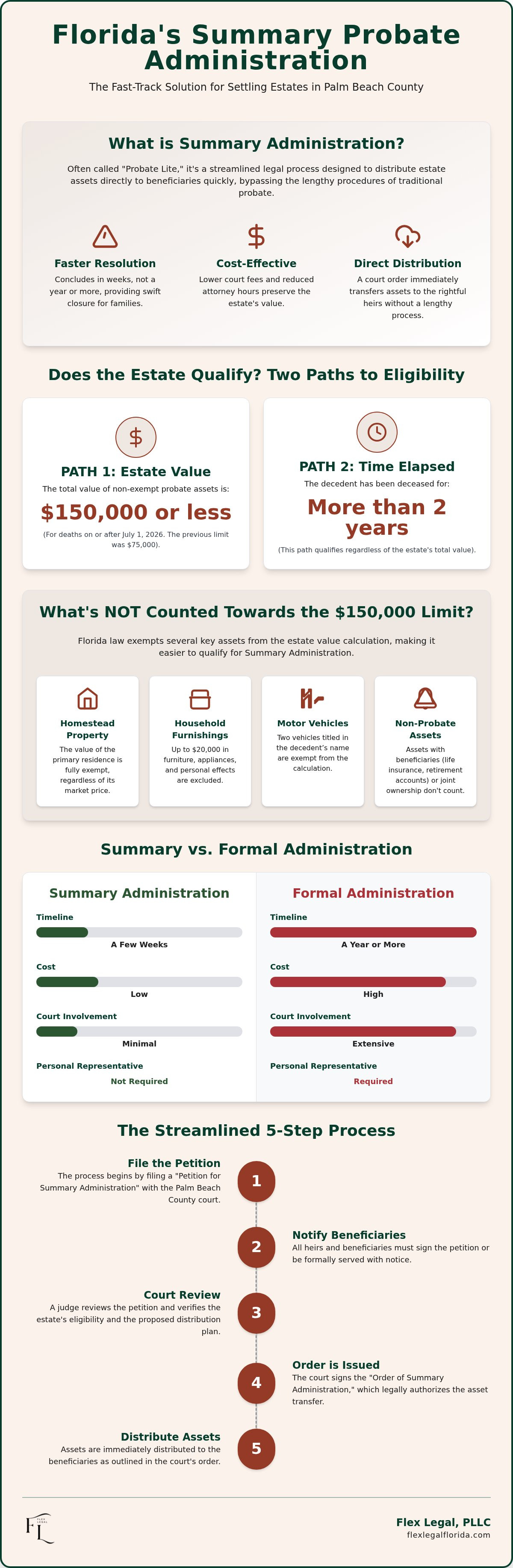
Determining if you can use the expedited path of Summary Probate Administration is the first step toward a faster resolution. In Florida, eligibility is not a matter of court discretion but follows strict rules defined in the Florida Statutes on Summary Administration. As of 2026, there are two primary ways an estate qualifies for this process. First, the value of the probate estate must be $150,000 or less for individuals who passed away on or after July 1, 2026. For those who passed before this date, the previous $75,000 limit still applies. Second, any estate, regardless of its total value, qualifies if the decedent has been deceased for more than two years.
Beyond these financial and chronological markers, procedural requirements exist. Every beneficiary named in the will, or those entitled to inherit under Florida law if there is no will, must either sign the petition or be formally served with notice. This ensures transparency and protects the rights of everyone involved. If you aren't sure where your loved one's estate falls, reaching out to an agile legal ally can provide the clarity you need to move forward confidently.
The $150,000 Asset Threshold Explained
Calculating the estate's value requires distinguishing between probate and non-probate assets. Non-probate assets, such as life insurance policies with designated beneficiaries or accounts held as "joint tenants with rights of survivorship," don't count toward the $150,000 limit. Crucially, the "Homestead Exception" allows you to exclude the value of a primary residence in West Palm Beach from this calculation. Because Florida law provides strong protections for homestead property, even a multi-million dollar home often doesn't count against the threshold. You can also exclude up to $20,000 in household furniture and two motor vehicles. When minor children are involved, additional protections apply, though their interests may require specific court filings to ensure their inheritance is managed correctly within the summary process.
The 2-Year Rule: A Hidden Opportunity
The two-year rule is a strategic tool that many competitors overlook. If a person has been deceased for more than two years, the estate automatically qualifies for Summary Probate Administration regardless of whether the assets are worth $200,000 or $2 million. This is because Florida's "non-claim" period for most creditors expires after two years. Since the risk of unknown debts is virtually eliminated, the court allows for a simplified distribution. This rule is especially helpful for complex family dynamics where heirs may have initially struggled to agree on how to proceed. Waiting out the two-year clock can turn a complicated formal administration into a straightforward summary filing, saving the family significant time and stress.
Summary vs. Formal Administration: Choosing the Right Path
Choosing between probate types isn't just a legal formality. It's a strategic decision that affects your family's finances and peace of mind. Summary is essentially a one-time petition filed with the court. In contrast, formal administration is an ongoing, court-supervised process that can last for many months. The most significant structural difference is the role of a Personal Representative. Formal administration requires the court to appoint an executor to manage the estate's affairs. Summary Probate Administration skips this step entirely, allowing the court to transfer assets directly to heirs based on the petition itself.
From a financial perspective, the summary route is typically thousands of dollars cheaper than the formal alternative. You avoid the recurring costs associated with long-term estate management, such as ongoing legal fees and bond requirements. This makes it the preferred choice for families who want to preserve as much of their inheritance as possible. For those dealing with larger or more complex estates that require full supervision, you can learn more by reading our guide on finding a Probate Lawyer in Palm Beach County: A 2026 Guide to Florida Estate Administration.
Speed and Efficiency Comparisons
Most families prioritize speed when settling a loved one's affairs. In the 15th Judicial Circuit of Palm Beach County, the average timeline for a summary proceeding is measured in weeks. Formal administration often takes six months to a year, or even longer if complications arise. Once the judge signs the "Order of Summary Administration," you have a powerful legal document. This order allows you to walk into a bank and immediately access or transfer the decedent's accounts. In many cases, the local court handles these petitions electronically. This often removes the need for stressful in-person hearings and speeds up the entire 2026 filing process.
Creditor Protection Differences
While speed is a benefit, you must consider creditor protection. Summary Probate Administration requires you to address known creditors, but it doesn't offer the same shield against unknown debts that formal probate provides. In a formal proceeding, your attorney publishes a "Notice to Creditors." This starts a 90-day clock that bars most future claims. Without this notice, beneficiaries in a summary proceeding may remain personally liable for the decedent's debts for up to two years. If you suspect your loved one had significant or complex debts, the formal route's structured notice period might be the safer path for your family.
The Step-by-Step Summary Administration Process in Palm Beach County
Moving through the 15th Judicial Circuit requires a clear plan and attention to detail. While Summary Probate Administration is significantly faster than formal probate, it still follows a specific legal sequence to ensure that assets transfer correctly and legally. Success depends on how well you prepare before the first document reaches the clerk's office in West Palm Beach. This process is designed for efficiency, but missing a single statutory requirement can lead to avoidable delays in your 2026 filing.
Step 1: Gathering Asset Information. You must collect the original Last Will and Testament along with a complete list of probate assets. This includes bank balances, vehicle titles, and property descriptions for any non-homestead real estate.
Step 2: Drafting and Filing the Petition. Your attorney prepares the Petition for Summary Administration. This document must be signed by the surviving spouse, if any, and all beneficiaries. It specifically requests that the court distribute the assets to the rightful heirs.
Step 3: Notifying Creditors. You're required to conduct a "diligent search" for any known creditors of the decedent. These debts must be paid from the estate assets or accounted for in the petition before the judge will sign off on the distribution.
Step 4: Obtaining the Final Order. Once the court reviews the petition and finds it meets all Florida legal standards, the judge issues the "Order of Summary Administration." This is the final decree that legally transfers ownership of the assets.
Filing with the 15th Judicial Circuit
Local expertise matters when dealing with the West Palm Beach probate court. In 2026, the 15th Judicial Circuit heavily utilizes the Florida Courts E-Filing Portal to streamline the process. Your legal team uses this portal to submit documents instantly, which significantly reduces the time it takes for a clerk to review your file. We work directly with local West Palm Beach clerks to verify document receipt and ensure that every filing fee is processed correctly. This modern, digital approach eliminates the friction of traditional paper filings and helps your case move to the judge's desk faster.
What Happens After the Court Order?
The "Order of Summary Administration" is your master key for asset distribution. You'll present certified copies of this order to banks and brokerage firms to close out accounts and receive funds. For vehicles, you'll take the order to the DMV to update the title. If the estate includes non-homestead real estate, the order is recorded in the public records of Palm Beach County to officially transfer the deed to the heirs. Once all assets are distributed and the file is closed, your family can finally move forward with financial certainty. If you're ready to start this process, our West Palm Beach probate team is here to act as your agile ally.
Navigating Florida Probate with Flex Legal: Modern, Efficient Solutions
Choosing the right legal partner transforms a complex court requirement into a manageable transition. At Flex Legal, we position ourselves as your agile ally, moving away from the slow, paper-heavy methods of the past to embrace a more responsive approach. Our focus on Summary Probate Administration ensures that your family doesn't get bogged down in administrative friction. Jennifer L. Flexer, Esq. founded this firm with a commitment to providing personalized, solution-oriented service that prioritizes your family’s unique needs. We don't believe in one-size-fits-all solutions; instead, we adapt our strategies to fit the specific assets and family dynamics involved in your case.
Transparency is a core value of our practice. We provide price certainty through statutory and hourly fee structures, so you aren't left guessing about the total cost of settling an estate. By leveraging modern communication tools, we keep you updated in real-time, ensuring you never feel out of the loop. This proactive approach reduces the anxiety often associated with legal proceedings and allows us to resolve cases with high-level planning and precision. We focus on results, not just process, ensuring that assets reach heirs with minimal court intervention.
Why a West Palm Beach Firm Matters
Local expertise is vital when working within the 15th Judicial Circuit. Our deep understanding of Palm Beach County judges and specific court procedures allows us to navigate the e-portal and clerk requirements with ease. This is especially beneficial for out-of-state heirs who need to handle ancillary probate for Florida property. Working with a local firm ensures that your filing meets the exact 2026 standards of the West Palm Beach courthouse. If you want to avoid these hurdles in the future, consider reviewing our Estate Planning Attorney in West Palm Beach: The 2026 Buying Guide for proactive asset protection strategies.
Your Next Steps: Securing the Estate
Starting the process is straightforward. We recommend scheduling a consultation to confirm eligibility and discuss the most efficient path forward. To make our first meeting as productive as possible, please bring the original Last Will and Testament, a death certificate, and a list of all known assets and creditors. Our team will review these details to ensure your filing moves through the system without unnecessary delays. Contact Flex Legal today to start your Summary Administration and take the first step toward a faster, more transparent distribution of assets.
Secure a Faster Path for Your Family's Legacy
Settling an estate doesn't have to be a multi-year ordeal filled with court delays. The 2026 updates to Florida law have opened the door for more families to use Summary Probate Administration, especially with the increased $150,000 asset threshold. By understanding how to exclude homestead property and leverage the two-year rule, you can bypass the traditional personal representative requirement and distribute assets in a fraction of the usual time.
You deserve a legal partner that values transparency and modern efficiency. Flex Legal provides the local West Palm Beach expertise needed to navigate the 15th Judicial Circuit with confidence. We prioritize price certainty through fixed-fee and statutory options while offering agile, modern support to keep you informed every step of the way. Don't let the weight of legal paperwork slow down your family's healing process.
Schedule Your Probate Consultation with Flex Legal today to see if your loved one's estate qualifies for the short-track process. We're here to help you move forward with clarity and peace of mind.
Frequently Asked Questions
How long does summary probate administration take in Florida?
Summary Probate Administration typically takes between three to five weeks to complete in Palm Beach County. This timeline is significantly faster than formal administration, which often stretches from six months to over a year. The speed depends on how quickly the court reviews the petition and how efficiently your legal team manages the e-filing process. Because no personal representative is appointed, the court moves directly toward issuing an order for asset distribution.
Can I do summary administration without a lawyer in West Palm Beach?
While Florida law allows individuals to file for summary administration without an attorney, it is rarely recommended for West Palm Beach residents. The 15th Judicial Circuit has strict procedural requirements and electronic filing standards that can be difficult for non-lawyers to navigate. Small mistakes in the petition or the diligent search for creditors can lead to court delays or the rejection of your case. Partnering with an agile legal ally ensures the process stays on track.
What is the difference between probate and summary administration?
Summary administration is a streamlined type of probate, whereas the term "probate" usually refers to the more complex formal administration. The primary difference is that summary proceedings don't require the court to appoint a personal representative to oversee the estate. Instead, the court issues a single order that transfers assets directly to the heirs. This makes it a "short-track" option for smaller estates or those where the decedent has been dead for over two years.
Does a house count toward the $75,000 limit for summary probate?
In Florida, your primary residence, known as homestead property, is generally excluded from the value calculation. As of July 1, 2026, the threshold for Summary Probate Administration increased to $150,000 in non-exempt assets. This means even if a home in West Palm Beach is worth millions, the estate may still qualify for the summary process as long as other assets like bank accounts and vehicles fall under the $150,000 limit after applicable exemptions.
What happens if a creditor appears during summary administration?
If a known creditor is identified during the process, their debt must be paid or otherwise provided for before the court will distribute assets. Unlike formal administration, which uses a published notice to bar unknown creditors, Summary Probate Administration leaves beneficiaries potentially liable for valid claims for up to two years. If significant debt is suspected, our team often suggests formal administration to provide the family with more robust legal protection against future claims.
Can I use summary administration if there is no will?
Yes, you can use the summary process even if your loved one passed away without a valid Last Will and Testament. This is known as an intestate estate. In these cases, the assets are distributed according to Florida’s intestacy laws, which prioritize the surviving spouse and children. The process remains streamlined, but the petition must clearly outline the legal heirs to ensure the court can issue a valid order of distribution that reflects the decedent's family structure.
How much are the court filing fees for summary administration in 2026?
For 2026 filings in the 15th Judicial Circuit, the court filing fee for summary administration is approximately $235. This is considerably lower than the $402 fee typically required for formal administration. These costs are set by the state legislature and are subject to change, so it's always best to verify the current schedule with the Palm Beach County Clerk’s office before filing. These fees are separate from attorney labor and other administrative costs related to the estate.
What is the 2-year rule for Florida probate?
The 2-year rule is a statutory provision that allows any Florida estate to qualify for summary administration regardless of its total value. Once a person has been deceased for more than two years, the risk of unknown creditor claims is legally diminished. This allows the court to bypass the more rigorous formal administration process. It is a strategic option for families who may have delayed probate or are dealing with complex assets that exceed the standard financial thresholds.



Comments