
Summary Administration vs. Formal Administration in Florida: Which Probate Path is Right for You?
- Kelly Mata
- May 20
- 12 min read

What if the fastest way to settle a Florida estate actually leaves you personally responsible for a loved one's unpaid debts? It is a common concern; many families worry that a quick process means cutting corners that could lead to legal headaches later. When comparing summary administration vs formal administration Florida, the choice often feels like a trade-off between speed and security. You want to distribute assets to beneficiaries quickly and minimize court involvement, but you also need to avoid the personal liability that comes with overlooked statutory requirements.
We are here to help you move forward with confidence and clarity. This guide compares the streamlined fast-track option against the more robust, traditional probate process to help you determine which path fits your specific needs. We will explore the new $150,000 threshold for non-exempt assets effective July 1, 2026, and explain why the "long way" is sometimes the safest strategy for protecting your family's legacy and your own peace of mind.
Key Takeaways
Learn the fundamental differences between the two probate tracks and how to choose the one that aligns with your family's specific goals.
Discover how the choice between summary administration vs formal administration Florida impacts your timeline, legal costs, and the speed of asset distribution.
Understand the specific scenarios where a Personal Representative is necessary to manage complex assets or resolve claims with third parties.
Use our strategic framework to move beyond simple math and determine which path provides the most protection against personal liability.
Explore how modern probate administration can minimize court involvement while ensuring every statutory requirement is met with clarity and speed.
Table of Contents
Understanding the Two Paths of Florida Probate
Probate isn't just a legal requirement; it's a bridge between a legacy and its beneficiaries. At its core, the probate process is the court-supervised method of transferring legal title from someone who has passed away to their rightful heirs. State law recognizes that not every estate requires the same level of scrutiny. Because of this, Florida offers two distinct tracks. Deciding between summary administration vs formal administration Florida is often the first and most critical decision a family faces after a loss.
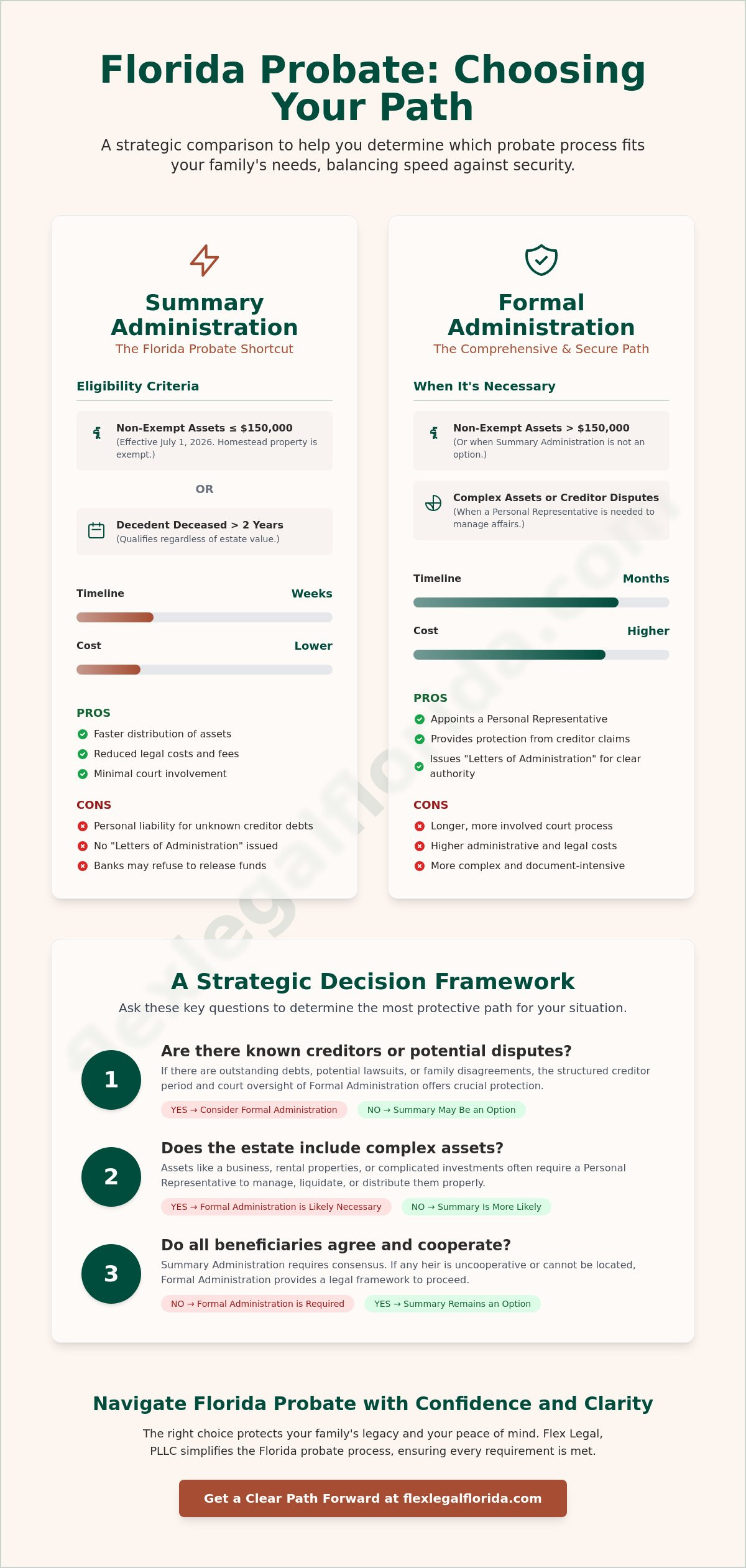
The shortcut of Summary Administration is usually available when the estate is valued under a certain threshold or if the person has been deceased for more than two years. Formal Administration is more involved and requires the court to appoint a Personal Representative. This individual takes charge of the estate, manages assets, and communicates with all interested parties. While it takes longer, the formal route offers a higher level of protection for the person managing the estate. This choice remains a strategic decision whether the decedent left a Last Will and Testament (testate) or passed away without one (intestate). Both paths aim for the same result, but the administrative burden varies significantly based on the estate's specific needs and complexity.
The Purpose of Probate in Florida
Probate serves several vital functions beyond just moving money. It validates the Last Will and Testament to ensure the right people inherit according to the decedent's wishes. It also provides a structured environment for identifying and notifying potential creditors so debts are settled fairly. Finally, probate is essential for clearing title to real estate, which is particularly important for protecting Florida homestead property rights for heirs.
Why Local Context Matters in Palm Beach County
While Florida statutes apply statewide, local court rules in the 15th Judicial Circuit influence specific filing procedures. The West Palm Beach courthouse has specific filing requirements that can stall an application if not handled precisely. Working with a probate lawyer in Palm Beach County helps you navigate regional judge preferences and decide between summary administration vs formal administration Florida without unnecessary friction.
Summary Administration: The Florida Probate Shortcut
Summary Administration is often the preferred route for those looking to resolve an estate with minimal friction. It's designed specifically for smaller estates or situations where a significant amount of time has passed since the decedent's death. When evaluating summary administration vs formal administration Florida, this track is the clear choice for those seeking to bypass traditional hurdles. It's generally less expensive and significantly faster. Instead of months of court supervision, the process typically concludes with a single "Order of Summary Administration." This court order directs the distribution of assets directly to heirs. It's a clean break, but it lacks the ongoing oversight of a Personal Representative.
Eligibility Requirements for Summary Probate
To qualify for this streamlined path, the estate must meet specific criteria. First, the total value of non-exempt Florida assets must be $150,000 or less as of the statutory update on July 1, 2026. Keep in mind that "exempt" assets, like a primary homestead, don't count toward this limit. Alternatively, if the decedent has been dead for more than two years, the estate qualifies regardless of its total value. This two-year rule is a common solution for families who discover forgotten assets years later. Finally, the process requires cooperation. All beneficiaries must either sign the petition or be formally served with notice of the proceedings.
The Pros and Cons of the Fast-Track Process
Efficiency is the primary draw here. In many cases, the distribution of assets can occur in weeks rather than months. This speed helps families close the estate without the weight of an ongoing court case. However, there are risks. Without the 90-day creditor window used in Formal Administration (Chapter 733), you might remain personally liable to known creditors. Additionally, banks may refuse to release funds without "Letters of Administration," which this process does not provide. If you're facing these hurdles, reaching out to Flex Legal, PLLC can clarify which path offers the best balance of speed and protection.
Formal Administration: The Comprehensive Probate Path
Formal Administration represents the standard, comprehensive path for Florida estates. While the shortcut mentioned in Summary Administration (Chapter 735) works for small estates, larger or more complex situations require a deeper level of oversight. This process is essential if the estate holds significant debt, involves litigation, or includes multiple pieces of real estate. It provides a structured environment to settle affairs correctly. When weighing summary administration vs formal administration Florida, the formal route is often the only way to ensure a truly clean break from the decedent's financial past.
This path is not just about moving assets; it's about providing a shield for the family. In a formal proceeding, the court remains involved until every debt is settled and every asset is accounted for. This oversight can feel slower, often taking six to nine months or longer, but it offers a level of finality that simplified processes cannot match. It's the right choice when you need to ensure that no loose ends remain to haunt the heirs years down the road.
The Role of the Personal Representative
The biggest difference in this path is the appointment of a Personal Representative (PR). The court issues "Letters of Administration," which act as the legal keys to the estate. With these letters, the PR has the official authority to talk to the IRS, access locked bank accounts, and sell real estate. This role carries a heavy fiduciary duty. The PR must act in the best interest of the beneficiaries and the creditors alike. In Palm Beach County, judges expect the PR to be diligent and transparent. Without this court-appointed authority, families often find themselves stuck when a bank or title company refuses to release assets without a specific representative named by the court.
The Creditor Protection Advantage
Protection is the primary reason many families choose this path even when they might qualify for the shortcut. Formal probate requires publishing a "Notice to Creditors" in a local Palm Beach County newspaper. This starts a strict 90-day clock. Unknown creditors have only that three-month window to file a claim. If they miss it, they're barred forever. This provides the cleanest possible break from the decedent's financial liabilities. In other types of administration, you might remain personally liable for those debts if you distribute the inheritance too early. By using the formal process, you use the law to permanently close the door on old debts.
Choosing Your Path: A Strategic Decision Framework
Selecting the right path isn't just about totaling the estate's value. It's about looking at the road ahead. While the $75,000 threshold is a clear marker, it's often the complexity of the assets that dictates the best strategy. When comparing summary administration vs formal administration Florida, you must weigh the speed of a shortcut against the protection of a full proceeding. For instance, a small estate with a complicated business interest or a pending IRS inquiry might still require the robust oversight of a formal process to avoid future complications.
Consider your need for a Personal Representative. If you need to access secure digital accounts, negotiate with a landlord, or handle a tax return, you likely need court-issued Letters of Administration. Without these, third parties often refuse to cooperate. You should also evaluate the decedent's debt profile. If there's a risk of unknown medical bills or lingering credit card debt, the formal process offers a permanent shield that the summary path lacks. Protection often outweighs speed when personal liability is on the line. It's better to spend a few extra months in court than to remain on the hook for a loved one's debts years later.
When to Choose Summary (Even if the Estate is Large)
You aren't always forced into the long road just because an estate is valuable. If the decedent has been dead for over two years, the $75,000 limit no longer applies. This makes summary administration a powerful tool for families resolving old estates or discovering forgotten assets. It's also an excellent choice when the bulk of the estate is "Exempt Property," such as a Florida homestead. Since the home's value isn't counted toward the threshold, even a multi-million dollar property can sometimes pass through the fast track if debts are minimal and all heirs agree on the distribution.
When Formal is Mandatory (Regardless of Estate Size)
Sometimes the shortcut simply isn't an option. If the Last Will and Testament specifically requires formal administration, the court must follow those instructions. You'll also need this path if the estate is insolvent, meaning debts exceed assets. In these cases, a Personal Representative must professionally mediate between creditors to ensure assets are distributed according to legal priority. Additionally, if the estate needs to pursue a wrongful death claim or manage a continuing business, the court must appoint a representative to take charge. If you're unsure which path fits your family's situation, we can help you design a customized plan. Reach out to our team for expert probate administration support that prioritizes your peace of mind.
How Flex Legal, PLLC Simplifies the Florida Probate Process
Flex Legal, PLLC provides modern, agile legal support for families in West Palm Beach. We believe that probate shouldn't be an intimidating hurdle that stalls your life. Instead, it's a phase that deserves clear, straightforward management from a partner who values your time. Our team offers precise guidance on the choice between summary administration vs formal administration Florida. We ensure you take the path that minimizes emotional stress while maximizing the inheritance left for your loved ones. We handle the heavy lifting. From meticulous court filings to complex creditor negotiations, we act as your agile ally in the legal system. Our work focuses on strategic alignment with your broader goals as your estate planning attorney West Palm Beach.
Our firm is built on the idea that legal services should adapt to the client, not the other way around. We steer away from the rigid, distant atmosphere of traditional firms. We prefer a partnership-based approach that prioritizes your comfort and clarity. By using accessible language to explain complex statutory requirements, we empower you to make informed decisions about your family's future. We don't just process paperwork; we design a path forward that respects the decedent's legacy and protects the heirs' interests.
Our Approach to Probate Administration
We prioritize transparent communication and adaptability. No two families are the same, so our support is never one-size-fits-all. Our deep experience with the Palm Beach County court system allows us to anticipate procedural needs before they become delays. We ensure smooth transitions from the initial filing at the West Palm Beach courthouse to the final distribution of assets. We also integrate our probate work with asset protection lawyers near me strategies. This ensures that the wealth passing through the court remains secure for the next generation once it reaches the beneficiaries.
Getting Started with Your Probate Consultation
Starting the process is simpler than you might expect. During our initial meeting, we review the essential documents to determine your eligibility for the fast-track or the formal path. Please bring the original Last Will and Testament, a certified copy of the death certificate, and a preliminary list of the decedent’s assets and known debts. We use this data to determine the most cost-effective path for your specific case. We look at the math, but we also look at the long-term risks of summary administration vs formal administration Florida. Our goal is to provide a solution that fits your timeline and your budget. Contact Flex Legal, PLLC today to schedule a consultation with Jennifer L. Flexer, Esq. Let’s move forward together.
Secure Your Family's Legacy with Confidence
Deciding on the right path for a loved one's estate shouldn't feel like a guessing game. You now understand that the choice between summary administration vs formal administration Florida depends on more than just the value of assets. While the summary shortcut offers speed, the formal path provides the essential legal authority and creditor protection needed for complex estates. Every family's situation is unique. Your legal strategy should be just as adaptable.
Founded by Jennifer L. Flexer, Esq., Flex Legal, PLLC specializes in Palm Beach County probate with a focus on modern, efficient solutions. We act as your agile ally, navigating the court system so you can focus on what matters most. Whether you need to resolve a small estate quickly or require a comprehensive formal proceeding, our team provides the clarity you deserve. Schedule a Probate Consultation with Flex Legal, PLLC Today and let us help you find the most effective way forward. You've done the hard work of honoring a legacy; we're here to make the legal transition seamless and supportive.
Frequently Asked Questions
How long does Summary Administration take in Florida?
Summary administration typically concludes within 4 to 8 weeks. This timeline is significantly faster than the formal track because it doesn't require the ongoing appointment of a personal representative or a lengthy creditor notification period. Once the court reviews the petition and issues the order, assets can be distributed to heirs immediately. It's an efficient solution for families who need to move forward without months of court oversight.
Can I do Summary Administration without a lawyer in Palm Beach County?
While Florida law technically allows individuals to file for summary administration without an attorney in very limited cases, it's rarely advisable. The 15th Judicial Circuit in Palm Beach County has specific procedural requirements for petitions and orders that are difficult to navigate alone. Professional guidance ensures that you correctly identify exempt assets and avoid personal liability for the decedent's debts. Most families find that the peace of mind is worth the investment.
What qualifies as an "exempt asset" in Florida probate?
Exempt assets include the decedent's primary Florida homestead and up to $20,000 in household furnishings, appliances, and ornaments. Additionally, two motor vehicles used as family vehicles are typically exempt from creditor claims. These assets are vital because their value isn't counted toward the monetary threshold when deciding between summary administration vs formal administration Florida. Identifying these early can often help an estate qualify for the faster track.
What happens if a creditor appears after Summary Administration is closed?
If a creditor appears after the process ends, the individuals who received the estate's assets may be held personally liable for the debt. Unlike formal probate, summary administration doesn't provide a 90-day "bar" against unknown creditors. This is a primary reason why many families choose the comprehensive formal path even for smaller estates. If there's any risk of outstanding medical bills or credit card debt, the formal process offers a safer, permanent shield.
Do I need a Personal Representative if there is a Will?
You only need a Personal Representative if you pursue formal administration. While a Will usually names an "executor," Florida law officially uses the term Personal Representative and only appoints one through the formal probate track. If you use summary administration, the court simply issues an order distributing the assets. No specific person is appointed to manage the estate's affairs, which can sometimes make it harder to deal with banks or insurance companies.
Is Florida Homestead part of the limit for Summary Administration?
No, the value of a Florida homestead is not included in the monetary limit. Effective July 1, 2026, the threshold for summary administration in Florida increases to $150,000 for non-exempt assets. Because the homestead is exempt, you can often use the summary shortcut for a multi-million dollar home as long as other assets don't exceed that $150,000 cap. This makes the shortcut accessible to many more families in the West Palm Beach area.
How much are the court filing fees for probate in West Palm Beach?
In 2026, the court filing fee for a summary administration is approximately $235. For those requiring a formal administration, the filing fee at the West Palm Beach courthouse is approximately $402. These fees are set by the state and are paid directly to the Clerk of the Court to initiate the legal proceedings. It's a standard cost that applies regardless of the estate's total value or the complexity of the assets involved.
Can a non-resident of Florida serve as a Personal Representative?
Yes, a non-resident can serve as a Personal Representative if they are a legally recognized close relative of the decedent. This includes spouses, siblings, parents, children, or other close family members as defined by Florida statutes. If the person is not a relative, they must be a Florida resident to qualify for the role. This rule ensures that the person managing the summary administration vs formal administration Florida process is either family or locally accessible to the court.


Comments