
Special needs trusts for lawsuit proceeds and benefit rules

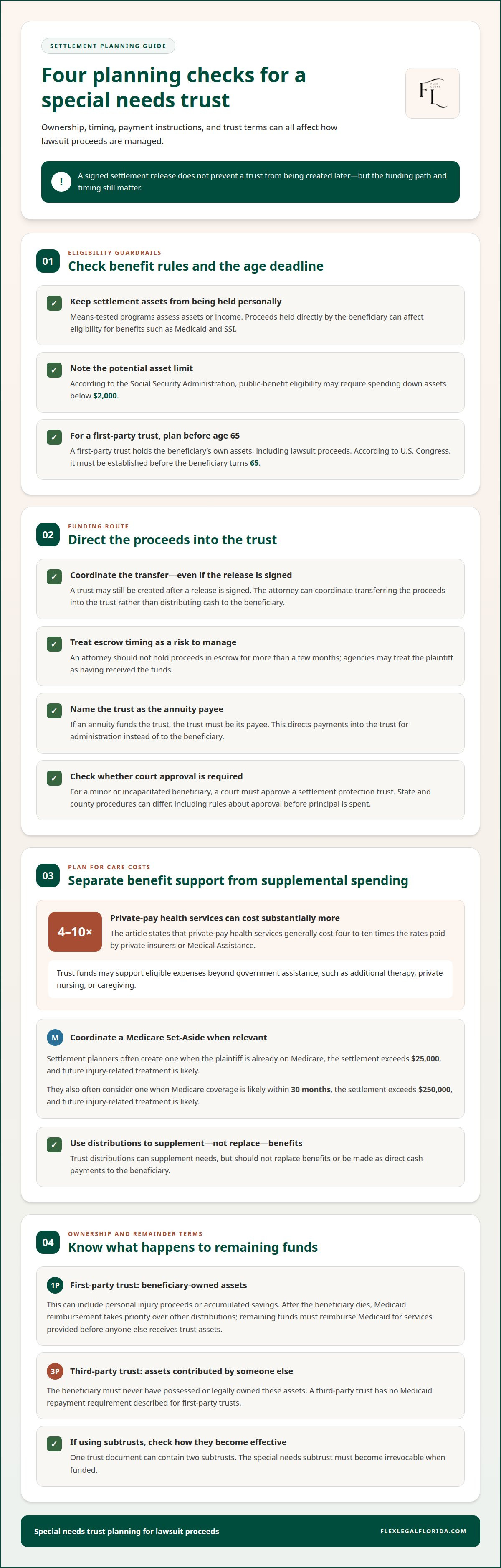
A lawsuit recovery doesn’t automatically have to put public benefits at risk. A special needs trust for lawsuit proceeds can hold funds that belong to a disabled beneficiary and may help preserve eligibility for benefits such as Medicaid and SSI. According to U.S. Congress, a first-party trust funded with the beneficiary’s assets must be established before the beneficiary turns 65.
It’s understandable to focus first on the settlement amount and how it will cover care. The trust’s structure matters just as much: it can shape how funds are managed, which expenses they can support, and what happens to any remaining assets. Signing a settlement release doesn’t prevent a trust from being created, but the timing and terms still need careful attention.
This article explains how settlement proceeds can be placed in a special needs trust, how distributions may affect benefits, and how trust provisions can address health-care costs. It also looks at subtrusts, which can organize different funds and responsibilities within one plan.
Table of Contents
Court-established trusts for disabled beneficiaries under age 65
A personal injury settlement can change a beneficiary’s countable assets or income. A court-established trust can hold the proceeds under defined terms, but timing, benefit rules, and administration all matter.
Settlement Funds Received Before Trust Creation
Creating a trust after settlement funds arrive means transferring proceeds the beneficiary has already received into a qualifying trust. A signed release doesn’t prevent this, but delays can create risk. An attorney shouldn’t hold proceeds in escrow for more than a few months because agencies may treat the plaintiff as having received the funds. For a minor or incapacitated beneficiary, a court must approve a settlement protection trust.
Means-Tested Benefits and Structured Settlements
Means-tested programs assess a beneficiary’s assets or income, so settlement proceeds held directly can affect eligibility. According to the Social Security Administration, public-benefit eligibility may require an individual to spend down assets below a $2,000.00 limit. A first-party special needs trust may help preserve eligibility while holding the beneficiary’s assets. According to U.S. Congress, it must be established before the beneficiary turns 65.
Structured settlement payments made directly to a person with a disability can create income that disrupts benefit eligibility. If an annuity funds a trust, the trust must be its payee. This directs payments into the trust for administration instead of to the beneficiary. Trust distributions can supplement needs, but shouldn’t replace benefits or be made as direct cash payments.
Benefit Risks, Deadlines, and State Variations
Common risks include receiving proceeds directly, missing the age deadline, or accepting annuity payments personally. Each can affect eligibility for means-tested benefits such as Medicaid and SSI. State procedures can also differ. For example, court approval may be required for a minor or incapacitated beneficiary, and some counties require approval before principal is spent. The governing state and the beneficiary’s circumstances shape how the trust is administered.
After a first-party trust beneficiary dies, Medicaid reimbursement takes priority over other distributions. Remaining funds must reimburse Medicaid for services provided to the beneficiary before anyone else receives trust assets. Families should account for this recovery provision when considering the trust’s terms and who may receive any remainder.
Creating a special needs trust after signing a settlement release
A signed release doesn’t prevent a trust from being created later, but the funding path still matters. Ownership, escrow handling, and annuity instructions shape how proceeds reach the trust and support future distributions.
First-Party Trusts for Lawsuit Settlements
A first-party special needs trust holds the disabled beneficiary’s assets, including lawsuit proceeds. This matters because settlement money belongs to the beneficiary rather than being a family gift. The trust can be created after a release is signed and funded with the recovery. Its terms guide distributions for supplemental needs and establish a framework for administration.
Funding a Trust After Settlement
After a release, the attorney coordinates transferring settlement proceeds into the trust instead of distributing cash to the beneficiary. If funds remain in escrow, the transfer plan should address constructive receipt risk and avoid treating the money as personally available. Settlement instructions and trust terms should align on the recipient, funding source, and permitted distributions. Thoughtful special needs planning can help coordinate these details.
Structured Settlements Payable to a Trust
A structured settlement delivers proceeds over time through an annuity, rather than paying the full recovery at once. If a special needs trust is intended to receive those payments, it must be named as the annuity’s payee. A first-party trust funded by an annuity also needs seed money for initial expenses before longer-term payments begin. The plan should account for administration fees on trust assets.
First-Party and Third-Party Trust Differences
A first-party trust holds the beneficiary’s assets, such as personal injury proceeds or accumulated savings. A third-party trust holds assets contributed by someone else, which the beneficiary never possessed or legally owned. This ownership distinction affects repayment: after the beneficiary’s death, a first-party trust reimburses Medicaid before remaining funds pass onward; a third-party trust has no such Medicaid repayment requirement. Establish ownership before setting the trust terms.
Medical Assistance and private health-care costs
Medicaid and Supplemental Security Income can support essential needs, while trust funds address eligible expenses beyond government assistance. Private-pay health services generally cost four to ten times the rates paid by private insurers or Medical Assistance. That gap makes budgeting for additional therapy, private nursing, or caregiving an important part of personal injury settlement planning.
A Medicare Set-Aside reserves settlement funds for future medical care related to the injury. Settlement planners often create one when the plaintiff is already on Medicare, the settlement exceeds $25,000, and future injury-related treatment is likely. They also often consider one when Medicare coverage is likely within 30 months, the settlement exceeds $250,000, and future injury-related treatment is likely. These arrangements need careful coordination with a special needs trust.
A Medicare Set-Aside is considered a countable asset by means-tested programs because the funds remain available to the plaintiff. The set-aside document should include language sufficient to satisfy the Centers for Medicare & Medicaid Services that it is properly administered. It should prohibit paying fees and expenses from set-aside funds, require investment of proceeds, and provide for distributions to CMS. There are currently no formal guidelines for Medicare Set-Asides, so the document’s terms matter.
Private medical insurance can also shape the plan. Under the Affordable Care Act, people with preexisting conditions can obtain private medical insurance. Families can budget for premiums alongside anticipated treatment and trust cash flow. Trust funds should not pay expenses already covered by government benefits; they can instead supplement care not covered, such as additional therapy or caregiving.
Repayment rules depend on the type of trust. A third-party special needs trust doesn’t have to reimburse Medicaid from remaining funds. In a pooled trust, funds left when the beneficiary dies are typically divided between Medicaid and the nonprofit managing the trust. These different outcomes affect how families evaluate repayment provisions and future distributions.
Special needs trust subtrust provisions
A settlement protection trust can organize lawsuit proceeds into separate subtrusts under one document. The key design decision is how each account will be funded, administered, and used without disrupting public benefits.
One document can contain two subtrusts: a settlement protection trust and a special needs subtrust. The first can hold settlement assets under the protection plan, while the second holds funds designated for the beneficiary’s supplemental needs. Clear transfer terms help trustees distinguish each account’s purpose, permitted distributions, and records. This gives families a practical way to coordinate settlement funds with the beneficiary’s care plan.
Funding changes the special needs subtrust’s legal status: once funded, it must become irrevocable. The document should spell out how assets move into that subtrust and who manages distributions. A trustee can use its terms to evaluate requests for items that support quality of life, such as additional therapy or recreation, while avoiding direct cash payments. Specific distribution rules make ongoing administration more consistent.
A Medicare Set-Aside may call for a different structure. If a future transfer to a special needs trust is possible and a Medicare Set-Aside arrangement is required, the settlement protection trust should be designed with three subtrusts. Separating these functions helps keep the set-aside distinct from funds intended for other needs. The document can define each subtrust’s purpose, funding path, and administration responsibilities.
Review the proposed provisions together: funding triggers, trustee authority, distribution standards, records, and what happens when funds remain. For example, a plan can identify which account pays injury-related treatment and which supports other supplemental needs. This is the core takeaway: tailor the subtrust structure to the settlement’s components and the beneficiary’s needs, rather than treating all proceeds as one pool. Plan special needs trust provisions around those distinct purposes.
Flex Legal, PLLC: Special Needs Planning
Flex Legal, PLLC helps families plan for lawsuit proceeds through Special Needs Planning. This can be useful when a settlement may affect public benefits, when trust provisions need to coordinate separate accounts, or when a beneficiary’s care needs change. Planning can address how a trust is funded, how distributions support supplemental needs, and how administration follows the document’s terms.
For broader estate planning, a Revocable Living Trust or Designation of Pre-need Guardian may fit alongside a special needs plan. Trust Administration Assistance can also help carry out the provisions already in place. Each plan should reflect the beneficiary’s circumstances and the role settlement funds need to play.
Contact Flex Legal, PLLC to discuss special needs planning for your family.
Shape a plan around the life ahead
A settlement plan should serve the person, not just organize the money. As care priorities and family responsibilities change, the trust document can provide a framework for decisions while keeping the beneficiary’s goals in view. A special needs trust for lawsuit proceeds is most useful when its terms connect financial administration with the support the person values in daily life.
Flex Legal, PLLC helps families consider how Special Needs Planning fits with related estate planning needs, including Revocable Living Trusts and Guardianship Proceedings. A conversation can focus on the beneficiary’s circumstances, the intended role of settlement funds, and the decisions the family wants its plan to address. This gives the planning process a clear starting point without assuming every family needs the same structure.
Contact Flex Legal, PLLC to discuss your planning needs. A thoughtful next step can help your family move forward with greater clarity.
Frequently Asked Questions
What is a special needs trust?
A special needs trust holds assets for a person with a disability and supports needs beyond government benefits. Its written terms guide the trustee’s decisions, including how to pay for eligible goods or services. For example, the trust might support recreation or additional caregiving. The funding source and provisions affect administration, so the document should reflect the beneficiary’s circumstances and intended support.
What is a Disability Trust?
A Disability Trust is a general term for a trust set up to hold assets for someone with a disability. The label alone doesn’t explain how it treats benefits, distributions, or funds remaining after the beneficiary’s death. Those details depend on the trust’s structure and terms. For instance, a trust funded by the beneficiary’s assets has different Medicaid repayment implications from one funded by someone else.
What is a Settlement Protection Trust?
A Settlement Protection Trust is designed to hold and manage personal injury settlement funds under specific trust terms. It can establish rules for managing and distributing assets rather than giving the beneficiary unrestricted access. For a minor or incapacitated person, a court must approve the settlement protection trust. Its provisions can also coordinate separate funds, such as a Medicare Set-Aside and a special needs subtrust.
What responsibilities does a trustee have?
A trustee manages trust assets and makes distributions according to the document. The role also includes keeping clear records of expenditures, paying trust bills, and assisting with tax preparation. Before paying an expense, for example, the trustee should document what it covers and assess whether the distribution follows the trust terms. Regular communication with benefits coordinators or special needs attorneys can help address changing program rules.
Who Should Serve as Trustee?
The trustee should be able to manage assets carefully, follow detailed trust terms, maintain records, and make consistent distribution decisions. A relative may understand the beneficiary’s routines, while a professional trustee may bring experience with administration, bills, and documentation. The choice also depends on the trust’s complexity and the family’s capacity for ongoing work. The document should clearly name the trustee and any successor.
Can lawsuit settlement proceeds be placed in a special needs trust?
Yes. A personal injury recovery can fund a first-party special needs trust because the proceeds belong to the beneficiary. The trust can be created after the settlement release is signed, but the transfer and payment instructions need coordination. If an annuity will make structured payments, the trust must be named as its payee. A special needs trust for lawsuit proceeds should also account for its terms and administration.



Comments