
Special Needs Trust for Autism in Florida: Funding and Payback

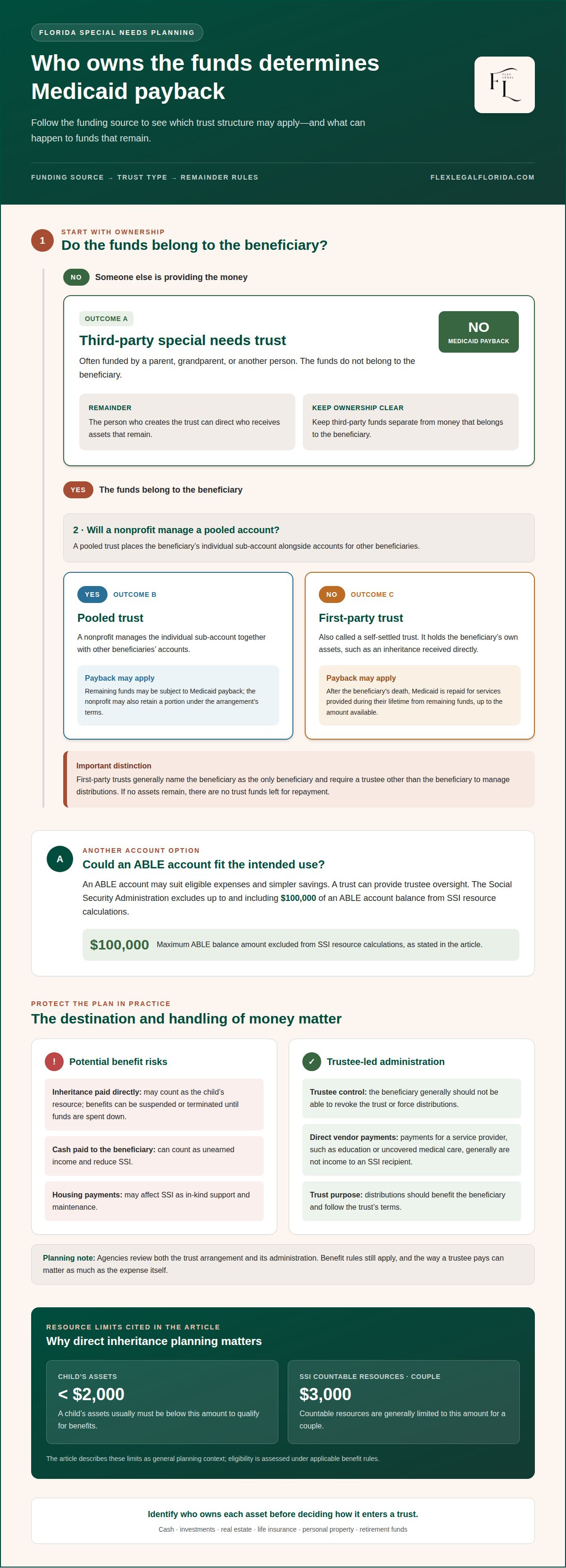
Who provides the money matters as much as how much is available. A special needs trust for autism in Florida may be funded by family members or other people. A third-party trust generally has no Medicaid payback requirement. If the trust holds the beneficiary’s own assets, it is a first-party trust, and Medicaid may be repaid from funds remaining after the beneficiary dies.
It is understandable to focus first on where the funds will come from, especially when an inheritance, gift, or other payment could affect needs-based benefits. The funding source also determines how payback works, so it is important to plan around the beneficiary’s assets and future needs.
This guide explains common ways to fund a special needs trust, the differences between first-party and third-party trusts, and when Medicaid payback applies. It also covers how Florida estate planning can connect a trust with a will and other arrangements for a child’s future.
Table of Contents
Does a third-party special needs trust have to repay the state?
No. A third-party special needs trust has no Medicaid payback requirement. It is funded by someone other than the beneficiary, often a parent or grandparent. The trust document can direct any remaining assets to people chosen by the person who created it. For example, a parent may name other family members to receive the remainder.
A first-party, or self-settled, trust holds money that belongs to the beneficiary, such as an inheritance received directly. It generally names the beneficiary as its only beneficiary and requires a trustee other than the beneficiary to manage distributions. Medicaid may be repaid from remaining funds for services provided during the beneficiary’s lifetime. That distinction makes the source of each deposit central to funding decisions.
A pooled trust offers another structure: a nonprofit manages an individual sub-account alongside accounts for other beneficiaries. It can accept the disabled person’s own assets, so remaining funds may be subject to Medicaid payback; the nonprofit may also retain a portion. By contrast, third-party funds do not belong to the beneficiary. Keep them separate from money that does belong to the beneficiary.
Families can choose among a third-party trust, a first-party trust, a pooled trust, or an ABLE account by considering who owns the funds, how the account will be managed, and the intended use. An ABLE account may suit eligible expenses and simpler savings, while a trust can provide trustee oversight. The Social Security Administration excludes up to and including $100,000 of an ABLE account balance from SSI resource calculations.
Establishment and maintenance costs depend on the trust’s complexity, funding, and administration needs; legal fees are provided after a quote request. Avoid depositing a beneficiary’s inheritance into a third-party trust, paying cash directly to the beneficiary, or making housing payments without considering SSI effects. Trust distributions should benefit the beneficiary, and direct payments to vendors can help avoid treating cash as the beneficiary’s income.
How Can a Florida Special Needs Planning Attorney Help Fund a Trust?
A Florida attorney can shape a special needs trust for autism in Florida around the beneficiary’s assets, benefit needs, and future support. The work includes identifying who owns each funding source and coordinating how it enters the trust. Cash, investments, real estate, life insurance, and personal property may require different planning. Retirement funds, including an IRA or 401(k), can carry additional restrictions. That review helps align the trust terms with the actual assets.
Trustee control is central to benefit eligibility. The beneficiary generally should not be able to revoke the trust or force distributions; otherwise, the principal may be treated as an available resource. Agencies review the trust arrangement, so both the document and its administration matter. The trustee manages the assets and decides whether a request fits the trust’s terms and the beneficiary’s needs. The beneficiary can benefit from the trust without owning its principal.
For example, a trustee may pay a service provider directly for an education expense or uncovered medical care. Direct payments to third parties generally are not income to an SSI recipient. Cash paid to the beneficiary can count as unearned income and reduce SSI. Housing payments may also affect SSI as in-kind support and maintenance. The way a trustee pays can therefore matter as much as the expense itself.
A special needs trust for autism in Florida can help preserve access to Florida Medicaid and Supplemental Security Income (SSI) by keeping qualifying assets under a trustee’s control. It does not replace benefit eligibility rules, and agencies assess the arrangement. An attorney can coordinate trust funding with the family’s estate plan and explain how income, distributions, and the beneficiary’s access to principal may affect benefits.
Florida special needs planning can coordinate the trust’s language, funding sources, and trustee responsibilities. It can also account for how the beneficiary’s support needs may change over time, including education and services not covered by government benefits.
Medicaid payback requirements
An inheritance paid directly to a child with a disability can put needs-based benefits at risk. The money may count as the child’s resource, and benefits can be suspended or terminated until funds are spent down. A child’s assets usually must be below $2,000 to qualify for benefits. For Supplemental Security Income (SSI), countable resources are generally limited to $3,000 for a couple. These limits make the destination of an inheritance important for family planning.
With a first-party trust, the beneficiary’s own assets fund the arrangement. When the beneficiary dies, Medicaid must be repaid for services provided during the beneficiary’s lifetime, using remaining trust assets up to the amount available. The balance may therefore be reduced before anything passes to family members. If no assets remain, there are no trust funds left for repayment.
A third-party trust works differently because someone other than the beneficiary contributes the funds. It has no Medicaid payback requirement, and the person who creates it can name who receives any remainder. A pooled trust may hold the beneficiary’s assets in an account managed by a nonprofit; under the arrangement’s terms, remaining funds may be divided between Medicaid repayment and the nonprofit.
For example, if a grandparent leaves an inheritance directly to a child receiving SSI, the funds may affect eligibility. Planning can direct intended support through an appropriate trust instead. Families may also consider life insurance as a potential funding source, with the trust’s terms guiding how proceeds support the beneficiary. After a first-party trust beneficiary dies, Medicaid is repaid from remaining funds for covered services provided during life. Any balance is handled under the trust’s terms, and repayment cannot exceed the amount remaining in the trust.
Florida estate-planning legal advice
Florida estate planning brings together trust terms, funding, and government-benefit considerations. The applicable rules depend on the trust type and the beneficiary’s circumstances.
How an Attorney Sets Up a Florida Special Needs Trust
An attorney drafts the trust to manage assets for the beneficiary without giving them direct control of its principal. According to the Office of the Law Revision Counsel, U.S. House of Representatives, a first-party special needs trust in Florida can be established for a disabled person only if that person is under 65 years old. The attorney considers the funding source, trustee powers, and how remaining assets will be handled.
For parents, coordination with the broader estate plan matters. A will can direct an inheritance intended for a child into the special needs trust instead of to the child directly. Florida law also recognizes a trust instrument as an alternative to guardianship. Families can consider the trust alongside other planning choices, including a child’s transition toward adulthood.
How an Attorney Helps Administer a Florida Special Needs Trust
Administration means managing trust assets and distributions under the document’s terms while considering the beneficiary’s needs and benefits. An attorney can advise trustees on reviewing requests, documenting decisions, and coordinating payments with federal and state programs. For example, paying a provider directly for an approved expense differs from giving cash to the beneficiary. The trustee’s records help show how each distribution serves the beneficiary.
Guidance for trustees matters as a beneficiary’s financial and support needs change. A trustee may need to assess whether a proposed payment fits the trust’s purpose and could affect benefits. Families should also plan for successor trustees so responsibilities can continue if the original trustee cannot serve. These details connect long-term estate planning with practical administration.
For guidance on Florida trust planning and administration, discuss your special needs trust with an attorney.
Flex Legal, PLLC: Special Needs Planning
Flex Legal, PLLC helps families in West Palm Beach shape special needs planning around the beneficiary’s needs, trust funding, and future administration. This support can be useful when considering a trust, preparing an estate plan, or deciding who will manage funds and make distributions.
Planning can also connect a special needs trust with a revocable living trust or a designation of pre-need guardian. These documents address different parts of a family’s plan, from directing assets to identifying future decision-makers. Trust administration assistance can help trustees understand their responsibilities as the beneficiary’s circumstances change.
For guidance on a Florida special needs trust and related estate planning, contact Flex Legal, PLLC.
Make the Next Planning Decision With Confidence
A thoughtful plan can adapt as an autistic person’s needs, preferences, and support network change. Consider the trust as one part of a broader discussion about who will help manage financial decisions and how the plan can keep pace through different life stages. A special needs trust for autism in Florida should reflect the person’s circumstances, not just a document template.
Consider what the beneficiary may need in the future, who is prepared to take on trustee responsibilities, and how the trust fits with the family’s wider estate plan. Clear coordination gives family members a shared framework and helps trustees understand the intentions behind the plan.
If you’re ready to discuss how these choices fit together, connect with Flex Legal, PLLC. A focused conversation can help you identify the planning questions that matter most and move forward with greater clarity.
Frequently Asked Questions
Can an attorney help me set up a special needs trust instead of using an online form?
Yes. An attorney can tailor the trust document to the beneficiary’s circumstances and coordinate it with the family’s estate plan. For example, the plan may need to address who will manage the trust, how assets will enter it, and who receives remaining third-party funds. A generic form may not account for those details or fit your family’s situation.
Can an irrevocable special needs trust ever be changed?
Possibly, but an irrevocable trust generally cannot be freely changed by its creator. The options depend on the trust’s wording, who is involved, and the reason for seeking a change. Before acting, have an attorney review the document and explain which options fit its terms and applicable law. Assess any proposed changes for their possible effects on benefits and the trust’s purpose.
Can the trust pay for ABA therapy?
A trustee may be able to use trust funds for ABA therapy if the trust permits the expense and the payment follows applicable benefit rules. The practical questions are how the therapy is billed and whether a public program covers it. For example, the trustee can review an invoice and arrange payment to the provider rather than giving money directly to the beneficiary.
How do trust payments affect SSI?
The effect depends partly on the payment’s form and purpose. Cash given to an SSI recipient can be treated as unearned income, while some housing-related payments can affect benefits differently from payments for other services. Before making a distribution, the trustee should identify the expense, recipient, and payment method, then keep records showing how the payment was made.
What Types of Government Benefits Apply?
Supplemental Security Income (SSI) and Medicaid are the key needs-based programs discussed in special needs planning. They serve different purposes, and eligibility is assessed under each program’s rules. A trust can support the beneficiary alongside these programs, but it does not itself grant eligibility. Families should consider which benefits the person receives and how trust assets and distributions fit into that picture.
What are the three main types?
The three main types are first-party, third-party, and pooled special needs trusts. A first-party trust holds the beneficiary’s own assets; a third-party trust receives assets from someone else; and a pooled trust uses an account managed by a nonprofit. The funding source distinguishes the types, while trustee arrangements and the treatment of remaining funds also differ.

Comments