
Special Needs Planning Checklist for Florida Parents: The 2026 Guide
- Kelly Mata
- Jul 3
- 12 min read

Updated: 5 days ago
What if a single $2,001 gift could legally dismantle your child's entire healthcare and income safety net? For many families, the fear of exceeding the strict $2,000 SSI asset limit is a constant source of stress. You want to ensure your child is cared for, but Florida's complex regulations and long APD waiver waitlists can make the future feel uncertain. This special needs planning checklist for Florida parents offers a clear, modern roadmap to protecting your child’s future while maintaining their eligibility for critical government benefits.
We understand that you need solutions that work in the real world, not just in a law book. It's vital to have a strategy that adapts to your family's unique dynamics and the latest legal shifts. This guide explains how to navigate the 2026 ABLE Age Adjustment Act and the nuances of Florida's guardian advocacy process. You'll learn how to build a flexible plan that preserves assets through specialized trusts and creates a seamless transition for your child's 18th birthday. We provide a streamlined path to secure your child's quality of life and give you the lasting peace of mind you deserve.
Table of Contents
Understanding the Florida Special Needs Ecosystem
Special needs planning is the legal process of providing for a loved one with a disability without jeopardizing their access to government benefits. It's a delicate balance. You want to provide a comfortable lifestyle, but you can't do it in a way that the government views as "excessive income." A foundational part of this process involves Understanding Disability and how various state and federal programs provide support. For families in the Sunshine State, this requires a specific strategy because Florida's rules for SSI and Medicaid are strict and unforgiving.
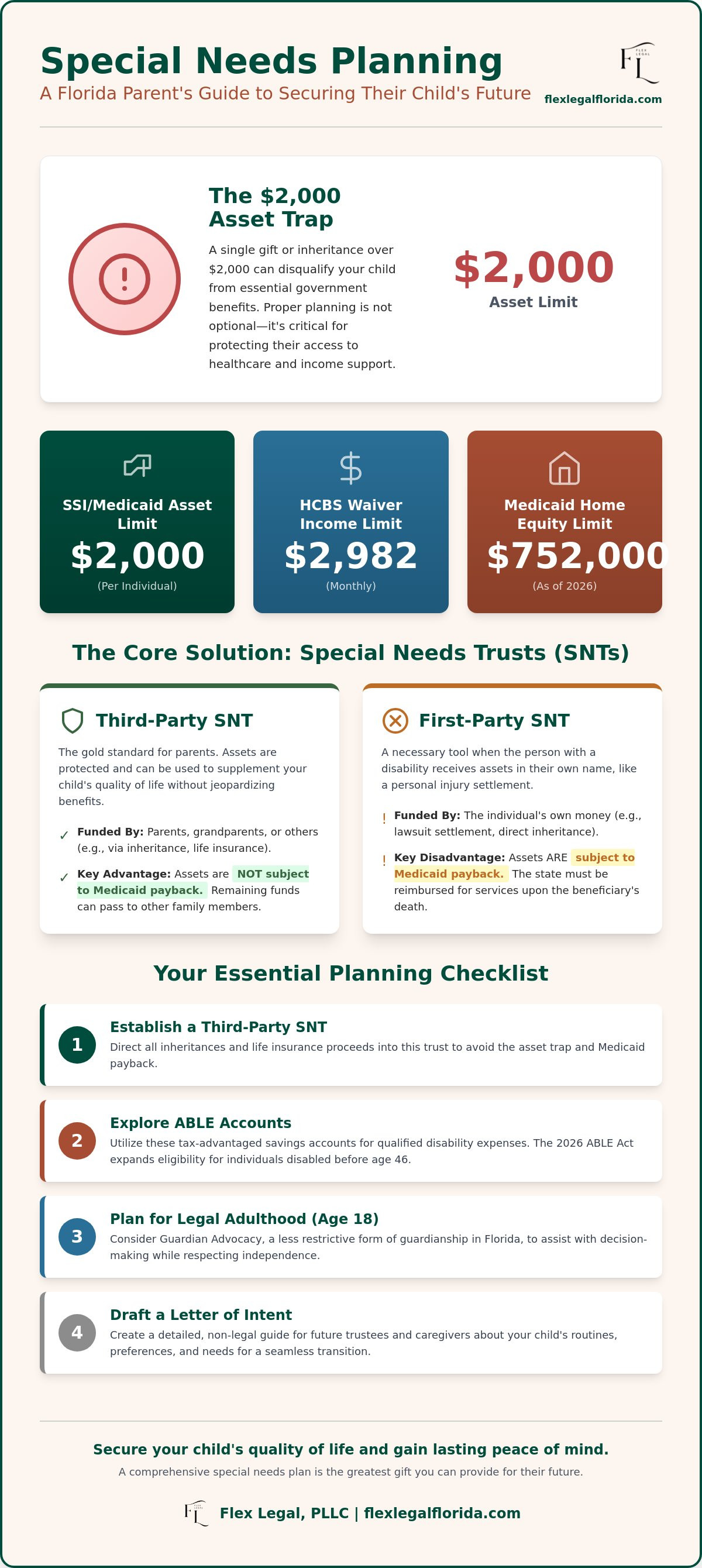
The "Asset Trap" is the most common pitfall. If a person with a disability has more than $2,000 in countable resources, they lose their Supplemental Security Income (SSI) and often their Medicaid coverage. This $2,000 limit hasn't changed in decades, despite the rising costs of living. Additionally, Florida benefit calculations look at "In-Kind Support and Maintenance" (ISM). If you provide free room and board to your adult child, the Social Security Administration may reduce their monthly check. This is why a special needs planning checklist for Florida parents must move beyond traditional estate planning.
Many parents assume a standard Last Will and Testament is enough. It isn't. Leaving a direct inheritance to a child with special needs is often the fastest way to trigger a benefit disqualification. A standard Will doesn't account for the complex interaction between private assets and public assistance. It lacks the protective language needed to shield an inheritance from being counted as a resource.
SSI and Medicaid Eligibility in Florida (2026)
In 2026, the financial thresholds for Florida Medicaid and SSI remain incredibly tight. A single applicant is limited to $2,000 in countable assets. For those seeking Home and Community-Based Services (HCBS) waivers, the monthly income limit is $2,982. If your child's income exceeds this, you'll need a Qualified Income Trust (QIT) to maintain eligibility. Titling assets correctly is non-negotiable. Even a small savings account in the child's name can cause an automatic disqualification, halting medical treatments and therapy services. Florida also sets a home equity limit of $752,000 for Medicaid applicants, which is a critical factor for families planning to leave the family home to their child.
The Consequences of "Doing Nothing"
Doing nothing often leads to a probate nightmare in West Palm Beach courts. When a child inherits assets directly, they're suddenly "too wealthy" for their benefits. This forces families into emergency "spend-downs" or expensive court-supervised guardianships. There's also the issue of distribution. In a special needs family, "fair" (equal shares) is rarely "equitable" (what each child actually needs). Proper planning ensures the child with a disability is supported for life without burdening their siblings or depleting the family’s legacy. Without a plan, the state’s default rules take over, and they rarely align with a parent's true wishes.
The Legal Essentials: Special Needs Trusts and Guardianship
The legal framework of your plan is what keeps assets safe. It ensures your child has an advocate for life. While the $2,000 asset limit feels like a barrier, Florida law provides specific tools to bypass it. These tools aren't just about money; they're about maintaining a high quality of life. High-level essential steps for special-needs planning often begin with choosing the right trust structure for your family's needs.
A special needs planning checklist for Florida parents must prioritize flexibility. Your legal documents shouldn't just meet today's requirements. They must adapt to future legislative shifts. This proactive approach is what distinguishes a modern plan from a static set of rules. It allows you to build a dynamic support system that evolves alongside your child. To understand how to align your legal strategy with a broader financial vision, learn more about resources for families with unique care requirements.
Third-Party vs. First-Party Special Needs Trusts
Third-party SNTs are the gold standard for parents. These trusts are funded with assets belonging to someone other than the child, such as an inheritance or life insurance proceeds. A Third-Party Special Needs Trust is the primary tool that avoids Medicaid payback requirements. In contrast, a First-Party SNT is funded with the child's own money, perhaps from a lawsuit settlement or a direct gift. While both protect benefit eligibility, the First-Party version requires a Medicaid "Payback Provision." This means that when the beneficiary passes away, the state must be reimbursed for the cost of care from the remaining funds.
Decision-Making Authority: Beyond Age 18
When a child turns 18, they're legally an adult in Florida. This is a critical milestone that many parents overlook until it's too late. If your child has a developmental disability, you might not need a full, restrictive guardianship. Florida Statute 744.3085 introduces Guardian Advocacy. This is a less intrusive process that allows parents to retain decision-making power over specific areas, like medical or educational choices, without declaring the child "incapacitated." It's a respectful way to support their independence while keeping essential safeguards in place.
Alternative tools like a Durable Power of Attorney or a Designation of Health Care Surrogate can sometimes replace the need for court intervention. However, if your child's needs require more formal oversight, navigating the Palm Beach County court system for guardianship proceedings requires precision. You should also consider a Designation of Pre-need Guardian. This document names who you want to serve as your child's legal guardian if you become unable to do so yourself, ensuring there's never a gap in their care.
Financial Tools: Florida ABLE Accounts and Medicaid Waivers
Financial planning for a child with a disability isn't just about saving money; it's about strategic placement. While the trusts discussed in the previous section provide a long-term foundation, Florida families have access to specialized tools that offer immediate, tax-advantaged flexibility. Integrating these tools into your special needs planning checklist for Florida parents ensures that your child has access to cash for daily needs without triggering a benefit freeze. In 2026, these options are more accessible than ever due to recent federal and state updates.
Florida ABLE United is a cornerstone of this strategy. Thanks to the ABLE Age Adjustment Act effective January 1, 2026, individuals whose disability began before age 46 are now eligible to open an account. For the 2026 calendar year, the annual contribution limit has increased to $20,000. These accounts are powerful because the first $100,000 in an ABLE account is completely excluded from the $2,000 SSI asset limit. This allows your child to build a meaningful cushion for disability-related expenses while keeping their monthly government checks intact.
The Synergy: Using an SNT and an ABLE Account Together
Smart planning uses both tools simultaneously to maximize benefits. A Third-Party SNT is ideal for holding large assets like a home or a significant inheritance. However, using trust funds for housing or food can sometimes trigger a reduction in SSI benefits. To avoid this, you can transfer funds from the trust into an ABLE account. Because ABLE funds can be used for "qualified disability expenses," including rent and groceries, without penalty, this combination protects the child's full SSI payment. It's a modern, agile way to manage wealth and daily costs together.
Navigating the APD and the iBudget Waiver
The iBudget Waiver, managed by the Florida Agency for Persons with Disabilities (APD), is the primary way to access home and community-based services. This waiver pays for critical supports like personal care assistance, life skills development, and respite care. However, the reality for families in West Palm Beach and across Florida is the "Waitlist." Currently, thousands of individuals are waiting for enrollment. Early registration is critical. The state typically only moves beneficiaries to the top of the list if they meet "crisis criteria," such as the death of a primary caregiver or a documented risk to the individual's safety.
To maintain eligibility once enrolled, you must participate in annual reviews and keep meticulous documentation. The APD requires updated medical records and proof of Florida residency to ensure the beneficiary still meets the level-of-care requirements. Staying organized isn't just a suggestion; it's a requirement for keeping these life-changing services active.
The Parenting Blueprint: Letter of Intent and Transition Planning
While your legal documents provide the structure, a Letter of Intent (LOI) provides the soul. It's a non-legal document that serves as a vital component of any special needs planning checklist for Florida parents. This blueprint guides future caregivers through the nuances of your child's personality, preferences, and daily needs. Without it, a successor trustee might have the funds but lack the context to maintain your child's specific quality of life. It's the difference between a child being "provided for" and a child being truly understood.
Transition planning is another critical pillar. In Florida, the "school bus stops coming" at age 22. This is the age when most students with disabilities age out of the public school system. You should begin coordinating with the Florida Department of Education (FDOE) transition services during the IEP process, ideally starting as early as age 14. This ensures a clear pathway to post-secondary education, vocational training, or meaningful employment. As your child's needs and interests evolve, it's essential to regularly update your revocable trust. This ensures your overall estate plan remains in sync with the specialized trusts you've established for your child's protection.
What to Include in Your Letter of Intent
Think of the LOI as a manual for your child’s life. It should be updated annually to reflect current realities. Key elements include:
Detailed daily routines, including sleep schedules, hygiene habits, and behavioral triggers.
Comprehensive medical history, current medication schedules, and specific dietary restrictions.
A list of social connections, favorite activities, and "quality of life" priorities that bring them joy.
Contact information for your special needs planning attorney, local therapists, and primary physicians.
The 18th Birthday Checklist
Turning 18 is a legal "game changer" in Florida. Even if your child still lives with you, they're considered an independent adult in the eyes of the law. You must apply for SSI as an adult, as the SSA "deeming" rules change; they no longer count parental income against the child’s eligibility. Additionally, male children must still register for Selective Service, though you can include a letter regarding their disability. This is also the time to finalize your legal authority through Guardian Advocacy or a Durable Power of Attorney to ensure you can still assist with medical and financial decisions. If you're feeling overwhelmed by these milestones, reaching out to an agile partner can help you streamline your transition strategy today.
Securing the Future with Flex Legal in West Palm Beach
Planning for a child’s future is a marathon, not a sprint. While the technical tools like ABLE accounts and specialized trusts provide the framework, the execution requires local precision. Florida laws are statewide, but the procedural hurdles in West Palm Beach often require a professional who understands the specific expectations of the local judiciary. Flex Legal provides that localized expertise. We ensure your plan is compliant and functional within the Palm Beach County court system. Using a comprehensive special needs planning checklist for Florida parents is the first step, but having an agile ally to implement it makes the difference.
Our approach at Flex Legal is built on transparency and modern efficiency. We've moved away from the rigid, intimidating models of traditional law firms. Instead, we offer a solution-oriented partnership that prioritizes your family's comfort. To help families plan with confidence, we provide flat-fee estate planning packages. This allows for predictable budgeting without the fear of hidden costs or hourly surprises. You deserve a plan that is as dynamic as your child's needs. We're here to ensure it stays that way.
A Partnership, Not Just a Transaction
We don't just draft documents; we create adaptable support systems. Our goal is to empower you with a plan that evolves alongside your family. By addressing potential issues now, we significantly reduce the long-term stress of probate in Palm Beach County for your loved ones. We utilize modern communication methods to keep you informed and involved throughout the process. This transparent support ensures you never feel like just another case file. We act as your peer and advocate, navigating the complexities of Florida law so you can focus on your child.
Start Your Special Needs Checklist Today
The best time to audit your current plan or start a new one is now. Waiting until a crisis occurs limits your options and increases the risk of benefit disqualification. We invite you to download our free Florida-specific planning worksheet to begin organizing your thoughts. Once you're ready, you can book a consultation with Jennifer L. Flexer, Esq. to review your specific situation. We'll look at your current assets, benefit status, and long-term goals to identify any gaps in your strategy. Schedule your special needs planning consultation at Flex Legal today. Taking this step provides the clarity and security your family needs for the years ahead.
Take Control of Your Child’s Financial Legacy
Securing your child’s future involves more than just drafting a will. It requires a strategic alignment of legal trusts, ABLE accounts, and state-specific waivers to ensure they never lose access to vital medical care. By following this special needs planning checklist for Florida parents, you’ve already taken the first step toward bypassing the $2,000 asset trap and planning for the critical transition into adulthood. Now it’s time to turn that knowledge into a legally sound reality that adapts as your family grows.
Flex Legal is a local West Palm Beach firm led by Jennifer L. Flexer, Esq. We specialize in navigating Florida Statute 744 and APD waiver requirements with a modern, agile approach. We offer flat-fee packages for comprehensive estate planning, so you can budget with confidence while building a protective shield around your child’s eligibility. You don’t have to navigate these complex regulations alone. Secure your child’s future with a Florida Special Needs Trust and gain the peace of mind that comes from a plan built to last. Your child’s security is our priority, and we’re ready to help you protect it.
Frequently Asked Questions
Does a Special Needs Trust in Florida need to be irrevocable?
Yes, a Special Needs Trust must be irrevocable to effectively shield assets from the $2,000 SSI resource limit. If the trust were revocable, the Social Security Administration would consider the funds accessible to the beneficiary, leading to an immediate loss of benefits. This permanent structure ensures that the assets are used solely to supplement, not replace, government assistance for your child's unique needs.
What is the difference between a First-Party and Third-Party SNT?
The primary difference involves the source of the funds and the Medicaid payback requirement. A First-Party SNT is funded with the child's own money, such as a personal injury settlement, and must reimburse the state for medical costs upon the beneficiary's death. A Third-Party SNT is funded by parents or relatives and has no payback requirement, allowing remaining funds to pass to other family members.
Can I use an ABLE account if my child is over 26?
Yes, as of January 1, 2026, the ABLE Age Adjustment Act has increased the disability onset age limit to 46. This means that if your child’s disability began before they turned 46, they are now eligible to open a Florida ABLE account regardless of their current age. This is a significant expansion that allows many more families to save up to $20,000 annually without affecting SSI eligibility.
How does Guardian Advocacy differ from full Guardianship in Florida?
Guardian Advocacy is a streamlined, less restrictive alternative to full guardianship designed specifically for individuals with developmental disabilities. Unlike traditional guardianship, it doesn't require a court to declare the individual "incapacitated." It's a key component of a special needs planning checklist for Florida parents because it allows you to retain decision-making authority over specific areas while preserving your child's legal rights and independence.
What happens to my child’s SSI if they inherit a house in Florida?
Directly inheriting a house will likely disqualify your child from SSI because the value of the property or the "income" from the inheritance will exceed strict resource limits. However, if the home is left to a Third-Party Special Needs Trust, it is generally not counted as a resource. This strategic titling ensures your child can continue living in the home while maintaining their monthly income and Medicaid coverage.
How often should I update my Florida special needs checklist?
You should review your special needs planning checklist for Florida parents at least once a year or after any major life change. Regulations change frequently; for example, the Florida Medicaid income limit rose to $2,982 in 2026. Regular updates ensure your trust distributions, ABLE account contributions, and transition plans remain fully compliant with current state and federal laws to prevent any accidental benefit interruptions.
Can I be the trustee of my own child’s Special Needs Trust?
Yes, parents can and often do serve as the initial trustees of a Third-Party Special Needs Trust. It's vital, however, to name a successor trustee who is familiar with complex Social Security and Medicaid distribution rules. Because the trustee must ensure that no payments are made that would count as "income" to the child, many parents choose to work with a professional co-trustee for added security.
Is a Letter of Intent legally binding in the state of Florida?
No, a Letter of Intent is not a legally binding document, but it is a critical practical guide for future caregivers. While your trust handles the financial and legal "how," the Letter of Intent explains the "who" and "what" of your child's daily life. It provides the essential context that legal documents lack, such as medical history, dietary preferences, and social routines, ensuring a seamless transition of care.


Comments