
Protecting Inheritance from SSI and Medicaid: A 2026 Florida Legal Guide
- Kelly Mata
- Jun 2
- 12 min read

An unexpected inheritance should be a gift for your future, not a legal crisis that threatens your essential healthcare. In Florida, the Social Security Administration's $2,000 resource limit hasn't been updated since 1989, which makes protecting inheritance from SSI and Medicaid a vital necessity for your financial survival. You're likely facing the stress of strict 10-day reporting deadlines during a time of grief, worried that a single check will disqualify you from the life-sustaining benefits you rely on every day.
It's understandable to feel trapped by these complex rules and the fear of losing your Medicaid coverage. We believe you deserve a partnership that prioritizes your quality of life over rigid bureaucracy. This guide outlines the exact strategies West Palm Beach families use to redirect assets into legal safe harbors like Special Needs Trusts and expanded ABLE accounts. You'll find a clear, flat-fee path to securing your inheritance while maintaining 100% eligibility for the public benefits you need to thrive.
Key Takeaways
Master the "10-day rule" to ensure you meet strict reporting requirements and avoid potential fraud allegations or benefit suspensions.
Discover how a First-Party Special Needs Trust serves as a legal safe harbor for protecting inheritance from SSI and Medicaid while enhancing your quality of life.
Leverage Florida-specific tools like ABLE United accounts to save up to $100,000 without jeopardizing your monthly benefit payments.
Uncover why certain assets, like an inherited primary residence, may be exempt from resource limits under Florida's robust homestead laws.
Transition from the stress of a sudden windfall to a clear, flat-fee plan that secures your financial future through professional Special Needs Planning.
Table of Contents
The Conflict: Why Inheritance Threatens SSI and Medicaid Eligibility
Receiving an inheritance should be a milestone that improves your life, not a source of panic. However, Supplemental Security Income (SSI) and Medicaid are "needs-based" programs. This means they are designed specifically for people who fall below strict financial ceilings. For many West Palm Beach families, protecting inheritance from SSI and Medicaid is the only way to keep life-sustaining healthcare coverage intact after a loved one passes away.
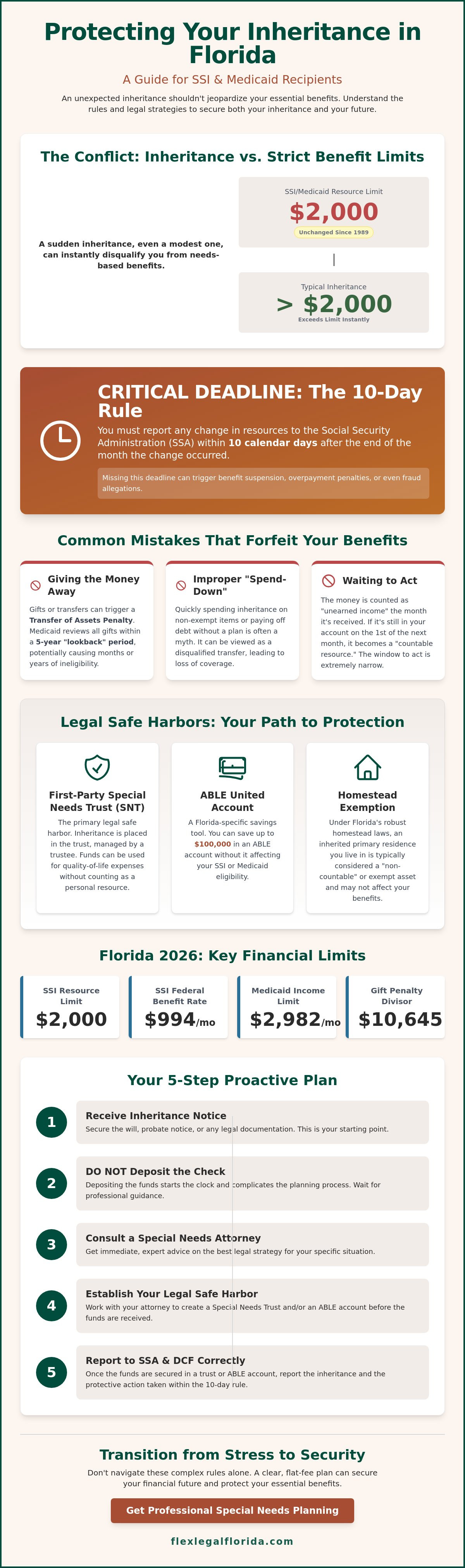
The biggest hurdle is the $2,000 individual resource limit. This number hasn't moved since 1989. If you receive even a modest inheritance, you'll likely exceed this cap instantly. When this happens, the government views you as having enough money to pay for your own food and medical care, leading to an immediate suspension of benefits.
Timing is everything. In the month you receive the money, the government treats it as "unearned income." If you still have that money in your bank account on the first day of the following month, it converts into a "countable resource." This distinction is critical. You have a very narrow window to act before the funds become a permanent disqualifier for your benefits.
Don't make the mistake of simply giving the money away to family members. The "Transfer of Assets" penalty exists to prevent people from divesting funds just to qualify for help. Medicaid reviews gifts made within a five-year "lookback" period. In 2026, the gift penalty divisor in Florida is $10,645. For every $10,645 you give away, you could face a month of ineligibility for long-term care benefits.
SSI Income and Resource Limits for 2026
In 2026, the individual federal benefit rate for SSI is $994 per month. Any unearned income over this amount usually wipes out your monthly check entirely. The Social Security Administration (SSA) uses sophisticated automated data exchanges with banks and state agencies to track your financial health. They look for "countable" assets like cash, stocks, and second vehicles while ignoring "non-countable" ones like your primary residence. Many families use Special Needs Trusts to keep inherited funds in the non-countable category, allowing the money to be used for quality-of-life expenses without triggering a benefit cut.
Florida Medicaid Long-Term Care Standards
Florida is an "income cap" state, which adds another layer of complexity. For 2026, the monthly income limit for Medicaid long-term care is $2,982. The Florida Department of Children and Families (DCF) audits inheritance reports with high precision. If you don't handle the funds correctly through protecting inheritance from SSI and Medicaid strategies, you also risk "Medicaid Estate Recovery." This is where the state seizes your remaining assets after you pass away to reimburse itself for the cost of your care. Proper planning prevents this outcome and keeps the money in your family.
The 10-Day Rule: Immediate Steps After Learning of an Inheritance
Time is your most valuable asset when an inheritance arrives. The Social Security Administration (SSA) requires you to report any change in your financial situation within 10 calendar days after the end of the month in which the change occurred. Missing this narrow window can trigger fraud allegations, overpayment penalties, or a total suspension of your benefits. When it comes to protecting inheritance from SSI and Medicaid, your speed and transparency are just as important as the legal tools you use.
You must document every detail of the windfall immediately. Keep copies of the will, the probate court notice, and the inheritance check itself. Many people mistakenly believe they can simply spend the money on personal bills before the government notices. This "spend-down" strategy is often a myth that leads to disaster. If you spend the money on the wrong things or give it away, the government may view it as a disqualified transfer. This can lead to a multi-year loss of coverage. Before you deposit that check, speaking with a professional about Special Needs Planning ensures you don't accidentally forfeit your health insurance.
The SSA provides official guidance on How Inheritance Affects SSI, noting that while the funds are considered a resource, specific legal safe harbors exist. In Florida, you aren't just dealing with the federal government; you must also satisfy the Florida Department of Children and Families (DCF).
Reporting Checklist for Florida Residents
Step 1: Secure the legal notice of inheritance. This is usually a letter from a probate attorney or the executor of the estate.
Step 2: Contact the local SSA field office in West Palm Beach. You can do this by mail, phone, or through the SSA online portal.
Step 3: Update your "MyACCESS" account. This is the Florida DCF portal used to manage your Medicaid eligibility. You must report the inheritance here to remain compliant with state rules.
Common Reporting Mistakes to Avoid
One of the most dangerous strategies is "waiting until the check clears" to report the funds. The SSA tracks financial changes through automated data exchanges. They often know about the money before you've even made a plan. Another risk involves joint bank accounts. If you deposit an inheritance into an account you share with a spouse or parent, the government may attribute the entire balance to you, instantly pushing you over the $2,000 limit. Avoid informal spend-downs, like paying off a family member’s debt. These are viewed as gifts and can trigger the Medicaid "lookback" penalty, resulting in months of lost benefits. Precision in protecting inheritance from SSI and Medicaid requires following these reporting rules to the letter.
Special Needs Trusts: Creating a Legal Safe Harbor
A Special Needs Trust (SNT) acts as a legal shield for your financial future. The core mechanism is simple but powerful: assets are owned by the trust itself, not by the individual receiving benefits. Because the beneficiary doesn't have direct control over the funds, the Social Security Administration doesn't count the money toward the $2,000 resource limit. This structure is the most reliable method for protecting inheritance from SSI and Medicaid while still allowing the funds to enhance your daily life.
If you've already inherited money or expect a check soon, a First-Party SNT, often called a "Barbara" trust, is the standard solution. It allows you to move your own assets into a protected account. However, these trusts come with a "Medicaid payback" provision. This means that when the beneficiary passes away, the state of Florida must be reimbursed for the cost of medical care provided. For families who want to be proactive, a Third-Party SNT is the gold standard. Parents or grandparents fund these trusts with their own money, and they don't require any payback to the state. This ensures that any remaining funds can stay within the family for future generations.
For smaller inheritances where the cost of a custom trust might not feel practical, a Pooled Trust is a viable alternative. These are managed by non-profit organizations that "pool" the resources of many beneficiaries for investment purposes while maintaining separate accounts for spending. Professional special needs planning helps you determine which of these "safe harbors" fits your specific financial landscape.
First-Party vs. Third-Party SNTs
The primary difference lies in the source of the money. A First-Party trust is funded by the beneficiary's own windfall, such as a direct inheritance. It must be established before the beneficiary turns 65. A Third-Party trust is funded by someone else's estate plan. Because the money never belonged to the beneficiary, the government has no claim to it after they pass. Choosing the right trustee is vital. They must understand Florida's strict distribution rules to ensure the trust doesn't accidentally trigger a benefit reduction.
What Can SNT Funds Be Used For?
SNT funds are intended for "supplemental needs" that improve your quality of life. This includes therapy, specialized medical equipment, travel, electronics, and home modifications. A major change occurred on September 30, 2024; trusts can now pay for food and groceries without reducing your monthly SSI check. However, the "ISM" rule still applies to housing. If the trust pays for your rent, mortgage, or utilities directly, your SSI payment can be reduced. We ensure your trust remains compliant with the latest SSA POMS guidelines so you can use your funds with confidence.
Florida-Specific Protections: ABLE Accounts and Homestead Nuances
Florida offers several powerful tools that work alongside trusts to safeguard your financial stability. While a Special Needs Trust is often the foundation of a legal plan, integrating state-specific options like ABLE accounts and homestead protections provides a multi-layered defense. These strategies are essential for protecting inheritance from SSI and Medicaid because they allow you to convert countable cash into exempt assets that the government cannot penalize.
One of the most effective ways to "spend down" an inheritance without losing money is by purchasing or upgrading exempt resources. In Florida, one primary vehicle of any value is generally excluded from your asset count. If you receive a $25,000 inheritance, using those funds to buy a reliable car for your transportation needs is a perfectly legal way to remain under the $2,000 limit. Similarly, you can use inherited funds to pay off a mortgage on your primary residence or make necessary home modifications, as these investments are typically protected under Florida's robust laws.
Utilizing Florida ABLE United
The ABLE Age Adjustment Act, which took effect on January 1, 2026, significantly expanded who can use these tax-advantaged accounts. You're now eligible if your disability onset occurred before age 46, a major increase from the previous age limit of 26. This change makes ABLE United accessible to millions more Floridians. You can contribute up to $20,000 per year into an ABLE account, and the first $100,000 is completely ignored by the SSA for SSI eligibility. Unlike First-Party SNTs, Florida law does not require ABLE account funds to be paid back to Medicaid upon the beneficiary's death, making it a highly efficient way to preserve wealth.
Inheriting Real Estate in Palm Beach County
Florida's homestead laws are among the strongest in the country. Your primary residence is generally a non-countable resource for Medicaid as long as your home equity doesn't exceed $752,000. However, inheriting a second home or a rental property can trigger an immediate loss of benefits because these aren't protected. We often use asset protection strategies like Enhanced Life Estate Deeds, also known as "Lady Bird Deeds," to manage these risks. These deeds allow property to pass automatically to a beneficiary upon death, avoiding the delays of probate and the reach of Medicaid estate recovery. If you're expecting to inherit property, our team can help you implement Asset Protection Planning to ensure your home remains a safe haven rather than a liability.
The Proactive Path: Working with a West Palm Beach Attorney
Attempting to manage a sudden windfall on your own often leads to permanent loss of benefits. A "DIY" approach to protecting inheritance from SSI and Medicaid is risky because a single mistake in a trust's language or a missed reporting deadline can trigger an irrevocable disqualification. We serve as your agile ally, providing modern and streamlined legal support that moves at the speed of your life. By partnering with a local estate planning attorney in West Palm Beach, you gain a partner who understands the specific operational nuances of the local DCF and SSA offices. This local expertise ensures your filings don't get lost in the shuffle of state bureaucracy.
The approach at Flex Legal, PLLC replaces the intimidating and often confusing hourly-billing model used by traditional firms. Instead, we offer clear, flat-fee packages for Special Needs Trusts and inheritance protection. This transparency allows you to focus on your family's future rather than worrying about a ticking clock during our meetings. We prioritize clarity and comfort, using modern communication methods to ensure you always know the status of your protection plan. We don't just provide a set of static rules; we offer a dynamic support system designed to adapt as your needs evolve.
The Danger of Disclaiming an Inheritance
Many families mistakenly believe that "refusing" the money through a legal disclaimer will solve their eligibility problem. This is a dangerous misconception that can lead to a total loss of coverage. The Social Security Administration treats disclaiming an inheritance as a "transfer for less than fair market value." In Florida, this action is viewed as giving away a resource you were entitled to receive. It can trigger a penalty period of up to 36 months, during which you're ineligible for benefits. Instead of walking away from your legacy, we help you implement legal alternatives that preserve the value of the funds while keeping your healthcare intact.
Next Steps for West Palm Beach Families
The first step toward peace of mind is a comprehensive Special Needs audit. During this process, we review the specific terms of the will or trust you've inherited from to identify potential "red flags" that could alert the SSA or DCF. To prepare for our meeting, you should gather any probate notices, copies of the inheritance check, and your current benefit award letters. We'll examine these documents to build a customized roadmap that balances your immediate needs with long-term asset preservation. Don't let a gift from a loved one become a financial burden. Secure your inheritance and your benefits today with Flex Legal, PLLC.
Securing Your Financial Future and Your Benefits
You now have the roadmap to transform a sudden windfall into a sustainable foundation for your future. By moving beyond reactive stress and utilizing the legal safe harbors discussed, from specialized trusts to ABLE accounts, you can ensure your inheritance enhances your life without compromising your health coverage. Effectively protecting inheritance from SSI and Medicaid is about more than just compliance; it's about preserving the legacy your loved ones intended for you to have.
At Flex Legal, PLLC, we provide the modern, empathetic legal support necessary to navigate these transitions with total certainty. Our team combines deep Florida-specific expertise with the predictability of flat-fee pricing, removing the intimidation often found in traditional law firms. We act as your agile ally in West Palm Beach, helping you implement a dynamic plan that adapts to your evolving needs. You don't have to face the complexities of the SSA or DCF alone.
Protect Your Benefits: Schedule a Flat-Fee Special Needs Consultation
Take the next step toward peace of mind and ensure your financial independence remains protected today.
Frequently Asked Questions
Can I lose my SSI if I inherit money in Florida?
Yes, you can lose your SSI benefits because a direct inheritance counts as unearned income in the month you receive it. If those funds remain in your bank account the following month, they become a countable resource. Since the individual resource limit is just $2,000, even a small windfall can trigger an immediate suspension of your monthly payments and healthcare coverage.
How much can I inherit without losing my Medicaid benefits?
You can inherit up to $2,000 as a single individual without losing Medicaid eligibility in Florida. For those receiving long-term care benefits, the monthly income limit is $2,982 for 2026. Any amount over these strict ceilings will disqualify you unless you use specific legal tools for protecting inheritance from SSI and Medicaid to shield the assets from the government's count.
What is a Special Needs Trust and do I need one for an inheritance?
A Special Needs Trust is a legal arrangement where a trustee manages assets for your benefit without those assets counting against government resource limits. You generally need one if your inheritance exceeds $2,000. It allows you to use the money for quality-of-life expenses while maintaining 100% eligibility for your public benefits. This is a core component of professional Special Needs Planning.
Can I use my inheritance to buy a house or a car and still keep my SSI?
Yes, you can spend your inheritance on exempt assets like a primary residence or one vehicle. Florida law generally protects your home as a non-countable resource regardless of its value. Buying a reliable car is also a valid "spend-down" strategy. You must document these purchases meticulously to prove to the Social Security Administration that the cash has been converted into an exempt form.
Does Florida have a "payback" rule for inherited Medicaid funds?
Florida requires a "payback" provision only for First-Party Special Needs Trusts, which are funded with your own inheritance money. Upon your death, the state must be reimbursed for the cost of your medical care from any remaining funds. However, Third-Party trusts funded by others and Florida ABLE United accounts do not require this payback, allowing the remaining wealth to stay within your family.
How long do I have to report an inheritance to the Social Security Administration?
You must report the inheritance within 10 calendar days after the end of the month in which you received the funds. This is a strict federal requirement. Missing this window can lead to overpayment penalties or fraud allegations. We recommend starting the reporting process the moment you receive a legal notice from a probate court to ensure you have time to protect the money.
Is an ABLE account better than a Special Needs Trust for an inheritance?
An ABLE account is often better for smaller inheritances because it has no Medicaid payback rule in Florida and lower administrative costs. However, you can only contribute $20,000 per year. For inheritances larger than this limit, a Special Needs Trust is the superior option. In 2026, you qualify for an ABLE account if your disability began before you turned 46.
Can a West Palm Beach estate lawyer help me if I already received the check?
Yes, a West Palm Beach attorney can help you even after the check has arrived. We use "emergency" Special Needs Planning to move the funds into a First-Party or Pooled Trust before the end of the calendar month. This rapid response prevents the inheritance from being counted as a resource, which is the most effective way of protecting inheritance from SSI and Medicaid.


Comments