
Lawyer for Guardianship of Disabled Adult Florida: A 2026 Guide
- Kelly Mata
- May 16
- 12 min read

Imagine the day your child turns 18 and you're suddenly told you no longer have the legal right to speak for them during a medical crisis. This "legal cliff" hits Florida families hard, turning a milestone birthday into a source of anxiety about the future. It's natural to worry about court oversight or losing the ability to protect someone who cannot fully protect themselves. Finding a lawyer for guardianship of disabled adult Florida is about more than just filing paperwork; it's about building a bridge to long-term security and peace of mind.
You deserve a process that feels like a partnership rather than a legal battle. We understand that you want to maintain control over essential care while respecting your loved one's independence. This guide shows you how to navigate the complexities of Florida's Chapter 744 with clarity, ensuring you gain the authority for medical and financial decisions without sacrificing dignity. We'll explore the differences between guardian advocacy and plenary guardianship, highlighting modern, least restrictive options and 2026 procedural updates that keep your family's unique needs at the center of every decision.
Key Takeaways
Understand why the 18th birthday triggers a shift in legal authority and how a lawyer for guardianship of disabled adult Florida helps you maintain your role as a protector.
Learn the difference between Guardian Advocacy and Plenary Guardianship to select the path that best balances safety with your loved one's dignity.
Discover the "least restrictive" legal mandate in Florida and when a Durable Power of Attorney might be a viable alternative to full guardianship.
Get a step-by-step preview of filing petitions in Palm Beach County to ensure a smooth, predictable transition through the local court system.
Explore how modern Special Needs Planning and streamlined Guardianship Proceedings can remove traditional legal friction for your family.
Table of Contents
Beyond the 18th Birthday: Why You Need a Guardianship Lawyer in Florida
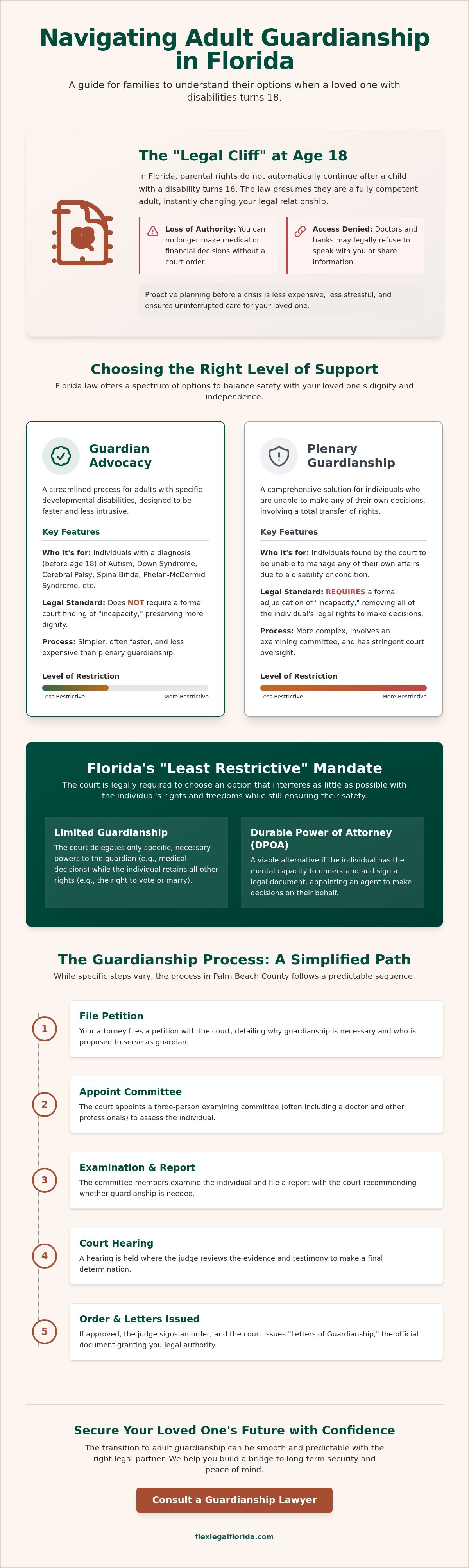
The transition to adulthood is usually a milestone worth celebrating, but for families caring for a person with disabilities, it often feels like a legal deadline. In Florida, parental rights don't continue automatically just because a child has a disability. Once that individual turns 18, the law views them as a fully competent adult with the sole right to make their own choices. This sudden shift is what many call the "legal cliff." Without a court order, you're legally a stranger to your child's medical records, bank accounts, and educational plans.
Securing a lawyer for guardianship of disabled adult Florida is the most effective way to reclaim your ability to protect them. A Legal Guardianship creates a formal relationship where the court appoints a guardian to act on behalf of a "Ward," the person found to be incapacitated. Under the 2026 Florida Probate Code, the process is designed to be transparent and protective. Proactive planning is always better than reacting to a crisis. If you wait until a medical emergency happens, you might be forced to seek emergency temporary guardianship, which is often more expensive, stressful, and restrictive than a planned proceeding.
The Legal Reality of Adulthood in Florida
Florida law presumes that every 18-year-old is legally competent to manage their own affairs regardless of their actual cognitive or physical abilities. If you don't have legal authority during a medical or financial crisis, doctors and banks may refuse to speak with you or follow your directions. Moving from the role of "parent" to "legal guardian" or "advocate" is an emotional transition, but it's a necessary step to ensure your loved one's care remains uninterrupted. It provides the legal standing you need to keep being the protector they've always relied on.
Protecting the Ward from Exploitation
Florida’s guardianship system is built on a foundation of checks and balances to prevent financial and physical abuse. A lawyer for guardianship of disabled adult Florida acts as your guide and buffer, helping you navigate court requirements like annual reports and accounting. Every guardian holds a fiduciary duty, which is a high legal standard requiring you to act solely in the Ward's best interests. Modern 2025 legislative updates, such as FL S1272, further protect Wards by ensuring they maintain social connections and aren't moved to restrictive settings without proper notice. This framework doesn't just grant you authority; it builds a wall of protection around your loved one's rights and dignity.
Guardian Advocacy vs. Plenary Guardianship: Choosing the Right Level
Choosing the right path for your loved one's future starts with understanding that Florida law doesn't treat every situation with a single, rigid rule. Guardianship is a spectrum. The goal is to provide necessary support without overstepping into areas where the adult can still make their own choices. Working with a lawyer for guardianship of disabled adult Florida helps you determine which legal framework fits your family's specific needs while meeting the court's strict requirements.
For many families, Guardian Advocacy under Florida Statute 393.12 is the preferred route. It's a streamlined process specifically designed for individuals with developmental disabilities. Unlike traditional proceedings, it doesn't require a formal adjudication of "incapacity," which often makes it faster and less expensive. If a more comprehensive solution is needed, Plenary Guardianship involves a total transfer of rights to the guardian. Alternatively, Limited Guardianship allows the court to delegate only specific powers, such as the right to marry or vote, while keeping others intact. Exploring the various Types of Florida Guardianship ensures you aren't removing more autonomy than is strictly necessary for safety.
Who Qualifies for Guardian Advocacy?
Guardian Advocacy is reserved for individuals with specific developmental disabilities listed under Florida law. These include Autism, Down syndrome, Cerebral Palsy, Spina Bifida, and Phelan-McDermid syndrome. To qualify, the disability must have manifested before the individual reached age 18. A lawyer for guardianship of disabled adult Florida can help you document these conditions to satisfy the court's evidentiary requirements. This path is deeply respectful. It avoids the clinical and often stigmatizing label of "incapacitated," focusing instead on the practical support the person needs to thrive in adulthood. Families often find this approach provides a sense of relief because it feels like a continuation of care rather than a legal judgment.
When is Plenary Guardianship Necessary?
Sometimes, a broader scope of authority is vital for a person's safety and well-being. Plenary guardianship is typically necessary for adults facing significant cognitive decline, severe mental health challenges, or complex medical conditions that fall outside the developmental disability category. This process involves a court-appointed Examining Committee of three professionals who evaluate the adult's ability to manage their own affairs. While this sounds formal, it serves as a critical safeguard for the individual's rights. Even after a guardian is appointed, Florida law allows for the restoration of rights if the Ward's condition improves, making the system adaptable to life's changes. If you're unsure which path is right for your situation, our team can help you evaluate Guardianship Proceedings to find the most compassionate fit.
Exploring Alternatives: The "Least Restrictive" Requirement
Florida law doesn't favor stripping away an individual's rights if a simpler solution exists. Under Chapter 744 of the Florida Statutes, the court is legally mandated to consider the "least restrictive" alternative before appointing a guardian. This means a judge must be convinced that no other legal tool can sufficiently protect the adult. Consulting with a lawyer for guardianship of disabled adult Florida is the best way to determine if these alternatives are legally sufficient for your family's needs. Often, a combination of private documents can provide the necessary authority without the ongoing oversight and expense of a court-supervised guardianship.
These alternatives focus on preserving as much of the individual's autonomy as possible while ensuring their health and finances are managed safely. Common tools include:
Health Care Surrogates: This document allows you to make medical decisions if your loved one is unable to do so, often without any court intervention.
Special Needs Trusts: These are essential for managing assets and inheritances without risking the individual's eligibility for vital government programs.
Joint Bank Accounts: For smaller amounts of money, simple joint ownership might suffice for basic financial management.
The Power of Attorney Alternative
A durable power of attorney is one of the most effective ways to avoid the guardianship process entirely. To sign this document, the disabled adult must have the "capacity" to understand the rights they are delegating. This is a lower legal threshold than full capacity, but it still requires the person to know they are giving you the power to handle their affairs. While a power of attorney is private and cost-effective, it has limits. Many banks and financial institutions prefer the finality of a court order for high-value assets, and a power of attorney can be revoked by the individual at any time if they still have the capacity to do so.
Special Needs Trusts and Financial Security
Integrating special needs planning into your strategy provides a layer of financial protection that guardianship alone cannot offer. These trusts allow a disabled adult to have funds for lifestyle improvements, like specialized equipment or travel, while protecting their access to SSI and Medicaid. A lawyer for guardianship of disabled adult Florida will often recommend a trust to manage an inheritance or settlement. It's vital to remember that a trust is strictly a financial vehicle; it doesn't grant you the legal right to provide medical consent for a surgery or psychiatric treatment. For those decisions, you'll still need a health care surrogate or a form of guardianship.
The Legal Process: Filing in Palm Beach County
Moving from planning to action requires a clear understanding of the local court system. In the 15th Judicial Circuit, the process is structured to be thorough yet efficient. Working with a lawyer for guardianship of disabled adult Florida ensures that your petition meets every technical requirement of the Palm Beach County courts. This prevents unnecessary delays that could leave your loved one without a legal advocate during a critical time.
The journey through the court system follows five primary steps:
Step 1: Filing the Petition. You must file a Petition for Guardian Advocacy or Appointment of Guardian with the court.
Step 2: Notice Requirements. The law requires formal notice to the Ward and their next of kin to ensure everyone is aware of the proceedings.
Step 3: Court-Appointed Attorney. To protect the Ward's rights, the court appoints an independent attorney to represent their interests.
Step 4: The Hearing. A judge in West Palm Beach reviews the evidence to confirm that guardianship is the least restrictive option.
Step 5: Letters of Guardianship. Once approved, the court issues these letters. They act as your "license" to make decisions on the Ward's behalf.
Local Expectations in the 15th Judicial Circuit
Palm Beach County has specific standards for those seeking to serve as guardians. You'll need to undergo a background check and a credit check as part of the application process. Additionally, the court requires all non-professional guardians to complete a mandatory 8-hour training course. This course is available in West Palm Beach and covers the legal, financial, and medical responsibilities you'll be undertaking. The Clerk & Comptroller's office plays a vital role here. They audit every report to ensure the Ward's assets and well-being are protected. If you're ready to start this journey, you can schedule a consultation for Guardianship Proceedings with our team today.
Ongoing Responsibilities and Annual Reports
Your role doesn't end once the hearing is over. Within the first 60 days, you must file an Initial Inventory and an Initial Guardianship Plan. These documents establish the baseline for the Ward's care and assets. Every year after that, you'll file an Annual Accounting, which tracks financial activity, and an Annual Plan, which details the Ward's physical and mental health. These filings can be complex. Many families find that probate lawyers in Palm Beach County are invaluable allies in managing these recurring requirements. Having a professional handle the paperwork ensures your focus remains where it belongs: on the care and happiness of your loved one.
Modern Special Needs Planning: How Flex Legal, PLLC Protects Your Future
Caregiving is a full-time commitment that leaves little room for navigating complex legal bureaucracies. We designed our "Agile Ally" approach to specifically address this reality by removing the friction often found in traditional law firms. When you're searching for a lawyer for guardianship of disabled adult Florida, you need a partner who values your time as much as you do. Flex Legal, PLLC utilizes virtual consultations and modern document management systems to ensure that your legal matters move forward without requiring you to sacrifice your daily routine. Our goal is to provide a seamless experience that integrates your immediate needs with a comprehensive estate plan, ensuring no detail of your loved one's future is left to chance.
Our firm prioritizes adaptability over rigid rules. We understand that every family's situation is unique, which is why we offer customized support systems rather than one-size-fits-all solutions. By leveraging modern technology, Flex Legal, PLLC keeps you informed at every stage of the process, from the initial petition to the final issuance of letters. This responsive model positions us as a forward-thinking alternative to slower, more traditional professional services.
Price Certainty for Special Needs Families
Most legal services rely on opaque hourly billing that can lead to "invoice shock" at the end of the month. We've moved away from that outdated model for standard filings. By offering flat-fee packages for Guardian Advocacy, we provide the price certainty that special needs families require to plan their finances effectively. You'll receive full transparency regarding court costs and filing fees from the very beginning of our partnership. This approach ensures your legal budget is invested directly into protecting your loved one rather than being consumed by unpredictable billable hours. We believe that financial clarity is essential for building a relationship based on trust and reliability.
A Partnership Built on Empathy
We believe that clarity is a form of compassion. Florida's guardianship statutes are notoriously dense, but we take pride in making them accessible and clear for every client. Our relationship doesn't end when the judge signs the order. Flex Legal, PLLC provides ongoing support to help you understand your fiduciary duties and the long-term responsibilities of your role. We're here to act as your expert peer, moving from identifying specific challenges to presenting a clear, adaptable path forward. If you're ready to secure your loved one's future with a modern, streamlined approach, schedule a consultation with a lawyer for guardianship of disabled adult Florida today. Let's build a plan that preserves dignity and ensures lasting protection.
Securing Your Loved One's Future with Confidence
Protecting a family member with disabilities requires a blend of legal precision and genuine empathy. We've explored how navigating the "legal cliff" at age 18 doesn't have to be a source of fear. Whether you choose Guardian Advocacy for its streamlined efficiency or explore least restrictive alternatives, the goal remains the same: ensuring your loved one is safe and their rights are respected. Finding a specialized lawyer for guardianship of disabled adult Florida is the first step toward creating a predictable, stress-free path for your family's future.
At Flex Legal, PLLC, we prioritize transparency and modern solutions. Our flat-fee pricing for Guardian Advocacy packages provides the financial certainty you need while our expertise in Florida Statute 393.12 ensures your case is handled with professional authority. We offer dedicated West Palm Beach local support to guide you through every filing and hearing in the 15th Judicial Circuit. You don't have to face these complex laws alone. Schedule your modern guardianship consultation with Flex Legal, PLLC today. Your peace of mind is our priority, and we're ready to act as your agile ally in this journey.
Frequently Asked Questions
Do I need a lawyer for guardianship of a disabled adult in Florida?
Yes, Florida law requires every guardian to be represented by a licensed attorney. This requirement ensures that all court filings and annual reports meet the strict standards found in Chapter 744 of the Florida Statutes. A lawyer for guardianship of disabled adult Florida acts as your essential guide, managing the complex interactions between your family and the 15th Judicial Circuit court system.
What is the difference between guardianship and guardian advocacy in Florida?
Guardian advocacy is a streamlined legal path specifically for individuals with developmental disabilities that manifested before age 18. It doesn't require a formal adjudication of "incapacity," which makes the process less invasive. Traditional guardianship is broader and requires a three-person examining committee to evaluate the adult's cognitive and physical abilities before a judge makes a ruling.
How much does it cost to get guardianship of an adult in Florida?
Total costs include court filing fees, background check fees, and costs for the court-appointed examining committee. General civil circuit court filing fees typically range from $250 to $400. According to 2026 data, the required examining committee usually costs between $500 and $1,500. These figures don't include professional legal fees, which vary based on the complexity of your specific case.
Can a disabled adult fight a guardianship petition?
Yes, every individual has the legal right to contest a guardianship petition. The court automatically appoints an independent attorney for the adult to ensure their voice is heard and their rights are protected. If the adult can demonstrate they have the capacity to manage their own affairs, or if a less restrictive alternative is available, the judge may deny the petition entirely.
What rights does a disabled adult lose under plenary guardianship?
Plenary guardianship involves the transfer of all delegable legal rights to a court-appointed guardian. This usually includes the right to enter into contracts, manage property, sue or be sued, and make major medical or residential decisions. A lawyer for guardianship of disabled adult Florida often works to secure a limited guardianship instead, which allows the individual to retain as much autonomy as safely possible.
Does Florida require a background check for guardians?
Yes, Florida law mandates that all potential guardians undergo a thorough criminal background check and a credit history review. This protective measure ensures that the person appointed to manage the Ward's life and assets is reliable and trustworthy. In Palm Beach County, these checks must be completed and reviewed by the court before you can receive your official Letters of Guardianship.
How long does the guardianship process take in Palm Beach County?
An uncontested guardianship or advocacy case usually takes between 60 and 90 days to complete. This timeline accounts for filing the petition, the mandatory evaluation period, and the final hearing before a judge. While emergency petitions can move faster, the standard process depends on the availability of the examining committee and the current court calendar in West Palm Beach.
Can I get guardianship without a court hearing?
No, a formal court hearing is a mandatory step in the Florida guardianship process. This hearing serves as a vital safeguard to ensure that the individual's rights are only removed when absolutely necessary. It allows the judge to review expert testimony and the court-appointed attorney's report before granting legal authority to a guardian.


Comments