
How to Settle an Estate in Palm Beach County: A Step-by-Step 2026 Guide

What if the most daunting part of losing a loved one wasn't the grief, but the fear of making a costly mistake in a West Palm Beach courtroom? Most families assume that learning how to settle an estate in Palm Beach County is a years-long journey through a dense legal maze. You likely feel the pressure of the 10-day deadline to deposit a will or the anxiety of navigating the 15th Judicial Circuit’s specific digital requirements. It's natural to worry about legal traps like the Florida Homestead rules or the high fees often associated with traditional, slower law firms.
At Flex Legal, PLLC, we believe estate settlement should be a strategic project handled with modern agility rather than a rigid set of intimidating rules. This guide provides the clarity you need to navigate the 2026 legal landscape with confidence. We'll break down the specific probate paths available to you, explain the local court systems, and show you how a partnership-based approach can protect your family's inheritance without the usual friction.
Key Takeaways
Learn the critical first steps for securing property and meeting the 10-day deadline for depositing a Will with the Clerk.
Discover how to settle an estate in Palm Beach County using the updated 2026 Summary Administration threshold to bypass lengthy court delays.
Navigate the 15th Judicial Circuit’s specific digital requirements, including the mandatory Online Scheduling System and filing checklists.
Identify potential pitfalls involving the Florida Homestead exemption that can complicate even the simplest property transfers.
Compare traditional statutory fees with modern, transparent pricing models to maximize the value of your family's inheritance.
Table of Contents
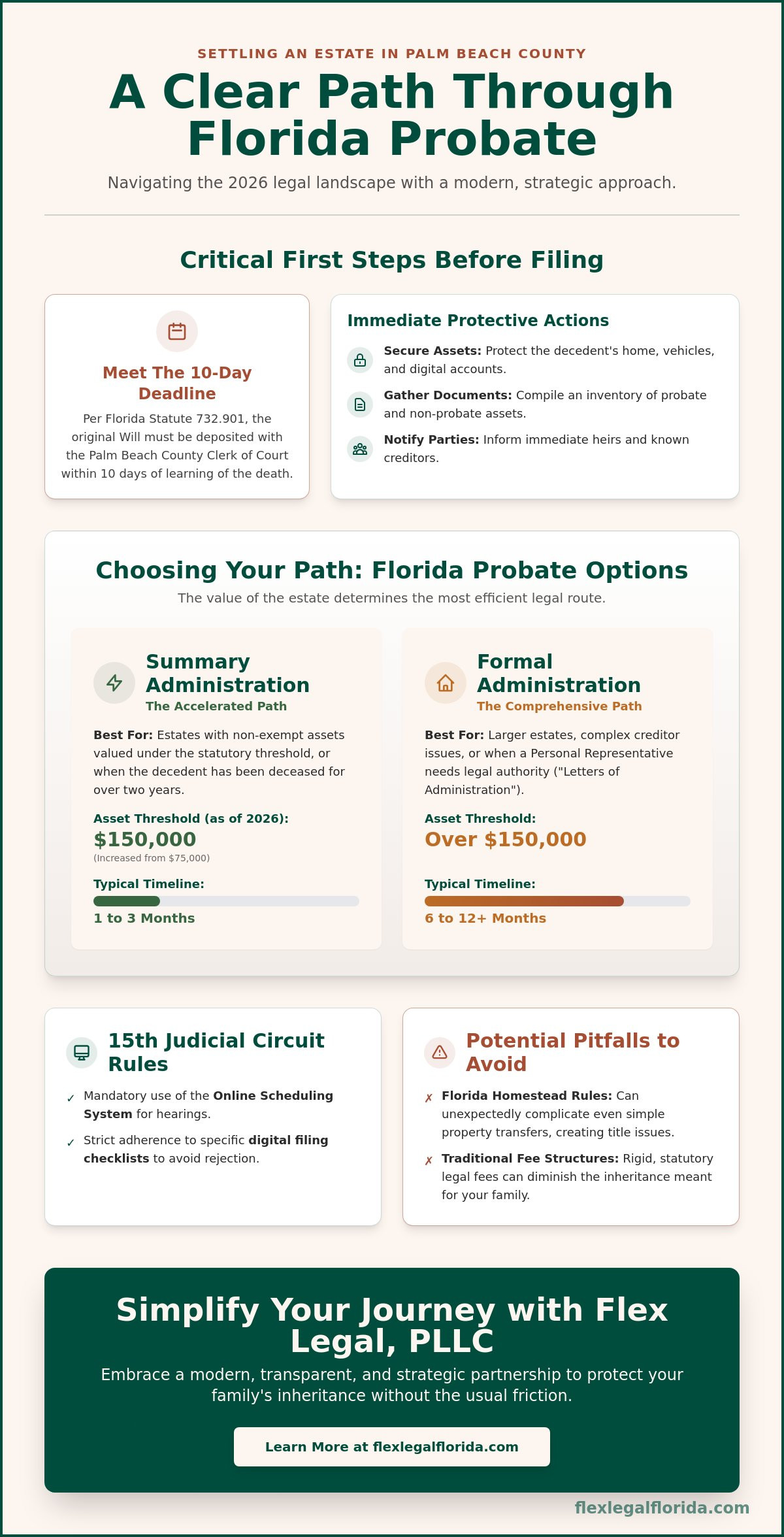
Immediate Steps: What to Do Before Filing with the Palm Beach Clerk
The first few days after losing a loved one are often a blur of emotion and logistics. While the legal process of probate might feel distant, the most critical work happens before you ever step foot in a courtroom. Your priority is protection. Secure the decedent's home, collect sensitive documents, and change passwords for digital accounts to prevent identity theft or unauthorized access. You'll also need to order five to ten certified copies of the death certificate. Financial institutions, insurance companies, and the court will each require their own original copy to process claims and filings.
Identifying and notifying immediate heirs and known creditors is your next move. Transparency at this stage reduces the risk of future litigation. If the decedent owned a business or high-value assets, securing those interests immediately prevents loss of value. This proactive approach is the hallmark of a strategic settlement process, ensuring you aren't just reacting to crises as they arise.
The 10-Day Rule for Filing the Will
Florida Statute 732.901 is strict: the person holding the original Last Will and Testament must deposit it with the Clerk of the Court within 10 days of learning about the death. In Palm Beach County, you'll take this document to the Clerk of the Circuit Court & Comptroller at 205 North Dixie Highway in West Palm Beach. If you can't find the original document, don't panic. While Florida law prefers the original, there are specific legal procedures to establish a lost will through testimony and evidence. This is a common hurdle when learning how to settle an estate in Palm Beach County, and it's where an agile legal partner helps you pivot quickly to keep the process moving.
Gathering the 'Estate Inventory' Early
Before filing a petition, you need a clear picture of what the decedent owned. Start by categorizing assets into two buckets: probate and non-probate. Probate assets are those held solely in the decedent's name, like a bank account without a beneficiary or a local condo. Non-probate assets, such as life insurance policies with designated beneficiaries or property held in a Revocable Living Trust, pass directly to heirs outside of court.
Organizing this list early is vital for the 15th Judicial Circuit’s requirements. The court expects precision. Having a detailed inventory of bank balances, VIN numbers for vehicles, and account statements allows your attorney to file the correct paperwork the first time. This early diligence prevents the administrative friction that often causes months of delay in the local court system. Mastering how to settle an estate in Palm Beach County effectively starts with this foundational list.
Choosing Your Path: The Three Types of Florida Probate
Florida probate isn't a one size fits all process. The path you take depends heavily on the total value of the assets and how long ago the decedent passed away. Choosing the wrong path can lead to months of unnecessary delays and higher court costs. In most cases, the Palm Beach County Clerk of the Circuit Court requires you to have a licensed attorney to file these proceedings. This isn't just a suggestion; Florida law mandates legal representation for any Formal Administration to ensure the rights of creditors and heirs remain protected.
The role of the Personal Representative, often called an executor, is the backbone of this journey. They're the strategic lead responsible for identifying assets, paying valid debts, and distributing what remains. Whether you're managing a small family account or a sprawling waterfront estate, understanding the different filing types is the first step in learning how to settle an estate in Palm Beach County with efficiency and confidence.
Formal Administration vs. Summary Administration
A major legislative shift occurred on July 1, 2026, that changed the landscape for local families. The threshold for Summary Administration increased from $75,000 to $150,000. If the non-exempt assets are under this amount, you can often use this "shortcut" to finish the process in one to three months. It's a faster, less expensive option with a filing fee of approximately $235. Additionally, any estate qualifies for Summary Administration if the decedent has been passed for more than two years, regardless of the estate's value.
Formal Administration is required for estates exceeding $150,000 or those involving complex creditor issues. This process is more thorough and typically takes six to twelve months. It requires the court to issue "Letters of Administration," which grant the Personal Representative the legal authority to act. Sometimes, we choose Formal Administration even for smaller estates. This is a strategic move if the family needs to file a lawsuit on behalf of the estate or if there's a need for an extended period to settle messy creditor claims. If you're unsure which path fits your situation, a quick consultation for probate administration can clarify your best move.
Disposition of Personal Property Without Administration
This is the simplest form of probate, but it's very limited. It's designed for families who paid for the decedent’s final expenses out of pocket and need reimbursement. You can file this directly with the Clerk without an attorney, provided the estate consists only of personal property exempt from creditors and non-exempt property that doesn't exceed the sum of funeral expenses and medical bills from the last 60 days. You cannot use this method if the decedent owned real estate. While it’s rare for most families learning how to settle an estate in Palm Beach County, it serves as a vital tool for very small estates with minimal assets.
The Step-by-Step Settlement Process in West Palm Beach
Once you've identified the correct probate path, the work moves into the courtroom. Understanding how to settle an estate in Palm Beach County requires following a specific sequence governed by the 15th Judicial Circuit. While The Florida Bar provides a broad overview of state rules, local administrative orders in West Palm Beach dictate the daily rhythm of your case. The process begins with filing the Petition for Administration. This formal document asks the court to officially open the estate and recognize the will.
After the judge reviews your initial filing, they issue "Letters of Administration." These aren't actual letters, but court orders that grant the Personal Representative the legal authority to act. With these in hand, you can access bank accounts, sell real estate, and manage business interests. From there, the estate enters a mandatory waiting period for creditors, followed by a final accounting and the eventual distribution of assets to heirs. The process concludes with a Petition for Discharge, which legally releases the Personal Representative from their duties and closes the case file forever.
Navigating the 15th Judicial Circuit's OLS System
Palm Beach County operates a digital-first probate court. Judges here use the Online Scheduling System (OLS) to receive and sign "Proposed Orders." Your attorney doesn't just mail a paper request; they upload digital documents that the judge reviews and signs electronically. This system is designed for efficiency, but it requires strict adherence to local rules. Per Administrative Order 6.202, all petitions for administration must be accompanied by a completed checklist submitted through OLS. Missing a single checkmark can stall your case for weeks. Precision in these digital filings is the heartbeat of your probate timeline, ensuring your case moves through the West Palm Beach courthouse without administrative friction.
Managing Creditors and the 'Notice to Creditors'
You can't distribute money to heirs until you've dealt with the decedent's debts. This requires publishing a "Notice to Creditors" in a local newspaper of general circulation, such as the Palm Beach Post. Once published, a 90-day clock begins. This window allows creditors to file claims against the estate. It's a period of forced patience; you generally shouldn't distribute significant assets until this window closes. A seasoned probate lawyer palm beach county ensures these claims are scrutinized and handled according to statutory priorities. This professional oversight shields you from personal liability, making sure you don't accidentally pay an invalid debt or distribute funds that should have gone to a legitimate creditor.
Palm Beach Pitfalls: Homestead, Taxes, and Litigation
Even with a clear roadmap, local roadblocks can stall your progress. Learning how to settle an estate in Palm Beach County requires an eye for specific legal traps that often catch families off guard. One of the most frequent hurdles involves the Florida Homestead Trap. In Florida, a primary residence is technically not a probate asset. It passes by operation of law to the heirs. However, you still need a court order to prove this status. Without an "Order Determining Homestead," you cannot clear the title or sell the property. Selling the house before this order is signed is a major risk that leads to significant title insurance nightmares.
Tax obligations also require careful timing. You must distinguish between the decedent's final income tax (form 1040) and the federal estate tax (form 706). While most estates won't reach the multi-million dollar threshold for federal estate taxes, every estate must address the final income tax return. Additionally, you should be prepared for the "Blue Memorandum." This is the Palm Beach Clerk’s specific way of rejecting filings that don't meet strict local standards. It's a common frustration, but an agile legal partner treats it as a quick procedural fix rather than a dead end. If you are facing these complexities, you can discuss your estate settlement strategy with our team today.
Securing the Homestead Exemption for Heirs
The Petition to Determine Homestead is your most powerful shield. In Florida, homestead property is exempt from the claims of most creditors. This means the family’s primary residence can often be saved even if the decedent had significant outstanding debts. Because Palm Beach County real estate values are exceptionally high, this filing is often the most financially significant part of the entire probate process. It ensures the home stays with the family rather than being sold to satisfy credit card balances or medical bills.
Resolving Family Disputes and 'Caveats'
Conflict is the primary driver of probate delays. Florida Statute 731.110 allows any "Interested Party" to file a Caveat with the court. This filing ensures that a Will cannot be admitted to probate without the caveator being notified first. It's a strategic tool used to prevent a Will from being processed if there are concerns about its validity or the decedent’s mental capacity. If an heir in the estate has a disability, it is vital to consult a special needs planning attorney. They can help structure the inheritance so it doesn't accidentally disqualify the heir from receiving essential government benefits like SSI or Medicaid.
Simplifying Your Journey with Flex Legal, PLLC
The administrative weight of closing a loved one’s life often feels like a full-time job at the exact moment you need space to grieve. We've designed our practice to be the agile ally you need during this transition. While traditional firms might leave you waiting weeks for a callback, our team prioritizes speed and clarity. We handle the technical heavy lifting of the 15th Judicial Circuit's OLS filings and mandatory checklists. This allows you to focus on your family while we navigate the procedural friction. Learning how to settle an estate in Palm Beach County becomes a manageable project rather than an overwhelming crisis when you have a strategic partner by your side.
Pricing transparency is a core value at Flex Legal, PLLC. In Florida, attorney fees for probate are frequently calculated as a percentage of the estate's value under Florida Statute 733.6171. For an estate valued at $300,000, this can result in fees of approximately $9,000. We offer flexible pricing structures, including flat-fee options for qualifying estates, so you know exactly what to expect without the fear of hidden costs. Our goal is strategic administration that reduces the time assets are locked in court, moving you toward distribution as efficiently as possible.
Why a Modern Firm Matters in 2026
The legal landscape has evolved, and your law firm should reflect that. We use modern technology to streamline communication and document signing, meaning you don't have to drive across West Palm Beach for every minor signature. We've moved beyond the stuffy, intimidating atmosphere of old-school law to become an approachable, empathetic ally. Our support doesn't end when the probate case closes. We often help families transition their inheritance into a revocable trust. This proactive planning ensures that future generations can avoid the probate process entirely, providing long-term security and peace of mind.
Next Steps: Your Consultation
Taking the first step is often the hardest part of the process. During your initial probate strategy session, we evaluate your specific situation to determine the most efficient path forward for your family. To make this session most effective, please bring the original Will, a death certificate, and a preliminary list of the decedent’s assets and debts. We'll provide a clear timeline and a tailored plan of action. Schedule your streamlined estate consultation with Flex Legal, PLLC today to begin the process with confidence and clarity.
Take Control of Your Family's Legal Future
Settling a loved one's affairs is a significant responsibility, but it doesn't have to be a source of constant stress. By understanding the 2026 updates and mastering the local digital requirements, you're already ahead of the curve. You now have a clear roadmap for how to settle an estate in Palm Beach County with strategic precision. This includes everything from the initial 10-day Will deposit to the final discharge of the Personal Representative.
At Flex Legal, PLLC, we're here to serve as your agile ally throughout this transition. Our team combines deep expertise in the 15th Judicial Circuit with a modern, solution-oriented approach that prioritizes your peace of mind. Whether you need help with complex litigation or prefer the clarity of our flat-fee estate planning packages, we provide the streamlined support your family deserves. You don't have to manage these court filings and local traps alone.
Start your stress-free estate settlement with Flex Legal, PLLC today. We'll handle the complexities so you can focus on what truly matters.
Frequently Asked Questions
Is an attorney required to settle an estate in Palm Beach County?
Yes, Florida law requires a licensed attorney for nearly all probate proceedings. You must have legal representation for any Formal Administration or if the estate has more than one beneficiary. While a "Disposition of Personal Property" doesn't require a lawyer, the 15th Judicial Circuit's complex digital filing systems and OLS checklists make professional guidance a practical necessity for most local families.
How long does the probate process typically take in West Palm Beach?
The timeline depends on the complexity of the assets and the probate path you choose. Summary Administration for estates under $150,000 often concludes in one to three months. Formal Administration generally takes six to twelve months. This period can extend if the estate faces creditor disputes, complex tax issues, or challenges to the validity of the Last Will and Testament.
What are the court filing fees for probate in Palm Beach County?
Filing fees are set by statute and paid to the Clerk of the Circuit Court & Comptroller. Opening a Formal Administration case costs approximately $401 to $402. If you're filing for Summary Administration, the fee is approximately $235. These costs are separate from attorney fees and are usually paid out of the estate's assets at the beginning of the process.
Can I look up a probate case online in Palm Beach County?
Yes, you can track the progress of a case through the Clerk’s online "Showcase" system. This portal allows you to view the docket and see which orders the judge has signed. While you can see the list of filings, sensitive documents like death certificates and specific financial inventories are restricted from public view to protect the privacy of the decedent and their heirs.
What is a 'Personal Representative' and who can serve in Florida?
A Personal Representative is the individual appointed by the court to manage the estate’s business. To serve in Florida, you must be at least 18 years old, have no felony convictions, and be a Florida resident. Non-residents can only serve if they are a close relative of the decedent, such as a spouse, sibling, parent, or child.
How do I handle out-of-state heirs when settling a Florida estate?
Managing out-of-state heirs is a routine part of how to settle an estate in Palm Beach County. Most modern firms use secure digital platforms for document signing and communication. Heirs don't need to travel to West Palm Beach for hearings. Your attorney coordinates all notices and distributions remotely, ensuring the process stays on track regardless of where the family lives.
What happens if there is no Will (Intestate Succession)?
If there's no Will, Florida’s intestacy laws dictate who receives the assets. The court follows a specific hierarchy, usually starting with the surviving spouse and children. This process still requires a formal probate filing to settle debts and legally transfer titles. It often takes longer than a testate case because the court must verify all potential heirs before distributing any property.
Can I avoid probate if the decedent had a Revocable Living Trust?
Assets held in a Revocable Living Trust generally bypass the probate court and pass directly to beneficiaries. This is one of the primary benefits of trust administration. However, you might still need a "pour-over" probate case if the decedent left assets in their individual name, such as a bank account or vehicle, that were never officially transferred into the trust's ownership.


Comments