
How to Set Up a Special Needs Trust in Palm Beach County: A 2026 Guide
- Kelly Mata
- May 15
- 13 min read

What if a well-meaning $5,000 gift from a grandparent accidentally stripped your child of their Medicaid health coverage and monthly SSI benefits? It's a heartbreaking reality for many Florida families who realize too late that traditional inheritance methods can lead directly to a "Medicaid Cliff." Understanding how to set up a special needs trust in Palm Beach County is about more than just legal paperwork; it's about building a protective shield around your loved one's future and well-being.
We know you're likely feeling overwhelmed by complex terms like "irrevocable" or "discretionary" and worried about who will manage these funds when you're no longer there to do it. You deserve a plan that offers both professional authority and genuine peace of mind. This 2026 guide provides a comprehensive roadmap for Palm Beach County families to preserve vital government benefits while securing a comfortable lifestyle for their children. We'll explore how to navigate the latest Florida legal updates, including the expanded trustee powers under SB 262 and the best ways to integrate ABLE accounts into your modern estate strategy.
Key Takeaways
Discover why an outright inheritance is the primary threat to your loved one's government benefits and how a supplemental support system prevents the "Medicaid Cliff."
Learn exactly how to set up a special needs trust in Palm Beach County while ensuring your documents meet the specific standards of Florida's 15th Judicial Circuit.
Navigate the complexities of the Florida Department of Children and Families review process and federal SSI compliance with a clear, step-by-step roadmap.
Compare the benefits of professional versus family trustees to ensure long-term stability and expert administration of your child's future resources.
Explore modern, flat-fee special needs planning solutions with Flex Legal, PLLC, designed to provide your family with a legally bulletproof plan and lasting peace of mind.
Table of Contents
Understanding Special Needs Trusts in the Florida Legal Landscape
A Special Needs Trust (SNT) acts as a legal safety net, specifically designed to hold assets for a person with a disability without disqualifying them from essential government programs. In Florida, the Social Security Administration (SSA) and the Department of Children and Families (DCF) maintain strict oversight on how these funds are handled. Learning about Understanding Special Needs Trusts is the first step toward building a secure future. Finding a local partner who understands how to set up a special needs trust in Palm Beach County is essential because regional court interpretations can vary. For many parents, the biggest concern isn't just providing money; it's ensuring that money doesn't replace the critical health insurance and monthly income their child relies on.
The fundamental rule is that the trust must supplement, not supplant, government benefits. When you explore how to set up a special needs trust in Palm Beach County, you're essentially creating a discretionary bucket of funds that the beneficiary doesn't "own" in the eyes of the law. This distinction is vital because programs like Medicaid and SSI are means-tested. They're only available to those with very limited resources. A properly drafted trust ensures that the beneficiary can enjoy a higher quality of life while remaining eligible for the basic support systems they need to survive.
The Core Purpose: Supplemental vs. Basic Support
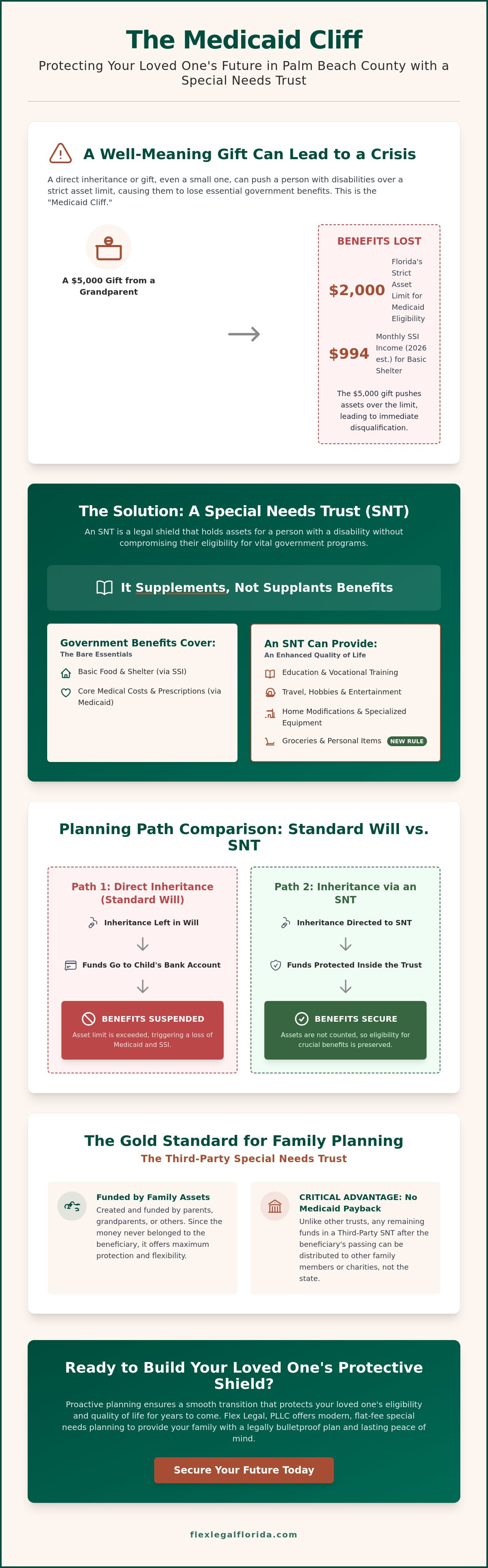
Government benefits are designed to cover the bare essentials. SSI provides a maximum of $994 per month for an individual in 2026, which is intended for basic shelter. Medicaid covers core medical costs. An SNT fills the gap for everything else that makes life meaningful. Under the Florida "Sole Benefit" rule, the funds must be used exclusively for the person with the disability. Under new standards, the Social Security Administration no longer considers food as "in-kind support and maintenance." This means a trust can now pay for groceries without reducing monthly SSI checks. Typical expenses an SNT might cover include:
Advanced medical treatments or specialized therapy not covered by Medicaid.
Educational expenses, including tuition or vocational training.
Travel, hobbies, and entertainment.
Electronic equipment, furniture, and home modifications.
Why a Standard Will is Not Enough
Leaving money directly to a child through a traditional Last Will and Testament is often a dangerous mistake. Florida's asset limit for single Medicaid applicants remains at a strict $2,000. If an inheritance of $10,000 or even $50,000 lands in their bank account, their benefits will likely be suspended immediately. This creates a crisis where the individual must "spend down" the money on basic needs until they're poor enough to qualify again. Proactive planning allows you to avoid this "Medicaid Cliff" entirely. By integrating special needs planning into your broader estate strategy now, you ensure a smooth transition that protects your loved one's eligibility and quality of life for years to come.
Choosing the Right Trust Structure for Your Family’s Needs
Selecting the correct legal vehicle is the most critical decision in your planning journey. The rules governing these accounts depend entirely on where the money comes from. If you are researching how to set up a special needs trust in Palm Beach County, you must first determine if you are protecting a family inheritance or managing the beneficiary’s own assets. Each path has distinct tax implications and state reporting requirements. Choosing the wrong structure can lead to unnecessary legal hurdles or the loss of Medicaid eligibility.
Third-Party Trusts: Protecting the Family Legacy
Third-party special needs trusts are widely considered the gold standard for parental estate planning. These trusts are funded by assets that never belonged to the beneficiary, such as a life insurance policy or the family home. Because the money comes from someone else, Florida law does not require a Medicaid payback provision. This means that when the primary beneficiary passes away, any remaining funds can go to other family members or charities. These trusts offer maximum flexibility. You can name successor beneficiaries and provide specific instructions on how the funds should enhance your child's life. For families seeking a tailored approach, professional special needs planning ensures your legacy remains intact while your child stays protected.
First-Party and Miller Trusts: Solving the Income Cap
First-party trusts are necessary when the person with a disability receives their own money, perhaps from a personal injury settlement or a direct inheritance. These must be established before the beneficiary turns 65. Unlike third-party versions, these require a provision to pay back the Florida Department of Children and Families for any Medicaid expenses incurred during the beneficiary's life.
Florida also presents a unique "income cap" challenge. In 2026, the monthly income limit for Nursing Home or Home and Community-Based Medicaid is $2,982. If your loved one’s income exceeds this even by a single dollar, they may lose coverage. A Qualified Income Trust, often called a Miller Trust, is the specific solution used to redirect that excess income and maintain eligibility. Understanding how to set up a special needs trust in Palm Beach County involves identifying these local income hurdles early.
Modern planning also looks at companion tools like ABLE accounts. As of January 1, 2026, the ABLE Age Adjustment Act has expanded eligibility to include those with a disability onset age up to 46. With an annual contribution limit of $20,000, these accounts work alongside your trust to provide quick, tax-advantaged access to funds for daily expenses. This multi-layered strategy creates an adaptable support system that grows with your family's needs.
Navigating Florida-Specific Medicaid and SSI Eligibility Rules
Florida's regulatory environment is unique, and staying compliant requires a deep understanding of both state and federal rulebooks. When you look into how to set up a special needs trust in Palm Beach County, you aren't just dealing with local courts. You're also interacting with the Florida Department of Children and Families (DCF) and the Social Security Administration. DCF acts as the gatekeeper for Medicaid eligibility, while the SSA follows the Program Operations Manual System (POMS) to determine if a trust is a "countable resource." To pass these reviews, the trust must grant the Trustee absolute discretion. If the beneficiary can legally demand a payment, the state views those funds as being in the beneficiary’s pocket, which can lead to an immediate loss of benefits.
In West Palm Beach, many families also utilize "Lady Bird Deeds" as a strategic companion to their special needs planning. This specific type of enhanced life estate deed allows you to transfer property to an SNT automatically upon your death. It bypasses the lengthy probate process and, more importantly, shields the home from Medicaid estate recovery. This ensures that the family home remains a resource for your loved one rather than being seized by the state to repay medical costs. It's a modern solution that fits perfectly within an agile, forward-thinking estate plan.
Real Estate and the Florida Homestead Advantage
A Special Needs Trust can legally own a home, providing a stable environment for the beneficiary. This is particularly powerful in Florida, where the primary residence is an exempt asset with an equity limit of $752,000 in 2026. Florida’s unlimited homestead exemption serves as a unique shield against creditors, making it one of the most robust asset protection tools in the country. By having the SNT hold the title, you protect the property from being counted against the $2,000 Medicaid asset limit while ensuring the beneficiary has a permanent place to live. It's a sophisticated way to manage high-value assets while maintaining eligibility for essential care services.
The Letter of Intent: More Than Just Legal Jargon
While the trust document handles the legal "how," a Letter of Intent addresses the personal "why." This non-binding document is your chance to speak directly to the future Trustee about your child’s daily life. It bridges the gap between complex legal theory and the actual care your loved one receives. You should document everything from medical history and preferred doctors to social habits and even the small things that bring them joy. Knowing how to set up a special needs trust in Palm Beach County includes preparing this human-centric guide. It ensures that when you're gone, the person managing the money understands the person they're supporting, not just the balance in the bank account.
The Step-by-Step Process to Establishing Your Trust in Palm Beach County
Setting the foundation for a secure future requires moving from legal theory into active implementation. When you're ready to learn how to set up a special needs trust in Palm Beach County, you'll find that the process is a sequence of precise administrative moves. It begins with drafting a document that specifically adheres to both federal POMS requirements and the local standards of Florida’s 15th Judicial Circuit. Once the document is finalized, you must obtain an Employer Identification Number (EIN) from the IRS. This allows the trust to act as its own tax entity. With the EIN in hand, you can open a dedicated trust bank account at a financial institution in West Palm Beach. This keeps trust assets completely separate from personal funds, which is a non-negotiable requirement for benefit eligibility.
Funding the trust is the next critical phase. This involves formalizing asset transfers or updating beneficiary designations on life insurance policies and retirement accounts. You aren't just "earmarking" money; you're legally retitling it. After the trust is funded, you must notify the Social Security Administration and the Florida Department of Children and Families. They'll review the document to ensure it doesn't count against the beneficiary’s asset limits. Missing this step can lead to a sudden suspension of benefits, even if the trust is perfectly drafted. Knowing how to set up a special needs trust in Palm Beach County means staying ahead of these reporting deadlines to ensure a seamless transition of care.
Local Filing and Administrative Realities
While many trusts are private, certain situations may require court oversight. The Palm Beach County Clerk of the Circuit Court & Comptroller serves as the central hub for any necessary filings. In the 15th Judicial Circuit, probate judges are particularly diligent about protecting the interests of incapacitated individuals. Having local expertise is a major advantage here. It helps you navigate the specific preferences of West Palm Beach judges and ensures that your filings meet regional procedural expectations without unnecessary friction. This local insight is what transforms a standard document into a robust, functional life plan.
Selecting and Empowering the Trustee
The choice of a Trustee is perhaps the most personal decision you'll make. This individual or entity carries significant fiduciary responsibilities under the Florida Trust Code. They must manage distributions carefully to avoid triggering benefit violations. If you choose a family member, they'll need specific training on what the trust can and cannot pay for. You might find our guide on Choosing a Trustee for a Special Needs Trust in Florida helpful as you weigh your options. Whether you opt for a professional or a loved one, the goal is a partnership that prioritizes the beneficiary’s comfort. If you're ready to begin this journey with a local ally, explore our special needs planning services to build your custom roadmap.
Securing Your Future with a Modern Palm Beach County Planning Ally
Choosing a legal partner shouldn't feel like entering a rigid, distant institution. At Flex Legal, PLLC, we’ve reimagined the planning experience to be as dynamic as the families we serve. When you're figuring out how to set up a special needs trust in Palm Beach County, you need more than just a stack of papers. You need an agile ally who can translate complex Florida statutes into a clear, actionable roadmap. Our approach prioritizes a sophisticated balance of professional authority and modern accessibility. We don't just draft documents. We coordinate with your existing financial advisors and care teams to ensure every piece of your loved one’s ecosystem works in harmony.
Our team simplifies the logistics of how to set up a special needs trust in Palm Beach County, allowing you to focus on what truly matters: your family. We strip away the dense, multi-clausal jargon that often alienates readers, opting instead for active verbs and straightforward declarations of value. This ensures you feel like a peer in the process, not just a client. By focusing on adaptability as a core value, we create support systems that can pivot as federal regulations or your personal circumstances evolve.
The Flex Legal, PLLC Difference: Transparent and Accessible
Transparency is the cornerstone of our partnership model. We utilize a flat-fee approach to special needs planning, giving Palm Beach families the certainty they need without the friction of unpredictable hourly billing. Our process focuses on streamlined drafting and modern communication methods, ensuring you’re never left in the dark. We view ourselves as a long-term ally for your beneficiary’s entire life journey. As laws like SB 262 evolve or family circumstances change, our flexible planning models adapt to keep your child’s protection bulletproof.
Next Steps: Your Consultation in West Palm Beach
Taking the first step toward peace of mind is straightforward. For your initial planning session in West Palm Beach, gathering a few key items will help us hit the ground running. We recommend you bring any existing wills or revocable living trusts, current benefit letters from the Social Security Administration or Florida DCF, and information regarding potential trust assets like life insurance policies or real estate details.
We'll use these to build a tailored strategy that reflects your specific goals. This isn't just about wealth management; it's about protecting your loved one’s dignity and ensuring they’re cared for on their own terms. Reach out to start your special needs planning journey with a team that values your time and your family's future. Let's build a plan that offers the security your child deserves and the clarity you've been looking for.
Protecting Your Legacy and Their Quality of Life
Securing your loved one’s future shouldn’t be a source of constant stress. By now, you’ve seen how the right legal structure protects an inheritance while maintaining essential healthcare and income. Whether you’re utilizing a third-party trust to preserve a family legacy or a Miller Trust to solve income cap issues, the goal remains the same. You’re building a foundation of dignity and stability. Understanding how to set up a special needs trust in Palm Beach County is the most impactful step you can take to ensure your child never faces the "Medicaid Cliff" or a sudden loss of benefits.
Flex Legal, PLLC is here to act as your agile ally in this process. We combine deep expertise in Florida Medicaid and SSI compliance with a modern, transparent approach to West Palm Beach estate planning. Our flat-fee pricing ensures you have total certainty from the very first session. You don't have to navigate these complex regulations alone. Secure your loved one’s future with a flat-fee Special Needs Trust plan from Flex Legal, PLLC. You’ve worked hard to provide for your family; now let’s make sure those resources are protected for a lifetime. Your peace of mind starts with a clear, adaptable plan today.
Frequently Asked Questions
What is the difference between a first-party and third-party SNT in Florida?
The origin of the funds is the primary difference. A first-party trust is funded with the beneficiary's own assets, such as a personal injury settlement or a direct inheritance they already received. A third-party trust is funded by assets from someone else, usually parents or grandparents. Because third-party trusts use outside money, they don't require a Medicaid payback provision in Florida. This allows family members to name successor beneficiaries to receive any remaining funds.
Can I set up a Special Needs Trust myself in Palm Beach County?
While you aren't legally barred from trying, attempting this without professional help is extremely risky. Understanding how to set up a special needs trust in Palm Beach County requires precise knowledge of Social Security's POMS and Florida’s specific trust laws. A single phrasing error can count the entire trust as a resource. This results in an immediate loss of Medicaid and SSI benefits. Most families find that the security of a bulletproof plan far outweighs the risks of a DIY document.
How much money can you put in a Special Needs Trust in Florida?
There is no legal maximum for how much money can be held within a Special Needs Trust. Unlike ABLE accounts, which have annual contribution limits of $20,000 in 2026, an SNT can hold millions of dollars or even high-value real estate. This makes them the ideal tool for protecting significant inheritances or large legal settlements. The goal is to provide a lifetime of support, regardless of the total dollar amount involved in the plan.
Will a Special Needs Trust affect my child’s Medicaid waiver services?
A properly established trust should not interfere with Medicaid waiver services. In fact, the primary reason to learn how to set up a special needs trust in Palm Beach County is to protect eligibility for programs like the iBudget Florida waiver. These Home and Community-Based Services have strict asset limits. By placing assets into a discretionary trust, you ensure your child continues to receive specialized care while having extra funds available for a higher quality of life.
Who can serve as a Trustee for an SNT in West Palm Beach?
You have several options for trustees in West Palm Beach, including family members, professional fiduciaries, or corporate trust departments. The right choice depends on the complexity of the assets and the needs of the beneficiary. Family members offer personal knowledge but may struggle with complex SSA reporting. Professional trustees provide expertise in Medicaid compliance and investment management. Many families choose a combination, naming a family member and a professional as co-trustees to balance heart and expertise.
What happens to the money in a Special Needs Trust when the beneficiary passes away?
The destination of the remaining funds depends entirely on the trust structure. For a first-party trust, Florida law requires that Medicaid be reimbursed for the cost of care provided during the beneficiary's life. Any leftover money then goes to the named heirs. For a third-party trust, there is no state payback requirement. You have total control to name siblings, other relatives, or charitable organizations as the final beneficiaries of the remaining assets in the trust.
Does Florida have a "payback" requirement for all special needs trusts?
No, the payback rule only applies to first-party trusts funded with the beneficiary's own money. Third-party trusts, which are the most common tool for parental estate planning, don't have this requirement. This is a vital distinction for families who want to ensure that any remaining inheritance stays within the family line. It’s one of the most powerful reasons to use a third-party structure whenever possible when planning for a loved one’s long-term future.
Can an SNT pay for a car or a vacation for the beneficiary?
Yes, these are classic examples of supplemental needs that a trust can cover. The trustee can pay for a vehicle, insurance, maintenance, or travel expenses directly to the service providers. This enhances the beneficiary's quality of life without providing them with direct cash that would count as income. Since the SSA no longer counts food as in-kind support, the trust has even more flexibility in 2026 to cover daily living enhancements that go beyond basic shelter.


Comments