
How a Special Needs Trust May Affect Medicaid Eligibility

A catastrophic-injury settlement can create a benefits problem if it goes directly to the injured person. A properly drafted and managed special needs trust for catastrophic injury may hold settlement funds while helping preserve eligibility for needs-based benefits such as Medicaid and SSI, provided the trust complies with applicable program rules.
It’s understandable to want settlement funds available for future care without putting essential benefits at risk. For SSI, the Social Security Administration sets the resource limit for an individual at $2,000, so how settlement money is received and held can matter.
This article explains what a special needs trust does, when injury settlement funds may go into one, and how the trust’s structure and administration can affect Medicaid eligibility. It also covers planning considerations to help families make informed decisions before a settlement is finalized.
Table of Contents
Does this protect Medicaid eligibility?
A special needs trust may help preserve Medicaid and SSI eligibility when settlement funds are structured and managed correctly. The key is how the money is held and used.
SSI and Medicaid Resource Eligibility
Resource eligibility rules limit assets available to a person applying for needs-based benefits. According to the Social Security Administration, the SSI resource limit for an individual in the United States is $2,000. Medicaid eligibility also depends on program rules, which can vary by state. For SSI, a child’s parents’ income and resources are generally attributed to the child during minority. At eighteen, the young adult’s own resources control, making the timing of a settlement important.
Settlement Effects on Benefit Eligibility
A personal injury settlement paid directly to someone receiving SSI or Medicaid can affect eligibility because the programs may consider income and resources. If an SSI recipient’s countable resources rise above $2,000, benefit eligibility may be affected. The same settlement can therefore create different consequences depending on how the person receives and holds the funds.
Pennsylvania has a separate option for certain future care costs. In Pennsylvania medical professional liability actions, MCARE § 509 provides for periodic payment of future medical and related expenses, with payments ending at the claimant’s death. This structure concerns specified future expenses; it does not by itself resolve how a settlement affects needs-based benefits.
Trusts for Preserving Eligibility
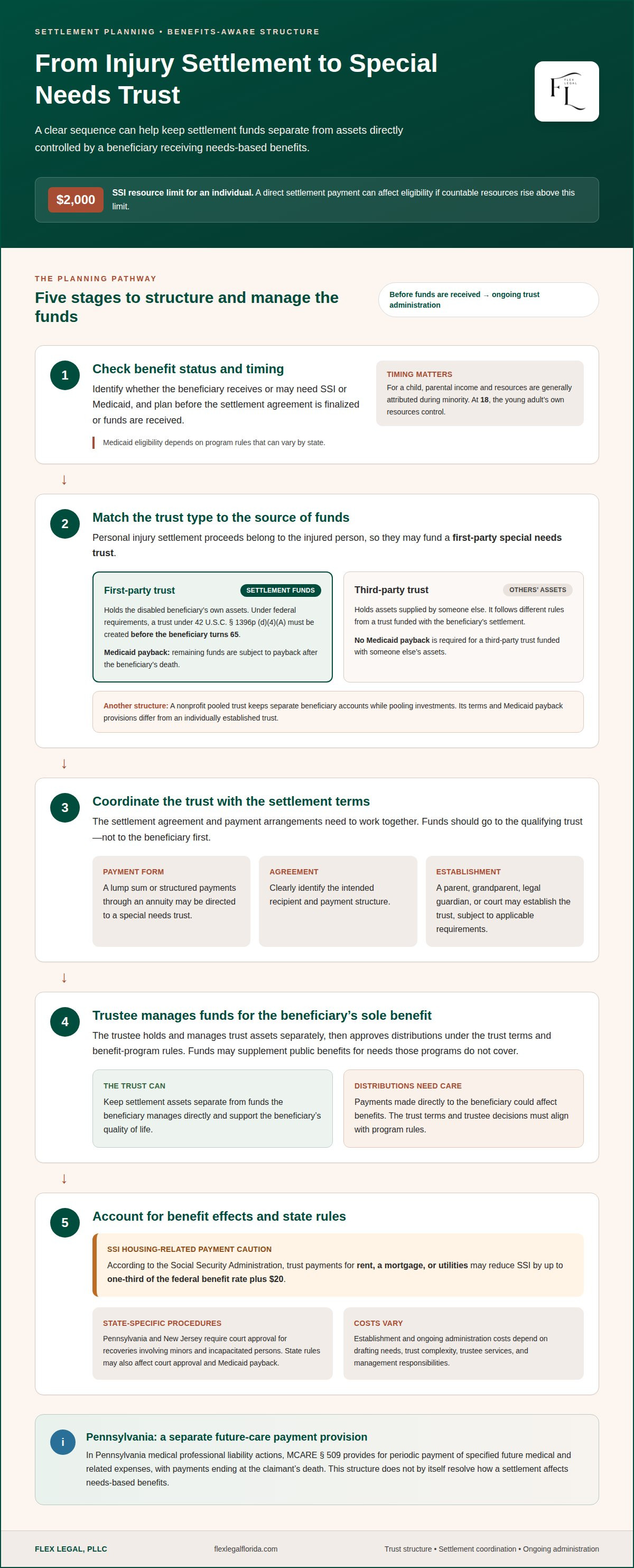
A properly drafted and administered first-party special needs trust can hold the disabled beneficiary’s settlement funds while helping preserve access to Medicaid and SSI. The settlement should go into a qualifying trust rather than be paid to the beneficiary first. The trustee manages the funds for the beneficiary’s sole benefit, following the trust terms and benefit-program rules.
Trust funds can supplement public benefits, but the way they are spent matters. For example, according to the Social Security Administration, trust payments for rent, a mortgage, or utilities may reduce SSI by up to one-third of the federal benefit rate plus $20. A first-party trust also requires Medicaid payback from remaining funds after the beneficiary’s death. A nonprofit pooled trust may be another structure to consider, depending on the circumstances.
What Is a Special Needs Trust?
A special needs trust holds assets for a person with a disability, with a trustee managing them for that person’s benefit. State rules may affect court approval and Medicaid payback. Establishment and ongoing administration costs depend on the trust’s complexity and the trustee services involved.
First-Party and Third-Party Trusts
A first-party trust holds assets belonging to the disabled beneficiary, while a third-party trust holds assets supplied by someone else. This distinction matters because the source of funds affects the trust’s terms and what happens to remaining assets. According to the Office of the Law Revision Counsel, U.S. House of Representatives, a first-party special needs trust under 42 U.S.C. § 1396p(d)(4)(A) must be created before the disabled beneficiary turns 65. A third-party trust funded with someone else’s assets doesn’t require Medicaid payback.
Trusts for Settlement Proceeds
Personal injury settlement proceeds belong to the injured person, so they may fund a first-party special needs trust. The beneficiary must meet the Social Security Act’s definition of disability, and the trust must satisfy federal requirements. A parent, grandparent, legal guardian, or court may establish the trust. The trustee manages the funds and approves distributions for the beneficiary’s sole benefit. This structure can support quality of life while keeping settlement assets separate from funds the beneficiary manages directly.
Pooled Trusts and State Rules
A pooled trust is managed by a nonprofit association, with separate accounts for beneficiaries and pooled investment funds. It can be an alternative, but its terms and Medicaid payback provisions differ from those of an individually established trust. State rules also shape settlement procedures. Pennsylvania and New Jersey require court approval for recoveries involving minors and incapacitated persons, making state-specific planning important, particularly when a settlement involves a minor.
Trust establishment and administration costs vary with drafting needs, the selected trustee, and ongoing management responsibilities. A special needs planning attorney can assess how the beneficiary’s assets, settlement terms, state rules, and long-term needs fit together.
Can settlement funds go into this trust?
Yes. A personal injury settlement can fund a first-party special needs trust, but the settlement agreement and payment arrangements need to work together. Common risks include receiving funds directly or making distributions that conflict with benefit rules. Planning before settlement documents are finalized can help families reduce these risks.
Protecting Settlement Funds
A properly structured trust holds settlement assets separately and assigns a trustee responsibility for managing and distributing them. This can help prevent a lump sum from becoming a resource directly controlled by someone receiving needs-based benefits. Trust funds may supplement public benefits for expenses those programs don’t cover, subject to applicable rules. The trustee’s decisions matter: payments made directly to the beneficiary could affect benefits, so the trust terms and administration must align.
Coordinating Trusts and Settlement Agreements
Coordination means matching the trust terms to the settlement payment method. A settlement may provide a lump sum or structured payments through an annuity, and either arrangement can be directed to a special needs trust. The agreement should clearly identify the intended recipient and payment structure. Families should also account for Medicaid reimbursement claims and the trust’s payback terms when planning how proceeds will be handled.
Lump-Sum Settlements and Countable Resources
A lump sum received by the injured person can become a countable resource and put needs-based eligibility at risk. Placing settlement proceeds into a qualifying trust can change how those funds are held, but it doesn’t make every payment harmless. For example, cash distributed to the beneficiary may affect SSI, while payments for certain living expenses can also change benefit calculations. Careful administration remains essential after the trust is funded.
Planning Trust Timing and Settlement Releases
Trust planning should begin before the settlement is finalized, not after the proceeds reach the injured person. Families negotiating an injury settlement should consult a special needs planning attorney before signing a release or settlement agreement. This allows time to align the trust structure, payment instructions, and any structured settlement terms. A pooled trust may be appropriate in some circumstances, but its terms and administration differ from those of an individually drafted trust.
Legal advice for special needs planning
Effective planning starts with identifying which benefits the injured person receives or may need. Supplemental Security Income and Medicaid are needs-based, while Social Security Disability Insurance is not subject to a resource limit. That distinction matters: a settlement may affect SSI or Medicaid even when SSDI eligibility remains unchanged. An attorney can map each benefit to the settlement structure and the person’s long-term care needs.
Next, legal review should connect the trust document to the settlement and any government claims. A special needs trust has specific requirements, and the trustee must manage distributions according to its terms and benefit rules. An attorney can also assess Medicaid or Medicare claims or liens against a personal injury recovery, including whether a claim may be compromised. This review helps clarify what funds remain available for the beneficiary.
State recovery rules can raise complex questions about which parts of a settlement represent medical costs. The U.S. Supreme Court’s decisions in Wos v. E.M.A. and Gallardo v. Marstiller address limits on state Medicaid recovery claims. Their application depends on the claim and governing law. Legal analysis should therefore consider the settlement allocation, the asserted lien, and the trust’s payback terms together.
Planning also extends beyond drafting. The trustee’s investment and distribution decisions affect how long assets can support care, equipment, and other supplemental needs. For a trust holding substantial assets, a professional fiduciary experienced with special needs trusts may help with ongoing administration. An ABLE account may complement a trust, but contribution and account rules can limit its role. The right structure depends on benefits, settlement terms, future expenses, and who will manage the funds.
For tailored guidance on coordinating benefit rules, settlement claims, and trust administration, arrange special needs planning before finalizing the legal structure.
Flex Legal, PLLC: Special Needs Planning
Flex Legal, PLLC helps families plan for a loved one’s needs through Special Needs Planning and related estate planning. After a catastrophic injury, this work can address how settlement assets fit with benefit eligibility, who will manage the trust, and how future decisions can be handled.
Turn to Flex Legal, PLLC when a settlement is under consideration, a trust needs to be established, or an existing trust requires administration. Planning may also connect with a Revocable Living Trust or a Designation of Pre-need Guardian as part of a broader family plan. The right structure depends on the beneficiary’s circumstances, available benefits, and long-term support needs.
For guidance on planning around an injury settlement or trust, contact Flex Legal, PLLC in West Palm Beach.
Build a plan that can adapt
A serious injury can reshape a family’s priorities over time. Planning should account not only for the settlement, but also for who will make decisions, how care needs may change, and how the beneficiary’s broader estate plan fits together. A special needs trust for catastrophic injury can be considered alongside other planning tools, with each choice tailored to the person’s circumstances.
Flex Legal, PLLC offers Special Needs Planning, Revocable Living Trusts, and Guardianship Proceedings in West Palm Beach. These services can help families coordinate trust planning with decision-making and future support needs. Discuss the beneficiary’s situation, settlement plans, and priorities with Flex Legal, PLLC.
Contact Flex Legal, PLLC for guidance on a plan that fits your family’s needs. A thoughtful start can make the path ahead feel more manageable.
Frequently Asked Questions
Can the trust be created after receiving money?
A trust may be established after funds arrive, but the payment may already affect needs-based benefit eligibility. If a settlement has been paid directly to the injured person, the funds may count as resources under program rules. A later transfer does not automatically undo that effect. The amount, how it was received, and the person’s current benefit status shape the next planning steps.
Does the beneficiary control the trust?
No. The trustee manages trust assets and decides whether requested distributions comply with the trust’s terms and benefit rules. For example, a beneficiary may explain a need for equipment or services, while the trustee reviews and pays an approved expense. This division helps keep trust property distinct from money the beneficiary can freely access. Careful trustee selection and clear instructions can support consistent decisions over time.
What happens to the money when the beneficiary dies?
For a first-party trust, remaining assets must reimburse each state that paid medical assistance for the beneficiary, using funds left after the beneficiary’s death. The trust document and applicable law govern any amount remaining after required payback. A third-party trust is different: under the stated rule, assets contributed by someone else do not require Medicaid payback. Families can consider these distinctions when deciding how to leave an inheritance.
Who can create a first-party SNT in Florida?
A disabled individual may establish their own first-party special needs trust under federal law. A parent, grandparent, legal guardian, or court may also establish one. Florida requirements still apply: the trust must comply with the federal exception and state Medicaid rules. For a minor or incapacitated person, local court approval may be required for a recovery, so settlement planning with Flex Legal, PLLC may involve both trust documents and court procedures.
What is a special needs trust for catastrophic injury?
A special needs trust for catastrophic injury can hold settlement assets for a person with a disability while a trustee manages the funds for the beneficiary’s needs. It is designed to supplement, not replace, public benefits. For instance, the trust may pay for eligible supplemental expenses that government programs don’t cover, with distributions subject to the trust terms and applicable benefit rules.
How does a first-party special needs trust work for a personal injury settlement?
The settlement belongs to the injured person, so it can fund a first-party trust if the person meets disability requirements and the trust qualifies. The settlement agreement and payment instructions should direct the funds into the trust rather than to the beneficiary. A trustee then manages the assets and reviews disbursements. At the beneficiary’s death, any remaining funds are subject to required Medicaid reimbursement.

Comments