
Florida trust decanting: how it works and its limits

An irrevocable trust can sometimes be reshaped without prior court approval, but decanting is not a blank check. Florida trust decanting explained through its core mechanism means an authorized trustee transfers assets from an existing trust into a second trust with revised terms. Florida SB 262 amended Section 736.04117 and was signed into law as Chapter 2025-159, according to the Florida Legislature. The trustee’s authority and the new terms remain subject to statutory limits.
If you're weighing a trust change, the key concern is not just what terms could be revised, but how the change may affect beneficiaries and taxes. This guide has Florida trust decanting explained in practical context, including the process, what SB 262 addresses, when tax-related distribution restrictions matter, and what beneficiaries can do if a trustee misuses the power. It also clarifies the difference between a possible planning tool and an automatic right to rewrite a trust, so you can better understand the issues before deciding what comes next.
Table of Contents
What if the Trustee Abuses Their Power While Decanting?
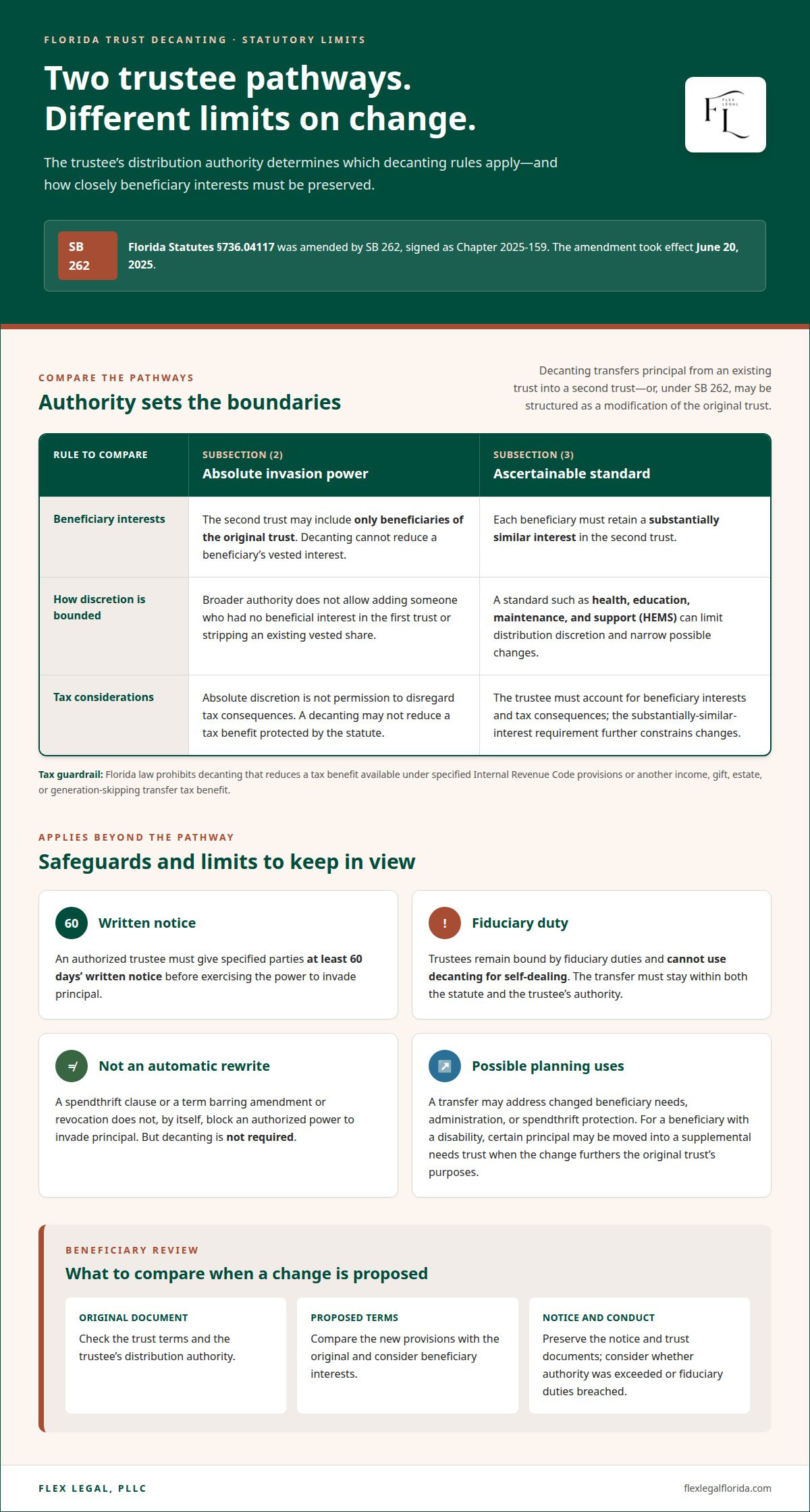
Florida trust decanting rules differ according to the trustee’s distribution authority. Under Florida Statutes §736.04117, an authorized trustee is someone other than the settlor or a beneficiary who can invade trust principal. A trustee with absolute invasion power follows the broader pathway in subsection (2). A trustee limited by an ascertainable standard follows subsection (3), where each beneficiary must retain a substantially similar interest in the second trust.
That broader authority still has firm limits. Under subsection (2), the second trust may include only beneficiaries of the original trust, and decanting cannot reduce a vested interest. For example, a trustee cannot use absolute power to add a relative who had no beneficial interest in the first trust or strip an existing beneficiary’s vested share. Florida trustees also remain bound by fiduciary duties and cannot use decanting for self-dealing.
The trustee may revise provisions to address changed circumstances or new laws, including trustee powers. A second trust may retain or alter a power of appointment granted in the first trust. But that flexibility does not authorize changes beyond the statute or the trustee’s distribution power. Florida Senate Bill 262 was signed into law as Chapter 2025-159, according to the Florida Legislature.
Notice is another safeguard. Section 736.04117 requires an authorized trustee to give specified parties at least 60 days’ written notice before exercising the power to invade principal. A beneficiary concerned about a proposed modification can preserve the notice and trust documents, compare the proposed terms with the original provisions, and consult trust counsel about whether the trustee exceeded statutory authority or breached fiduciary duties.
A spendthrift clause or a provision barring amendment or revocation does not, by itself, block an authorized trustee’s power to invade principal under subsection (9). Still, subsection (10) does not require a trustee to decant; choosing not to act does not itself imply impropriety. The document, the trustee’s authority, beneficiary interests, and the proposed changes determine the limits.
What Is Trust Decanting Under Florida SB 262 in 2026?
Decanting moves assets from an existing irrevocable trust into a trust with revised terms. Florida SB 262 amended Section 736.04117 and took effect on June 20, 2025. This overview of Florida trust decanting explains how that transfer can adapt trust terms while remaining within statutory limits.
Reasons for Decanting
Decanting can adapt an irrevocable trust when its original provisions no longer fit a beneficiary’s needs. For example, a trustee may transfer assets to a supplemental needs trust for a beneficiary with a disability or update administrative terms as circumstances change. The proposed transfer must fit the authority granted by Florida law and the trust instrument. Florida trust decanting, explained through this process, gives trustees a way to address changed needs.
Revocable and Irrevocable Trusts
A revocable trust can generally be changed by its settlor, while decanting offers a statutory path to revise certain irrevocable trusts. That distinction matters because an irrevocable trust’s terms aren’t simply rewritten at the trustee’s discretion. Section 736.04117 sets conditions for using the trustee’s distribution power, and the original document may also limit or prohibit decanting.
To fund a second trust, an authorized trustee transfers principal from the original trust under the applicable statutory pathway. The trustee may create a new trust or, under SB 262, structure decanting as a modification of the original trust instead. A suitable pre-existing trust may also receive the assets. The new terms can address administration, beneficiary needs, or spendthrift protection, but the transfer must stay within the trustee’s authority.
For a beneficiary who may need means-tested government benefits, Florida law allows certain trust principal to be moved into a supplemental needs trust. The trustee must determine that the change furthers the original trust’s purposes. Decanting may also address a drafting mistake, combine compatible trusts, or adjust administration. Each goal requires reviewing the trust terms, beneficiary interests, and any notice requirements before assets move.
If a trust’s terms need to adapt to disability-related needs, special needs planning can help frame the planning questions.
Tax-related limits on distributions to a second trust
A trustee’s distribution authority does not erase tax limits on transferring assets. Before decanting, the trustee must consider the original trust’s terms, each beneficiary’s interests, and how the second trust could affect tax treatment.
Absolute discretion can give a trustee broader flexibility, but it is not permission to disregard tax consequences. Florida law prohibits decanting that reduces a tax benefit available under specified Internal Revenue Code provisions or another income, gift, estate, or generation-skipping transfer tax benefit. For example, new terms must not sacrifice an existing tax advantage simply to change distributions or strengthen asset protection.
A trustee whose authority follows an ascertainable standard faces an additional constraint: each beneficiary must retain a substantially similar interest in the second trust. A standard such as health, education, maintenance, and support, often shortened to HEMS, can limit distribution discretion. The terms of a second trust should take beneficiaries’ interests into account. This restriction may narrow the options for modifying distributions or adding protective provisions.
Some assets carry specific federal rules. Under Florida Statutes section 736.04117(5)(b), a trustee may not transfer S corporation stock to a second trust that isn’t a permitted shareholder under Internal Revenue Code section 1361(c)(2). Section 736.04117(5)(d) also bars a transfer involving a trust-held interest subject to Internal Revenue Code section 401(a)(9), if decanting would shorten its otherwise applicable maximum distribution period.
Tax review should also consider powers and beneficiary rights. Giving a grantor a power absent from the original trust, or giving a beneficiary a general power of appointment, can raise estate-tax inclusion issues. The IRS often treats a decanted trust as a continuation of the original for income-tax purposes. An attorney can assess these effects alongside distribution terms, because asset-protection flexibility cannot override the statute or eliminate protected tax benefits.
How trust decanting works in Florida
Florida’s process depends on the trustee’s authority, the trust’s terms, and statutory requirements. Section 736.04117 also requires attention to notice and documentation.
The Decanting Process
Decanting is a fiduciary exercise of authority to move trust principal into revised terms or another trust. First, the trustee identifies the governing law and confirms the trust falls within Section 736.04117. The trustee then evaluates the original document, beneficiaries’ interests, and the proposed changes. This review matters because a useful estate-planning adjustment must stay within both statutory limits and the trustee’s powers.
Florida permits decanting without prior court approval in some circumstances, but the trustee remains subject to fiduciary duties. The trustee must use a written instrument, signed and acknowledged, then file it with the first trust’s records. For example, a trustee changing administrative provisions should document how the change serves the trust’s purposes. Decanting may also alter administration, but moving a trust to another state can raise filing and tax-residency considerations.
Notice Before Decanting
Before exercising the power to invade principal, an authorized trustee must give specified parties at least 60 days’ written notice under Section 736.04117. The notice period gives affected people an opportunity to review the proposed action and respond. The statute’s notice requirement matters even when a trustee believes a change fits the beneficiaries’ circumstances.
Beneficiaries have a 60-day period to object to a proposed decanting; an objection may require the trustee to seek court approval. The trustee may proceed if no objection is made during the notice period, or if an earlier effective date is agreed upon or the right to object is waived. Clear notice and records help distinguish a considered fiduciary decision from an unexplained change. For guidance on administration duties, discuss trust administration.
Flex Legal, PLLC: Revocable Living Trusts
Flex Legal, PLLC helps Florida families plan through Revocable Living Trusts and Trust Administration Assistance. If you’re considering decanting, start by understanding how the proposed change fits the existing trust, its beneficiaries, and your broader estate plan. A review can clarify whether the issue concerns administering current terms or planning for future flexibility.
For families planning around a beneficiary’s disability, Special Needs Planning can address how trust decisions relate to that person’s needs. Guardianship Representation for Adults or Guardianship Proceedings may also be relevant when a court-appointed guardian is part of the family’s situation. Each approach addresses a different planning need, so the right starting point depends on the question you’re trying to resolve.
Contact Flex Legal, PLLC to discuss your trust planning questions.
Make Your Next Trust Decision Deliberately
Florida trust decanting, explained in context, is a starting point for a broader planning decision. Before changing course, consider what outcome matters most: clearer administration, terms that better fit a beneficiary’s circumstances, or a trust structure that supports your estate plan. A focused conversation can help turn those priorities into questions about authority, timing, and the effect on the people the trust is meant to protect.
If you’re weighing a possible change or want to plan ahead, Flex Legal, PLLC can help you consider your trust-related needs and next steps. The right approach should reflect the trust document and the people who depend on it, rather than a template or assumption.
Contact Flex Legal, PLLC to discuss your estate-planning questions and move forward with a clearer plan.
Frequently Asked Questions
What Are the Different Types of Decanting?
Florida law provides different decanting pathways based on the trustee’s distribution authority. A trustee with absolute discretion may use the pathway under subsection (2), while authority restricted by an ascertainable standard follows subsection (3). Structurally, assets may move to a newly created trust or a suitable existing trust. Florida SB 262 also allows an authorized trustee to structure decanting as a modification of the original trust.
When Is Decanting Necessary?
Decanting isn’t mandatory, even when a trust’s terms no longer fit a beneficiary’s circumstances. Florida Statutes section 736.04117(10) doesn’t require a trustee to use the power, and declining to act doesn’t itself imply impropriety. For example, a trustee may decide that preserving the current distribution structure better serves the trust’s purposes than changing its terms. The key distinction is between an available option and a required action.
When Is Trust Decanting a Useful Strategy?
Decanting may be useful when an irrevocable trust’s existing provisions no longer support its beneficiaries or practical administration. A change in a beneficiary’s needs, for example, may prompt consideration of different distribution terms or special needs planning. The trustee must assess whether the proposed adjustment fits the original trust’s purposes and statutory authority. Decanting is not a general-purpose rewrite, and tax or beneficiary-interest limits may narrow the available changes.
When is Court Approval Needed?
Court approval may become relevant if a beneficiary objects to a proposed decanting during the notice period; the objection may require the trustee to seek approval. Florida law also permits decanting without prior court approval in some circumstances, subject to statutory criteria and fiduciary duties. A dispute about the trustee’s authority or the effect on beneficiary interests can make court involvement important to resolving the issue.
What is trust decanting under Florida law?
Trust decanting under Florida law is a method for an authorized trustee to move principal from an existing irrevocable trust into revised terms. The receiving arrangement may be a new trust or, under Florida SB 262, a modification of the original trust. It gives trustees a way to adapt certain trust provisions without treating every change as a settlor’s direct amendment. The trustee’s authority and statutory limits still govern.
Which Florida statute governs trust decanting, and what does it require?
Florida Statutes section 736.04117 governs trust decanting. It applies to trusts governed by Florida law or administered principally in Florida and provides different pathways based on the trustee’s distribution authority. An exercise must be documented in a written instrument, signed and acknowledged by the authorized trustee, and filed with the first trust’s records. The statute also sets notice rules and limits on permissible changes.



Comments