
Florida ABLE Account Rules 2026: The Complete Guide to the Age 46 Expansion
- Kelly Mata
- May 14
- 13 min read

For years, a rigid age limit prevented millions of Americans from accessing the financial freedom they deserved. That changed on January 1, 2026, when the disability onset age for eligibility officially jumped from 26 to 46. This landmark shift means that if you are one of the millions now eligible, the Florida ABLE account rules 2026 allow you to save for the future without the constant fear of losing your Medicaid or SSI benefits. It's a new era for disability asset protection in the Sunshine State.
We know the anxiety that comes with managing "excess" savings while trying to maintain essential support. You shouldn't have to choose between long term financial security and your daily healthcare needs. This guide will show you exactly how to master the new $20,000 annual contribution limit and use these tax-free accounts as a cornerstone of your broader estate plan. We'll break down the latest eligibility requirements, qualified expenses, and the specific ways Florida protects your ABLE funds from Medicaid recovery.
Key Takeaways
Understand how the 2026 age expansion from 26 to 46 opens financial doors for millions of Floridians to build tax-free wealth.
Learn how to navigate the Florida ABLE account rules 2026 to maximize your $20,000 annual contribution limit while keeping your benefits secure.
Discover the $100,000 asset threshold for SSI and why Florida Medicaid eligibility remains protected regardless of your account balance.
Compare the flexibility of beneficiary-managed ABLE accounts with the robust, long-term protection of trustee-led Special Needs Trusts.
See how to strategically integrate your ABLE account into a comprehensive Florida estate plan to ensure a seamless financial legacy.
Table of Contents
The 2026 Florida ABLE Expansion: Why the Age 46 Rule Changes Everything
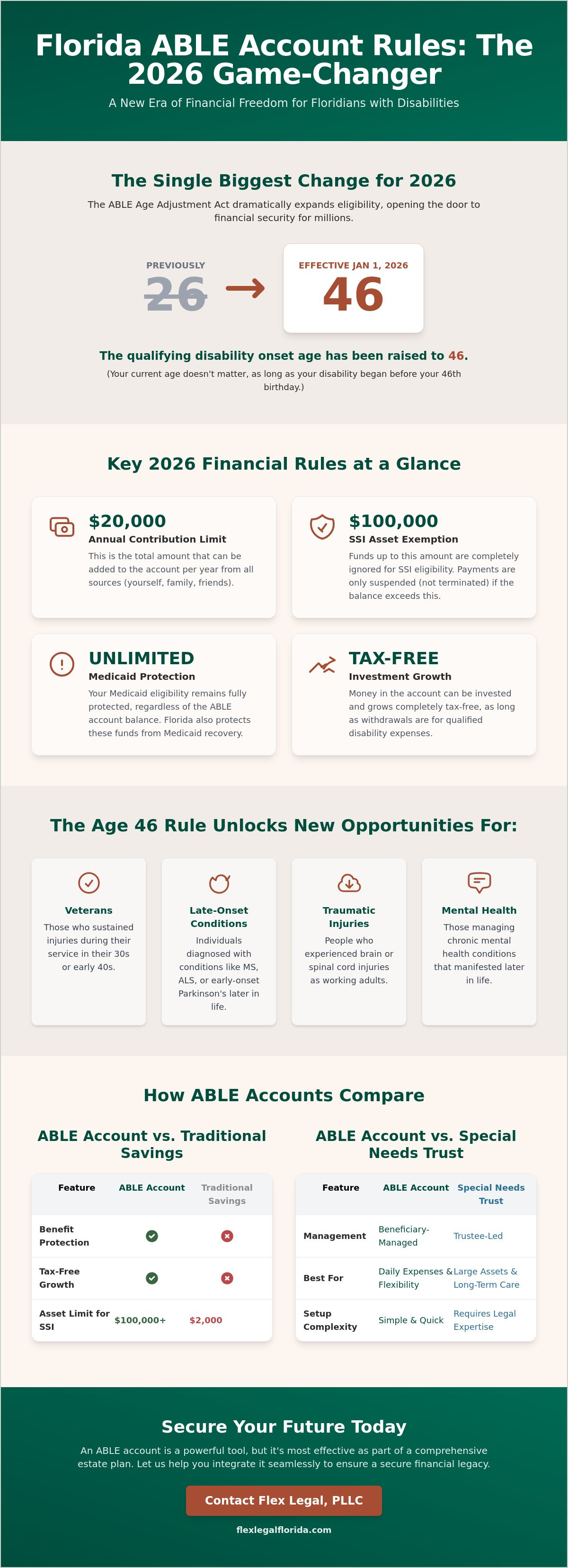
On January 1, 2026, the landscape for disability savings in Florida shifted dramatically. The ABLE Age Adjustment Act finally went into effect, correcting a long-standing gap in the law that left millions of adults without a viable way to save. Previously, only those who became disabled before age 26 could open an ABLE account. Now, that threshold has expanded to include anyone whose disability began before age 46. This isn't just a minor update; it's a fundamental change in how Floridians manage their financial futures.
An ABLE account is a tax-advantaged savings vehicle designed specifically for individuals with disabilities. For Florida residents, these accounts provide a way to save money for "qualified disability expenses" without losing access to vital public benefits. The Florida ABLE account rules 2026 reflect this new federal expansion, allowing adults who were previously excluded to finally protect their assets. It's vital to understand that your current age doesn't matter. You could be 50 or 60 years old today and still qualify, provided you can document that your disability began before your 46th birthday.
Who Qualifies Under the New Age 46 Rule?
The jump from age 26 to 46 represents a massive demographic shift. This expansion invites a diverse group of people into the program who were previously forced to spend down their assets to stay below benefit limits. Qualifying conditions generally include mobility issues, neurological disorders, mental health conditions, and chronic illnesses. Specifically, this change provides a lifeline for:
Veterans who sustained life-altering injuries during their service in their 30s or early 40s.
Individuals diagnosed with late-onset conditions such as Multiple Sclerosis (MS), ALS, or early-onset Parkinson's.
People who experienced traumatic brain injuries or spinal cord injuries as working adults.
Those managing chronic mental health conditions that manifested later in life.
The "onset" requirement simply means the condition must have been present and documented by a physician before you turned 46. If you meet this criteria, you can now leverage the Florida ABLE account rules 2026 to build wealth securely.
ABLE Accounts vs. Traditional Savings
Standard savings accounts are often a trap for those on Supplemental Security Income (SSI). If your assets exceed $2,000, you risk losing your monthly income. ABLE accounts provide a powerful shield against this "resource limit." Under the 2026 rules, up to $100,000 in an ABLE account is completely ignored by the Social Security Administration when determining SSI eligibility. For Medicaid, there's often no limit at all on how much you can keep in the account.
Beyond benefit protection, these accounts offer tax-free growth under IRS Section 529A. This means your investments can grow without being chipped away by taxes, as long as the funds are used for disability-related costs. Unlike court-supervised guardianship accounts that often require judge approval for every withdrawal, ABLE accounts are agile. You or your legal representative can access funds quickly for daily needs, making them a far more responsive tool for modern life.
2026 Contribution Limits and Financial Rules for Florida Residents
The financial mechanics of the Florida ABLE account rules 2026 are designed to offer maximum flexibility while maintaining benefit eligibility. For the 2026 calendar year, the total annual contribution limit from all sources is $20,000. This includes money you deposit yourself, along with contributions from family, friends, or even special needs trusts. It's a significant increase from previous years that allows for faster wealth accumulation without risking your safety net.
When it comes to Supplemental Security Income (SSI), the first $100,000 in your Florida ABLE United account is completely exempt from the asset limit. If your balance exceeds $100,000, your SSI payments may be suspended, but your eligibility isn't terminated. This is a vital distinction. You won't lose your status, and your Medicaid coverage remains entirely unaffected regardless of how much you save in the account. Florida's program is particularly robust here, as the state does not seek Medicaid estate recovery from these funds. For more detailed guidance on state-specific regulations, the ABLE National Resource Center provides updated comparisons across different programs.
The 'ABLE to Work' Bonus: Saving More in 2026
Employed beneficiaries can push their savings even further. If you're working and don't participate in an employer-sponsored retirement plan, you can contribute an additional amount beyond the $20,000 cap. This extra allowance is the lesser of your gross income or the prior year's federal poverty level for a one-person household, which is $15,650 based on 2025 figures. This means a working individual could potentially save over $35,000 in a single year. You'll need to track these earnings carefully to ensure you stay within the "ABLE to Work" guidelines, but the payoff for your financial independence is immense.
Self-Certification and Documentation Requirements
One common point of confusion involves how to prove eligibility under the expanded age limit. You don't necessarily need an active SSI or SSDI award to open an account. Instead, you can "self-certify" by maintaining a physician's letter that confirms your disability onset occurred before age 46. This letter must state that you have a physical or mental impairment resulting in "marked and severe functional limitations" that has lasted or is expected to last for at least 12 months.
While you don't submit this letter to the state or the IRS when opening the account, you must keep it in your permanent records. The IRS may request this documentation during an audit to verify you're following the Florida ABLE account rules 2026. Ensuring your paperwork is in order is a simple step that prevents future legal headaches. If you're unsure how to document late-onset conditions, consulting with an expert in asset protection planning can provide the clarity you need to move forward confidently.
ABLE Accounts vs. Special Needs Trusts: Choosing the Right Protection
Deciding between an ABLE account and a Special Needs Trust (SNT) isn't about picking a winner. It's about selecting the right tool for your specific financial goals. One of the most attractive features of ABLE United is the low barrier to entry. You can open an account online with no sign up fees or monthly maintenance costs. In contrast, a Special Needs Trust is a legal entity that requires a professional to draft a custom document, which involves initial legal fees. However, that investment provides a level of protection and customization that a standard savings account simply can't match.
The Florida ABLE account rules 2026 empower the beneficiary with direct control. You can use a debit card to pay for your own groceries, rent, or transportation. This autonomy is vital for many adults, but it has its limits. A Special Needs Trust utilizes a Trustee to manage the funds. This structure is often safer for individuals who might be vulnerable to financial exploitation or who need help managing large sums of money. The Trustee ensures that the money is used solely for the beneficiary's benefit while strictly adhering to government regulations.
When an ABLE Account is Sufficient
For many Floridians, an ABLE account is the perfect standalone solution for personal earnings or smaller gifts. If you're managing your own income through the "ABLE to Work" provision, this account provides a tax free way to grow your wealth without complex legal structures. It's an ideal way to maintain daily financial independence while keeping your benefits secure. If you're looking for guidance on how to set this up alongside other legal protections, consulting a Special Needs Planning Attorney can help you navigate the nuances of the 2026 landscape.
Why High-Asset Families Still Need Special Needs Trusts
While the Florida ABLE account rules 2026 are generous, they aren't designed for large scale wealth transfer. You can't deposit a $500,000 inheritance or a significant life insurance payout into an ABLE account because of the $20,000 annual contribution cap. This is where a Special Needs Trust becomes essential. A Third Party SNT allows parents or grandparents to leave unlimited assets for a loved one's care. Crucially, while Florida currently refrains from Medicaid estate recovery on ABLE United accounts, a Third Party SNT offers an ironclad guarantee that remaining funds stay within the family. Using both tools in a hybrid strategy often provides the best of both worlds: the autonomy of an ABLE account for daily spending and the long term security of a trust for significant family assets.
Qualified Disability Expenses: Spending Your 2026 ABLE Funds
The real power of an ABLE account lies in its flexibility. Unlike some restrictive legal structures, these funds are meant to be used for your daily life. The IRS defines "Qualified Disability Expenses" (QDEs) broadly. They include any costs that help you maintain or improve your health, independence, or quality of life. Under the Florida ABLE account rules 2026, your spending remains tax-free as long as it falls within these generous categories.
Housing: This includes rent, mortgage payments, property taxes, and utilities.
Transportation: Use funds for car payments, fuel, insurance, or even ride-sharing services.
Health and Wellness: Cover medical premiums, therapy, dental care, and adaptive equipment not covered by insurance.
Education: Pay for tuition, books, and job training programs to advance your career.
Basic Living: Groceries, clothing, and even cell phone bills are considered qualified expenses.
It's vital to spend your funds wisely. If you use money for an expense the IRS doesn't consider a QDE, the earnings portion of that withdrawal is subject to regular income tax. You'll also face a 10% federal penalty. Keeping your spending aligned with your disability-related needs is the best way to preserve your wealth and your eligibility for support.
Housing Expenses and the SSI 'One Month Rule'
If you receive Supplemental Security Income (SSI), housing expenses require specific timing. The Social Security Administration applies a "one month rule" to these withdrawals. When you take money out of your account for rent or utilities, you must spend it within that same calendar month. If that cash sits in your personal checking account into the next month, it could be counted as a resource. This might lead to a temporary suspension of your benefits. To avoid this, use your ABLE debit card for direct vendor payments. This ensures the transaction is immediate and keeps you in full compliance with the Florida ABLE account rules 2026.
Record Keeping for QDEs
You don't need to submit receipts to the state when you make a withdrawal, but you must be prepared for the IRS. ABLE United doesn't track your spending for you. That responsibility rests solely on the account owner or their legal representative. We recommend maintaining a dedicated "QDE Folder" in your home or on a secure cloud drive. Save every receipt, invoice, and bank statement related to your disability expenses. This is especially important for "Quality of Life" items like specialized therapy or assistive technology. If you're looking for a way to integrate these savings into a larger strategy, our team provides comprehensive asset protection planning to ensure your financial future is ironclad.
Integrating ABLE into Your West Palm Beach Estate Plan
An ABLE account shouldn't be a standalone island in your financial life. It's most effective when it functions as a tactical tool within a broader, modern legal strategy. The Florida ABLE account rules 2026 provide the framework, but your estate plan provides the long term security. By integrating these accounts into your high level planning, you ensure that every dollar works toward your independence without jeopardizing the benefits you rely on every day. It's about building a system that's as agile as you are.
When we design a Last Will and Testament or a Revocable Living Trust for West Palm Beach families, we look at the big picture. You can specifically name an ABLE account as a recipient for smaller bequests or structured distributions from a trust. This prevents a sudden influx of cash from triggering a benefit suspension. It's a streamlined way to move assets into a tax advantaged environment while maintaining the protective umbrella of your overall estate plan. This level of customization ensures that your financial legacy supports your lifestyle rather than complicating it. We focus on these modern solutions to bypass the slower, traditional models of asset protection.
Power of Attorney and ABLE Management
Not every beneficiary can open or manage an account on their own. In these cases, an Authorized Legal Representative (ALR) steps in to handle the day to day logistics. It's vital to ensure your durable power of attorney specifically grants the power to open, manage, and fund ABLE accounts. Without this specific language, your family might face unnecessary friction or be forced into costly guardianship proceedings to manage your assets. We prioritize clarity in these documents to keep you in the driver's seat. A well-drafted document identifies who has the authority to act as your ALR, ensuring your financial autonomy remains intact even if your capacity changes.
The Flex Legal, PLLC Advantage: Flat-Fee Special Needs Planning
We don't believe in the rigid, slow models of traditional professional services. Our approach is agile and built for the modern needs of Palm Beach County residents. At Flex Legal, PLLC, we specialize in coordinating ABLE accounts with Special Needs Trusts to create a dynamic support system. This hybrid strategy allows you to enjoy the daily flexibility of ABLE while keeping larger family inheritances safe from Medicaid estate recovery. Our flat fee model ensures transparency and comfort throughout the entire process, removing the anxiety often associated with professional legal fees.
The 2026 expansion is a significant opportunity for adults who were previously excluded from these benefits. Don't leave your eligibility or your asset protection to chance. Contact our team today to audit your current strategy and ensure you're fully leveraging the Florida ABLE account rules 2026 to protect your future. We act as your agile ally, turning complex regulations into a clear, adaptable path forward.
Take Control of Your Financial Independence in 2026
The 2026 age expansion has transformed ABLE accounts from a niche tool into a powerful asset protection strategy for millions of Floridians. By mastering the Florida ABLE account rules 2026, you can now build a tax-free safety net that honors your independence while preserving your essential Medicaid and SSI support. Whether you're leveraging the annual contribution limit for your own earnings or coordinating your account with a larger legacy plan, the path to financial security is clearer than it's ever been.
You don't have to navigate these complex legislative changes alone. At Flex Legal, PLLC, we serve as an agile, modern ally for West Palm Beach families seeking clarity and confidence. Our specialized Florida special needs planning expertise and transparent flat-fee pricing models take the mystery out of the legal process. We're here to help you integrate these new rules into a cohesive, high-level strategy that protects your lifestyle for years to come.
Secure your family's future with a 2026 Special Needs Plan from Flex Legal, PLLC. Your financial freedom is within reach, and we're ready to help you claim it.
Frequently Asked Questions
Can I have more than one ABLE account in 2026?
No, you're only allowed to have one active ABLE account nationwide at any given time. While you can choose to open an account in a state other than Florida, you can't maintain two separate accounts simultaneously. If you decide to switch programs, you must roll the funds from your old account into the new one within 60 days to avoid tax penalties and ensure your savings remain protected.
Does the money in a Florida ABLE account affect my Medicaid eligibility?
Your Medicaid eligibility isn't affected by the balance in your account, regardless of how much you save. Unlike the $100,000 threshold that triggers an SSI benefit suspension, Florida Medicaid has no upper limit for ABLE funds. This protection allows you to accumulate significant wealth for your long term needs without the constant worry of losing your healthcare coverage or essential support services.
What happens to the funds in an ABLE account when the beneficiary dies?
When a beneficiary passes away, the funds in the account are first used to pay any outstanding qualified disability expenses or funeral costs. Under the Florida ABLE account rules 2026, the state program specifically refrains from filing Medicaid recovery claims against these accounts. This means any remaining balance can typically pass to your chosen heirs through your estate plan rather than being seized by the state to pay back medical costs.
Can family members contribute to my ABLE account in 2026?
Yes, anyone can contribute to your account, including parents, grandparents, friends, or even a special needs trust. The total combined amount from all sources can't exceed the $20,000 annual limit for 2026. This makes the account an excellent tool for families who want to provide financial support or holiday gifts without accidentally disqualifying the beneficiary from their monthly government benefits.
Is there a minimum age to open an ABLE account in Florida?
Florida doesn't set a minimum age requirement to open or maintain an account. A parent or legal guardian can open an account for a child at any time, provided the child has a qualifying disability. The only age related restriction is that the disability onset must have occurred before the individual turned 46. This allows families to start saving for a child's future needs as early as possible.
How do the 2026 rules affect people who became disabled after age 46?
If your disability began after your 46th birthday, you don't currently qualify for an account under the Florida ABLE account rules 2026. The federal expansion specifically targets those with an onset age before 46. If you fall into this category, you'll need to look at other asset protection tools. We often recommend third party special needs trusts or other legal structures to protect your assets while maintaining benefit eligibility.
Can I roll over a 529 college savings plan into an ABLE account?
Yes, you can roll over funds from a standard 529 college savings plan into an ABLE account for the same beneficiary or a qualifying family member. These rollovers are now a permanent feature of the law but stay subject to the $20,000 annual contribution limit. It's a great option for families who realized their student may not need full college tuition funds and want to repurpose those savings for daily disability expenses.
Are ABLE account distributions taxable in Florida?
Distributions from a Florida ABLE account aren't taxable as long as you spend the money on qualified disability expenses. This tax free status applies to both the original contributions and any investment earnings the account has generated over time. If you use the funds for non-qualified items, you'll pay regular income tax on the earnings portion of the withdrawal plus a 10% federal penalty.


Comments