
Duties of a Successor Trustee in Florida: A Comprehensive 2026 Guide
- Kelly Mata
- Jun 11
- 12 min read

Accepting the role of a successor trustee is often seen as a final gesture of family loyalty, but in the eyes of the Florida legal system, it's a high-stakes professional assignment. It's perfectly natural to feel a sense of analysis paralysis when you're suddenly tasked with the duties of a successor trustee in Florida. You likely want to honor your loved one's legacy, yet the fear of making a paperwork error or facing a lawsuit from a frustrated beneficiary can feel heavy.
We understand that you're looking for clarity, not more confusion. This guide simplifies your responsibilities for 2026, incorporating recent legislative shifts like Senate Bill 262 that expanded trustee powers. You'll gain a clear, step-by-step roadmap for handling tax filings, managing distributions, and protecting yourself from personal liability. We'll show you how to transform an overwhelming list of chores into a manageable process that keeps you in control and your family's assets secure.
Key Takeaways
Pinpoint the exact events that trigger your authority so you can step into your role with clarity and confidence.
Understand the legal duties of a successor trustee in Florida under Chapter 736 to ensure you remain in full compliance with state law.
Follow a structured 90-day timeline to manage trust assets efficiently while meeting every critical legal deadline.
Identify high-risk pitfalls like self-dealing to protect your personal assets and avoid potential lawsuits from beneficiaries.
Explore how modern trust administration services offer the price certainty and expert support needed to navigate complex family dynamics.
Table of Contents
What is a Successor Trustee in Florida and When Does Your Role Begin?
A successor trustee is the person or entity designated to step in and manage trust assets when the original trustee can no longer fulfill their obligations. If you've been named in this capacity, you're essentially the backup manager for an estate plan. To understand the foundational concept of What is a Trustee?, it helps to view the role as a legal custodian of property held for someone else's benefit. You don't own the assets; you manage them according to a specific set of rules.
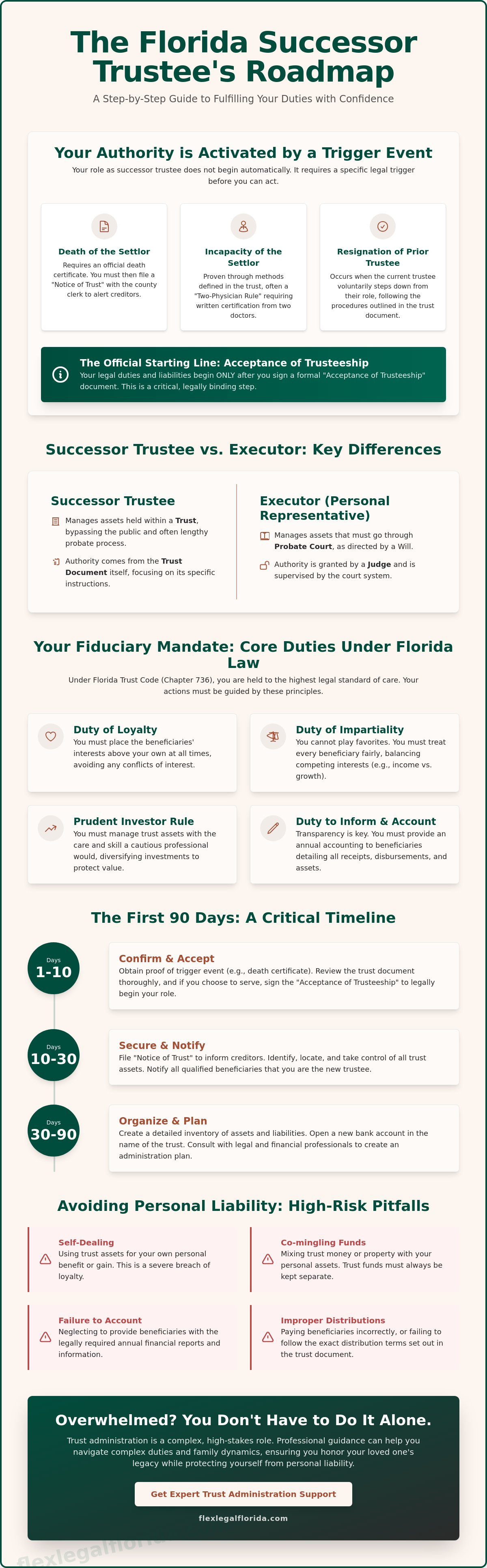
Your authority doesn't activate just because your name appears in the document. It requires a specific trigger event. In Florida, this usually happens in one of three ways: the settlor passes away, a court or physicians determine they're incapacitated, or the current trustee voluntarily resigns. Until one of these occurs, you have no legal power over the trust's holdings.
You aren't legally responsible for the duties of a successor trustee in Florida until you formally accept the role. This is done through a written "Acceptance of Trusteeship" document. Signing this is the moment your legal clock starts. It's the point where you officially take on the fiduciary burden. Don't rush this step without understanding the liability you're assuming. Once you sign, you're on the hook for the trust's administration and its compliance with state law.
The Legal Triggers: Death vs. Incapacity
Proving incapacity isn't always straightforward. Most Florida trust documents include a "Two-Physician Rule," requiring two separate doctors to certify in writing that the settlor can no longer manage their financial affairs. This protects the settlor from a premature takeover while giving you the clear authority you need to pay bills and manage investments. If the trigger is death, your first task is obtaining the death certificate. You'll then need to file a "Notice of Trust" with the Palm Beach County Clerk. This public notice alerts creditors that a trust exists and starts the clock on their claims. If you're unable or unwilling to serve, the document usually names a secondary backup, or the beneficiaries might need to petition a court to appoint a professional.
Successor Trustee vs. Executor: Clearing the Confusion
People often use these terms interchangeably, but they're distinct roles. An executor, known in Florida as a Personal Representative, handles assets that go through probate court. A successor trustee manages assets already held within the trust, allowing you to bypass the slow and public probate process entirely. Your focus is on the trust's specific instructions rather than court-supervised asset distribution. It's common for one person to serve as both the Personal Representative and the successor trustee to ensure a seamless transition of the entire estate.
The Fiduciary Mandate: Mandatory Duties Under the Florida Trust Code
Florida law is precise when it comes to estate management. The Florida Trust Code, found in Chapter 736, isn't just a suggestion; it's your mandatory rulebook. When you take on the duties of a successor trustee in Florida, you become a fiduciary. This means you're held to the highest legal standard. It's about more than just following instructions. It's about protecting the settlor's intent while serving the people they loved with total transparency.
Your primary obligation is the Duty of Loyalty. You must place the beneficiaries' interests above your own at all times, even if a decision is personally inconvenient. This often overlaps with the Duty of Impartiality. You might have a surviving spouse who needs income today and children who want the principal preserved for the future. Balancing these conflicting needs requires a steady hand and a clear understanding of the trust's specific language. You can't play favorites; you must treat every beneficiary with the same level of fairness and respect.
Managing money isn't just about avoiding losses. The Prudent Investor Rule requires you to manage assets with the care and skill a cautious professional would use. You're expected to diversify investments and consider the current economic landscape to protect the trust's purchasing power. If you're unsure how to balance these complex financial requirements, professional trust administration support can provide the technical guidance needed to stay compliant.
Duty to Inform and Account
Transparency is your best defense against conflict. Florida law requires you to provide an annual accounting to all "qualified beneficiaries." This report must detail all receipts, disbursements, and the current value of assets. By providing this information, you trigger a 6-month limitation on claims. Once a beneficiary receives the accounting and doesn't object within six months, they generally lose the right to sue you for those specific actions. Regular communication keeps everyone aligned and reduces the risk of expensive litigation.
Duty to Protect and Segregate Assets
Mixing personal and trust funds is the fastest way to lose your legal protection. You must keep trust assets in separate, clearly labeled bank and brokerage accounts. For real estate in West Palm Beach, this means ensuring the property is properly insured and maintained. You also need to evaluate homestead status, which can impact taxes and creditor protection. Finally, you must identify and value non-probate assets, such as life insurance policies or retirement accounts that name the trust as the beneficiary, to ensure the total estate is accounted for correctly.
The First 90 Days: A Successor Trustee Timeline
The first three months of your tenure are often the most demanding. You're balancing personal grief with a sudden influx of administrative tasks. We recommend an "Agile Administration" approach. This means moving with speed to protect assets while maintaining the total precision required by state law. You'll often need to coordinate your efforts with a probate lawyer in Palm Beach County to ensure the trust administration doesn't conflict with any necessary court filings. A central part of your early work is establishing the "Date of Death" valuation. This figure is vital for tax purposes and sets the baseline for the duties of a successor trustee in Florida moving forward.
Weeks 1-4: Discovery and Notification
Your first month is about establishing your legal presence. You must apply for a new Employer Identification Number (EIN) from the IRS because the settlor's Social Security number is no longer valid for the trust's tax purposes. You'll also need to send formal notifications to financial institutions and the Social Security Administration. Filing a "Notice of Trust" with the local clerk is a high priority. This starts the clock for creditors to file claims, which helps you understand the trust's true liabilities sooner rather than later. In Florida, this filing is a standard protective measure that simplifies your long-term debt resolution strategy.
Weeks 5-8: Inventory and Appraisal
Once the initial shock subsides, your focus shifts to a detailed physical and financial inventory. Create a comprehensive list of every asset, from bank accounts to personal effects. For Florida real estate, hire a professional appraiser to get a certified value as of the date of death. This isn't just a formality; it's a protection against future disputes over asset value. Simultaneously, review the revocable trust document to identify specific distributions or conditions that must be met before assets can be moved or sold.
Weeks 9-12: Debt Resolution and Initial Accounting
The end of the first quarter is the time to settle the books. You'll need to distinguish between legitimate debts and predatory claims that often surface after a death notice. Providing a clear status update to beneficiaries at this stage is a smart move. It shows you're active and transparent, which naturally lowers the temperature of family dynamics. Finally, assess the trust's liquidity. You'll need to know if you have enough cash on hand to cover the 2026 tax obligations or the costs of maintaining trust property. Successfully managing these duties of a successor trustee in Florida early on prevents small issues from turning into expensive legal battles.
Avoiding Personal Liability and Common Florida Pitfalls
Serving in this role is a significant responsibility, but it doesn't have to be a source of constant anxiety. One of the most overlooked duties of a successor trustee in Florida is the ongoing obligation to protect yourself from personal liability. A "Breach of Fiduciary Duty" isn't always a malicious act. It often stems from simple mistakes, like "Self-Dealing." Even if you buy a vehicle from the trust at a fair market price, beneficiaries can claim you used your position for personal gain. This type of transaction is a major red flag that can lead to personal lawsuits regardless of your intentions.
Florida Homestead laws add another layer of complexity. If the trust holds the settlor's primary residence, specific constitutional rules dictate how that property is handled. Treating a homestead like any other asset can lead to title issues or legal challenges from heirs who have protected rights to the home. To mitigate these risks, modern trustees use a "Trust Disclosure Document." This filing is a powerful tool that shortens the window for beneficiaries to sue you from several years down to just six months, providing you with much-needed finality and peace of mind.
The Problem with Informal Distributions
The pressure to distribute funds quickly can be intense, especially during family milestones. However, handing out checks before all debts and taxes are settled is a dangerous gamble. If a creditor emerges later and the trust is empty, you may be forced to pay that debt out of your own pocket. A "Refunding Agreement" is a practical solution here. It's a contract where beneficiaries agree to return funds if an unexpected liability arises after the initial distribution. If the trust owes federal estate taxes and you distribute the assets first, the IRS can hold you personally liable for the unpaid balance.
Record Keeping in the Digital Age
Precise record keeping is your best defense in the digital age. Florida courts have little patience for missing receipts or vague expense reports. You're expected to track every penny, from property maintenance costs to professional fees. Using modern accounting tools or seeking trust administration support ensures your records are bulletproof. If you're feeling overwhelmed by the paperwork, you can consult with a trust administration expert to ensure your records meet Florida's strict legal standards.
How Flex Legal Supports Successor Trustees in West Palm Beach
Managing the duties of a successor trustee in Florida doesn't have to be a solitary or stressful journey. At Flex Legal, we position ourselves as your agile ally. We understand that you're likely balancing this role with a career, family, and your own personal life. Our approach is designed to remove the friction of legal administration. By offering both flat-fee and hourly structures, we provide the price certainty you need to manage the trust's budget effectively. You'll know exactly what to expect from a cost perspective, allowing you to focus on the human side of your responsibilities.
Being based in West Palm Beach gives us a distinct advantage. We're familiar with local court nuances and the specific requirements of the Palm Beach County Clerk. This regional expertise ensures that your filings move through the system without unnecessary delays. We aren't just a distant service provider; we're a local partner that understands the specific landscape of Florida estate law. Our goal is to handle the legal complexity so you can preserve family harmony during a difficult transition.
Streamlined Trust Administration Services
We take the heavy lifting off your shoulders. Our team assists with critical "Notice of Trust" filings and handles the delicate task of beneficiary communications. Trust documents can be dense and difficult to interpret, especially regarding complex distribution formulas or specific conditions. We help you decode these instructions to ensure every beneficiary receives exactly what the settlor intended. Our process is partnership-based. We coordinate closely with your CPAs and financial advisors to create a unified support system that protects the trust's value.
Take the Next Step with Confidence
Don't wait for a conflict to erupt before you seek professional guidance. Being proactive is the best way to satisfy the duties of a successor trustee in Florida while staying protected. A professional consultation to review your "Acceptance of Trusteeship" can prevent costly errors before they happen. It’s about building a foundation of transparency and legal compliance from day one. If you’re ready to move forward with a clear plan and expert support, schedule a consultation with Flex Legal today to discuss how we can streamline your administration process.
Stepping Into Your Role with Clarity and Control
You've now seen that managing a trust is a structured process rather than an unpredictable burden. By sticking to the 90-day timeline and respecting the high fiduciary standards of Chapter 736, you can navigate the duties of a successor trustee in Florida without risking your own financial security. Transparency with beneficiaries and meticulous record keeping are your best tools for preventing family friction and avoiding personal liability.
Led by Jennifer L. Flexer, Esq., Flex Legal, PLLC specializes in the nuances of the Florida Trust Code to provide the modern support trustees deserve. Whether you need help interpreting a complex document or want the price certainty of our flat-fee estate planning options, we act as your agile ally. You have the roadmap; now you just need the right partner to ensure every step is taken with precision.
Secure your legacy or start your trusteeship right—contact Flex Legal, PLLC today.
You've honored a loved one by accepting this role. Now, give yourself the peace of mind that comes from professional guidance and a clear path forward. We're here to help you succeed.
Frequently Asked Questions
Can a successor trustee be a beneficiary of the trust in Florida?
Yes, it's very common for a family member to serve as both a beneficiary and a trustee. You can absolutely hold both roles, but you must be extra cautious to avoid any appearance of favoritism. Florida law requires you to maintain a strict duty of impartiality, ensuring that your personal interests as a beneficiary don't interfere with your legal obligations to others named in the trust.
How much does a successor trustee get paid in Florida?
Florida doesn't use a fixed fee schedule, so compensation must be "reasonable" based on the complexity of the work. For 2026, industry standards show that family trustees often receive between 0% and 1% of the trust assets annually. Professional trustees typically charge 0.5% to 1.5%, while a one-time distribution fee for closing a trust usually ranges from 1% to 3% of the total trust value.
What happens if a successor trustee fails to perform their duties?
Failure to fulfill the duties of a successor trustee in Florida can lead to a "breach of fiduciary duty" claim. Beneficiaries can petition the court to have you removed or even hold you personally liable for any financial losses caused by your negligence. This is why maintaining transparent records and meeting all legal deadlines is vital for your own protection and the trust's health.
Does a successor trustee have to file a tax return for the trust?
Yes, you're responsible for filing a federal fiduciary income tax return, known as Form 1041, if the trust earns more than $600 in annual income. You'll also need to provide Schedule K-1s to beneficiaries so they can report their share of the trust's income on their own returns. With the 2026 federal estate tax exemption at $15 million, most trusts won't owe estate taxes, but income taxes remain a yearly requirement.
Can a successor trustee change the terms of a Florida trust?
Generally, you cannot change the core terms of an irrevocable trust, but recent laws like Senate Bill 262 have expanded trustee powers. As of June 20, 2025, "authorized trustees" who aren't also beneficiaries have broader authority to modify trust terms or "decant" assets into a new trust to adapt to changing circumstances. However, these actions usually require specific legal triggers and careful coordination with an attorney to ensure compliance.
How long does it typically take for a successor trustee to distribute assets?
The timeline depends entirely on the trust's complexity and the nature of the assets. For simple trusts that distribute everything immediately, the process might take four to eight months. If the trust involves complex tax filings or business interests, it's common for the administration to last one to two years. You must also account for the two-year statute of limitations for creditor claims unless you've shortened it through formal notice.
Do I need a lawyer to serve as a successor trustee in West Palm Beach?
While Florida law doesn't strictly mandate hiring an attorney, most trustees find it's a necessary safeguard against personal liability. A local expert helps you navigate the specific duties of a successor trustee in Florida while ensuring you don't miss critical filings with the Palm Beach County Clerk. Having professional support allows you to handle complex legal jargon and tax requirements with much more confidence and speed.
Can I resign as a successor trustee after I have already started?
Yes, you can resign at any point, but you must follow the specific procedures outlined in the trust document. This usually involves providing written notice to the beneficiaries and the next named successor. If the trust is silent on resignation, you'll need to petition a Florida court for permission. Remember that you're still responsible for an accounting of your actions during the time you served before your resignation is finalized.


Comments