
Contesting a Will in Florida: A 2026 Guide to Standing, Grounds, and Process

Updated: Jul 19
You discover a sudden, late-stage change to a loved one's estate plan that feels entirely wrong, but the legal clock is already ticking toward a strict 90-day deadline. It is deeply unsettling to feel cheated by a document that doesn't reflect the reality you knew. When you are facing the prospect of contesting a will in Florida, the anxiety over high legal fees and long court battles can feel just as overwhelming as the sense of betrayal itself.
We understand that you need clarity, not just more complexity. You deserve to know exactly where you stand and what it takes to protect your inheritance without getting lost in outdated legal jargon. This guide provides a modern path through the 2026 probate landscape, helping you navigate your legal rights with confidence and precision. We focus on providing straightforward answers that respect your time and your emotional well-being.
You will learn how to confirm your legal standing, what specific evidence is required to prove undue influence, and how recent shifts in Florida law might streamline your path to a resolution. We are here to act as your agile ally, turning confusion into a clear, strategic plan for moving forward.
Table of Contents
Understanding Standing: Who Can Legally Contest a Will in Florida?
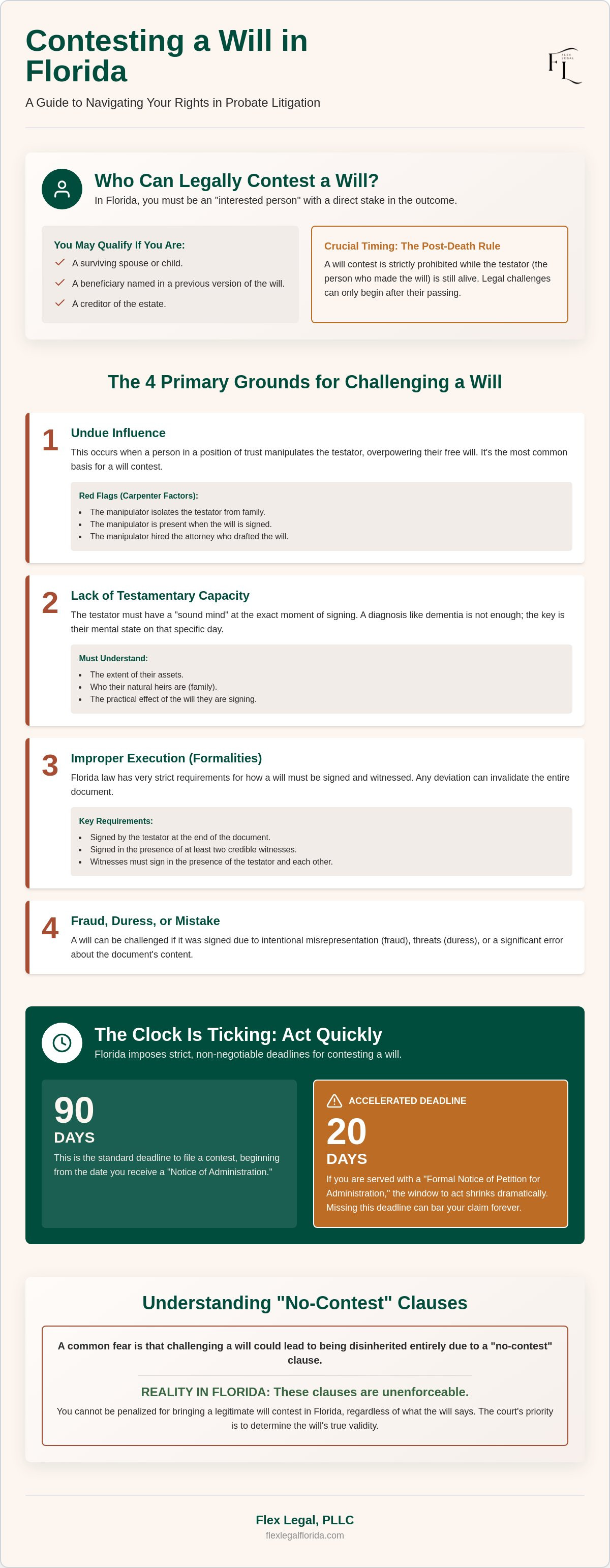
Before you can step into a courtroom, you must prove you have a legal right to be there. In the legal world, this is called standing. You can't challenge a document just because you find it unfair or unkind. Florida law requires you to be an "interested person" before you can begin the process of contesting a will in Florida. This rule ensures that probate proceedings remain focused on those with a direct financial or legal stake in the outcome.
The 'Interested Person' Requirement
According to Florida Statute 733.109, an interested person is anyone who may reasonably be affected by the outcome of the probate proceeding. This definition is broader than many realize. It naturally includes a surviving spouse and children who were left out of a recent amendment. However, it also extends to beneficiaries named in a previous version of the will. If a new, suspicious will replaces an older one where you were a primary beneficiary, you have the standing to challenge the new document. Even creditors can sometimes qualify as interested persons, as the validity of a will determines how and when an estate's debts are settled.
Why Timing is Everything: The Post-Death Rule
One of the most common points of confusion is when you can actually take action. Florida law strictly prohibits a Will contest while the testator is still alive. A will is considered a "living" document that the creator can change at any time until their death. Because of this, no one has a vested right to an inheritance while the person is still living. You cannot sue to invalidate a document that the testator could technically revoke tomorrow morning.
If you suspect that a loved one is currently being manipulated or is a victim of fraud, you don't have to wait idly. While you can't challenge the future will yet, you can explore other protective measures. This often involves looking into Guardianship Proceedings to protect a vulnerable adult from financial exploitation. Taking proactive steps like reviewing a Durable Power of Attorney or establishing a guardianship can prevent the need for a costly legal battle after they pass away. By acting now, you act as an agile protector of their legacy before a fraudulent will even enters probate.
The 4 Primary Grounds for Challenging a Florida Will
Having legal standing is only the first hurdle. To succeed in contesting a will in Florida, you must prove that the document is legally invalid based on specific statutory grounds. These aren't just opinions on fairness; they are rigorous legal standards defined in the Florida Probate Code. If you can't tie your objection to one of these four pillars, the court will likely uphold the will as written.
Undue Influence and the Carpenter Factors
Undue influence is the most common ground for a challenge. It occurs when a person in a position of trust, like a caregiver, neighbor, or relative, manipulates the testator into making choices they wouldn't have made otherwise. Because this pressure usually happens behind closed doors, Florida courts use the "Carpenter Factors" to identify circumstantial evidence of wrongdoing. Red flags include the beneficiary isolating the testator from family, being present during the will's execution, or personally hiring the attorney who drafted the document. If you notice these patterns, it's often the first step in a successful probate administration dispute.
Lack of Testamentary Capacity
A testator must have a "sound mind" at the exact moment they sign their will. This means they must understand the extent of their assets, know who their natural heirs are, and grasp the practical effect of the document they are signing. A medical diagnosis of dementia or Alzheimer's doesn't automatically invalidate a will. The law focuses on whether the person had a "lucid interval" during the signing ceremony. Proving a lack of capacity often requires a blend of medical records and testimony from those who witnessed the testator's behavior on that specific day. Heavy medication or sudden mental decline can be pivotal factors here.
Formalities of Execution
Florida is incredibly strict about how a will is signed. Even a perfectly "fair" will can be tossed out if it fails to meet these technical requirements. The law requires the testator to sign in the presence of at least two witnesses, who must also sign in the presence of the testator and each other. This "presence" requirement is literal; if a witness stepped out of the room for a moment, the will might be void. Most valid wills also include a self-proving affidavit signed by a notary. If these formalities aren't met, the court can't admit the will to probate, regardless of the testator's intent.
Fraud or Forgery
Fraud occurs when a testator is tricked into signing a document. For example, they might be told they are signing a power of attorney when it's actually a new will. Forgery, on the other hand, involves a signature that wasn't actually made by the testator. Both are serious claims that require precise evidence, often involving handwriting experts or digital forensic analysis. If you suspect the intent behind the signature is a lie, you have a strong basis for contesting a will in Florida.
The Florida Will Contest Timeline: Why You Must Act Quickly
In Florida probate, silence is often interpreted as consent. If you have concerns about the validity of a document, your opportunity to speak up is governed by a strict, unforgiving clock. Missing a deadline doesn't just complicate your case; it usually ends it before it even begins. This is why understanding the procedural triggers for contesting a will in Florida is as vital as having a strong legal argument. The court prioritizes the efficient distribution of assets, which means the window for litigation is intentionally narrow.
The 90-Day Statute of Limitations
Once the court appoints a Personal Representative, their first major task is to alert everyone involved. They do this by sending a "Notice of Administration." The moment you receive this document, a 90-day countdown begins. This is your standard window to file a formal objection. Waiting until the final week is a significant risk. Preparing a lawsuit requires time to gather evidence and draft precise legal pleadings. If you don't file within this 90-day period, the court will likely bar your claim forever. The assets will be distributed according to the contested will, and you'll lose your chance to set the record straight. Consulting a probate lawyer in Palm Beach County early in this window ensures you have the time to build a robust strategy without the pressure of a looming deadline.
The 20-Day Emergency Window
Sometimes, the timeline is even more aggressive. If a petitioner serves you with "Formal Notice" before the will is even admitted to probate, you may have as few as 20 days to respond. This high-speed window is often used to clear potential obstacles quickly so the estate administration can proceed without the threat of a future lawsuit. Receiving a certified letter from a probate court is a signal to act immediately. The Florida Bar's Guide to Probate outlines how these notices function within the broader estate sequence, but the local reality is simple: 20 days is barely enough time to find an ally and review the facts. You must be prepared to move with speed and precision.
The Personal Representative holds the power to start these clocks. By serving notice, they are effectively forcing your hand. This procedural efficiency is designed to keep the probate system moving, but it can be a trap for the unwary. If you suspect something is wrong with a loved one's estate plan, don't wait for a certified letter to land on your doorstep. Early planning gives you the agility to respond to these short deadlines without the friction of a last-minute panic. When the clock is ticking, having a clear path forward is your best defense.
Strategic Considerations: Costs, Risks, and Mediation
Deciding to move forward with contesting a will in Florida is as much a business decision as it is a legal one. While the emotional weight of a dispute is heavy, you must also weigh the financial reality of litigation against the potential inheritance. Modern probate disputes aren't just about winning in court; they're about finding the most efficient, adaptable path to a fair resolution. This requires a clear-eyed look at the risks involved and the strategic tools available to help you reach a settlement without a years-long trial.
The Truth About No-Contest Clauses
Under Fla. Stat. 732.517, a provision in a will that penalizes a person for contesting it is unenforceable. Many people are terrified to speak up because they see a "penalty clause" in the document that threatens to strip away their existing inheritance if they lose a challenge. In Florida, these clauses are effectively ignored by the courts. This gives you the freedom to seek justice and challenge a suspicious document without the fear of a built-in financial penalty. It's a vital protection that ensures the probate process remains transparent and accountable. However, keep in mind that this is different from being disinherited entirely from the start; if you were left out of the will from day one, you are fighting to get in, rather than fighting to keep what was already promised.
Mediation and Settlement
The majority of Florida probate judges will require you to attend mediation before they ever allow your case to go to trial. Mediation is a confidential process where a neutral third party helps both sides find common ground. It is often the preferred route for families who want to preserve their privacy and avoid the public friction of a courtroom battle. Settlement can be significantly faster than trial, allowing you to move forward with your life sooner. At Flex Legal, PLLC, we act as your agile ally during these negotiations, using a tech-forward approach to present evidence clearly and push for a resolution that respects your rights. We prioritize streamlined solutions that minimize the financial and emotional burden on you.
Strategic litigation also involves looking at the bigger picture of the estate plan. Often, a dispute over a will is tied to other documents, such as a Durable Power of Attorney or a living trust. If a caregiver used undue influence to change a will, they might have also used a power of attorney to drain bank accounts while the testator was still alive. Successfully contesting a will in Florida frequently requires untangling these interconnected legal threads to ensure the entire estate is protected. If you are ready to evaluate your options with a team that values transparency and modern communication, contact Flex Legal, PLLC today for a strategic case review.
How Flex Legal, PLLC Navigates Probate Litigation and Estate Disputes
The traditional legal model often feels like a rigid black box. You're left in the dark while costs mount and family tensions rise. We've built Flex Legal, PLLC to be different. We prioritize a partnership-based approach where you're an active participant in your legal strategy. When you are contesting a will in Florida, you're often dealing with high emotional stakes and complex family dynamics. You need a firm that responds quickly and uses modern tools to keep your case moving forward. Our deep roots in the 15th Judicial Circuit mean we're intimately familiar with the local Palm Beach County court procedures. This allows us to navigate the system with precision and adaptability.
A Reassuring Hand in a Stressful Time
Jennifer L. Flexer, Esq. is dedicated to stripping away the intimidating jargon that often surrounds probate litigation. We focus on providing a reassuring hand and absolute clarity during what is undoubtedly a stressful time. By utilizing technology-driven evidence gathering, we can often identify the circumstantial markers of undue influence more efficiently than traditional methods. Our agile approach is particularly effective when contesting a will in Florida. It allows us to pivot quickly as new evidence of manipulation or fraud comes to light. This isn't just about winning a case; it's about protecting your assets and seeking a resolution that respects your loved one's true legacy.
Because we also serve as an estate planning attorney in West Palm Beach, we have a unique perspective on how valid documents are created. We look at the "big picture" of the estate, including how the will interacts with other instruments like trusts or powers of attorney. This comprehensive view ensures that your inheritance is protected from every angle. We focus on minimizing the friction of probate disputes through modern systems that prioritize your comfort and your results.
Next Steps: Your Consultation
We believe in transparency from the very first interaction. During your initial evaluation, we provide a steady, logical assessment of the facts to determine if your case has the legal standing and grounds required to succeed. To make this first meeting as productive as possible, please gather any relevant documentation you have available. This includes the most recent version of the will, any prior versions that existed, the death certificate, and a detailed list of the events that triggered your concerns. We'll look at the evidence together and map out a path that balances the risks of litigation with the value of the assets at stake. It's time to move from confusion to a clear, adaptable plan. Schedule a consultation with Flex Legal, PLLC today to protect your inheritance and take the first step toward a resolution.
Taking the Next Step Toward Resolution
Success in probate court requires a combination of legal standing, verifiable grounds, and swift action within Florida's strict procedural windows. You've seen that the law provides clear protections against undue influence and technical errors, but these rights are only effective if you act before the 90-day deadline expires. When you are contesting a will in Florida, having an agile ally who understands the local nuances of the 15th Judicial Circuit is your greatest advantage.
Flex Legal, PLLC, led by Jennifer L. Flexer, Esq., is here to provide the sophisticated authority and modern accessibility your case deserves. We offer fixed-price options for initial estate reviews to ensure you can evaluate the strength of your challenge with absolute transparency. Our focus is on removing the friction from estate disputes while securing the legacy your loved one intended. Secure your family's future—contact Flex Legal, PLLC for a probate litigation consultation today. You don't have to face this transition alone; we're ready to help you find a clear path forward.
Frequently Asked Questions
Can you contest a will in Florida if you were intentionally left out?
Yes, being intentionally disinherited doesn't bar you from contesting a will in Florida if the document was created through undue influence or if the testator lacked mental capacity. You still have legal standing as an heir-at-law to challenge the document's validity. However, you must prove a specific legal ground for invalidity rather than simply arguing that the omission was unfair or unkind to your family.
What is the most common reason a will is overturned in Florida?
Undue influence is the most frequent ground for overturning a will in Florida courts. This occurs when a person in a position of trust manipulates a vulnerable testator into changing their estate plan against their true wishes. Judges look for specific "red flags," such as the beneficiary isolating the testator or being actively involved in the drafting process, to determine if the document is actually a product of coercion.
How much does it cost to contest a will in Palm Beach County?
The financial investment for probate litigation depends on the estate's complexity and the length of the dispute. You'll encounter standard court costs, such as the $402 filing fee for formal administration required by Florida courts. Attorney fees are often structured around statutory guidelines or customized agreements. We prioritize transparency by discussing these costs upfront during our initial strategic review, ensuring you have a clear understanding of the potential investment.
Does a 'No-Contest' clause prevent me from challenging a will in Florida?
No, a "no-contest" clause is completely unenforceable under Florida Statute 732.517. Even if the will explicitly states that you lose your inheritance for challenging it, the court will ignore that provision. This legal protection ensures that beneficiaries can bring legitimate concerns about fraud or manipulation to a judge without the fear of an automatic financial penalty, regardless of what the document claims.
How long does a typical Florida will contest take to resolve?
A typical will contest can take anywhere from six months to several years to reach a final resolution. The speed of your case depends on the court's schedule and whether the parties are willing to participate in mediation. Most Florida judges require mediation early in the process, which often leads to a faster settlement and avoids the friction and public nature of a long courtroom trial.
Can a step-child contest a will if there was no formal adoption?
Step-children generally do not have standing to contest a will unless they were legally adopted or named as beneficiaries in a previous version of the document. Without a formal adoption, Florida law doesn't recognize step-children as "heirs-at-law" who would automatically inherit if no will existed. If you were included in a prior estate plan but removed later, you might still have a path forward to challenge the change.
What happens to the estate if the judge rules the will is invalid?
If a judge rules that a will is invalid, the estate is typically distributed according to a previous, valid will. If no prior document exists, the assets are distributed based on Florida's intestacy laws. These laws provide a specific hierarchy for distribution, usually starting with the surviving spouse and children. This ensures that the estate assets are handled through a predictable legal framework rather than remaining in limbo.
Do I need to live in Florida to contest a Florida will?
You don't need to live in Florida to challenge a will that is being probated in a Florida court. Standing is based on your financial or legal interest in the estate, not your physical location or residency. We frequently represent out-of-state heirs and beneficiaries in the Palm Beach County courts, using modern communication methods to keep our clients informed and involved throughout the entire litigation process. For those managing similar estate or business legalities in Texas, C.Y. Lee Legal Group offers experienced representation to protect your family's interests.



Comments