
Asset Protection Trust Florida: The 2026 Guide to Securing Your Wealth

Updated: Jul 20
What if a single lawsuit could erase thirty years of hard work because you relied on a "standard" trust that doesn't actually work in Florida? It's exhausting to sort through conflicting advice about out-of-state trusts while worrying if your savings will be drained by long-term care costs or a sudden legal claim. You've worked too hard to let the strict $2,000 Medicaid asset limit or a predatory creditor dictate your family's future, which is why exploring an asset protection trust florida strategy is your best defense.
We understand that securing your legacy requires more than a one-size-fits-all document. This 2026 guide clarifies exactly how to implement a sophisticated strategy to shield your home and savings. You'll learn how to utilize unique state laws, including the 2025 updates to trustee powers, to build a defense that adapts to your needs. We'll preview the essential layers of protection, from homestead exemptions to irrevocable structures, so you can stop worrying and start feeling confident about your financial security.
Table of Contents
Understanding Asset Protection Trusts in Florida: What Actually Works?
Revocable vs. Irrevocable Trusts: Balancing Control and Creditor Protection
Florida Medicaid Asset Protection Trusts (MAPTs): Securing Long-Term Care
Beyond the Trust: Building a Multi-Layered Asset Protection Strategy
Designing Your Adaptable Asset Protection Plan with Flex Legal
Understanding Asset Protection Trusts in Florida: What Actually Works?
An asset protection trust florida strategy is less about a single "magic" document and more about a calculated legal structure. At its core, an Asset-protection trust is a fiduciary arrangement where a third party holds assets on behalf of a beneficiary. This separation creates a legal barrier that makes it significantly harder for outside parties to seize those assets during a lawsuit or financial crisis. However, the way these trusts function in Florida is unique compared to other states.
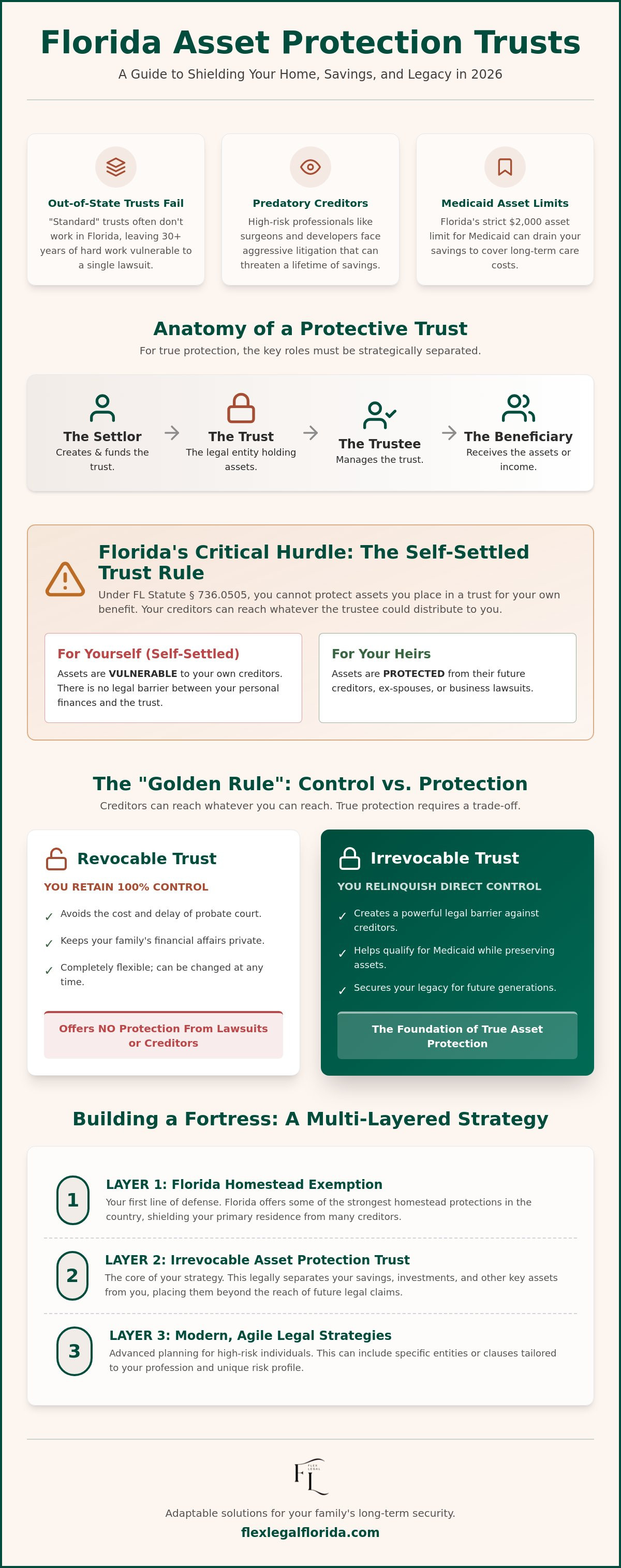
Three specific roles make this engine run. The Settlor is the person who creates and funds the trust. The Trustee is the manager who follows the trust's instructions. The Beneficiary is the person who receives the assets or income. In a standard revocable trust, you might fill all three roles. For true asset protection, these roles must be strategically separated to create a meaningful legal distance between you and your wealth.
The backbone of this protection is the Spendthrift Clause. This specific provision restricts a beneficiary's ability to transfer their interest in the trust to anyone else. Because the beneficiary cannot voluntarily give the money away, Florida law generally prevents a creditor from involuntarily taking it. It's a simple concept with powerful results, provided the trust is structured correctly from the start.
The Legal Reality of Self-Settled Trusts in 2026
Florida Statute § 736.0505(1)(b) creates a significant hurdle for those seeking to protect their own money. It states that if a trust is "self-settled," meaning you created it for your own benefit, your creditors can reach the maximum amount the trustee could potentially distribute to you. Florida public policy overrides out-of-state trust choices for residents because the state refuses to let individuals use self-settled trusts to evade local creditor claims. While you generally cannot protect assets you put in a trust for yourself, you can provide ironclad protection for your heirs. There is a massive difference between shielding assets from your own creditors versus shielding them from your children's future ex-spouses or business partners.
Why West Palm Beach Residents Seek Trust Protection
We see a growing trend among West Palm Beach professionals who are shifting their focus from simple tax planning to comprehensive liability planning. Surgeons, real estate developers, and business owners often face a higher risk of aggressive litigation. One bad day at the office shouldn't mean losing a lifetime of savings. Many families also use these tools to prepare for the staggering costs of long-term care. If you're concerned about your specific risk profile, connecting with asset protection lawyers near me is the most effective way to build an adaptable plan that actually holds up in court.
Revocable vs. Irrevocable Trusts: Balancing Control and Creditor Protection
The "Golden Rule" of trust law is simple: creditors can generally reach whatever the trust creator can reach. If you have the power to pull money out for a vacation, a judge has the power to order you to pull it out for a legal settlement. This fundamental concept is central to the legal definition of an asset protection trust. True protection requires a fundamental shift in how you view ownership. You're trading personal control for legal invisibility.
The "Control Trade-off" is the price you pay for security. In Florida, you cannot have your cake and eat it too. If you want assets to be shielded from creditors, they must be legally removed from your personal bucket and placed into a separate legal entity. By relinquishing the right to change the trust at will, you create a barrier that courts respect. It's a strategic move that trades immediate flexibility for long-term peace of mind. Without this separation, your wealth remains a target.
Revocable Trusts: The Probate Shield
A revocable trust is a vital tool for privacy and avoiding the 150,000 probate filings Florida courts handle annually. It keeps your family's business out of the public record and ensures a smooth transition of assets. However, it's not a lawsuit shield. Because the settlor maintains 100% control, creditors have 100% access. This is a common misconception among Florida newcomers. They often arrive with a living trust from another state, assuming they're protected, only to find their assets are completely exposed to professional liability or personal injury claims.
Irrevocable Trusts: The Asset Fortress
An irrevocable asset protection trust florida operates on a different level. Once you transfer assets, you generally cannot "revoke" the transfer or take the property back on a whim. This lack of power is actually your greatest strength. If you don't have the legal authority to withdraw funds, a judge cannot compel you to do so to satisfy a debt. These structures often utilize "Discretionary Distributions." This means an independent trustee decides when and if to give you money. Because you don't have an enforceable right to the funds, your creditors don't either.
As we move through 2026, the federal estate tax exemption remains at $15,000,000 per individual. While this high threshold reduces tax anxiety for many families, it doesn't reduce the risk of aggressive litigation. The focus has shifted from avoiding taxes to securing wealth against professional risks. Choosing between these structures depends on your specific goals and risk level. If you're ready to see which structure fits your needs, exploring Asset Protection Planning options can help you find the right balance of control and safety.
Florida Medicaid Asset Protection Trusts (MAPTs): Securing Long-Term Care
The financial reality of aging in Florida is stark. As of July 2026, a single applicant for long-term care Medicaid is limited to just $2,000 in countable assets. Without a plan, a lifetime of savings can vanish in months to cover nursing home costs. A Medicaid Asset Protection Trust (MAPT) serves a very specific purpose. It allows you to qualify for essential benefits without first going broke. By transferring assets into this specialized asset protection trust florida structure, you effectively start the clock on eligibility while preserving your legacy.
To understand how this works, you must distinguish between "countable" and "non-countable" assets. Countable assets include cash, stocks, and secondary real estate. Non-countable assets generally include your primary residence and one vehicle. However, simply owning a "non-countable" home isn't enough. If you own the home in your own name at the time of your passing, the state can file a claim against it to recover the costs of your care. An MAPT prevents this "Estate Recovery" by moving the home out of your individual estate while you're still alive.
Proactive planning in West Palm Beach is non-negotiable because of the 5-Year Look-Back Rule. Any assets transferred into a trust within five years of a Medicaid application can trigger a penalty period. In 2026, the Medicaid gifting penalty divisor is $10,645 per month. This means for every $10,645 transferred, you could be ineligible for one month of state-funded care. Starting early ensures that when you need help, your assets are already seasoned and protected. This strategy doesn't just benefit you. It protects the inheritance of your children, ensuring they receive what you intended rather than seeing it consumed by healthcare providers.
Qualifying for Medicaid without Losing the Family Home
Florida’s unique homestead rules provide strong protection, but they have limits. For 2026, the home equity limit for Medicaid eligibility is $752,000. If your home's equity exceeds this amount, you may be ineligible for benefits unless the property is structured correctly. MAPTs allow the grantor to receive income generated by the trust assets but strictly prohibit access to the principal. This specific limitation is what tells the state the money is no longer yours. It's a calculated trade that secures your housing while opening the door to long-term support.
The Role of an Independent Trustee
In a Medicaid protection scenario, you cannot be your own trustee. If you retain the power to distribute money to yourself, the state views those funds as available for your care. Choosing between a family member and a professional fiduciary in Palm Beach County is a significant decision. A professional offers neutral, expert management, while a family member brings personal connection. This choice often mirrors the complexities found in special needs planning, where long-term stability is the primary goal. Your trustee ensures the trust remains compliant with evolving state regulations, protecting your eligibility for years to come.
Beyond the Trust: Building a Multi-Layered Asset Protection Strategy
For married couples, Tenancy by the Entireties (TBE) is a powerful first line of defense. When you own property as TBE, the asset is owned by the "marriage" rather than the individuals. This means a creditor of just one spouse cannot seize the property to satisfy a debt. It's a simple, cost-effective way to protect joint bank accounts and real estate. However, TBE only works while both spouses are alive and married. This is why we use trusts to provide a secondary layer of protection that continues even after a spouse passes away.
Business owners often face the highest risk of litigation. We complement trust structures with Limited Liability Companies (LLCs) to wall off professional risks from personal savings. When an asset protection trust florida holds the membership interest of an LLC, you achieve both operational liability protection and long-term estate planning benefits. This integrated approach simplifies Business Succession Planning and ensures your company can continue to thrive without exposing your family's home to business-related lawsuits.
The Power of the Florida Homestead
Your primary residence is often better protected by the Florida Constitution than by any trust document. Florida provides an unlimited exemption from most judgment creditors for your home, regardless of its value. However, you must be careful when "funding" your home into a trust. If you use the wrong kind of irrevocable structure, you could accidentally lose your homestead property tax benefits or even the creditor protection itself. Many residents find that a "Lady Bird Deed" is a more agile alternative. It allows the home to transfer automatically to heirs while keeping the constitutional protections fully intact during your lifetime.
Statutory Exemptions: IRAs, Annuities, and Life Insurance
Florida law (Chapter 222) automatically shields specific asset classes from creditors by default. Qualified retirement accounts like 401(k)s and IRAs, as well as annuities and the cash value of life insurance policies, are generally exempt from claims. You don't always need a complex trust for these specific assets. Instead, the focus should be on coordination. We recommend aligning these exempt assets with a durable power of attorney. This ensures that if you become incapacitated, your representative has the immediate authority to manage these protected accounts without court intervention.
Designing Your Adaptable Asset Protection Plan with Flex Legal
Securing your wealth isn't a one-time event; it's a dynamic process that evolves alongside your life and business. At Flex Legal, we reject the rigid, intimidating atmosphere of traditional law firms. We act as your agile ally, providing modern solutions that prioritize clarity over complexity. When we design an asset protection trust florida strategy, we aren't just filing paperwork. We're building a customized defense system that respects your need for both security and flexibility.
A significant part of our modern approach is price certainty. We offer flat-fee estate planning because we believe you shouldn't face financial surprises while trying to secure your future. This transparency allows us to focus entirely on the quality of your plan rather than billable hours. Our deep understanding of Palm Beach County probate administration informs every protection strategy we build. By knowing exactly how assets are challenged during the administration process, we can implement stronger shields during your lifetime to prevent those vulnerabilities.
The Flex Legal Partnership Model
We believe your legal plan should grow as your family or business expands. Jennifer L. Flexer is committed to West Palm Beach families, ensuring that complex legal jargon never stands in the way of actionable security. We bridge that gap by translating sophisticated trust laws into a clear path forward. This partnership model means we're here to adjust your strategy as regulations change or as your asset profile shifts. You aren't just a client; you're a partner in a forward-thinking legal process that values speed and transparency.
Secure Your Future Today
The most effective time to protect your wealth is before you actually need to. Waiting until a lawsuit is filed or a medical crisis occurs can lead to "fraudulent transfer" claims, where a court might undo your hard work. We encourage you to review your current liability exposure now while your financial waters are calm. Taking a proactive step today ensures that your asset protection trust florida is seasoned and ready if a storm ever arrives. You can book a consultation directly through our website to start building your adaptable defense today. Let's ensure your legacy is secure, streamlined, and ready for whatever the future holds.
Take Control of Your Financial Legacy Today
Securing your wealth in Florida requires moving beyond traditional, static documents. We've explored how a robust asset protection trust florida strategy relies on a layered defense, combining irrevocable structures with powerful constitutional homestead protections. By acting now, you avoid the risks of "fraudulent transfer" claims and ensure your family remains protected against future creditors or the rising costs of long-term care.
Flex Legal, PLLC brings a modern, agile approach to West Palm Beach families. We provide specialized expertise in Medicaid and Special Needs planning, ensuring your strategy is as adaptable as your life. Our flat-fee pricing for estate planning packages offers the price certainty you deserve in an unpredictable world. You don't have to navigate these complex laws alone when you have a dedicated ally by your side.
Secure your legacy with a custom asset protection strategy from Flex Legal, PLLC.
You've spent a lifetime building your savings. It's time to enjoy the peace of mind that comes with knowing your legacy is truly secure.
Frequently Asked Questions
Does Florida allow Domestic Asset Protection Trusts (DAPTs)?
Florida does not currently have its own Domestic Asset Protection Trust (DAPT) statute. While some states allow you to create a trust for your own benefit that shields assets from creditors, Florida public policy generally prohibits this for residents. To achieve security, you must typically use an irrevocable structure where you aren't the sole beneficiary of the funds you've contributed.
What is the difference between a revocable and irrevocable trust for asset protection?
A revocable trust provides probate avoidance but zero creditor protection because you maintain full control over the assets. An irrevocable asset protection trust florida requires you to give up the power to change the trust at will. This loss of control is what prevents a judge from ordering you to use trust funds to pay a legal judgment or settlement.
Can a creditor take my house if it is in a Florida trust?
Your primary residence is generally protected by the Florida Constitution's homestead exemption, but placing it in the wrong trust can complicate matters. If you move your home into an irrevocable trust, you must ensure the trust is drafted to preserve your property tax benefits and constitutional protections. Mistakes here can lead to losing your valuable homestead status and exposing the property to claims.
How much does it cost to set up an asset protection trust in Florida?
The cost of establishing a trust varies significantly based on the complexity of your assets and your specific protection goals. Factors like whether you're planning for Medicaid eligibility or shielding a business from professional liability will influence the legal work required. It's best to consult with a professional to receive a quote tailored to your unique financial situation and risk profile.
What is the 5-year look-back period for Florida Medicaid trusts?
The 5-year look-back period is a timeframe where Medicaid reviews all asset transfers to ensure you didn't give money away just to qualify for benefits. In 2026, the gifting penalty divisor is $10,645 per month. Any transfer into an irrevocable trust within 60 months of your application could result in a period of ineligibility for state-funded long-term care.
Can I be the trustee of my own asset protection trust in Florida?
You generally cannot be the trustee of your own trust if your goal is lawsuit protection or Medicaid eligibility. If you have the power to distribute money to yourself, the law views that money as being within your reach. Creditors or the state can then argue that those funds should be used to satisfy your obligations or pay for your medical care.
Is an offshore trust better than a Florida irrevocable trust?
Offshore trusts offer a high level of protection but come with extreme costs and complex reporting requirements that aren't necessary for most families. A properly structured Florida irrevocable trust provides significant security for local residents without the regulatory headaches of international banking. Most people find that domestic strategies offer the best balance of safety and accessibility for their wealth; however, if you are also managing cross-border business or immigration matters, you may want to check out Tosolini, Toniutti & Partners for specialized guidance on legal paths for extraordinary individuals.
How does a spendthrift clause protect my inheritance?
A spendthrift clause protects an inheritance by legally preventing a beneficiary from assigning their interest to someone else. Because the beneficiary can't voluntarily give the money to a creditor, the creditor can't step in and take it either. It ensures the wealth you leave behind stays in the family rather than going to a child's ex-spouse or a business creditor after you're gone.



Comments