
Asset Protection Strategies for Florida Residents: A 2026 Legal Guide

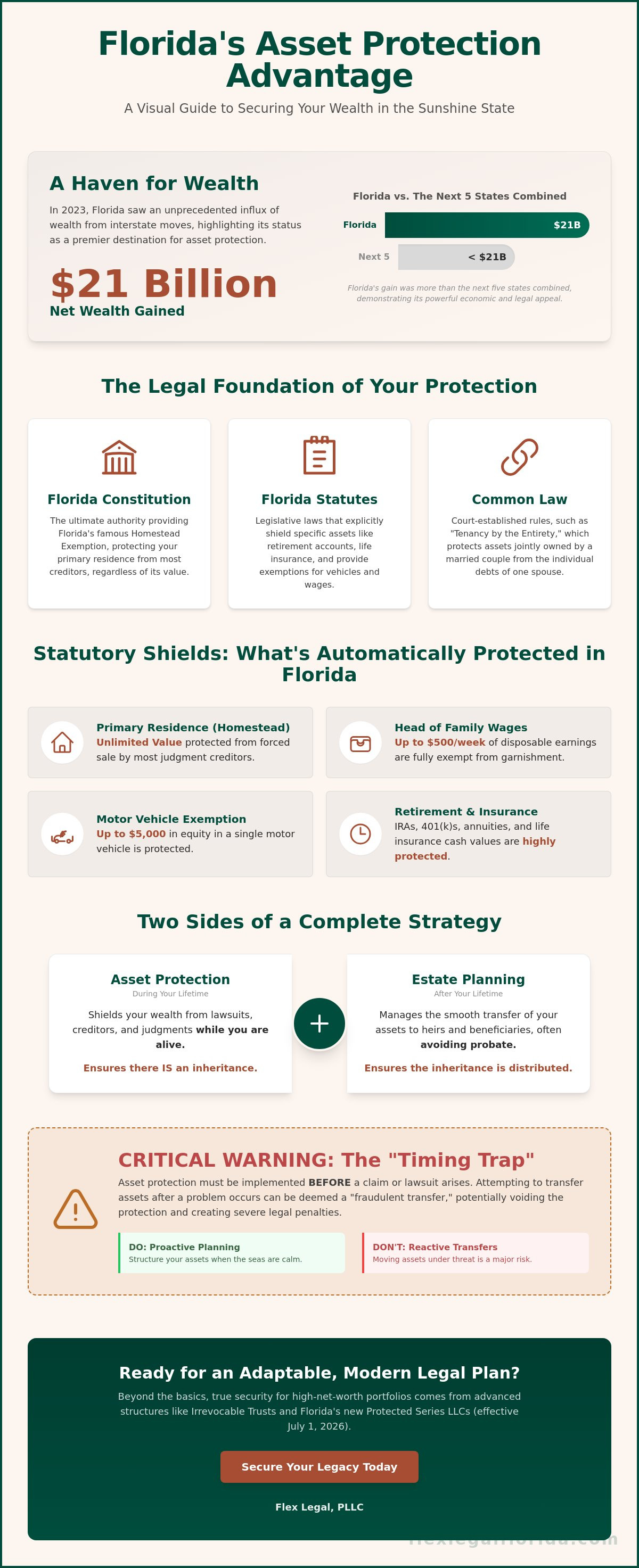
Florida gained a massive $21 billion in net wealth from interstate moves in 2023, more than the next five states combined. This incredible influx of capital highlights why so many people are searching for proactive asset protection strategies for Florida residents to secure their financial futures. You’ve worked hard to build your success. It’s perfectly normal to feel anxious that a single lawsuit or an unexpected judgment could threaten your home or your retirement savings.
We believe that protecting your legacy shouldn’t feel like a struggle against rigid, outdated legal systems. You need a modern framework that adapts as your life changes. This guide shows you how to leverage Florida’s unique constitutional exemptions to shield your assets from creditors. We will explore the new Protected Series LLC laws effective July 1, 2026, and provide a clear path for choosing the right trusts and business structures to keep your wealth safe and accessible.
Key Takeaways
Learn why Florida’s homestead exemption makes your primary residence a nearly impenetrable fortress against legal judgments.
Identify the accounts and personal property that are automatically shielded from creditors under the latest asset protection strategies for Florida residents.
Explore how irrevocable trusts and modern entities provide structural security for those with high-net-worth portfolios.
Recognize the "timing trap" and learn how to implement your safeguards before a claim arises to avoid fraudulent transfer risks.
Move beyond one-size-fits-all templates to create an adaptable legal plan that grows with your business and family.
Table of Contents
The Florida Advantage: Why the Sunshine State is a Haven for Asset Protection
Florida is widely recognized as one of the most debtor-friendly states in the country. This reputation isn't accidental. It's built on a foundation of robust legal barriers that make it incredibly difficult for creditors to seize personal wealth. When we discuss asset protection strategies for Florida residents, we're talking about a proactive shield for your family. It's about securing what you've built against the risk of unforeseen lawsuits or financial judgments. Florida's laws provide a level of security that few other states can match, especially for those who take the time to plan ahead.
It's vital to distinguish between ethical planning and illegal evasion. Hiding assets or misrepresenting ownership is a recipe for legal disaster. Instead, we use established legal techniques for protecting assets to ensure your property remains yours. This transparency is what gives your plan its strength. By organizing your affairs openly and legally, you create a defensive perimeter that holds up under judicial scrutiny. True protection is about structure, not secrets. Managing these variables requires precision. Working with asset protection lawyers near me ensures your strategy is tailored to local West Palm Beach nuances and current 2026 regulations.
Asset Protection vs. Estate Planning: Understanding the Intersection
Many people assume that a standard Revocable Living Trust is enough to protect them. While these are excellent for probate avoidance, they don't typically shield assets from creditors during your lifetime. Asset protection planning is the necessary partner to your legacy planning. One ensures your heirs receive their inheritance smoothly; the other ensures there's an inheritance left for them to receive. Modern legal solutions bridge this gap. We create multi-layered structures that address both your immediate risks from lawsuits and your long-term goals for probate avoidance. You shouldn't have to choose between protecting your life today and your legacy tomorrow.
The Legal Sources of Your Protection
Your security in Florida comes from three distinct pillars that work together to form a comprehensive defense:
Florida Constitution: This is the ultimate authority. It provides the famous homestead exemption that protects your primary residence from most judgment creditors, regardless of the home's value.
Florida Statutes: These are laws passed by the legislature that protect specific assets. This includes retirement accounts, life insurance proceeds, and the recently updated motor vehicle exemptions that provide up to $5,000 in protection for a single vehicle.
Common Law: These are rules established through court decisions. A prime example is Tenancy by the Entirety. This protects assets owned jointly by a married couple from the individual debts of either spouse.
By integrating these sources, asset protection strategies for Florida residents become more than just a set of rules. They become a dynamic support system that adapts to your unique lifestyle and business needs.
Statutory Shields: Assets Automatically Protected Under Florida Law
Florida law provides a built-in defense system for your most valuable possessions. These are known as "exempt assets," which means judgment creditors are legally barred from seizing them to satisfy a debt. Understanding these statutory shields is the first step in developing effective asset protection strategies for Florida residents. While many states offer some form of protection, Florida’s exemptions are remarkably generous, particularly regarding your home and your ability to earn a living.
Your primary residence is your strongest fortress. The Florida Homestead Exemption protects your home from a forced sale by most judgment creditors, regardless of the home's value. This protection is unique because it's rooted in the state constitution. Beyond your home, Florida protects your daily livelihood. If you're the head of a family, providing more than half of the support for a dependent, your disposable earnings up to $500 per week are entirely exempt from garnishment. Additionally, as of 2026, a debtor's interest in a single motor vehicle is exempt up to $5,000 in value. To ensure these protections remain active if you're ever unable to manage them yourself, it's essential to have a durable power of attorney in place. This allows a trusted agent to defend your exempt status even during incapacity.
The Magic of Tenancy by the Entirety (TbyE)
Married couples in Florida have access to a powerful ownership structure called Tenancy by the Entirety. When you own property this way, the law views the couple as a single unit rather than two individuals. This means a creditor of just one spouse cannot seize the asset. To maintain this protection, you must satisfy the "Six Unities": possession, interest, title, time, marriage, and the right of survivorship. It's a highly effective tool, but it's fragile. Mistakes like transferring a deed without the proper language or filing for divorce can "break" the unity and expose the asset to creditors. This is why proactive asset protection planning is so vital for maintaining your family's security.
Retirement and Insurance: The Financial Safety Nets
Florida law heavily favors savers. Most retirement accounts, including 401ks and IRAs, are fully protected from creditor claims. This ensures that a legal setback today won't compromise your quality of life in the future. Similarly, the cash surrender value of life insurance policies and the proceeds of annuity contracts are shielded by state statute. Even your children's future is protected through exemptions for 529 college savings plans and prepaid tuition contracts. However, these shields only work if they're implemented before a problem arises. Waiting until you're served with a lawsuit can trigger fraudulent transfer laws, which allow courts to undo transfers made specifically to hinder or delay a creditor.
Advanced Shielding: Trusts and Entities for High-Level Protection
Statutory exemptions provide a solid baseline, but they have limits. For those with significant business interests or diverse investment portfolios, relying solely on automatic protections isn't enough. You need active, structural safeguards. Moving into advanced asset protection strategies for Florida residents means shifting ownership from your personal name into legal entities designed to withstand legal pressure. This approach doesn't just hide assets; it changes the legal reality of who owns them, making it much harder for a creditor to reach your wealth.
A revocable trust serves as an excellent foundation for any plan. While its primary role is probate avoidance, it keeps your affairs private and organized. However, if your goal is shielding assets from your own future creditors, you'll likely need to explore more robust options. We look at your specific risk profile to determine if a more complex structure is necessary to keep your family's future secure.
Revocable vs. Irrevocable Trusts: Which Shield Do You Need?
The choice between trust types usually comes down to a trade-off between control and protection. With a revocable trust, you maintain total control. You can change the terms at any time; however, because of that control, a judge can often order you to pay creditors from those assets. An Asset Protection Trust is typically irrevocable. By giving up the absolute power to change the trust or access the principal at will, you create a legal barrier that creditors cannot easily cross. In Florida, the debate over "self-settled" trusts is ongoing, but carefully drafted structures can still provide high-level security for your legacy.
The LLC as an Asset Protection Tool
Limited Liability Companies are staples for business owners and real estate investors. Florida law is particularly favorable because of "charging order" protection. This means if you're sued personally, a creditor's remedy against your interest in a multi-member LLC is often limited to receiving distributions rather than seizing the business assets. This keeps the entity intact and your partners protected. For real estate investors, LLCs allow you to compartmentalize risk. By placing different properties into separate entities, a slip-and-fall at one location won't jeopardize your entire portfolio.
Starting July 1, 2026, Florida residents can utilize the new Protected Series LLC law (CS/SB 316). This allows you to create separate "series" within a single parent LLC, each with its own assets and liabilities. It's a modern, streamlined solution for managing complex holdings without the administrative burden of dozens of separate companies. Maintaining corporate formalities is still essential. If you don't treat the business as a separate entity, a court might "pierce the veil" and hold you personally liable. We help you build these structures to ensure they're agile enough for your lifestyle but strong enough for your protection.
The "Timing" Trap: Avoiding Fraudulent Transfer Pitfalls
The most effective asset protection strategies for Florida residents share one common trait: they're implemented long before a creditor appears. In the legal world, timing is everything. If you wait until you're served with a lawsuit or a business deal goes south to start moving money, you've already lost. Florida courts are highly experienced at spotting last-minute maneuvers. They use the Florida Uniform Fraudulent Transfer Act (FUFTA) to undo transactions meant to hinder, delay, or defraud a creditor.
Planning ahead is the only way to ensure your shield holds up under pressure. Under FUFTA, the general look-back period for challenging a transfer is four years. There's also a discovery rule that allows a claim to be brought within one year after a transfer was or could have been discovered. For transfers made to an "insider," such as a family member or business partner, the look-back period is one year if the debtor was insolvent at the time. This makes early action essential. If you want to secure your future, start your asset protection planning while your financial horizon is clear.
What Constitutes a Fraudulent Transfer?
A transfer doesn't have to involve actual intent to be considered fraudulent. Courts also look for constructive fraud. This happens when you transfer an asset for less than its fair market value while you're insolvent or about to become insolvent. Essentially, if you give away a $500,000 property to a relative for a nominal fee, it triggers immediate red flags. Judges look for "badges of fraud" to determine if a transfer was illegitimate. These include transferring assets after being threatened with a suit, retaining control over property after selling it, or moving nearly all your wealth into exempt categories suddenly. Documentation is your best defense. Keeping clear records of legitimate business transactions helps prove that your transfers had a valid purpose beyond avoiding debt.
The Risks of "Do-It-Yourself" Asset Shifting
Moving money to a family member’s bank account is one of the most common DIY mistakes. It rarely works. Creditors can easily trace these transfers, and a judge can order your relative to return the funds. Beyond losing the asset, you could face civil or even criminal penalties for fraudulent conversion. The legal landscape is too complex for templates or guesswork. Working with an estate planning attorney West Palm Beach provides the professional oversight needed to navigate these pitfalls. We help you build a plan that is both legally sound and ethically transparent, ensuring your family's security isn't compromised by a simple timing error.
Building Your Adaptable Plan: Next Steps for West Palm Beach Residents
Moving from understanding the law to taking action requires a shift in focus. While we've explored the statutory shields and trust structures available to you, the most effective asset protection strategies for Florida residents are those that are actively managed. A static document from an online template can't account for the subtle shifts in your business or family life. These generic forms often fail during a crisis because they lack the precision required by Florida's specific 2026 legal standards. We take a different approach.
At Flex Legal, PLLC, we act as an agile ally. We ensure your plan is a dynamic support system rather than a set of rigid rules. This is particularly vital for families who need a special needs planning attorney. When government benefits and inheritance intersect, even a small titling error can jeopardize a loved one's future care. Regular annual reviews allow us to adjust your strategy as your wealth grows and the law evolves. We prioritize clarity and comfort throughout this process.
The Asset Protection Audit: What to Bring to Your Consultation
Before we meet, organizing your financial details helps us move straight to strategy. This preparation ensures our time together is efficient and focused on results. Please prepare the following:
Asset Inventory: A comprehensive list of all assets, including real estate, bank accounts, and investment portfolios.
Ownership Documentation: Current titles or deeds for all property to verify how your assets are currently held.
Liability Assessment: A summary of your primary risks, such as business ownership, professional practice, or teen drivers in the household.
Policy Review: Copies of existing insurance policies to identify where legal shielding is needed to fill coverage gaps.
Why a Local West Palm Beach Expert Matters
Local court tendencies in Palm Beach County can influence how a judge views your asset transfers. We understand these nuances and design plans that stand up to local scrutiny. Our process is built on transparency and accessibility. By using a flat-fee model, we provide a clear, predictable path forward without the friction of hourly billing. Ready to secure your future? Schedule your consultation with Flex Legal, PLLC today. We're here to help you build a plan that is as resilient as it is adaptable.
Take Control of Your Financial Future
Florida offers some of the most robust "safety nets" in the country, but they only work if you take the first step. We've explored how to move beyond basic exemptions to build advanced structural shields that withstand legal pressure. By implementing these asset protection strategies for Florida residents today, you ensure that your home, business, and savings remain secure against future uncertainty. Proactive planning is the only way to achieve true peace of mind before a claim ever arises.
Flex Legal, PLLC provides a modern, agile alternative to traditional, rigid legal services. Led by West Palm Beach estate expert Jennifer L. Flexer, Esq., we prioritize transparency through a flat-fee pricing model. This approach ensures you receive a customized plan without the stress of unpredictable costs or hidden fees. We act as your dedicated ally, helping you navigate complex laws with clarity and confidence. Our focus remains on creating a streamlined experience that respects your time and your goals.
Secure your legacy with a custom asset protection plan from Flex Legal, PLLC. You've worked hard to build your life in the Sunshine State. We're here to help you keep it. Reach out today to start building an adaptable plan that grows with you and protects what matters most.
Frequently Asked Questions
Is my home 100% protected in Florida if I have a mortgage?
Your home is protected from most judgment creditors, but not from your mortgage lender. The Florida Homestead Exemption shields your primary residence from lawsuits and credit card judgments regardless of its value. However, this protection does not apply to consensual liens. If you stop making mortgage payments, the lender can still foreclose on the property. It also doesn't protect you from property tax liens or mechanic's liens for home improvements.
Can a creditor take my IRA or 401k in a Florida lawsuit?
Generally, no. Florida statutes provide robust protection for most retirement accounts, including ERISA-qualified plans and IRAs. This is one of the most reliable asset protection strategies for Florida residents because these accounts are usually entirely exempt from creditor attachment. Whether you have a 401k through an employer or a personal Roth IRA, these funds are legally off-limits to someone who wins a civil judgment against you.
How long do I have to live in Florida to claim the homestead exemption?
For creditor protection, the shield applies as soon as you move into the home with the intent to make it your permanent residence. There is no specific waiting period for the constitutional protection to begin. If you are seeking the homestead tax discount, you must be a resident by January 1st of the application year. Be aware that federal bankruptcy laws require 1,215 days of residency to claim the full state exemption value.
Does a revocable living trust protect my assets from lawsuits?
No, a revocable living trust does not provide asset protection from your own creditors. Because you maintain the power to change or cancel the trust at any time, the law views you as the owner of those assets. If a judge orders you to pay a debt, they can also order you to use trust assets to satisfy it. These trusts are primarily used for probate avoidance and managing your affairs if you become incapacitated.
What is the "Head of Household" exemption and how do I qualify?
This exemption protects your wages from being garnished by a creditor. To qualify, you must provide more than 50% of the financial support for a child or other dependent. If you meet this criteria, your disposable earnings of $500 per week or less are completely exempt from garnishment. For earnings above that amount, a creditor cannot touch your wages unless you have signed a written agreement allowing them to do so.
Can I protect my assets if I have already been sued?
It is much harder to implement new protections once a lawsuit is active or even threatened. Transfers made after a claim arises are often viewed as fraudulent under Florida law, meaning a court can undo them. However, you can still maximize the use of your existing statutory exemptions. You should consult a professional to review your current holdings and determine which assets are already shielded by state law despite the pending litigation.
What is the best type of trust for asset protection in Florida?
An irrevocable trust is typically the most effective structure for high-level protection. By giving up the right to change the trust or access the principal at will, you create a legal barrier that creditors cannot cross. There are several variations of these trusts depending on whether you are protecting a business, real estate, or liquid investments. We customize these structures to ensure they provide maximum security while still meeting your long-term financial goals.
How much does it cost to set up an asset protection plan in West Palm Beach?
The cost of a plan depends entirely on the complexity of your assets and the specific legal entities you need. A plan for a family with one home is much simpler than a plan for a real estate investor with multiple properties and businesses. We focus on transparency by using flat-fee pricing for our services. This ensures you know exactly what your investment will be without the stress of unpredictable hourly billing or hidden costs.



Comments