
ABLE Account vs. Special Needs Trust: A 2026 West Palm Beach Selection Guide
- Kelly Mata
- May 10
- 13 min read

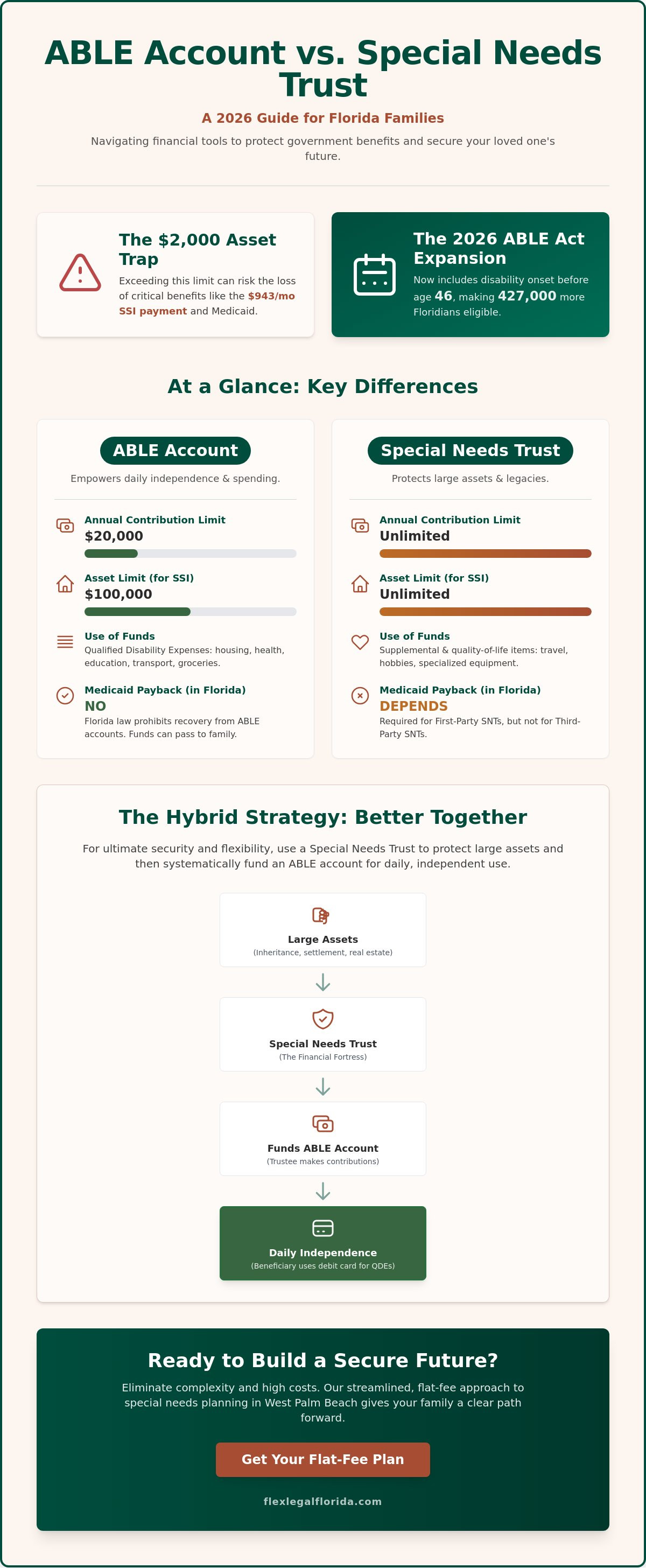
Did you know that as of January 1, 2026, approximately 427,000 Floridians with disabilities became newly eligible for financial independence thanks to the ABLE Act age expansion? This shift, which now includes those with a disability onset before age 46, has many families questioning the best strategy for an ABLE account vs special needs trust West Palm Beach. You likely worry that a well-intended inheritance or a simple savings account could accidentally trigger a loss of the $943 monthly SSI payment or critical Medicaid benefits. It is a valid concern, and you deserve a legal partner that prioritizes clarity over complexity.
We're here to show you that protecting your child's future doesn't have to be intimidating or filled with hidden fees. This guide explains how to leverage the $20,000 annual ABLE contribution limit alongside the long-term protection of a Special Needs Trust. We'll walk through the latest 2026 regulations, including new flexibility for grocery expenses, to help you build a seamless and secure financial legacy. By the end, you'll have a clear, flat-fee path to choosing the right tools for your family's specific needs.
Key Takeaways
Identify why the $2,000 asset limit still poses a threat in 2026 and how to bypass it using modern, tax-advantaged tools.
Compare the $20,000 annual contribution cap of ABLE accounts against the unlimited capacity of Special Needs Trusts for managing larger legacies.
Master the selection framework for an ABLE account vs special needs trust West Palm Beach to protect government benefits from unexpected windfalls.
Explore the hybrid strategy that uses a trust to fund an ABLE account, providing your loved one with a debit card for daily independence.
Access a streamlined, flat-fee path to special needs planning that eliminates the friction and high costs of traditional legal models.
Table of Contents
Understanding the 2026 Special Needs Landscape in Florida
The $2,000 asset limit is a relic that continues to haunt Florida families. For decades, individuals relying on Supplemental Security Income (SSI) or Medicaid have lived under the constant threat of losing their safety net if they saved even a modest amount of money. In 2026, this "asset trap" remains the primary hurdle for families in Palm Beach County. However, the legal landscape has shifted dramatically. As of January 1, 2026, the ABLE Age Adjustment Act expanded eligibility to individuals who experienced the onset of their disability before age 46. This single change opened doors for approximately 427,000 Floridians who were previously excluded from these benefits.
Understanding the choice between an ABLE account vs special needs trust West Palm Beach requires looking at these tools as a modern defense system. ABLE accounts, managed through Florida’s ABLE United program, offer a tax-advantaged way to save for "Qualified Disability Expenses" without triggering the $2,000 resource limit. Up to $100,000 in an ABLE account is completely disregarded for SSI purposes. Meanwhile, Special Needs Trusts (SNTs) act as a legal fortress. They are capable of holding unlimited assets, such as real estate or large inheritances, that an ABLE account simply cannot accommodate due to its $20,000 annual contribution cap.
Why West Palm Beach Families Need a Plan
Palm Beach County is one of the most expensive regions in Florida. The $943 monthly federal SSI rate barely covers basic utilities in our local market, let alone housing. Relying solely on government benefits often leads to a compromised quality of life. Strategic planning helps you protect eligibility for Florida-specific Medicaid waivers, such as the iBudget waiver, which provides essential home and community-based services. Partnering with a special needs planning attorney ensures your legal documents are tailored to current Florida statutes and local court preferences. We focus on creating a seamless path that avoids the friction of traditional law firm models.
The Core Goal: Supplemental vs. Basic Support
The primary purpose of these financial tools is to provide "supplemental" support rather than replacing basic government aid. ABLE accounts are designed for "Qualified Disability Expenses" (QDEs). These include health, education, housing, and transportation. SNTs go a step further by funding quality-of-life items that government benefits never cover, like specialized furniture, hobby equipment, or travel. While ABLE accounts empower the beneficiary with direct access to funds for daily spending, a Special Needs Trust grants a trustee the authority to manage and protect the principal assets for the beneficiary's long-term security.
ABLE Account vs. Special Needs Trust: Key Differences
Choosing between an ABLE account vs special needs trust West Palm Beach involves weighing immediate flexibility against long-term asset protection. In 2026, the annual contribution limit for an ABLE account has risen to $20,000. This is a hard cap from all sources combined. Conversely, a Special Needs Trust (SNT) has no contribution ceiling. If a grandparent leaves a $500,000 inheritance, an ABLE account cannot receive it all at once; an SNT can. This makes the trust a superior vehicle for large windfalls or estate planning legacies.
Tax efficiency is another major differentiator. ABLE accounts function similarly to 529 college savings plans. Earnings grow tax-free, and withdrawals are tax-exempt when used for Qualified Disability Expenses. Trusts are different. They are subject to compressed federal income tax brackets, meaning they often reach the highest tax rates at much lower income levels than individuals. Following the Social Security Administration's rules on ABLE accounts is essential to ensure these tax benefits don't accidentally disqualify the beneficiary from monthly SSI payments.
Medicaid payback rules also vary significantly in Florida. A unique benefit of Florida’s ABLE United program is that the state prohibits Medicaid recovery from these accounts after the beneficiary passes away. This allows remaining funds to go to family members. With SNTs, the rule depends on the type. A First-Party SNT requires a Medicaid payback, while a Third-Party SNT, funded by parents or relatives, does not. If you're feeling overwhelmed by these choices, our team can help you explore a tailored strategy that fits your family's dynamic.
Management and Oversight
Control is where these tools diverge most. An ABLE account empowers the beneficiary to manage their own money, often through a simple debit card. This promotes independence for daily spending. An SNT requires a Trustee to oversee distributions. This third-party oversight is a safety net that prevents the beneficiary from being exploited or spending the principal too quickly. Selecting a reliable Trustee in Palm Beach County is a strategic decision that ensures the trust's longevity and compliance with SSA reporting requirements.
Maximum Account Ceilings
The $100,000 threshold is a critical number for SSI recipients. If an ABLE account balance exceeds $100,000, SSI payments are suspended, though Medicaid eligibility usually continues. SNTs don't have this restriction. They can hold millions without affecting SSI. In some cases, a revocable trust created by a parent can be designed to pour assets into a Third-Party SNT upon their death. This creates a seamless transition of wealth while maintaining the beneficiary's government support.
How to Choose the Right Tool: A Step-by-Step Framework
Deciding between an ABLE account vs special needs trust West Palm Beach doesn't have to be a guessing game. We use a logical "if/then" framework to help families identify the most efficient path forward. This process prioritizes your loved one's immediate needs while safeguarding their long-term eligibility for benefits like SSI and Medicaid. By following four specific steps, you can determine which tool, or combination of tools, aligns with your financial goals.
Step 1: Confirm the Age of Onset. Under the 2026 regulations, the beneficiary must have experienced the onset of their disability before age 46 to qualify for an ABLE account. If the onset occurred later in life, a Special Needs Trust (SNT) becomes the primary legal option. Step 2: Evaluate the Asset Size. ABLE accounts are restricted by a $20,000 annual contribution limit. If you are planning for a $500,000 inheritance or the transfer of a family home, an SNT is the only vehicle capable of holding those assets without disqualifying the beneficiary from benefits. Step 3: Assess Capability. Does the beneficiary have the desire and ability to manage their own spending? ABLE accounts offer a debit card for direct access. If they require more oversight, the Trustee structure of an SNT provides a necessary layer of protection. Step 4: Identify the Funding Source. Money coming from a parent or grandparent should typically go into a Third-Party SNT to avoid Medicaid payback rules, whereas the beneficiary's own wages might be better suited for an ABLE account.
Scenario A: The Small Inheritance or Graduation Gift
For smaller windfalls, such as a $15,000 graduation gift or a modest inheritance, the ABLE account is often the path of least resistance. It allows you to bypass the setup costs and administrative complexity of a full trust for a relatively small sum. These funds can be used immediately for housing, transportation, or health expenses. Because Florida law protects ABLE United accounts from Medicaid recovery, it remains a highly efficient way to build a modest "rainy day" fund while maintaining the $943 monthly SSI payment.
Scenario B: The Comprehensive Estate Plan
High-net-worth families in West Palm Beach often find that an ABLE account alone is insufficient for a comprehensive legacy. When the goal is to protect a significant investment portfolio or a primary residence, a Third-Party Special Needs Trust is essential. This structure ensures that the principal remains untouched by creditors or government recovery efforts. Consulting an estate planning attorney west palm beach allows you to integrate this trust into a broader strategy, ensuring a seamless transition of wealth that provides for your child’s quality of life for decades to come.
The Hybrid Strategy: Why You Likely Need Both
Many advisors present the choice of an ABLE account vs special needs trust West Palm Beach as an "either/or" decision. This perspective is outdated. In reality, the most effective financial plans for Florida families use these tools in tandem to create a "Trust-to-ABLE" pipeline. This hybrid approach allows you to enjoy the unlimited asset capacity of a trust while utilizing the tax-free growth and spending flexibility of an ABLE account. By coordinating both, you maximize the beneficiary's independence without risking the $943 monthly SSI payment.
The strategic flow of money is simple. A Special Needs Trust (SNT) acts as the reservoir, holding large inheritances, life insurance payouts, or investment portfolios. Because an ABLE account has a $20,000 annual contribution limit, it cannot handle a major windfall alone. However, the Trustee of the SNT can transfer funds into the ABLE account in increments. This gives the beneficiary direct access to money via an ABLE debit card for daily "Qualified Disability Expenses," while the SNT protects the bulk of the family's wealth from creditors or mismanagement.
Using both tools also helps you navigate Florida’s Medicaid payback rules. While Florida law protects ABLE United accounts from state recovery, First-Party SNTs still require a reimbursement to the state upon the beneficiary's death. By using a Third-Party SNT as the primary holding vehicle and only moving what is needed into the ABLE account, you ensure that the majority of your legacy can eventually pass to other family members rather than being claimed by the government.
Solving the Housing Penalty
One of the most technical benefits of this hybrid strategy involves "In-Kind Support and Maintenance" (ISM). Normally, if a trust pays for a beneficiary’s rent or mortgage directly, the Social Security Administration reduces their SSI check by up to one-third. However, funds in an ABLE account can be used for housing without triggering this penalty. To avoid the one-third reduction in SSI benefits, a West Palm Beach renter can have their Trustee transfer funds from their Special Needs Trust into an ABLE account specifically to cover monthly housing costs. This simple maneuver keeps more money in your loved one's pocket every month.
A Modern Ally in Asset Protection
Special needs planning is not a static event; it's a dynamic support system. These tools work most effectively when paired with a durable power of attorney. This ensures that if a primary caregiver becomes incapacitated, a successor has the immediate legal authority to manage both the trust and the ABLE account. Flex Legal adopts an "Agile" approach to these services, moving away from rigid, one-size-fits-all models to create a plan that adapts as your family's needs evolve. If you're ready to build a secure future, you can start your special needs plan with our streamlined, flat-fee process today.
Implementing Your Plan with Flex Legal in West Palm Beach
Choosing between an ABLE account vs special needs trust West Palm Beach is a significant milestone, but implementing that plan shouldn't feel like a burden. Flex Legal Florida was built to move away from the rigid, intimidating atmosphere of traditional law firms. We act as an agile ally for families, prioritizing clarity over complex legalese. Our goal is to provide a seamless path toward financial security, ensuring your loved one's benefits remain intact while their quality of life improves. We don't just provide documents; we provide a dynamic support system tailored to your specific goals.
We understand that financial predictability is essential for families managing disability expenses. That's why we offer flat-fee special needs planning packages. You'll never have to worry about surprise billable hours or hidden costs when setting up a Third-Party SNT or seeking strategic guidance on ABLE United accounts. This price certainty allows you to focus on what matters most: the long-term well-being and independence of your child. It's a modern approach to law that respects your time and your budget.
Our consultations are designed to be flexible and highly personalized. We don't believe in one-size-fits-all solutions. Instead, we analyze your family dynamics, the size of potential inheritances, and the beneficiary's unique capabilities. Whether you need a standalone trust or a hybrid strategy that coordinates an ABLE account with a larger estate plan, we provide the strategic roadmap you need. We move seamlessly from identifying your pain points to presenting a clear, friction-free path forward.
Our Modern Process
We've streamlined our drafting process to be direct and purposeful. You won't find dense, confusing clauses that require a law degree to decode. You'll also have direct access to attorney Jennifer L. Flexer for your most complex questions. This local expertise is vital, especially when coordinating with a probate lawyer palm beach county to ensure that inheritances from a deceased relative's estate are funneled correctly into a trust. This coordination prevents assets from hitting a personal bank account and triggering a loss of benefits.
Secure Your Loved One’s Future Today
The risk of waiting is real. If an inheritance or a large gift hits a beneficiary's bank account tomorrow without a plan in place, they could lose their SSI and Medicaid eligibility instantly. Proactive planning empowers your child with the tools they need for independence while you gain the peace of mind that comes with a secure legal foundation. Don't let the complexity of the 2026 rules stop you from taking action. Schedule your flat-fee strategic planning session at our West Palm Beach office today and let’s build a future that is both flexible and secure.
Build a Legacy of Security and Independence
Protecting your loved one’s quality of life requires more than just a savings account; it requires a strategic framework that adapts to Florida’s evolving legal environment. Throughout this guide, we’ve highlighted how the 2026 ABLE Age Adjustment Act has expanded eligibility to roughly 427,000 additional Floridians. We’ve also shown why the $20,000 annual ABLE limit makes a Special Needs Trust essential for larger assets. Deciding between an ABLE account vs special needs trust West Palm Beach is about finding the right balance of daily autonomy and long-term protection.
You don't have to navigate these complex SSI and Medicaid rules alone. At Flex Legal, we offer specialized expertise and a modern, accessible West Palm Beach office where your comfort is our priority. We prioritize price certainty through flat-fee special needs planning, so you can focus on your family instead of billable hours. It’s time to move past the friction of traditional law and embrace a partnership that puts your child’s future first. Secure your family’s future with a flat-fee Special Needs Plan from Flex Legal. We’re ready to help you build a path that is both secure and flexible.
Frequently Asked Questions
Can a person with a disability have both an ABLE account and an SNT in Florida?
Yes, you can and often should have both an ABLE account and a Special Needs Trust in Florida. This hybrid approach allows you to fund an ABLE account for daily independence while the trust holds larger assets like inheritances or real estate. It's a strategic way to manage an ABLE account vs special needs trust West Palm Beach to ensure maximum flexibility and benefit protection.
Does a West Palm Beach ABLE account have a Medicaid payback provision?
No, Florida law currently prohibits Medicaid recovery from ABLE United accounts after the beneficiary passes away. This is a significant advantage over many other states and over First-Party Special Needs Trusts. It ensures that any remaining funds in the account can pass to designated beneficiaries or family members rather than being seized by the state to reimburse medical costs.
What is the maximum I can put into an ABLE account in 2026?
The total annual contribution limit for an ABLE account in 2026 is $20,000 from all sources combined. If the beneficiary is working and doesn't contribute to an employer-sponsored retirement plan, they may be able to contribute an additional $15,650 under the ABLE to Work Act. Florida’s ABLE United program also maintains a lifetime contribution cap of $418,000.
What happens to the money in a Special Needs Trust after the beneficiary passes away?
The outcome depends on whether the trust is a First-Party or Third-Party Special Needs Trust. A First-Party trust, funded with the beneficiary's own money, requires a Medicaid payback to the state for services provided during their life. A Third-Party trust, funded by parents or relatives, allows the remaining assets to pass directly to other family members without state interference.
Can I use ABLE account funds to pay for rent in West Palm Beach without losing SSI?
Yes, you can use ABLE account funds to pay for rent or mortgage costs without triggering the Social Security Administration's "In-Kind Support and Maintenance" (ISM) penalty. Usually, if a trust or a third party pays for housing directly, the $943 monthly SSI check is reduced by up to one-third. Using an ABLE account for these costs keeps the full SSI payment intact.
Do I need a lawyer to set up an ABLE account in Florida?
You don't strictly need a lawyer to open an ABLE United account, but professional guidance is vital for integrating it into a comprehensive plan. Because these accounts interact with complex federal and state rules, a mistake in funding can jeopardize eligibility for critical benefits. We help families coordinate their ABLE account vs special needs trust West Palm Beach so every tool works together seamlessly.
How does the 2026 ABLE Age Adjustment Act change my eligibility?
The 2026 ABLE Age Adjustment Act expanded eligibility to individuals who experienced the onset of their disability before age 46. This is a major increase from the previous limit of age 26. As of January 1, 2026, this change made approximately 427,000 more Floridians eligible for these tax-advantaged accounts, allowing older adults with disabilities to finally access these savings tools.
Can a Special Needs Trust hold a house in Palm Beach County?
Yes, a Special Needs Trust can hold title to a primary residence or other real estate in Palm Beach County. This protects the home as an exempt asset for Medicaid and SSI purposes while ensuring the beneficiary has a secure place to live. The trust also provides a reliable management structure for property taxes, insurance, and maintenance costs throughout the beneficiary's life.


Comments